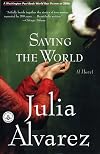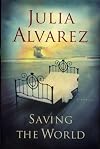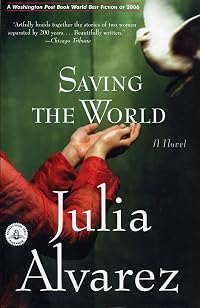
Saving the World
by Julia Alvarez
On This Page
Description
Fiction. Literature. HTML:Latina novelist Alma Huebner is suffering from writer's block and is years past the completion date for yet another of her bestselling family sagas. Her husband, Richard, works for a humanitarian organization dedicated to the health and prosperity of developing countries and wants her help on an extended AIDS assignment in the Dominican Republic. But Alma begs off joining him: the publisher is breathing down her neck. She promises to work hard and follow him a bit show more later.The truth is that Alma is seriously sidetracked by a story she has stumbled across. It's the story of a much earlier medical do-gooder, Spaniard Francisco Xavier Balmis, who in 1803 undertook to vaccinate the populations of Spain's American colonies against smallpox. To do this, he required live "carriers" of the vaccine.
Of greater interest to Alma is Isabel Sendales y Gómez, director of La Casa de Expósitos, who was asked to select twenty-two orphan boys to be the vaccine carriers. She agreed— with the stipulation that she would accompany the boys on the proposed two-year voyage. Her strength and courage inspire Alma, who finds herself becoming obsessed with the details of Isabel's adventures.
This resplendent novel-within-a-novel spins the disparate tales of two remarkable women, both of whom are swept along by machismo. In depicting their confrontation of the great scourges of their respective eras, Alvarez exposes the conflict between altruism and ambition. show less
Tags
Recommendations


























Member Reviews
i had no idea about the historical parts of this book - the way balmis brought (or tried to bring) the smallpox vaccine all over the world. so interesting how it had to be done back then, to keep the vaccine active. and an interesting fiction to make of it. i was less interested in the present day parallel story for most of it. although the common themes of poverty, who gets medical treatment/care, and more were all intriguing. especially the main issue (based on the title) of spending your life to save the world of one thing (in this case smallpox) and see it ruined by something else (in this case war). do you still try? is it worth it? can you justify the sacrifices that must be made (that includes people) if the world will fall to show more something else? what does it mean to save the world if it's at the cost of certain people and their sacrifice? what does it mean to save the world if that's from the perspective of wealthy white people, bringing "salvation" to poor people of color in a different part of the world?
really interesting conceptually, and she writes well. i'm not even entirely sure why i'm not wholly satisfied with it. it's good, but not great. thematically, though, it's fantastic. show less
really interesting conceptually, and she writes well. i'm not even entirely sure why i'm not wholly satisfied with it. it's good, but not great. thematically, though, it's fantastic. show less
This is one of the best books I have read in a long time. This is literature, not just an amazing compelling read. Julia Alvarez is truly an American treasure. I could not put this book down and read it over a period of 2-3 days. It is partly historical fiction. The book moves back and forth between two remarkable women, one a present day American Hispanic writer, and the other a Spanish woman who in 1803 travels from Spain to the Americas with Francisco Balmis to vaccinate the populations of Spain's American colonies against smallpox. The historical Isabel selected 22 orphan boys from Spain to be the carriers of the cowpox virus so that vaccine could be made continuously. She is brought to take care of the boys on the 2 year show more expedition. The Latina novelist Alma, finds herself obsessed with Isabel's story, but faces a similar adventure in her own life which takes her to the Dominican Republic. The two women in the book face the dilemma of plagues (in the case of Isabel, small pox, in the case of Alma, Aids), poverty, politics and altruism. Do the ends justify the means? Can poor people be used for the greater good even if their lives and health are endangered in the process? The use of the orphans in 1803 to prevent smallpox and the use of poor people in the third world to test an Aids vaccine raise similar dilemma's dilemmas in the lives of these two women. The book is written with great compassion and insight. Now I must read "In the name of Salome" which has been sitting on my to read shelf for some time. show less
Honestly, this book probably deserves more stars. It is beautifully written, and, unlike some of the other reviewers, I liked the back and forth between the two stories/time periods. The themes of the present day events are illuminated by the events in Isabel's story; Alma's story would certainly lose something if readers were not able to read the novel she is working on.
But I don't plan on re-reading it, and I can't think of friends to whom I'd recommend it off-hand.
It was ultimately much more sad than I'd expected, either from the cover copy or from the beginning of the novel itself. In fact, the tragedies of the latter half of the novel seemed to undermine the hopefulness so much a part of the beginning.
But I don't plan on re-reading it, and I can't think of friends to whom I'd recommend it off-hand.
It was ultimately much more sad than I'd expected, either from the cover copy or from the beginning of the novel itself. In fact, the tragedies of the latter half of the novel seemed to undermine the hopefulness so much a part of the beginning.
I had never heard of the Smallpox expedition to Spanish America. It was interesting to learn about. Francisco Balmis is portrayed as a brilliant yet flawed man. I had never thought about what they would have had to done to keep the smallpox vaccine viable. With no refrigeration it would have to be live carriers. I loved Isabella's struggle to maintain hope in the face of the obstacles that they faces.
My first Alvarez novel. While I found it hard, at first, to like Alma, with her doubts about her husband & her dithering about her progress on her contracted novel, I did like the love she showed for her elderly neighbor, & the moments of self-awareness that shone thru the more she delved into the historic story she was writing. I loved how Alma's thoughts at the end of one chapter were reflected in Isabel's in the historic chapters.
I found some great quotes to inspire me. Living outside of your comfort zone, taking that blind step forward into the future, appeal to me.
I was disappointed in the ending, how Alma appears accepting of the way things turned out, yet we aren't shown the struggle this would take (other than in the first few show more days) so it seemed false. show less
I found some great quotes to inspire me. Living outside of your comfort zone, taking that blind step forward into the future, appeal to me.
I was disappointed in the ending, how Alma appears accepting of the way things turned out, yet we aren't shown the struggle this would take (other than in the first few show more days) so it seemed false. show less
Very, very entertaining, very, very well written. The two stories of Isabel and Alma are put together in a way that makes them mirror each other, a voice from the past with a voice from the present. I enjoyed the character Tera - everyone knows someone like her. The idea of doing something crazy on a whim to try and solve a problem bigger than oneself is prevalent, as well as the victories and consequences.
A historical fiction novel that tells the story of Don Francisco Balmis, the courageous Spainaid who embarked on a two year voyage across the world to rid the world of smallpox. He left Spain with 22 orphan boys who were live-carriers of the disease in order to vaccinate people in an attempt to rid the future populations of this deadly disease. Along with him,Isabel,an orphanage director accompanies and acts as a caregiver and 'mother' to these boys. Along the way, they were met with hostility and skepticism and the travelers grew weary with illness and indifference. Alongside this tale, we hear about Alma, a modern day Hispanic novelist who is intrigued by this story of Balmis and Isabel. Her husband,Richard, a do-gooder and an show more employee of HI (Help International) goes to the Dominican Republic in an effort to set up a clinic that will research the AIDS epidemic and help the poverty striken population. Richard, is taken hostage by a radical, yet youthful and inexperienced group and global-relations, diplomacy and peacefulness are shattered. Isabel finds she is drawing strength from the tale of Isabel and draws reserve from the calm that Isabel's gift as a story-teller brings to soothe the orphan boys' fears. The two stories are told in tandem and the reader is equally immersed in both tales as they attempt to meld together. show less
Members
- Recently Added By
Lists

Viral Outbreaks and Pandemics
82 works; 8 members
Author Information

34+ Works 18,622 Members
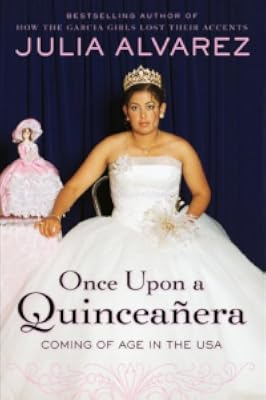
Julia Alvarez was born in New York City on March 27, 1950 and was raised in the Dominican Republic. Before becoming a full-time writer, she traveled across the country with poetry-in-the-schools programs and then taught at the high school level and the college level. In 1991, she earned tenure at Middlebury College and published her first book How show more the Garcia Girls Lost Their Accent, which won the PEN Oakland/Jefferson Miles Award for excellence in 1991. Her other works include In the Time of the Butterflies, The Other Side of El Otro Lado, and Once upon a Quinceañera: Coming of Age in the USA. (Bowker Author Biography) show less
Common Knowledge
- Canonical title
- Saving the World
- Original title
- Saving the world
- Original publication date
- 2006
- People/Characters
- Francisco Balmis; Isabel Sendales y Gomez; Alma Huebner (Fulana de Tal); Tera
- Important places
- Caribbean Region; Dominican Republic; Hispaniola; Vermont, USA
- Important events
- Smallpox Epidemic 1764
- Dedication
- For Bill
believer - First words
- In the fall of her fiftieth year, Alma finds herself lost in a dark mood she can't seem to shake.
- Quotations
- I am living in this very real, distressing world, and I am having desperately to dream in order to go on living. (p. 349)
Somebody's got to do it. Just like someone has to go to the edge and look and come back and tell about it. That was always her part...But what if what she has seen is not something she wants to broadcast? What if there's noth... (show all)ing but the still, sad music of humanity over that edge? What does she come back and tell? We're floating on faith. We're floating on love. (p.170-1)
We must not live entirely, or even mainly, for our own time. The soul exceeds its circumstances. (p. 165)
We don't stand for something that can be argued or taught in a book in a school. Wat we stand for is not an opinion, it is an intuition. (p. 279) - Last words
- (Click to show. Warning: May contain spoilers.)The ashes fly out from all their hands--floating on faith, floating on love--blessing the ground.
Classifications
Statistics
- Members
- 680
- Popularity
- 42,193
- Reviews
- 16
- Rating
- (3.26)
- Languages
- 6 — Dutch, English, French, German, Portuguese, Spanish
- Media
- Paper, Audiobook, Ebook
- ISBNs
- 19
- UPCs
- 1
- ASINs
- 6