On This Page
Description
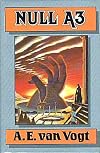
Gilbert Gosseyn, the man with extra brain who staved off disaster for the solar system, finds himself launched on his greatest challenge - a showdown with the originators of cosmic civilization.Tags
Recommendations








Member Reviews
Il primo libro della trilogia, Non-A, mi aveva decisamente affascinato: l'idea di un mondo in cui l'aristotelismo, con tutti i suoi limiti, è obsoleto, e invece prevale la Semantica Generale, era in qualche modo vicina al mio modo di sentire, allora come ora. Già il secondo libro, che privilegiava la parte avventurosa rispetto a quella cognitiva, era un po' deludente. Questo terzo, in cui tutto l'uso che viene fatto del non-aristotelismo e della semantica Generale è relativo a un continuo sltapicchiare qua e là per l'universo, con poco costrutto se non quello di dare in moglie una imperatrice a uno dei duplicati Gosseyn, allo scopo, si pensa, di allevare una stirpe imperiale non aristotelica, beh, è decisamente noioso. Un ottimo show more esempio del fatto che i sequel di libri ben riusciti spesso e volentieri non producono altro che delusioni. show less
Questo epilogo del ciclo che ha protagonista il molteplice Gilbert Gosseyn, fu scritto da Van Vogt con uno stacco di circa trent'anni rispetto a i primi due libri.
Nel Sistema Solare l'Istituto di Semantica Generale ha creato il sistema del Non-A (Non Aristotelico) che è al contempo una filosofia e un modo di vivere che consentono a coloro che lo praticano un notevole vantaggio sui loro simili. Queste solo le premesse di un altro dei rutilanti romanzi di Van Vogt dove spaziano Imperi extra-galattici, razze aliene, e veri e propri supe-ruomini come il Gosseyn protagonista del libro che ha addirittura a sua disposizione tutta una serie di corpi clonati di varie età, un cervello supplementare in grado dì farlo spostare istantaneamente show more nello spazio. show less
Nel Sistema Solare l'Istituto di Semantica Generale ha creato il sistema del Non-A (Non Aristotelico) che è al contempo una filosofia e un modo di vivere che consentono a coloro che lo praticano un notevole vantaggio sui loro simili. Queste solo le premesse di un altro dei rutilanti romanzi di Van Vogt dove spaziano Imperi extra-galattici, razze aliene, e veri e propri supe-ruomini come il Gosseyn protagonista del libro che ha addirittura a sua disposizione tutta una serie di corpi clonati di varie età, un cervello supplementare in grado dì farlo spostare istantaneamente show more nello spazio. show less
May 9, 2011Italian
""
Sep 2, 2015French
Ratings
Members
- Recently Added By
Author Information

335+ Works 22,555 Members
A. E. Van Vogt was born on April 26, 1912 in Manitoba, Canada. He graduated from the University of Ottawa in 1928. His first story sales were to true story confession magazines in the early 1930s while he was working as a census clerk and representative of Maclean Trade Papers. He wrote plays for Canadian radio and in 1939, he began submitting show more stories and serials to Astounding Science Fiction. He wrote more than 35 novels during his lifetime including Slan, The Weapon Shops of Isher, The World of Null-A, The Pawns of Null-A, The Weapons Makers, The Violent Man, The Silkie, The Battle of Forever, and The House That Stood Still. He died on January 26, 2000 at the age of 87. (Bowker Author Biography) show less
Some Editions
Series

Belongs to Publisher Series
Work Relationships
Is contained in
Common Knowledge
- Canonical title
- Nul-A Three
- Original title
- Null-A Three
- Alternate titles
- Null A3
- Original publication date
- 1985
- Dedication
- • To my dear wife, Lydia, an exceptionally beautiful woman for asking me the questions that finally started me thinking about what a third Null-A novel should be about.
• For Jacques Sadoul, editor of J'ai Lu, who seve... (show all)ral times urged me to write a sequel.
• To Fred Pohl who, when he was editor of Galaxy Magazine, was the first person to ask me to write a Null-A sequel.
• To the late John W. Campbell, Jr., who - as editor of Astounding Science Fiction (now called Analog) - when he serialized "The World of Null-A", called it a "once-in-a-decade classic."
• For the late Jack Goodman, editor of Simon and Schuster, who printed a revised "World" in 1948 - the first post-WWII science-fiction novel put out in hard cover by a major publisher.
• For Raymond Healy, who recommended "World" to Jack Goodman.
• For Don Wollheim who, printed the first paperback edition of "World" in 1953, and later printed "Players" under the title "The Pawns of Null-A."
• To Count Alfred Korzybski, the Polish born mathematician, who formulated the Concepts of General Semantics, on which the Null-A novels are based. Korzybski's major work, "Science and Sanity," was first published in 1933, with the sub-heading: "An Introduction to Non-Aristotelian Systems and to General Semantics." The count died in 1950.
"Science and Sanity" is obtainable from the following:
Institute of General Semantics
3029 Eastern Avenue
Baltimore, Maryland 21224
International Society for General Semantics
Box 2469
San Francisco, Calif. 94126
(ISGS publishes a quarterly journal, Et Cetera) - First words
- Gilbert Gosseyn opened his eyes in pitch darkness.
- Last words
- (Click to show. Warning: May contain spoilers.)The meaning was: "You both have all my best wishes ... brother!"
- Original language
- English
Classifications
Statistics
- Members
- 345
- Popularity
- 91,881
- Reviews
- 4
- Rating
- (3.38)
- Languages
- 8 — Dutch, English, French, German, Italian, Portuguese, Romanian, Swedish
- Media
- Paper, Audiobook
- ISBNs
- 10
- ASINs
- 5