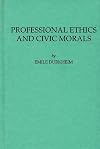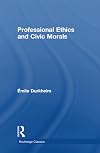
Professional Ethics and Civic Morals (Routledge Classics in Sociology)
by Émile Durkheim
51 Members (3.00)
On This Page
Description
Émile Durkheim is one of the founding fathers of sociology and Professional Ethics and Civic Morals is one of his most neglected yet insightful works.Durkheim's view that the instability of industrial society was connected to the decline of religion and his characterization of the state as the ultimate moral force in society revealhis lifelong engagement with the relationship between the individual and society. In Professional Ethics and Civic Morals Durkheim poses a major question: given show more the negative social consequences of unfettered markets, which caused whathe termed ‘anomie’, how is the state to reconcile morality with the market? Durkheim argues that the answer is to be found in the evolution of a civil religion, in the form of professional codes and civic values, which would counteract the effects of individualism, just as guilds had regulated medieval economic life. Arguing that the state has a vital role to play in moral life and that morals are at bottom social facts – a controversial position which drew considerable criticism – Durkheim also argues that the state had a duty to protect the rights of the individual, via a form of cosmopolitan patriotism. Durkheim also articulates a highly original and critical interpretation of the rules around property and inheritance – aperspective which resonates with debates about inequality and the redistribution of wealth today. Included in this Routledge Classics edition is a new introduction by Bryan S.Turner, placing Durkheim in contemporary context and outlining the key tenets of Professional Ethics and Civic Morals. show lessTags
Recommendations


































Member Reviews
Members
- Recently Added By
Author Information

159+ Works 6,475 Members
Emile Durkheim was born in Epinal, France on April 15, 1858. He received a baccalauréats in Letters in 1874 and Sciences in 1875 from the Collège d'Epinal. He became a professor of sociology at the Sorbonne, where he founded and edited the journal L'Annee Sociologique. He is renowned for the breadth of his scholarship; for his studies of show more primitive religion; for creating the concept of anomie (normlessness); for his study of the division of labor; and for his insistence that sociologists must use sociological (e.g., rates of behavior) rather than psychological data. He published several works including His Suicide in 1897. His notion of community, his view that religion forms the basis of all societies, had a profound impact on the course of community studies. He died on November 15, 1917 at the age of 59. (Bowker Author Biography) show less
Classifications
Statistics
- Members
- 51
- Popularity
- 594,990
- Rating
- (3.00)
- Languages
- English, Portuguese
- Media
- Paper, Ebook
- ISBNs
- 13