
Colin Crouch (1) (1944–)
Author of Post-Democracy
For other authors named Colin Crouch, see the disambiguation page.
About the Author
Colin Crouch is Professor Emeritus of the University of Warwick, and the External Scientific Member of the Max Planck Institute for Social Research at Cologne.
Series
Works by Colin Crouch
The Knowledge Corrupters: Hidden Consequences of the Financial Takeover of Public Life (2015) 32 copies, 1 review
Capitalist Diversity and Change: Recombinant Governance and Institutional Entrepreneurs (2005) 10 copies
Are Skills the Answer?: The Political Economy of Skill Creation in Advanced Industrial Countries (1999) 7 copies
After the Euro: Shaping Institutions for Governance in the Wake of European Monetary Union (2000) 6 copies
Changing Governance of Local Economies: Responses of European Local Production Systems (2004) 6 copies
Towards Greater Europe?: A Continent Without an Iron Curtain (The Political Quarterly) (1992) 3 copies
Tagged
Common Knowledge
- Birthdate
- 1944
- Gender
- male
- Education
- London School of Economics
University of Oxford (DPhil, 1975) - Occupations
- professor of sociology (European University Institute of Florence)
professor of governance and public management (University of Warwick Business School) - Organizations
- Международная шахматная федерация (ФИДЕ|Англия)
- Nationality
- UK
- Associated Place (for map)
- UK
Members
Reviews
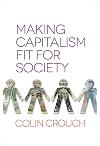
I approached this book in the spirit of something that I ought to read, rather than wanting so to do. The book was a pleasant surprise, in that it is written in a style that, whilst professorial and measured, never loses the average reader (me!!).
Professor Crouch writes from an unashamedly left of centre position, but is far from the old idea of the raving 'Trot' academic. He explains clearly, and I think in a fairly unconfrontational way, where we are politically and how we got here. He show more concentrates, but not exclusively, on the UK and seems to instinctively know when to push on at speed and where greater explanation is required. I found that I could understand every concept after a single reading - and I am certainly no financial wizz-kid!
Where the book is a little more fuzzy, is in the strategies needed to move to a fair society now that the Labour Party has renounced the old socialist propositions of state ownership of the means of production. Again, I would be surprised if many people would argue the fact that, whilst a level of common sense from the Labour Party is welcome, the headlong rush into a congested middle ground, where one party looks much like another, is something to be regretted. Many people feel disenfranchised and the number of voters falls with each fresh election.
The one concept which I (remember, a fiscal ignoramus) would have liked to see tackled, is the possibility that Capitalism is simply running out of time: this is an almost taboo topic and, whenever I try to raise it, it seems that the stock reaction is to shout it down as proof that I am a Communist (I AM NOT!!!) Capitalism has not been an ever present state of human life and, I see no reason why it should last for ever, however, this is not broached and so, I shall get off my soap box.
This book is well worth the read, whether your political persuasion is to the left, right or totally apathetic. Colin Crouch has written a book that, were everyone to read it, the discussion of our future could be held upon a higher plain than it is currently. show less
Professor Crouch writes from an unashamedly left of centre position, but is far from the old idea of the raving 'Trot' academic. He explains clearly, and I think in a fairly unconfrontational way, where we are politically and how we got here. He show more concentrates, but not exclusively, on the UK and seems to instinctively know when to push on at speed and where greater explanation is required. I found that I could understand every concept after a single reading - and I am certainly no financial wizz-kid!
Where the book is a little more fuzzy, is in the strategies needed to move to a fair society now that the Labour Party has renounced the old socialist propositions of state ownership of the means of production. Again, I would be surprised if many people would argue the fact that, whilst a level of common sense from the Labour Party is welcome, the headlong rush into a congested middle ground, where one party looks much like another, is something to be regretted. Many people feel disenfranchised and the number of voters falls with each fresh election.
The one concept which I (remember, a fiscal ignoramus) would have liked to see tackled, is the possibility that Capitalism is simply running out of time: this is an almost taboo topic and, whenever I try to raise it, it seems that the stock reaction is to shout it down as proof that I am a Communist (I AM NOT!!!) Capitalism has not been an ever present state of human life and, I see no reason why it should last for ever, however, this is not broached and so, I shall get off my soap box.
This book is well worth the read, whether your political persuasion is to the left, right or totally apathetic. Colin Crouch has written a book that, were everyone to read it, the discussion of our future could be held upon a higher plain than it is currently. show less

It is a strange twist of book publishing that some English language non-fiction books appear in a German translation nearly half a year before they are actually published in their original language in their home market. Reading Colin Crouch's laments about the troubles of the UK's public services and market failures in German without adding corresponding German cases reads a bit odd, if not insular.
The book easily and convincingly demolishes the false claims of neoliberalism. Crouch still show more seems to believe that neoliberals would change their views if confronted with facts and better theories. Unfortunately, this is not the case, as Paul Krugman recently seems to have realized. As Game of Thrones demonstrated, knowledge is not power, power is power. Crouch's discussion and dismantling of false claims is noble but ultimately futile, as shown by the George W. Bush official who quipped disdainful about reality-based views. Crouch's book convincingly shows, what has been apparent for years now, that the Emperor is stark naked indeed.
I wish that he had mentioned ordoliberalism more as it offers a solution to most of the problems presented by the neoliberal creed. To prevent market failure such as Volkswagen's current cheating scandal, strong government institutions need to provide checks and balances to enforce rules and regulations so that a market economy can work to the benefit of the most (instead of a few oligarchs).
Crouch's examples of the failures in UK privatization schemes are heartbreaking. Instead of service improvements, the contracts are often awarded to crony companies. Good regulation is actually not that hard if aptly defended and offers huge benefits to the general public, such as a 20 USD monthly cost for a pharma dosage in the UK compared to 20.000 USD in the free market, baby! USA. Given such profit margins, politics and the government has been too weak to resist the bribes, similar to the Narco-dollars overwhelming the weak government institutions in Central and South America.
The author's praise of old school technocrats and experts is a useful corrective to the disdain shown by many neoliberals but he goes too far. Austerity is a prime case where experts went with the wrong option for the patient. In most medical systems, nurses can not perform some sensible services because the doctor lobby eagerly preserves their privileges instead of allowing a redesign of the services under a case management approach.
So a deserving quick read that unfortunately will preach to the already converted and fails to fully introduce the Anglo-American world to the concept of ordoliberalism. Perhaps, like re-engineering, it needs some American to rediscover and market an idea already described by Germans many decades ago. show less
The book easily and convincingly demolishes the false claims of neoliberalism. Crouch still show more seems to believe that neoliberals would change their views if confronted with facts and better theories. Unfortunately, this is not the case, as Paul Krugman recently seems to have realized. As Game of Thrones demonstrated, knowledge is not power, power is power. Crouch's discussion and dismantling of false claims is noble but ultimately futile, as shown by the George W. Bush official who quipped disdainful about reality-based views. Crouch's book convincingly shows, what has been apparent for years now, that the Emperor is stark naked indeed.
I wish that he had mentioned ordoliberalism more as it offers a solution to most of the problems presented by the neoliberal creed. To prevent market failure such as Volkswagen's current cheating scandal, strong government institutions need to provide checks and balances to enforce rules and regulations so that a market economy can work to the benefit of the most (instead of a few oligarchs).
Crouch's examples of the failures in UK privatization schemes are heartbreaking. Instead of service improvements, the contracts are often awarded to crony companies. Good regulation is actually not that hard if aptly defended and offers huge benefits to the general public, such as a 20 USD monthly cost for a pharma dosage in the UK compared to 20.000 USD in the free market, baby! USA. Given such profit margins, politics and the government has been too weak to resist the bribes, similar to the Narco-dollars overwhelming the weak government institutions in Central and South America.
The author's praise of old school technocrats and experts is a useful corrective to the disdain shown by many neoliberals but he goes too far. Austerity is a prime case where experts went with the wrong option for the patient. In most medical systems, nurses can not perform some sensible services because the doctor lobby eagerly preserves their privileges instead of allowing a redesign of the services under a case management approach.
So a deserving quick read that unfortunately will preach to the already converted and fails to fully introduce the Anglo-American world to the concept of ordoliberalism. Perhaps, like re-engineering, it needs some American to rediscover and market an idea already described by Germans many decades ago. show less
In "Making Capitalism Fit for Society," Colin Crouch argues that there is a need for assertive social democracy. Crouch makes clear that social democracy differs from socialism. While socialism seeks to replace capitalism with state control of the economy, social democracy accepts the market and private ownership as the best way to conduct most economic business. However, markets are unable to meet all societal goals. There is a role for government within capitalist society. That role is to show more ensure that the collective needs of citizens not addressed by the markets are met.
Crouch clearly explains the differences between the dominant neoliberal paradigm and that of social democracy. He discusses the strengths and weaknesses of each mindset. Crouch does not hide his dissatisfaction with the neoliberal approach to the economy. The book’s purpose is to justify the need for social democracy. However, the book is not a mindless, emotionally-driven attack on neoliberalism. This book is for readers who want to understand the challenges of creating a form of capitalism that supports a more equitable society. Crouch writes for the thoughtful reader who is interested in living within a society that balances profit and people. show less
Crouch clearly explains the differences between the dominant neoliberal paradigm and that of social democracy. He discusses the strengths and weaknesses of each mindset. Crouch does not hide his dissatisfaction with the neoliberal approach to the economy. The book’s purpose is to justify the need for social democracy. However, the book is not a mindless, emotionally-driven attack on neoliberalism. This book is for readers who want to understand the challenges of creating a form of capitalism that supports a more equitable society. Crouch writes for the thoughtful reader who is interested in living within a society that balances profit and people. show less

This book is essentially an extended essay on the problems with neoliberalism. It's focus is primarily on British politics but manages to cover US and European aspects as well. Despite its short length, it manages to cover the subject well.
Awards


You May Also Like


Associated Authors
Statistics
- Works
- 38
- Members
- 474
- Popularity
- #52,000
- Rating
- 3.4
- Reviews
- 6
- ISBNs
- 159
- Languages
- 8