Of the Farm
by John Updike
On This Page
Description
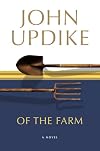
Of the Farm recounts Joey Robinson's visit to the farm where he grew up and where his mother now lives alone. Accompanied by his newly acquired second wife, Peggy, and an eleven-year-old stepson, Joey spends three days reassessing and evaluating the course his life has run. But for Joey and Peggy, the delicate balance of love and sex is threatened by a dangerous new awareness.Tags
Recommendations















Member Reviews
A fictionalized story about John Updike and his mother, Linda Hoyer Updike, [Of the Farm] depicts a visit by the son to his mother's small farm. JU/Joey Robinson drives from NYC for a weekend. He's going to fire up the old farm tractor and mow fields before a township weed-mowing deadline. He's accompanied by his new wife, Peggy, and her 11-year-old son, Richard. Low-key chats, bickering, revelations, and recriminations ensue. Through Joey, Updike seems to be analyzing his relationship with his mother, perhaps sorting through his marriage, and especially assessing what he, as an only, will do when she dies.
Updike had a sharp eye for body language and nuanced exchanges: between mother and son, between son and new wife, between mother show more and new wife, between all three and 11-year-old Richard. A barbed remark hits its target, and the speaker exits. Who was the real target? What was the intended message? What's the underlying message? What does it reveal of the speaker? Is negotiation appropriate? Who's to make the first move?
His mastery of description and poetic expression and word choices is well known.
Here's a sample passage; Joey's mother invites him to join a walk the others are taking around the farm's boundaries. "No, I'll mow until lunch." As narrator, he tells us:
Updike cites Joey's mother's "hurt gaze" and Peggy's "prim" lips as evidence the women are united in annoyance. He notes them "walking warily on the stubble", each in isolation, Peggy because "her sandals...left the sides of her feet exposed, and my mother, head bowed, was inspecting my work for errors, for ruined nests, butchered birds."
The story is a weaving, the author/narrator bringing disparate threads together, drawing them into a tapestry of shared lives.
The true-life backstory is that when John was born, the Updike family lived in town, about two blocks from the Shillington (PA) High School where Wesley Updike taught and John would eventually study. But Linda Updike pined for her family's farm, which her father had sold so he could move his family into town. When she was able to buy it after World War II, she uprooted the men and they moved to Plowville. Seventy-plus years ago, Plowville was far more remote than today's 10 minute drive would suggest. When this novel was published, of course, Wesley was still alive. Updike was still with his first wife and their four children. And so in this story, composed a decade before his mother died, he noodled around with issues that involved people close to him, issues he'd eventually have to deal with. How would his mother get along should his father die? How would Linda react to John divorcing, with his ex-wife taking their four children—his mother's only grandchildren—into a new marriage? How would a new wife, say for example, the woman he was having an affair with at that time, fit into their tight family.
I liked this novel as well as any Updike I've read. I may read it again, in concert with a reread of [The Centaur], which focused on Wesley Updike and was published the year before [Of the Farm]. And I'll add a first reading of [Marry Me!], which was written at the same time but not published until the late 1970s. show less
Updike had a sharp eye for body language and nuanced exchanges: between mother and son, between son and new wife, between mother show more and new wife, between all three and 11-year-old Richard. A barbed remark hits its target, and the speaker exits. Who was the real target? What was the intended message? What's the underlying message? What does it reveal of the speaker? Is negotiation appropriate? Who's to make the first move?
His mastery of description and poetic expression and word choices is well known.
Here's a sample passage; Joey's mother invites him to join a walk the others are taking around the farm's boundaries. "No, I'll mow until lunch." As narrator, he tells us:
I would mow and my mother would get to know Peggy: this was our bargain. I demanded of the three others that they mingle without involving me. I feared I might lose myself amid their confused apprehensions of one another and hoped, as my mother's hurt gaze left me and Peggy's lips went prim, that annoyance with me would tend to unite them. They moved away, walking warily on the stubble; Peggy wore sandals that left the sides of her feet exposed, and my mother, head bowed, was inspecting my work for errors, for ruined nests, butchered birds. Richard began to run in circles like the dogs, chasing the wisps of milkweed flax that alternated with cabbage butterflies in the air. I noted with pride that both women were tall, big. It seemed a sign of great wealth that I could afford to snub them, and this prosperity enriched the triumph of floating between the steady wheels that reduced all unruly flowers to the contour of a cropped field.
After five or six circuits I saw them emerge from the woods, tinted specks, and bob toward the house along the horizon of the slope of land that descended to the foundations of the abandoned tobacco shed. Bouncing dogs, jogging child, plodding women: my tractor's long slow turning as I watched them gave me the illusion of pulling the string of them tight.
Updike cites Joey's mother's "hurt gaze" and Peggy's "prim" lips as evidence the women are united in annoyance. He notes them "walking warily on the stubble", each in isolation, Peggy because "her sandals...left the sides of her feet exposed, and my mother, head bowed, was inspecting my work for errors, for ruined nests, butchered birds."
The story is a weaving, the author/narrator bringing disparate threads together, drawing them into a tapestry of shared lives.
The true-life backstory is that when John was born, the Updike family lived in town, about two blocks from the Shillington (PA) High School where Wesley Updike taught and John would eventually study. But Linda Updike pined for her family's farm, which her father had sold so he could move his family into town. When she was able to buy it after World War II, she uprooted the men and they moved to Plowville. Seventy-plus years ago, Plowville was far more remote than today's 10 minute drive would suggest. When this novel was published, of course, Wesley was still alive. Updike was still with his first wife and their four children. And so in this story, composed a decade before his mother died, he noodled around with issues that involved people close to him, issues he'd eventually have to deal with. How would his mother get along should his father die? How would Linda react to John divorcing, with his ex-wife taking their four children—his mother's only grandchildren—into a new marriage? How would a new wife, say for example, the woman he was having an affair with at that time, fit into their tight family.
I liked this novel as well as any Updike I've read. I may read it again, in concert with a reread of [The Centaur], which focused on Wesley Updike and was published the year before [Of the Farm]. And I'll add a first reading of [Marry Me!], which was written at the same time but not published until the late 1970s. show less
Very autobiographical novel, based on Updike's own mother, her much loved farm, and the difficult relationship that ensues as , after leaving his wife and children, he visits her with his second wife and stepson. There are so many strands running through it - the mother's awareness of her age and infirmity; the sense of loss as she fears never seeing her grandchildren again; her bitterness at seeing her adored son taking up with someone she deems stupid (and his own qualms that she may be right.) Great piece of writing.
This short little novel is a treasure trove of great writing. A deceptively simple story jam packed with drama, atmosphere and description. It traces the return of Joey, the protagonist, to the farm on which he grew up. He is there to introduce his new second wife and stepson to his widowed mother, with whom he has a challenging relationship. While the book is really about relationships: - between Joey and his new wife; Joey and his mother; his mother and deceased father; mother and new daughter-in-law, etc,-it is the back and forth between Joey and his mother that holds the most interest, creates the most tension, and ultimately the most revelations. The exploration of character; the pull and impact of one's past and the gorgeous and show more unusual writing, make this a great little book to savor. show less
"In this short novel, Updike tells the story of a family's strained visit to the ancestral farm in Pennsylvania. The book has an autobiographical feel translated through Updike's colorful, dense, and sometimes beautiful prose. A divorced man returns to his mother's farm with his new wife and stepson. Throughout, there are memories of his childhood, his dead father, and the suggestion that his mother was largely responsible for the end of his first marriage. The story is alternately sad and compelling. The author manages to project the beauty of the farm, the dark personality of the mother, and the confused worry of the new wife. It is a surprising little book. Nicholson Baker has cited this as one of his favorite Updike novels." show more Thumbnail review by John Q. McDonald Review URL: http://sprg.ssl.berkeley.edu/~jmcd/book/revs/oftf.html show less
Incredible book. Very internal-dialogue and thought driven rather than plot driven.
Un consultor de empresas neoyorquino, hace un paréntesis en su vida cotidiana para regresar a la granja dónde creció y dónde aún vive su madre, viuda y ya demasiado mayor para realizar ella sola algunas tareas domésticas. Los asuntos pendientes, las diferencias, la tensión, los fantasmas del pasado.......
Jul 27, 2014 (Edited)Spanish
Ratings
Members
- Recently Added By
Author Information

340+ Works 53,355 Members
American novelist, poet, and critic John Updike was born in Reading, Pennsylvania on March 18, 1932. He received an A.B. degree from Harvard University, which he attended on a scholarship, in 1954. After graduation, he accepted a one-year fellowship to study painting at the Ruskin School of Drawing and Fine Art in Oxford, England. After returning show more from England in 1955, he worked for two years on the staff of The New Yorker. This marked the beginning of a long relationship with the magazine, during which he has contributed numerous short stories, poems, and book reviews. Although Updike's first published book was a collection of verse, The Carpentered Hen and Other Tame Creatures (1958), his renown as a writer is based on his fiction, beginning with The Poorhouse Fair (1959). During his lifetime, he wrote more than 50 books and primarily focused on middle-class America and their major concerns---marriage, divorce, religion, materialism, and sex. Among his best-known works are the Rabbit tetrology---Rabbit, Run (1960), Rabbit Redux (1971), Rabbit Is Rich (1981), and Rabbit at Rest (1988). Rabbit, Run introduces Harry "Rabbit" Angstrom as a 26-year-old salesman of dime-store gadgets trapped in an unhappy marriage in a dismal Pennsylvania town, looking back wistfully on his days as a high school basketball star. Rabbit Redux takes up the story 10 years later, and Rabbit's relationship with representative figures of the 1960s enables Updike to provide social commentary in a story marked by mellow wisdom and compassion in spite of some shocking jolts. In Rabbit Is Rich, Harry is comfortably middle-aged and complacent, and much of the book seems to satirize the country-club set and the swinging sexual/social life of Rabbit and his friends. Finally, in Rabbit at Rest, Harry arrives at the age where he must confront his mortality. Updike won the Pulitzer Prize for both Rabbit Is Rich and Rabbit at Rest. Updike's other novels range widely in subject and locale, from The Poorhouse Fair, about a home for the aged that seems to be a microcosm for society as a whole, through The Court (1978), about a revolution in Africa, to The Witches of Eastwick (1984), in which Updike tries to write from inside the sensibilities of three witches in contemporary New England. The Centaur (1963) is a subtle, complicated allegorical novel that won Updike the National Book Award in 1964. In addition to his novels, Updike also has written short stories, poems, critical essays, and reviews. Self-Consciousness (1989) is a memoir of his early life, his thoughts on issues such as the Vietnam War, and his attitude toward religion. He was elected to the American Academy of Arts and Letters in 1977. He died of lung cancer on January 27, 2009 at the age of 76. (Bowker Author Biography) John Updike was born in 1932, in Shillington, Pennsylvania. Since 1957 he has lived in Massachusetts. His novels have won the Pulitzer Prize, the National Book Award, the National Book Critics Circle Award, & the Howells Medal. (Publisher Provided) John Updike was born in 1932 and attended Harvard College and the Ruskin School of Drawing and Fine Art in Oxford, England. Form 1955 to 1957 he was a staff member of The New Yorker, which he contributed numerous writings. Updike's art criticism has appeared in publications including Arts and Antiques, The New Republic, The New York Times Book Review, and Realites, among many others. He is the author of such best-selling novels as Rabbit Run and Rabbit is Rich. His many works of fiction, poetry and criticism have been awarded the Pulitzer Prize, the National Book Award, the American Book Award, and the National Book Critics Circle Award. For the past 40 years he has lived in Massachusetts. (Publisher Provided) John Updike is the author of some 50 books, including collections of short stories, poems, & criticism. His novels have won the Pulitzer Prize, the National Book Award, the National Book Critics Circle Award, & the Howells Medal. Born in Shillington, Pennsylvania, in 1932, he has lived in Massachusetts since 1957. (Publisher Provided) show less
Some Editions
Series
Belongs to Publisher Series
A tot vent (263)
Work Relationships
Common Knowledge
- Canonical title
- Of the Farm
- Original title
- Of the Farm
- Original publication date
- 1965-11-15
- People/Characters
- Joey Robinson
- Important places
- Olinger [Shillington], Pennsylvania, USA; Pennsylvania, USA
- Epigraph
- Consequently, when, in all honesty, I've recognized that man is a being in whom existence precedes essence, that he is a free being who, in various circumstances, can want only his freedom, I have at the same time recogniz... (show all)ed that I can want only the freedom of others.
--SARTRE - First words
- We turned off the Turnpike onto a macadam highway, then off the macadam onto a pink dirt road.
- Last words
- (Click to show. Warning: May contain spoilers.)"Your farm?" I said. "I've always thought of it as our farm."
Classifications
Statistics
- Members
- 447
- Popularity
- 67,993
- Reviews
- 6
- Rating
- (3.33)
- Languages
- 8 — Catalan, English, French, German, Italian, Polish, Russian, Spanish
- Media
- Paper, Audiobook, Ebook
- ISBNs
- 24
- ASINs
- 11