
On This Page
Description
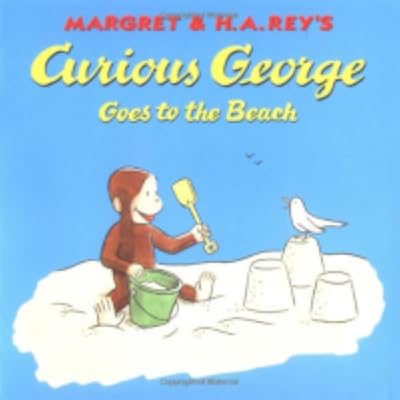
Curious George has fun feeding the sea gulls at the beach and then saves the day when he rescues a picnic basket and helps his friend overcome her fear of the water.Tags
Recommendations



Member Reviews
There are several reasons why I feel this is a good book. For one, I feel the characters in the story are very believable, and are similar to many children. When George first arrives at the beach, he is very anxious to get into the water, build sandcastles, and feed bread to the seagulls. However, when George’s friend, Betsy, arrives at the beach, she is extremely apprehensive toward all of the elements. The story highlights two different kinds of child emotions, both of which many people have experienced in their lifetime. In addition to the characters, I also enjoyed the illustrations. For each activity George engages himself in, an illustration is drawn depicting it. The reader is left with little confusion as to what the author is show more trying to say. The images are very colorful, and have minute details within them, that bring the scenes to life. The main idea to this story is do not be afraid of your fears. George was afraid that he had made the Man in the yellow hat angry, while Betsy was afraid to swim in the water. In the end, both characters resolved and conquered their fears, and all ended well. show less
SUMMARY
Curious George goes to the beach with the man with the yellow hat. George plays on the beach, sits in the lifeguards chair, and feeds the seagulls. When the picnic basket floats into the ocean, George swims out and saves that basket. George's friends Betsy, who conquered her fear of swimming, shares her food with him to celebrate.
REVIEW
Curious George is always a great series for young readers. Students will have a fun time following George on his adventures. He shows that curiosity is not a bad thing and that it is okay to explore things that you may be unfamiliar with. I also liked that this book included an underlying theme about overcoming fear with Betsy's fear of the water. This story is also easy for students to connect to show more because many students have vacationed at a beach before. Some may have even had to conquer a fear of the ocean, just like Betsy! show less
Curious George goes to the beach with the man with the yellow hat. George plays on the beach, sits in the lifeguards chair, and feeds the seagulls. When the picnic basket floats into the ocean, George swims out and saves that basket. George's friends Betsy, who conquered her fear of swimming, shares her food with him to celebrate.
REVIEW
Curious George is always a great series for young readers. Students will have a fun time following George on his adventures. He shows that curiosity is not a bad thing and that it is okay to explore things that you may be unfamiliar with. I also liked that this book included an underlying theme about overcoming fear with Betsy's fear of the water. This story is also easy for students to connect to show more because many students have vacationed at a beach before. Some may have even had to conquer a fear of the ocean, just like Betsy! show less
Written by Margaret and H.A. Rey, “Curious George Goes to the Beach” was a very enjoyable book to read that I liked a lot. After reading this story, I found it to have two main purposes. The main purposes of this story are to introduce the reader to the concept of cause and effect, and to teacher the reader that there are consequences for misbehaving. In order to fulfill the book’s purpose, the authors used text elements, such as word choice and layout, illustrations, and a relatable storyline.
One text element that was used to help fulfill the story’s purpose was the word choice. This book is written using very simple language that is clear and easy to understand. Also, the sentences in the text are very short, detailed, and show more to the point. This allows the reader to comprehend the story easily and follow along with the text without getting lost or confused. Along with this, the author also created a visually appealing text layout throughout the story. For example, on each page, there is text in different areas on the page. This technique catches the reader’s attention and makes the book more fun to read. By engaging the reader in this way, the authors are providing the reader with a better opportunity to comprehend the story.
In addition to word choice and layout, the illustrations also play a part in fulfilling the story’s message. Brightly colored illustrations are included on each page, which keeps the reader engaged and interested in the story. Moreover, the illustrations provided are spread across the page in a sequential way that directly follows the actions of the story and relates to the text on the page. For example, one page’s text says, “George watched the lifeguard. The lifeguard sat in a special chair. Sometimes he blew a whistle.” This page’s illustration directly relates to this text because it depicts George watching the lifeguard sit in his chair, while he plays in the sand. The text-illustration connects created by the authors’ help the reader to comprehend the story more easily because the illustrations give a visual representation to reinforce the text.
Lastly, the author’s use a relatable story line to help fulfill the story’s purpose. Although George is a monkey, he is experiencing difficulty with following directions, which all readers can relate to. Furthermore, the consequences of George’s actions, or the cause and effect situations, are realistic things that could be expected to happen given the situations. This provides the reader with the chance to gain a deeper connection to the storyline and George’s character, which helps the reader really grasp the messages in the story. The use of these different text elements allows the authors’ to successfully fulfill their purposes of introducing the reader to the concept of cause and effect and teaching the reader that there are consequences to our actions, while creating a book that is wonderfully written and truly enjoyable to read. show less
One text element that was used to help fulfill the story’s purpose was the word choice. This book is written using very simple language that is clear and easy to understand. Also, the sentences in the text are very short, detailed, and show more to the point. This allows the reader to comprehend the story easily and follow along with the text without getting lost or confused. Along with this, the author also created a visually appealing text layout throughout the story. For example, on each page, there is text in different areas on the page. This technique catches the reader’s attention and makes the book more fun to read. By engaging the reader in this way, the authors are providing the reader with a better opportunity to comprehend the story.
In addition to word choice and layout, the illustrations also play a part in fulfilling the story’s message. Brightly colored illustrations are included on each page, which keeps the reader engaged and interested in the story. Moreover, the illustrations provided are spread across the page in a sequential way that directly follows the actions of the story and relates to the text on the page. For example, one page’s text says, “George watched the lifeguard. The lifeguard sat in a special chair. Sometimes he blew a whistle.” This page’s illustration directly relates to this text because it depicts George watching the lifeguard sit in his chair, while he plays in the sand. The text-illustration connects created by the authors’ help the reader to comprehend the story more easily because the illustrations give a visual representation to reinforce the text.
Lastly, the author’s use a relatable story line to help fulfill the story’s purpose. Although George is a monkey, he is experiencing difficulty with following directions, which all readers can relate to. Furthermore, the consequences of George’s actions, or the cause and effect situations, are realistic things that could be expected to happen given the situations. This provides the reader with the chance to gain a deeper connection to the storyline and George’s character, which helps the reader really grasp the messages in the story. The use of these different text elements allows the authors’ to successfully fulfill their purposes of introducing the reader to the concept of cause and effect and teaching the reader that there are consequences to our actions, while creating a book that is wonderfully written and truly enjoyable to read. show less
Great story about how George goes to the because/ He starts feeding the birds and makes friends with a crab. In feeding everyone other than himself he looses his picnic basket and has to swim out into the ocean and save it.
Cute book and we enjoyed reading it together a few times. Now DS is moving onto different interests and I think it's time to release this book to another BookCrosser.
This book talks about a monkey names George who goes to the beach and meets different animal friends. Younger readers will enjoy this adventure and want to hear more of George's adventures.
Members
- Recently Added By
Author Information

295+ Works 69,929 Members
Hans Augusto Rey was born on September 16, 1898 in Hamburg, Germany. He escaped to Paris with his wife after the Nazi's invaded. While in Paris, Hans's animal drawings came to the attention of French publisher, who commissioned him to write a children's book. The result, Rafi and the Nine Monkeys, is little remembered today, but one of its show more characters, an adorably impish monkey named Curious George, was such a success that the couple considered writing a book just about him. Their work was interrupted with the outbreak of World War II. As Jews, the Reys decided to flee Paris before the Nazis seized the city. Hans built two bicycles, and they fled Paris just a few hours before it fell. Among the meager possessions they brought with them was the illustrated manuscript of Curious George. The books were published by Houghton Mifflin in 1941. Curious George was an instant success, and the Reys were commissioned to write more adventures of the mischievous monkey and his friend, the Man in the Yellow Hat. They wrote seven stories in all. Their title Happy Halloween made The New York Times Best Seller List in 2013. At first, Margret's name was left off the cover because there was a glut of women already writing children's fiction. In later editions, this was corrected, and Margret now receives full credit for her role in developing the stories. H. A. Rey died in 1977 and in 1989 Margaret Rey established the Curious George Foundation to help creative children and prevent cruelty to animals. (Bowker Author Biography) show less

130+ Works 52,813 Members
Margarete Elisabeth Waldstein was born in Hamburg on May 16, 1906. She briefly met her future husband, H. A. Rey, when she was a young girl, but then left for Hamburg to study art. They were reunited in 1935 in Rio de Janeiro, where Rey had gone to escape the political climate in Germany. Margret convinced Hans to leave the family business, and show more soon they were working together on a variety of projects. Hans and Margret were married in Brazil on August 16, 1935, but they soon moved to Paris. It was there that Hans published his first children's book, after a French publisher saw his newspaper cartoons of a giraffe and asked him to expand upon them. Raffy and the Nine Monkeys was the result, and the debuted the mischievous monkey named Curious George. After Raffy and the Nine Monkeys was published, the Reys began a book of Curious George's own. Before the new manuscript could be published, the Reys, both German Jews, found themselves being forced to flee the Nazi occupation. From Lisbon, they made their way to Brazil and on to New York City, where they began a whole new life as children's book authors. Curious George was published by Houghton Mifflin in 1941. All the Curious George books, including the seven original stories by Margret and Hans, have sold over 25 million copies and are so popular that the original story has never been out of print. Margret Rey passed away in 1996, but not before establishing the Curious George Foundation in 1989, which gives money to children and animals. (Bowker Author Biography) show less
All Editions
Series

Work Relationships
Is contained in
Common Knowledge
- Original title
- Curious George Goes to the Beach
- Original publication date
- 1999
- People/Characters
- Curious George; The Man with the Yellow Hat
- First words
- This is George.
- Last words
- (Click to show. Warning: May contain spoilers.)There was plenty for everyone...and there was even a little for guests.
Classifications
Statistics
- Members
- 1,095
- Popularity
- 23,204
- Reviews
- 8
- Rating
- (3.79)
- Languages
- Chinese, English, Korean
- Media
- Paper, Ebook
- ISBNs
- 16
- UPCs
- 4
- ASINs
- 7