On This Page
Description
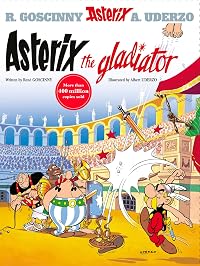
When Cacofonix the bard is taken to Rome as a present for Julius Caesar, Asterix and Obelix set out to rescue him, sailing with master salesman Ekonomikrisis, the Phoenician merchant. How do our Gaulish friends come to end up training as gladiators? The next Games in the Circus Maximus are not quite what Caesar and the Roman public expect...Tags
Recommendations






























Member Reviews
This review is written with a GPL 4.0 license and the rights contained therein shall supersede all TOS by any and all websites in regards to copying and sharing without proper authorization and permissions. Crossposted at WordPress, Blogspot, & Librarything by Bookstooge’s Exalted Permission
Title: Asterix the Gladiator
Series: Asterix #4
Authors: Goscinny & Uderzo
Translators: Bell & Hockridge
Rating: 4 of 5 Stars
Genre: Comics
Pages: 51
Words: 3K
Synopsis:
From Wikipedia.org
While stopping at the Roman Camp of Compendium, Prefect 'Odius Asparagus' wants one of the indomitable Gauls as a present for Julius Caesar. Because none of the others can be captured, Centurion Gracchus Armisurplus decides on Cacofonix the bard. Soldiers sent by the show more centurion, although driven away by Cacofonix's singing at first, counteract this by stuffing parsley in their ears and capture him easily. A young boy named Picanmix from the village raises the alarm to Asterix and Obelix, and the Gauls attack Compendium; but learn that the prefect has already left in his galley with Cacofonix.
Asterix and Obelix therefore board a ship with Ekonomikrisis the Phoenician merchant, who agrees to take them to Rome after they save him from the pirates. In Rome, after Cacofonix has subjected the slaves in the prefect's galley to his bad singing, the prefect presents him to Julius Caesar; but when Caius Fatuous, the gladiators' trainer, declares Cacofonix unfit to serve as a gladiator, Caesar decides to throw the bard to the lions. Upon arrival in Rome, Asterix and Obelix befriend Instantmix (a Gaulish chef working in Rome) and visit the public baths. There, Caius Fatuous decides they would be perfect candidates for the gladiators' fights in the Circus Maximus, and he arranges to have them captured. That night, Asterix and Obelix visit Instantmix in his insula, where he identifies the location of Cacofonix. The next morning, the Gauls' first attempt at rescuing the bard fails when they raid the Circus prison and discover that Cacofonix has been transferred to a lower basement. Caius Fatuous has his men try to ambush them in groups of three, but Asterix and Obelix defeat them with ease, and apparently without taking notice.
Caius Fatuous then offers a reward of 10,000 sestertii to any citizen who captures Asterix and Obelix; but the two of them volunteer as gladiators to infiltrate the following Games, and Fatuous places them in training under his assistant Insalubrius. Soon, the Gauls demoralize Insalubrius and irritate Caius Fatuous by having the other gladiators play guessing-games instead of training. Later, when Fatuous plans the Games to Julius Caesar, the Gauls go on a stroll, with Caius Fatuous (reluctantly) as their guide. On the eve before the games, Asterix and Obelix visit Cacofonix in his cell and inform him of their intentions to free him and the gladiators.
The next day, during the chariot races, Asterix and Obelix substitute themselves for an inebriated contestant, and win the race. As Cacofonix is put into the arena to be killed by the lions, he sings to the Romans, and thus frightens the lions into retreat; whereupon Caesar orders the gladiators' competition to begin. When Asterix, Obelix, and the gladiators introduce Caesar to their guessing-game, and Caesar insists on a martial contest, Asterix challenges a cohort of Caesar's own guard, and the two Gauls win easily. Seeing that the audience are amused, Caesar releases the three Gauls and grants them Fatuous as a prisoner. Soon afterwards, the four men meet back up with Ekonomikrisis, and Asterix surprises him and his men by having Caius Fatuous row the ship back to the Gaulish Village alone. After a brief journey (plus a second run in with the pirates, which sinks their ship), the Gauls arrive home and Ekonomikrisis keeps his promise to return Caius Fatuous to Rome. The villagers then celebrate the return of their heroes with a banquet, only with Cacofonix having to sit it out bound and gagged after offering to sing a song to celebrate his triumphant return.
This book is noteworthy in the Asterix series as the first in which Obelix says his famous catchphrase "These Romans are crazy!"
My Thoughts:
Fun. Cacofonix the Bard gets kidnapped, only to be shut up time and again every time someone hears him sing. Even Asterix and Obelix threaten to not take him back to Gaul if he tries to sing to them at the end of the book. How can that not make you laugh?
The running gag for this story is Obelix playing a game of “hit the romans” and using their helmets as proof that he knocked them out. You seem him constantly with a huge pile of roman helmets lined up like soup bowls in his arms every time he meets a new group of them. There were a couple of word plays that went right over my head, as I didn't see what what was supposed to be funny, but missing a joke here or there isn't necessarily a bad thing.
Overall, a good way to spend the evening.
★★★★☆ show less
Title: Asterix the Gladiator
Series: Asterix #4
Authors: Goscinny & Uderzo
Translators: Bell & Hockridge
Rating: 4 of 5 Stars
Genre: Comics
Pages: 51
Words: 3K
Synopsis:
From Wikipedia.org
While stopping at the Roman Camp of Compendium, Prefect 'Odius Asparagus' wants one of the indomitable Gauls as a present for Julius Caesar. Because none of the others can be captured, Centurion Gracchus Armisurplus decides on Cacofonix the bard. Soldiers sent by the show more centurion, although driven away by Cacofonix's singing at first, counteract this by stuffing parsley in their ears and capture him easily. A young boy named Picanmix from the village raises the alarm to Asterix and Obelix, and the Gauls attack Compendium; but learn that the prefect has already left in his galley with Cacofonix.
Asterix and Obelix therefore board a ship with Ekonomikrisis the Phoenician merchant, who agrees to take them to Rome after they save him from the pirates. In Rome, after Cacofonix has subjected the slaves in the prefect's galley to his bad singing, the prefect presents him to Julius Caesar; but when Caius Fatuous, the gladiators' trainer, declares Cacofonix unfit to serve as a gladiator, Caesar decides to throw the bard to the lions. Upon arrival in Rome, Asterix and Obelix befriend Instantmix (a Gaulish chef working in Rome) and visit the public baths. There, Caius Fatuous decides they would be perfect candidates for the gladiators' fights in the Circus Maximus, and he arranges to have them captured. That night, Asterix and Obelix visit Instantmix in his insula, where he identifies the location of Cacofonix. The next morning, the Gauls' first attempt at rescuing the bard fails when they raid the Circus prison and discover that Cacofonix has been transferred to a lower basement. Caius Fatuous has his men try to ambush them in groups of three, but Asterix and Obelix defeat them with ease, and apparently without taking notice.
Caius Fatuous then offers a reward of 10,000 sestertii to any citizen who captures Asterix and Obelix; but the two of them volunteer as gladiators to infiltrate the following Games, and Fatuous places them in training under his assistant Insalubrius. Soon, the Gauls demoralize Insalubrius and irritate Caius Fatuous by having the other gladiators play guessing-games instead of training. Later, when Fatuous plans the Games to Julius Caesar, the Gauls go on a stroll, with Caius Fatuous (reluctantly) as their guide. On the eve before the games, Asterix and Obelix visit Cacofonix in his cell and inform him of their intentions to free him and the gladiators.
The next day, during the chariot races, Asterix and Obelix substitute themselves for an inebriated contestant, and win the race. As Cacofonix is put into the arena to be killed by the lions, he sings to the Romans, and thus frightens the lions into retreat; whereupon Caesar orders the gladiators' competition to begin. When Asterix, Obelix, and the gladiators introduce Caesar to their guessing-game, and Caesar insists on a martial contest, Asterix challenges a cohort of Caesar's own guard, and the two Gauls win easily. Seeing that the audience are amused, Caesar releases the three Gauls and grants them Fatuous as a prisoner. Soon afterwards, the four men meet back up with Ekonomikrisis, and Asterix surprises him and his men by having Caius Fatuous row the ship back to the Gaulish Village alone. After a brief journey (plus a second run in with the pirates, which sinks their ship), the Gauls arrive home and Ekonomikrisis keeps his promise to return Caius Fatuous to Rome. The villagers then celebrate the return of their heroes with a banquet, only with Cacofonix having to sit it out bound and gagged after offering to sing a song to celebrate his triumphant return.
This book is noteworthy in the Asterix series as the first in which Obelix says his famous catchphrase "These Romans are crazy!"
My Thoughts:
Fun. Cacofonix the Bard gets kidnapped, only to be shut up time and again every time someone hears him sing. Even Asterix and Obelix threaten to not take him back to Gaul if he tries to sing to them at the end of the book. How can that not make you laugh?
The running gag for this story is Obelix playing a game of “hit the romans” and using their helmets as proof that he knocked them out. You seem him constantly with a huge pile of roman helmets lined up like soup bowls in his arms every time he meets a new group of them. There were a couple of word plays that went right over my head, as I didn't see what what was supposed to be funny, but missing a joke here or there isn't necessarily a bad thing.
Overall, a good way to spend the evening.
★★★★☆ show less
Asterix and Obelix travel to Rome to rescue Caliphonix the Bard. It's a very simple plot without too much at stake. Asterix is basically super human and he is never in any real danger. It seems he could just take on the whole Roman Empire if he wanted to. There are some character design choices for dark skinned slaves in this volume that could be interpreted as racist. This was probably not high on the French illustrator's priority list in the mid 60's.
The Asterix comics with Julius Caesar are usually among my favorites so this was a joy to find. And finally we have a story centered around the world's most misunderstood musical genius (in his own perspective) Caconophix. I love how the translators use modern songs with "Gaulish" lyrics. Classic!
As a kid I would read and reread the Asterix (and Tintin) comics over and over again. My primary school library (and local council library) had quite a collection of both, and at least with regards to Asterix, between them had pretty much all of them (with Tintin I had to go and persuade my parents to purchase the ones that were not available, so with the exception of the first two, I had read all of the Tintin comics, and the Asterix comics that had been released at the time).
However, after a very long hiatus, I borrowed a collection of Asterix comics from my friend and reread them and found them amusing. That was about fifteen years ago. Now, being a 'young' adult and working fulltime (as well as having access to the internet which show more means that I can get copies of the albums at least half of what I would be paying at a bookstore in Adelaide) I have now managed to collect and read all of the Tintin comics and I am slowly obtaining the Asterix comics as well (for some reason I seem to have moved away from borrowing books from the library, I guess because if I purchase them, not only can I then give them to by Dad, but I can take my time reading them).
I must admit that this one had me in stitches. This is number four in the series but we are seeing the development of the characters and the albums continuing. We saw that with the Tintin comics as well with Herge continuing to develop the characters and their friends as more and more albums were produced, and it is good to read them in order to see this development. In this album see Obelix begin his little game of counting the number of Romans he beats up by collecting their helmets. After every fight Obelix walks away with a pile of helmets in his hands, and of course in the final combat in the arena, we see a huge pile of helmets stacked in the corner. Also in this one we meet the pirates, who end up being another one of those groups that Obelix loves beating up.
Ceaser's birthday is coming up and the prefect of Gaul decides that he was to get Ceaser a special present, namely one of the indominable Gauls for the arena, so they decide to capture the weakest link, Cacofonix the Bard. Despite the fact that absolutely nobody likes his singing (probably because he has absolutely no musical talent whatsoever) he is still a Gaul and still a member of the village, so Asterix and Obelix go on a quest to Rome to rescue him. Along the way they meet up with the arena boss, who also happens to be the main villain of the peace.
There are some really amusing anecdotes in this album, particularly where Obelix looks for somebody to take care of his menhir delivery business while he is away (and I am still puzzled as to why the village actually needs all those menhirs), and then you see Obelix passing it on to Geriatrix, the village old person (elder would be an inappropriate word as Vitalstatistix is actually the leader of the village, Geriatrix is just an old guy with a very young wife) who looks at him oddly and says 'I don't think this is the right job for me'.
What is also amusing (but as I said this one had me on the floor in stitches) is how they just seem to wonder through Rome with impunity. If there is one thing that does not bother Asterix and Obelix and that is Roman legions, and in fact Romans. It is interesting how they painted Rome in the book because while historical accuracy is limited to an extent (Ceaser, in reality, was fighting a civil war when he returned from Gaul and then he was assassinated, so I suspect that the entire period of the Asterix comics is actually set over a period of only a few years). Oh, and the Latin that they throw around is actually heaps amusing, particularly when the entire Circus Maximus (the Collesseum hadn't been built at this stage, so kudos to the authors for at least being somewhat accurate here) is applauding Ceaser with the exception of Marcus Brutus, who sits behind Ceaser with a sour look on his face, and Ceaser then turns around to him and says 'et tu brutae'. show less
However, after a very long hiatus, I borrowed a collection of Asterix comics from my friend and reread them and found them amusing. That was about fifteen years ago. Now, being a 'young' adult and working fulltime (as well as having access to the internet which show more means that I can get copies of the albums at least half of what I would be paying at a bookstore in Adelaide) I have now managed to collect and read all of the Tintin comics and I am slowly obtaining the Asterix comics as well (for some reason I seem to have moved away from borrowing books from the library, I guess because if I purchase them, not only can I then give them to by Dad, but I can take my time reading them).
I must admit that this one had me in stitches. This is number four in the series but we are seeing the development of the characters and the albums continuing. We saw that with the Tintin comics as well with Herge continuing to develop the characters and their friends as more and more albums were produced, and it is good to read them in order to see this development. In this album see Obelix begin his little game of counting the number of Romans he beats up by collecting their helmets. After every fight Obelix walks away with a pile of helmets in his hands, and of course in the final combat in the arena, we see a huge pile of helmets stacked in the corner. Also in this one we meet the pirates, who end up being another one of those groups that Obelix loves beating up.
Ceaser's birthday is coming up and the prefect of Gaul decides that he was to get Ceaser a special present, namely one of the indominable Gauls for the arena, so they decide to capture the weakest link, Cacofonix the Bard. Despite the fact that absolutely nobody likes his singing (probably because he has absolutely no musical talent whatsoever) he is still a Gaul and still a member of the village, so Asterix and Obelix go on a quest to Rome to rescue him. Along the way they meet up with the arena boss, who also happens to be the main villain of the peace.
There are some really amusing anecdotes in this album, particularly where Obelix looks for somebody to take care of his menhir delivery business while he is away (and I am still puzzled as to why the village actually needs all those menhirs), and then you see Obelix passing it on to Geriatrix, the village old person (elder would be an inappropriate word as Vitalstatistix is actually the leader of the village, Geriatrix is just an old guy with a very young wife) who looks at him oddly and says 'I don't think this is the right job for me'.
What is also amusing (but as I said this one had me on the floor in stitches) is how they just seem to wonder through Rome with impunity. If there is one thing that does not bother Asterix and Obelix and that is Roman legions, and in fact Romans. It is interesting how they painted Rome in the book because while historical accuracy is limited to an extent (Ceaser, in reality, was fighting a civil war when he returned from Gaul and then he was assassinated, so I suspect that the entire period of the Asterix comics is actually set over a period of only a few years). Oh, and the Latin that they throw around is actually heaps amusing, particularly when the entire Circus Maximus (the Collesseum hadn't been built at this stage, so kudos to the authors for at least being somewhat accurate here) is applauding Ceaser with the exception of Marcus Brutus, who sits behind Ceaser with a sour look on his face, and Ceaser then turns around to him and says 'et tu brutae'. show less
Five out of ten. CBR format.
The romans capture the Gauls village bard, Cacofonix, and plan to use him in the Circus. Only by becoming gladiators can Asterix and Obelix rescue him.
A little more interesting story than usual, in which the village's bard is kidnaped by the Romans. The boys take off to rescue him, and somehow end up as gladiators in the Roman Circus.
ASTERIX ET OBELIX
Members
- Recently Added By
Lists

1960s, Best books published therein
254 works; 22 members

The Story of the World: History for the Classical Child: Activity Book One
291 works; 3 members

Books Read in 2024
4,623 works; 126 members

Las mejores obras literarias releídas en 2023 (R. D.)
11 works; 1 member
Author Information


Albert Uderzo was born on April 25, 1927 in Fismes, France as Alberto Aleondro Uderzo. In 1940, when he was just 13, he worked for Paris Publishing Society where he learned the basics for his profession - designing text and letters and editing photos. During World War II he worked on a farm and later as a furniture maker with his father. His show more drawing skills were put aside until 1945 when he entered a comic strip competition and later worked on a cartoon film titled Clic Clac. In the mean time he moved to Paris and worked on the magazine O.K. where he created several comics such as Arys Buck and Belloy. It was then that he met Rene Goscinny and the two worked on new comic book characters like Ompah-pah, Jehan Pistolet and Luc Junior. In 1959 they started a magazine called Pilote aimed at older children. It was the first issue that introduced the character Asterix and it was a big hit. By 1967 the comic became so popular that they decided to devote all their time to the series. Albert Uderzo was the illustator of all thirty Asterix adventures and the writer of the last eight adventures. show less
Some Editions
Awards and Honors
Notable Lists
Series

Belongs to Publisher Series
Work Relationships
Is contained in
Asterix Omnibus 02: Asterix the Gladiator #4, Asterix and the Banquet #5, Asterix and Cleopatra #6 by René Goscinny
De avonturen van Asterix de Galliër. [1]: De Galliër ; Het gouden snoeimes ; De Gothen ; De gladiatoren by René Goscinny
Asterix collectie I: 1 de Galliër, 2 het gouden snoeimes, 3 en de Gothen, 4 en de gladiatoren, 5 en de ronde van Gallia, 6 en Cleopatra by Albert Uderzo
Asterix - Werkedition mit Lexikon - Band 3 und 4 - Asterix als Gladiator / Der Kampf der Häuptlinge by René Goscinny
Asterix bind 3: Asterix og goterne : Asterix og styrkedråpene : Asterix som gladiator : Asterix - Gallia rundt by Goscinny
ASTERIX THE CONQUEROR 3 IN 1 POCKET (TITLES 4, 5 and 6) CLEOPATRA, GOTHS AND GLADIATOR BIND UP HODDER ... and the Goths", "Asterix the Gladiator" by René Goscinny
Die Abenteuer des Asterix, Band 1: Asterix der Gallier / Asterix und Kleopatra / Asterix als Gladiator / Der Kampf der Häuptlinge by René Goscinny
Has the adaptation
Common Knowledge
- Canonical title
- Asterix the Gladiator
- Original title
- Astérix gladiateur
- Alternate titles*
- Asterix y gladiator
- Original publication date
- 1964
- People/Characters
- Asterix; Obelix; Cacofonix; Ekonomikrisis; Julius Caesar
- Important places
- Rome, Italy; Gaul
- Important events
- Roman Empire
- Epigraph*
- Y flwyddyn yw 50 cyn Crist. Mae Gâl i gyd yn nwylo'r Rhufeiniaid ... I gyd? Nage! Erys o hyd un pentref Galiaid anorchfygol sy'n llwyddo i ddal eu tir yn erbyn yr imperialwyr. Ac nid yw bywyd yn hawdd i'r llengfilwyr Rhufein... (show all)ig sy'n gorfod gwarchod gwersylloedd milwrol Bagiatrum, Ariola, Cloclarum a Bolatenae ...
- Dedication*
- [Dim]
- First words*
- Mae cynnwrf mawr yng ngwersyll Rhufeinig Bagiatrum, gan fod Platedo Gracchus, llywodraethwr Gâl, yn ymweld â'r canwriaid Gaius Gallarbedlototophus.
- Last words*
- (Click to show. Warning: May contain spoilers.)Dethlir dychweliad ein harwyr i'r pentre Galiadd â gwledd odidog ... ac oni bai bod gan Odlgymix ymrwymiad arall, fe fyddai'n siwr o fod wedi canu! ...
- Original language
- French
- Canonical DDC/MDS
- 741.5944
- Disambiguation notice
- latin edition, do not combine with the main work. See dead languages rule.
*Some information comes from Common Knowledge in other languages. Click "Edit" for more information.
Classifications
- Genres
- Graphic Novels & Comics, Fiction and Literature
- DDC/MDS
- 741.5944 — Arts & recreation Drawing & decorative arts Drawing Comic books, graphic novels, fotonovelas, cartoons, caricatures, comic strips History, geographic treatment, biography European France & Monaco
- LCC
- NC1499 .U3 .G593 — Fine Arts Drawing. Design. Illustration Drawing. Design. Illustration Pictorial humor, caricature, etc.
- BISAC
Statistics
- Members
- 1,989
- Popularity
- 10,551
- Reviews
- 14
- Rating
- (4.05)
- Languages
- 32 — Afrikaans, Bable, Catalan, Czech, Danish, Dutch, English, Esperanto, Estonian, Finnish, French, German, Scottish Gaelic, Irish, Galician, Greek, Hungarian, Indonesian, Italian, Latin, Lithuanian, Norwegian (Bokmål), Farsi/Persian, Polish, Portuguese, Scots, Croatian, Slovak, Spanish, Swedish, Turkish, Welsh
- Media
- Paper, Audiobook, Ebook
- ISBNs
- 107
- ASINs
- 31