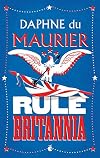
Rule Britannia
by Daphne du Maurier
On This Page
Description
A political/economic alliance between the United States and England leads to open hostility when Marines land in Cornwall.Tags
Recommendations



















Member Reviews
Rule Britannia is a bit of a disappointment, if only because the purpose of Daphne du Maurier week hosted by Heaven Ali is to celebrate the work of a British author whose books have stood the test of time, and this book is not one of her best.
It is however, a strangely relevant one, as Ali explains in her review. This is part of the blurb from the Victor Gollancz 1972 First Edition:
Emma, who lives in Cornwall with her grandmother, a famous retired actress, wakes one morning to find that the world has apparently gone mad: no post, no telephone, no radio, a warship in the bay and American soldiers advancing across the field towards the house. England has withdrawn from the Common Market and, on the brink of bankruptcy, has decided that show more salvation lies in a union—with the United States. Theoretically it is to be an equal partnership; but to some people it soon begins to look like a takeover bid.
Well, of course, with Brexit looming, and the prospect of economic chaos in plain sight, the plot doesn't seem as fanciful to us as it might have in 1972 when Britain was just about to join the Common Market (and my grandmother was sending us gloomy missives about it). I don't know if du Maurier (1907-1989) was also one of the naysayers, or merely satirising them, but she certainly beats the nationalist drum in this book. Her eccentric characters morph from bewildered onlookers into a somewhat amateur resistance movement, and though their activities are mostly only insults and mockery, the American occupiers and the London politicians who've stitched up the union take them very seriously indeed.
USUK (yes, say it out loud, it's not subtle) is being promoted as a union of English-speaking peoples, intended to form a bloc with Australia, New Zealand, Canada (huh? Quebec?) and bizarrely, South Africa. Methinks du Maurier (who was getting on a bit by then) had not been paying attention because South Africa (a) had Afrikaans not English as its national language, and (b) had long memories of the Boer War, and with plenty of hard feelings (c) had ditched Britain and became a republic in 1962. (Perhaps she had an old imperial atlas with South Africa still coloured pink).
The Trevalan household is a strange one. Emma's mother died when she was young, and her father, Vic, a bombastic merchant banker, has left her in the care of her grandmother. But Mad (a childhood abbreviation of Madame) has also adopted a collection of undisciplined boys, ranging from three-year-old Ben (who is black, mute, and the only one whose adoption is not explained); six-year-old Colin who was abandoned at a pop festival; nine-year-old Sam, who was a battered baby; twelve-year-old Andy whose intellectual parents died in an air-crash; seventeen-year-old Terry whose drug-addled mother couldn't name his father; and nineteen-year-old Joe, whose parents abandoned him to migrate to Australia because he was illiterate and he embarrassed them. There is also Dottie, who was Mad's dresser when she was on the stage but has reinvented herself as a housekeeper; and Folly, an ancient Dalmatian. All the flawed 'offspring' turn out to have some quality which is indispensable.
But needless to say, my hackles rose when Ben was addressed as a Blackamoor by Vic. And why isn't his adoption explained? Is there an offensive assumption about black parental responsibility happening here?
To read the rest of my review please visit https://anzlitlovers.com/2019/05/08/r... show less
It is however, a strangely relevant one, as Ali explains in her review. This is part of the blurb from the Victor Gollancz 1972 First Edition:
Emma, who lives in Cornwall with her grandmother, a famous retired actress, wakes one morning to find that the world has apparently gone mad: no post, no telephone, no radio, a warship in the bay and American soldiers advancing across the field towards the house. England has withdrawn from the Common Market and, on the brink of bankruptcy, has decided that show more salvation lies in a union—with the United States. Theoretically it is to be an equal partnership; but to some people it soon begins to look like a takeover bid.
Well, of course, with Brexit looming, and the prospect of economic chaos in plain sight, the plot doesn't seem as fanciful to us as it might have in 1972 when Britain was just about to join the Common Market (and my grandmother was sending us gloomy missives about it). I don't know if du Maurier (1907-1989) was also one of the naysayers, or merely satirising them, but she certainly beats the nationalist drum in this book. Her eccentric characters morph from bewildered onlookers into a somewhat amateur resistance movement, and though their activities are mostly only insults and mockery, the American occupiers and the London politicians who've stitched up the union take them very seriously indeed.
USUK (yes, say it out loud, it's not subtle) is being promoted as a union of English-speaking peoples, intended to form a bloc with Australia, New Zealand, Canada (huh? Quebec?) and bizarrely, South Africa. Methinks du Maurier (who was getting on a bit by then) had not been paying attention because South Africa (a) had Afrikaans not English as its national language, and (b) had long memories of the Boer War, and with plenty of hard feelings (c) had ditched Britain and became a republic in 1962. (Perhaps she had an old imperial atlas with South Africa still coloured pink).
The Trevalan household is a strange one. Emma's mother died when she was young, and her father, Vic, a bombastic merchant banker, has left her in the care of her grandmother. But Mad (a childhood abbreviation of Madame) has also adopted a collection of undisciplined boys, ranging from three-year-old Ben (who is black, mute, and the only one whose adoption is not explained); six-year-old Colin who was abandoned at a pop festival; nine-year-old Sam, who was a battered baby; twelve-year-old Andy whose intellectual parents died in an air-crash; seventeen-year-old Terry whose drug-addled mother couldn't name his father; and nineteen-year-old Joe, whose parents abandoned him to migrate to Australia because he was illiterate and he embarrassed them. There is also Dottie, who was Mad's dresser when she was on the stage but has reinvented herself as a housekeeper; and Folly, an ancient Dalmatian. All the flawed 'offspring' turn out to have some quality which is indispensable.
But needless to say, my hackles rose when Ben was addressed as a Blackamoor by Vic. And why isn't his adoption explained? Is there an offensive assumption about black parental responsibility happening here?
To read the rest of my review please visit https://anzlitlovers.com/2019/05/08/r... show less
Daphne du Maurier's final novel is an odd one. I hope it was intended as a satirical farce, but somehow I doubt it. I perhaps might have understood it better if I knew more about British politics in 1972. This is clearly an anti-American piece, but it doesn't exactly regard greater Britain all that highly either. It strikes me as an odd tirade by a cranky old woman telling a story about another exceedingly cranky eccentric old actress who lives life like she has never left the stage and goes Mao (as in chairman) to foment a rebellion. There is some rather surprising bits of casual racism in here that I find bizarre even for 1972 when this was published. Calling a young black boy a "darkie" ... Really? Jeez. Anyway I think I probably show more speed read through some of the parts once I decided the book was failing me. The Americans are invited to invade Britain to form the YouSuck coalition ... I mean the USUK coalition and the American plan is to turn everything into theme parks to solve the unemployment problem. Maybe this should be shelved with "The Mouse That Roared." Actually, that's an insult to the Mouse. Sheesh, I guess America really has a worse image problem than I thought.
The intro to the Virago edition was informative and probably helped me understand the book the little that I did. I'm a little undecided how to rate this. I decided on 2 stars because for me it was less than what I consider an average good read. However, it IS well written - just that the story is rather off. And I did enjoy reading parts of it much more than my short review suggests. In a word, I was disappointed. show less
The intro to the Virago edition was informative and probably helped me understand the book the little that I did. I'm a little undecided how to rate this. I decided on 2 stars because for me it was less than what I consider an average good read. However, it IS well written - just that the story is rather off. And I did enjoy reading parts of it much more than my short review suggests. In a word, I was disappointed. show less
When I started reading 'Rule Britannia', it seemed very firmly in the 'cosy catastrophe' sub-genre. It is set in rural Cornwall during the 1970s. After a period of economic chaos, the UK suddenly forms a political union with America, which to the book's characters manifests itself as a very unwelcome military occupation. The tale is told by Emma, a spirited but rather directionless young woman of twenty. She lives with her grandmother, an eccentric retired actress, and her grandmother's six adopted sons.
For the first eighty pages or so, the narrative gently and amusingly introduces the characters and bucolic setting. From then on, the story becomes a lot darker and quite gripping. It asks interesting questions about the practicality show more and morality of resistance to occupation, making it clear that there are no easy answers. This is the first Du Maurier novel I've read and I liked the combination of frivolity and thoughtfulness in her writing. The characters were entertaining but retained a certain depth and ambiguity. Even Emma's apparent naivety was well tempered by the strength of her protectiveness towards her family, even in extreme circumstances. In fact, the unconventional family unit rang very true to me, especially the conversations between Emma's grandmother and her father in which they constantly talked over one another.
'Rule Britannia' isn't a dystopia, but it leans slightly in that direction. I would still place it in the 'cosy catastrophe' sub-genre with a side of family drama. Nonetheless, it has a darkness about it as well, which kept me reading avidly. show less
For the first eighty pages or so, the narrative gently and amusingly introduces the characters and bucolic setting. From then on, the story becomes a lot darker and quite gripping. It asks interesting questions about the practicality show more and morality of resistance to occupation, making it clear that there are no easy answers. This is the first Du Maurier novel I've read and I liked the combination of frivolity and thoughtfulness in her writing. The characters were entertaining but retained a certain depth and ambiguity. Even Emma's apparent naivety was well tempered by the strength of her protectiveness towards her family, even in extreme circumstances. In fact, the unconventional family unit rang very true to me, especially the conversations between Emma's grandmother and her father in which they constantly talked over one another.
'Rule Britannia' isn't a dystopia, but it leans slightly in that direction. I would still place it in the 'cosy catastrophe' sub-genre with a side of family drama. Nonetheless, it has a darkness about it as well, which kept me reading avidly. show less
I’ve found in my experience that you can never go completely wrong with any of Daphne du Maurier’s novels—even this one, which isn’t exactly up my alley. I’m used to her books being historical fiction, suspense, or nonfiction, so I didn’t know how I would like this somewhat-futuristic one.
The novel is set on the eve of an ominous US/UK “alliance” in which American marine personnel are stationed in and around a small Cornish town. Emma is a young woman who lives with her grandmother, a famous actress who has a habit of adopting stray children. This is the story of Emma and her family, and how a Cornish town rebels against the US/UK alliance.
This book is similar to some of her other books and stories; in particular, the show more atmosphere of this novel reminds me a lot of the short story “The Birds.” Although the American marines aren’t outwardly dangerous at first, there’s a menacing air to them that becomes downright creepy over time. The book is described as being futuristic, but it’s hard to know exactly when this book is supposed to take place. It’s also been described as political commentary, but du Maurier’s message isn’t exactly clear—she’s a lot better at creating atmosphere as opposed to making political commentary.
As far as the characters go, mad is of course head and shoulders above the rest; I love that she’s both eccentric and humorous, especially in the way she dresses. I’m not sure, though, why du Maurier kept emphasizing people’s ages; we must hear over and over again that Mad is 79. Maybe it was foreshadowing to prepare the reader for the end of the book, but I thought that part of the story was clumsily done. Although this book is a page-turner, I don’t think that it’s one of du Maurier’s best, unfortunately. show less
The novel is set on the eve of an ominous US/UK “alliance” in which American marine personnel are stationed in and around a small Cornish town. Emma is a young woman who lives with her grandmother, a famous actress who has a habit of adopting stray children. This is the story of Emma and her family, and how a Cornish town rebels against the US/UK alliance.
This book is similar to some of her other books and stories; in particular, the show more atmosphere of this novel reminds me a lot of the short story “The Birds.” Although the American marines aren’t outwardly dangerous at first, there’s a menacing air to them that becomes downright creepy over time. The book is described as being futuristic, but it’s hard to know exactly when this book is supposed to take place. It’s also been described as political commentary, but du Maurier’s message isn’t exactly clear—she’s a lot better at creating atmosphere as opposed to making political commentary.
As far as the characters go, mad is of course head and shoulders above the rest; I love that she’s both eccentric and humorous, especially in the way she dresses. I’m not sure, though, why du Maurier kept emphasizing people’s ages; we must hear over and over again that Mad is 79. Maybe it was foreshadowing to prepare the reader for the end of the book, but I thought that part of the story was clumsily done. Although this book is a page-turner, I don’t think that it’s one of du Maurier’s best, unfortunately. show less
Super uneven - du Maurier is always a bit hit or miss for me (I love Rebecca, My Cousin Rachel, The Birds...not so much Jamaica Inn or Don't Look Now). Sometimes it's hard to tell whether she's a great writer who riffs on pulp themes or a pulp writer who sometimes hits on something great, which is true of many authors!
Re: Rule Britannia especially, it felt very uneven, as though it were a combination of several drafts - a satirical comedy version and a serious suspense/romance take on the same premise. At times things would seem quite serious and dramatic, and at others the narrator would seem like a parody character and the most absurd could-never-happen-in-reality things would happen and be taken as normal! I almost stopped reading show more midway through, but I did want to know what would happen enough to go on.
I wouldn't recommend it as a first or even second du Maurier novel, but if you're already a fan it's a fun oddity (being her last novel published ever) about an 80-year-old British woman leading a rebellion against US invaders. show less
Re: Rule Britannia especially, it felt very uneven, as though it were a combination of several drafts - a satirical comedy version and a serious suspense/romance take on the same premise. At times things would seem quite serious and dramatic, and at others the narrator would seem like a parody character and the most absurd could-never-happen-in-reality things would happen and be taken as normal! I almost stopped reading show more midway through, but I did want to know what would happen enough to go on.
I wouldn't recommend it as a first or even second du Maurier novel, but if you're already a fan it's a fun oddity (being her last novel published ever) about an 80-year-old British woman leading a rebellion against US invaders. show less
Not one of her best known novels. I think that’s probably because it deals with some uncomfortably “close to home” issues. Politically, a bit of a hot potato, especially in today’s climate. It’s rather simplistic but the premise is thought-provoking. Invasion for one’s own good. The cavalry come over the hill to save Britain – good thing or bad thing? Not fully finished by Ms Maurier either – she needed to revisit the book to deepen the characterisation and develop the story. Neither the Americans or the English nor the Celts come out as believable.
Reread. I've owned this in paperback for many years after initially reading it from the library. In many ways, this was uncannily prescient, and currently very apposite. I don't want to get into the political implications of the storyline but it is something that needs to be kept in mind...
Highly recommended.
Highly recommended.
Members
- Recently Added By
Lists

Favourite Virago Modern Classics
183 works; 38 members

Books Read in 2018
4,360 works; 110 members

Favorite Science Fiction
452 works; 216 members
Author Information

203+ Works 57,325 Members
Daphne Du Maurier was born in London on May 13, 1907 and educated in Paris. In 1932, she married Lieutenant-General Sir Frederick Browning. She began writing short stories of mystery and suspense for magazines in 1928, a collection of which appeared as The Apple Tree in 1952. Her first novel, The Loving Spirit, was published in 1931. Her tightly show more woven, highly suspenseful plots and her strong characters make her stories perfect for adaptation to film or television. Among her many novels that were made into successful films are Jamaica Inn (1936), Rebecca (1938), Frenchman's Creek (1941), Hungry Hill (1943), My Cousin Rachel (1952), and The Scapegoat (1957). Her short story, The Birds (1953), was brought to the screen by director Alfred Hitchcock in a treatment that has become a classic horror-suspense film. She died on April 19, 1989 at the age of 81. (Bowker Author Biography) show less
Some Editions
Awards and Honors
Distinctions
Series
Belongs to Publisher Series
Virago Modern Classics (505)
Common Knowledge
- Canonical title
- Rule Britannia
- Original publication date
- 1972
- People/Characters
- Emma; Madam; Dottie; Ben; Colin; Andy (show all 15); Sam; Joe; Terry; Vic (Pa); Jack Trembath; Myrtle Trembath; Mick Trembath; Mr. Willis; Dr. Bevil Summers
- Important places
- Poldrea
- Dedication
- For Glads, a promise, with love. Bean
Kilmarth, November 1971 - March 1972 - First words
- Emma awoke to the sound of 'planes passing overhead, but she was not fully conscious, and the sound merged with her dream
- Last words
- (Click to show. Warning: May contain spoilers.)The helicopters were still flying eastward into the sun.
- Original language
- English
Classifications
Statistics
- Members
- 767
- Popularity
- 36,345
- Reviews
- 23
- Rating
- (3.58)
- Languages
- 10 — Danish, Dutch, English, Finnish, French, German, Italian, Portuguese, Russian, Swedish
- Media
- Paper, Audiobook, Ebook
- ISBNs
- 31
- ASINs
- 24