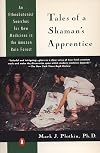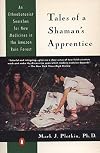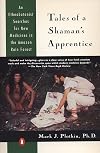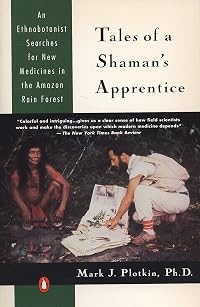
Tales of a Shaman's Apprentice: An Ethnobotanist Searches for New Medicines in the Amazon Rain Forest
by Mark J. Plotkin
On This Page
Description
"For thousands of years, healers have used plants to cure illness. Aspirin, the world's most widely used drug, is based on compounds originally extracted from the bark of a willow tree, and more than a quarter of medicines found on pharmacy shelves contain plant compounds. Now Western medicine, faced with health crises such as AIDS, Alzheimer's disease, and cancer, has begun to look to the healing plants used by indigenous peoples to develop powerful new medicines. Nowhere is the search more show more promising than in the Amazon, the world's largest tropical forest, home to a quarter of all botanical species on this planet - as well as hundreds of Indian tribes whose medicinal plants have never been studied by Western scientists." "In Tales of a Shaman's Apprentice, ethnobotanist Mark J. Plotkin recounts his travels and studies with some of the most powerful Amazonian shamans, who taught him the plant lore their tribes have spent thousands of years gleaning from the rain forest. For more than a decade, Dr. Plotkin has raced against time to harvest and record new plants before the rain forests' fragile ecosystems succumb to overdevelopment - and before the Indians abandon their own culture and learning for the seductive appeal of Western material culture." "Tales of a Shaman's Apprentice relates nine of the author's quests, taking the reader along on a wild odyssey as he participates in healing rituals; discovers the secret of curare, the lethal arrow poison that kills in minutes; tries the hallucinogenic snuff epena that enables the Indians to speak with their spirit world; and earns the respect and fellowship of the mysterious shamans as he proves that he shares both their endurance and their reverence for the rain forest." "Mark Plotkin combines the Darwinian spirit of the great writer-explorers of the nineteenth century - curious, discursive, and rigorously scientific - with a very modern concern for the erosion of our environment and the vanishing culture of native peoples. As Plotkin says, every time one of the old shamans dies, it's as if a library has burned to the ground. In Tales of a Shaman's Apprentice, he shows his determination to preserve their knowledge not only as a contribution to Western medicine, but as an irreplaceable part of their heritage."--BOOK JACKET.Title Summary field provided by Blackwell North America, Inc. All Rights Reserved show lessTags
Recommendations























Member Recommendations

Member Reviews
The evidence is conclusive: humankind despoils the landscape.
We remove the forest and replace it with pasture land, or mono-culture, or air-strips, or villages, town, cities, and industrial wasteland.
When we take away the tropics jungle we take with it the diversity of plant and wildlife, indigenous homelands, and millennia of knowledge about the way the land actually works.
I couldn’t read Mark Plotkin’s 1993 book about his time among the indigenous peoples of Surinam and northern Brazil without a lump in my throat knowing that by now, most of what he saw is gone forever. It is simply heartbreaking.
I am sitting here nursing tendonitis in my elbow reading about his own elbow troubles and submitting to a native shaman to remove his show more pain, which he does and I am wondering: where can you get a shaman when you really need one?
In these tropical jungles Plotkin finds the most amazing mixture of terror and beauty. From the large predators, including jaguar and giant anteater, to the microbial predators: skin digging larvae. Sandflies carrying the deadly leishmaniasis. Man eating crocodiles. Deadly mosquitoes. Parasites. And on and on.
Then the beautiful birds, and plants, the waterfalls and jungle canope.
And who owns what: the national governments? The aboriginals? Mankind. Who owns the future discoveries or medicines pioneered by indigenous doctors?
Who should pay for killing languages and cultures and way-of-life when civilization intrudes on people in their natural habitat?
So many awful questions to ask about what “progress” has done to this planet and its peoples without needing to become romantic about life in the bush.
Although, while i was reading Plotkin’s account of tribal medicinal rituals I couldn’t help but compare it with the rituals we have replaced them with: the annual trip to the family doctor; the bland waiting room; the white lab coats; the medical records, now on HP tablets and the doctor cursing about how damn slow the software is; the physical exams. Eyes. Nose. Throat. Joints. Rectum. The lifting of the genitals.
“Say AHHHHH!!!!”
But the jungles are more even than the Indians. In South America there is the detritus of the colonial period. Patois and the descendents of black slaves. Prostitution and poverty in the city slums. Dutch and French, Spanish and Portuguese languages intermingled. Poor Brazilians lured to the jungle for a new life. And Missionaries. And soldiers. Venereal disease. Garbage. And the smell of gasoline wafting through the air. show less
We remove the forest and replace it with pasture land, or mono-culture, or air-strips, or villages, town, cities, and industrial wasteland.
When we take away the tropics jungle we take with it the diversity of plant and wildlife, indigenous homelands, and millennia of knowledge about the way the land actually works.
I couldn’t read Mark Plotkin’s 1993 book about his time among the indigenous peoples of Surinam and northern Brazil without a lump in my throat knowing that by now, most of what he saw is gone forever. It is simply heartbreaking.
I am sitting here nursing tendonitis in my elbow reading about his own elbow troubles and submitting to a native shaman to remove his show more pain, which he does and I am wondering: where can you get a shaman when you really need one?
In these tropical jungles Plotkin finds the most amazing mixture of terror and beauty. From the large predators, including jaguar and giant anteater, to the microbial predators: skin digging larvae. Sandflies carrying the deadly leishmaniasis. Man eating crocodiles. Deadly mosquitoes. Parasites. And on and on.
Then the beautiful birds, and plants, the waterfalls and jungle canope.
And who owns what: the national governments? The aboriginals? Mankind. Who owns the future discoveries or medicines pioneered by indigenous doctors?
Who should pay for killing languages and cultures and way-of-life when civilization intrudes on people in their natural habitat?
So many awful questions to ask about what “progress” has done to this planet and its peoples without needing to become romantic about life in the bush.
Although, while i was reading Plotkin’s account of tribal medicinal rituals I couldn’t help but compare it with the rituals we have replaced them with: the annual trip to the family doctor; the bland waiting room; the white lab coats; the medical records, now on HP tablets and the doctor cursing about how damn slow the software is; the physical exams. Eyes. Nose. Throat. Joints. Rectum. The lifting of the genitals.
“Say AHHHHH!!!!”
But the jungles are more even than the Indians. In South America there is the detritus of the colonial period. Patois and the descendents of black slaves. Prostitution and poverty in the city slums. Dutch and French, Spanish and Portuguese languages intermingled. Poor Brazilians lured to the jungle for a new life. And Missionaries. And soldiers. Venereal disease. Garbage. And the smell of gasoline wafting through the air. show less
This is a really fascinating story about an ethnobotanist trying record as much information from the traditional healers/shamans in Suriname as possible before they are completely destroyed and their knowledge lost. Missionaries in Suriname have been particularly trying to destroy indigenous cultures by destroying faith in shamans. As someone of Surinamese background and the sole remaining descendent of one of those Surinamese shamans, I really appreciate this book to connect me back to my own history.
A fascinating look into South American native traditions of sorcery, hallucinogenics, and mystery. Plotkin creates an ethos for doing research while promoting local cultures and allowing them to reap the benefits of western consumption.
Great read that will probably lead to numerous other books about the region/subject. Interesting travel mixed w/ ethnobotany and conservation make for a book that is hard not to like.
“I found Mark Plotkin’s book to be an exciting and inspiring mix of ethnobotany and adventure, useful to anyone interested in shamanism and rain forest conservation.”
A fine combination of adventure, anthropology, medicinal plant biology and ethnopharmacology.
An ethnobotanist recounts his experiences in the rain forests tracking the shamans whose knowledge of the curative powers of plants and herbs could hold the key to the cure for AIDS, cancer, and other life-threatening illnesses. 20,000 first printing. $20,000 ad/promo.
Members
- Recently Added By
Author Information

7 Works 718 Members
Mark J. Plotkin is President of the Amazon Conservation Team and the author of Tales of a Shaman's Apprentice and Medicine Quest.
Common Knowledge
- Important places
- Amazon Rainforest, Amazon Basin, South America
- Blurbers
- McKenna, Terence
Classifications
- Genres
- Anthropology, Nonfiction, Science & Nature, Travel, General Nonfiction, Biography & Memoir
- DDC/MDS
- 581.6 — Natural sciences & mathematics Plants (Botany) Specific topics in natural history of plants Miscellaneous nontaxonomic kinds of plants
- LCC
- F2230.1 .B7 .P56 — Local History of the United States, Canada and Latin America Latin America. Spanish America South America General
- BISAC
Statistics
- Members
- 611
- Popularity
- 48,051
- Reviews
- 8
- Rating
- (4.01)
- Languages
- Dutch, English, French, German
- Media
- Paper, Audiobook, Ebook
- ISBNs
- 13
- ASINs
- 7