
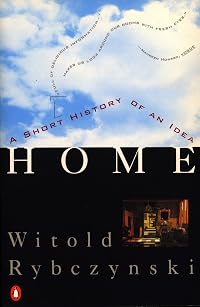
Home; a Short History of an Idea
by Witold Rybczynski
On This Page
Description
In this illuminating book, Witold Rybczynski walks us through five centuries of homes both great and small, from the smoke-filled manor halls of the Middle Ages to the Ralph Lauren-designed environments of today. On a house tour like no other-one that delightfully explicates the very idea of "home"-you'll see how social and cultural changes influenced styles of decoration and furnishing, learn the connection between wall-hung religious tapestries and wall-to-wall carpeting, discover how some show more of our most welcome luxuries were born of architectural necessity, and much more. show lessTags
Recommendations























Member Recommendations
Member Reviews
This could have been a very interesting book, and there's some very good stuff in the last four chapters or so, but Rybczynski's over-enthusiastic pitch to his publisher seems to have trapped him into writing several chapters about the early history of domesticity that he didn't really have enough material for when it came down to it. As for the opening chapter, an obviously-recycled magazine article about Ralph Lauren that has little to do with the rest of the book, the less said the better...
Where it starts getting interesting is when Rybczynski gets to the 19th century and discusses how style, technology and user requirements competed to influence people's expectations of how homes should be designed and built. Architects and show more designers don't come out of this story very well, and Rybczynski's real heroes this time seem to be the pioneers of "domestic engineering" (later called "home economics"), people like Catherine Beecher and Christine Frederick, who encouraged American women to take control of their own workplaces and insist that houses be arranged in practical, efficient ways. That was something completely new to me, which looks as though it might be interesting to follow up further.
Rybczynski argues quite forcefully that "comfort" is the element that is most important in measuring the success of any environment designed for people, and condemns "style" as a harmful influence that leads us to overlook important usability questions. Austere modernism comes out of the equation worse than retro-styles, interestingly: he argues that 18th-century furniture designers were better at ergonomics than their modern counterparts because they worked by gradual improvement of established designs, whilst 20th-century fashions force the designer to produce something ground-breakingly different every time. He also comes out strongly against de-cluttered interiors - a kitchen is a workshop where tools should be within reach; a bathroom without anywhere to leave your soap is just silly - so it's pretty obvious that no-one has paid much attention to this book in the last thirty years... show less
Where it starts getting interesting is when Rybczynski gets to the 19th century and discusses how style, technology and user requirements competed to influence people's expectations of how homes should be designed and built. Architects and show more designers don't come out of this story very well, and Rybczynski's real heroes this time seem to be the pioneers of "domestic engineering" (later called "home economics"), people like Catherine Beecher and Christine Frederick, who encouraged American women to take control of their own workplaces and insist that houses be arranged in practical, efficient ways. That was something completely new to me, which looks as though it might be interesting to follow up further.
Rybczynski argues quite forcefully that "comfort" is the element that is most important in measuring the success of any environment designed for people, and condemns "style" as a harmful influence that leads us to overlook important usability questions. Austere modernism comes out of the equation worse than retro-styles, interestingly: he argues that 18th-century furniture designers were better at ergonomics than their modern counterparts because they worked by gradual improvement of established designs, whilst 20th-century fashions force the designer to produce something ground-breakingly different every time. He also comes out strongly against de-cluttered interiors - a kitchen is a workshop where tools should be within reach; a bathroom without anywhere to leave your soap is just silly - so it's pretty obvious that no-one has paid much attention to this book in the last thirty years... show less
Amidst architects' commentaries on their craft, too often impenetrable or breathtakingly arrogant, Rybczynski's book stands out as a down-to-earth vision of priorities. The main point of drawing and constructing a house, Ryczynski reminds his fellow architects and the rest of us, is to enable a family to make a comfortable home within -- not to produce a novel piece of sculpture that will look good in a glossy magazine or coffee table book. Rybszynski is a good storyteller. He entertains as he educates us about the history of our concern with such matters as privacy, air quality, efficiency, light, and intimacy in our homes.
This book examines how the ideas of "home" and "comfort" and "domesticity" came into being and changed over the years and the relation of these ideas to technology in the home. For the most part, the book covers the period from the middle ages to the present. It is the author's claim that during this period, the home as an idea (rather than a shelter) came into being.
During the middle ages, homes contained many people who were only tenuously connected. A person's livelihood was based out of the same building that was used for sleeping and eating, so the buildings housed servants, employees, and apprentices in addition to the family. The family itself was abbreviated because children were sent off as apprentices when they became old show more enough. The large household (sometimes up to 25 people), the lack of privacy due to being a place of business, and the less coherent family led to the medieval idea of home being quite different from the modern idea of home.
Over time, the ideas of home, comfort, domesticity, privacy, and intimacy started to become more common. These ideas had several sources. Eventually, where people work became more separated from where people lived; it became a distinctly different part of the same building or another building completely. Aristocrats started valuing furniture for its ability to provide comfort as well as the status or appearance it provided; these ideas eventually became more wide spread. Children stopped leaving the family to become apprentices. As industrial jobs became more common, servants were harder to find; this led to the development of technology that could allow a family to maintain a home without servants, and increased privacy. It was interesting to see how these ideas have changed over time. Like so many (more or less) historical works that focus on home life, it shows how our modern idea of the "traditional" family is actually a idea that has changed over time.
At times, Rybczynski focuses on the design home when other social factors should also be considered. He seems to think that nostalgia for past decorative and architectural styles expresses a longing for a sense of homeyness no longer present (I am with him so far) and that this lack of homeyness can be blamed on the fact that modern design (modern in the Le Corbusier sense) is not comfortable and intimate. He does not consider that the modern lack of homeyness may have less to do with any architectural style and more to do with how society has changed. Today, families tend to be more spread out geographically, people are part of many disjoint communities and have to balance them, houses are built in a cookie cutter manner that focuses on maximizing profits rather than comfort. I think lack of homeyness has less to do with the fact that there is a line of sight from the living room through the dining room to the kitchen and more to do with the fact that people plop in front of the TV when they get home from a work place where they are expected to be friends with everyone but not too close to anyone.
Overall, I really really liked this book until I got to the last two chapters. The second to last chapter was the author ranting against modern architecture in a book where it is not relevant proportional to the space devoted to it. The last chapter was a rant against "science" and definitions. Because science (behavioral psychology) has only been able to experimentally determine what comfort is not, science is of no use in defining what comfort is; we cannot hope to have any sort of general definition at all. The best we can do is define comfort as being like an onion [no please, not the onion analogy]; comfort is a complex and many layered thing, but you cannot examine it by cutting it up because then it loses its oniony nature. Instead, comfort can only be defined with vague descriptions of particular comfortable situations (comfort is a good book, a pot of tea in just the right place, and lots of comfy pillows). The author claims that this is the best we can do to define comfort, but then goes on to say that these descriptions define comfort because they address convenience, efficiency, domesticity, physical ease, privacy, and intimacy. Which is it, can we generalize or not? (Okay, that rant felt good. =) show less
During the middle ages, homes contained many people who were only tenuously connected. A person's livelihood was based out of the same building that was used for sleeping and eating, so the buildings housed servants, employees, and apprentices in addition to the family. The family itself was abbreviated because children were sent off as apprentices when they became old show more enough. The large household (sometimes up to 25 people), the lack of privacy due to being a place of business, and the less coherent family led to the medieval idea of home being quite different from the modern idea of home.
Over time, the ideas of home, comfort, domesticity, privacy, and intimacy started to become more common. These ideas had several sources. Eventually, where people work became more separated from where people lived; it became a distinctly different part of the same building or another building completely. Aristocrats started valuing furniture for its ability to provide comfort as well as the status or appearance it provided; these ideas eventually became more wide spread. Children stopped leaving the family to become apprentices. As industrial jobs became more common, servants were harder to find; this led to the development of technology that could allow a family to maintain a home without servants, and increased privacy. It was interesting to see how these ideas have changed over time. Like so many (more or less) historical works that focus on home life, it shows how our modern idea of the "traditional" family is actually a idea that has changed over time.
At times, Rybczynski focuses on the design home when other social factors should also be considered. He seems to think that nostalgia for past decorative and architectural styles expresses a longing for a sense of homeyness no longer present (I am with him so far) and that this lack of homeyness can be blamed on the fact that modern design (modern in the Le Corbusier sense) is not comfortable and intimate. He does not consider that the modern lack of homeyness may have less to do with any architectural style and more to do with how society has changed. Today, families tend to be more spread out geographically, people are part of many disjoint communities and have to balance them, houses are built in a cookie cutter manner that focuses on maximizing profits rather than comfort. I think lack of homeyness has less to do with the fact that there is a line of sight from the living room through the dining room to the kitchen and more to do with the fact that people plop in front of the TV when they get home from a work place where they are expected to be friends with everyone but not too close to anyone.
Overall, I really really liked this book until I got to the last two chapters. The second to last chapter was the author ranting against modern architecture in a book where it is not relevant proportional to the space devoted to it. The last chapter was a rant against "science" and definitions. Because science (behavioral psychology) has only been able to experimentally determine what comfort is not, science is of no use in defining what comfort is; we cannot hope to have any sort of general definition at all. The best we can do is define comfort as being like an onion [no please, not the onion analogy]; comfort is a complex and many layered thing, but you cannot examine it by cutting it up because then it loses its oniony nature. Instead, comfort can only be defined with vague descriptions of particular comfortable situations (comfort is a good book, a pot of tea in just the right place, and lots of comfy pillows). The author claims that this is the best we can do to define comfort, but then goes on to say that these descriptions define comfort because they address convenience, efficiency, domesticity, physical ease, privacy, and intimacy. Which is it, can we generalize or not? (Okay, that rant felt good. =) show less
Many of us may look around our houses and only see the four walls which contain a variety of styles of furniture and decorations, not questioning why we live in our homes the way we do. Witold Rybczynski's book "Home: A Short History of an Idea" opens our eyes to why those four walls are the way they are, and the evolution of the furnishings within our homes. This fascinating history of domesticity traces the way people have occupied their homes, as well as the ideas of family and privacy. He covers the notion of home and comfort from the houses of the early Greeks and Romans to the modern structures of today. Even topics as mundane as the development of the chair is covered in a very interesting and revealing way. A most worthwhile and show more fascinating book. show less
Home: A Short History of an Idea by Witold Rybczynski
Witold Rybczynski's Home: A Short History of An Idea, published in 1986, is an early forerunner of the microhistory, a recent nonfiction genre that focuses on a single idea or thing and explicates its historical relevance and evolution by bringing together multiple disciplines. (Mark Kurlansky's Cod is the premier example of the microhistory.) Rybczynski, who writes for the New York Times Sunday Magazine, is a professor of architecture at McGill University. The tone of the book is that of a relaxed and confident professor's lecture, with asides, opinions, and humor while he covers the last 500 or so years of Western domestic life. Chapters tackle the key developments of each century show more by opening with an analysis of a contemporary depiction of a domestic interior. Today the elements of a comfortable home are taken for granted, but Rybczynski delineates how the concepts of privacy, intimacy, comfort, leisure, ease, domesticity, and the addition of modern comforts provided by electricity, central heating, and ventilation have created our modern home. He sharply criticizes some modern architecture and design styles for their lack of comfort, but does not advocate a slavish return to period interiors, either. In this book, art history, literature, social history, economics, sociology, and gender roles inform the reader's growing understanding of the place we call home.
“We can appreciate the interiors of the past, but if we try to copy them we will find that too much has changed. What has changed the most is the reality of physical comfort—the standard of living—largely as the result of advances in technology. Technological changes have affected the evolutionof comfort throughout history, of course, but ours is a special position. The evolution of domestic technology...demonstrates that the history of physical amenities can be divided into two major phases: all the years leading up to 1890, and the three following decades. If this sounds outlandish, it is worth reminding ourselves that all the “modern” devices that contribute to our domestic comfort—central heating, indoor plumbing, running hot and cold water, electric light and powerand elevators—were unavailable before 1890, and were well known by 1920. We live, like it or not, on the far side of a great technological divide. As John Lukacs reminds us, although the home of 1930 would be familiar to us, tit have been unrecognizable to the citizens of 1885. Until then recreating the past was plausible—even if it was rare—after 1920 it became an eccentricity.” pp.219-220 show less
Witold Rybczynski's Home: A Short History of An Idea, published in 1986, is an early forerunner of the microhistory, a recent nonfiction genre that focuses on a single idea or thing and explicates its historical relevance and evolution by bringing together multiple disciplines. (Mark Kurlansky's Cod is the premier example of the microhistory.) Rybczynski, who writes for the New York Times Sunday Magazine, is a professor of architecture at McGill University. The tone of the book is that of a relaxed and confident professor's lecture, with asides, opinions, and humor while he covers the last 500 or so years of Western domestic life. Chapters tackle the key developments of each century show more by opening with an analysis of a contemporary depiction of a domestic interior. Today the elements of a comfortable home are taken for granted, but Rybczynski delineates how the concepts of privacy, intimacy, comfort, leisure, ease, domesticity, and the addition of modern comforts provided by electricity, central heating, and ventilation have created our modern home. He sharply criticizes some modern architecture and design styles for their lack of comfort, but does not advocate a slavish return to period interiors, either. In this book, art history, literature, social history, economics, sociology, and gender roles inform the reader's growing understanding of the place we call home.
“We can appreciate the interiors of the past, but if we try to copy them we will find that too much has changed. What has changed the most is the reality of physical comfort—the standard of living—largely as the result of advances in technology. Technological changes have affected the evolutionof comfort throughout history, of course, but ours is a special position. The evolution of domestic technology...demonstrates that the history of physical amenities can be divided into two major phases: all the years leading up to 1890, and the three following decades. If this sounds outlandish, it is worth reminding ourselves that all the “modern” devices that contribute to our domestic comfort—central heating, indoor plumbing, running hot and cold water, electric light and powerand elevators—were unavailable before 1890, and were well known by 1920. We live, like it or not, on the far side of a great technological divide. As John Lukacs reminds us, although the home of 1930 would be familiar to us, tit have been unrecognizable to the citizens of 1885. Until then recreating the past was plausible—even if it was rare—after 1920 it became an eccentricity.” pp.219-220 show less
Most interesting: 1. family (kids of paupers in service of strangers); 2. evolution of the term 'home' from 'public', uncomfortable, multipurpose to 'private', cosy, homey. 3. servants .. we want privacy more than free time
Dr. Rybczynski, has written an interesting exploration of the interaction between technology and the concept of "Comfort" in the American and European family dwelling. I have found him an interesting and insightful observer.
The prose is good magazine quality, and the illustrations, sadly few, are well chosen for his points. this is a couple of hours reading about a topic whose importance may have slipped your mind, up to when he engages you.
The prose is good magazine quality, and the illustrations, sadly few, are well chosen for his points. this is a couple of hours reading about a topic whose importance may have slipped your mind, up to when he engages you.
Members
- Recently Added By
Lists

Books Read in 2016
4,666 works; 199 members

Mustich's 1000 Books to Read Before You Die: A Life Changing List
1,001 works; 19 members

CXB Books read in 2025
16 works; 1 member
Author Information

31+ Works 6,209 Members
Witold Rybczynski is an architect and emeritus professor of urbanism at the University of Pennsylvania.
Awards and Honors
Common Knowledge
- Canonical title
- Home; a Short History of an Idea
- Original publication date
- 1986
- Dedication
- To my parents, Anna and Witold
- First words
- We've all seen this comfortable man; his face looks out from the advertising pages of magazines.
- Blurbers
- Lukacs, John
Classifications
- Genres
- Art & Design, Nonfiction, Sociology, History, General Nonfiction
- DDC/MDS
- 728.019 — Arts & recreation Architecture Residential and related buildings
- LCC
- NA7125 .R9 — Fine Arts 2599.5-2599.9 Architectural criticism Architecture Special classes of buildings Classed by use Domestic architecture. Houses. Dwellings
- BISAC
Statistics
- Members
- 1,097
- Popularity
- 23,318
- Reviews
- 18
- Rating
- (3.89)
- Languages
- 7 — Chinese, English, French, German, Polish, Spanish, Swedish
- Media
- Paper, Audiobook, Ebook
- ISBNs
- 19
- ASINs
- 5