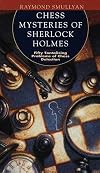
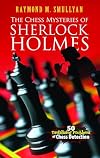
The Chess Mysteries of Sherlock Holmes: 50 Tantalizing Problems of Chess Detection
by Raymond Smullyan
On This Page
Description
Join the master sleuth as he and Dr. Watson examine interrupted chess matches at clubs and country homes, examining the pieces' current positions to identify previous moves. Rather than predicting the outcome of these games, the Baker Street duo focus on past events, using the same variety of logical reasoning that unlocks the secrets to their ever-popular mysteries. Holmes instructs Watson (and us) in the intricacies of retrograde analysis in order to deduce on which square the white queen show more was captured, whether a pawn has been promoted, and which piece has been replaced by a coin. The mysteries grow increasingly complex, culminating in a double murder perpetrated by the devious Professor Moriarty. Philosopher and logician Raymond Smullyan brilliantly recaptures the mood of Sir Arthur Conan Doyle's tales. Readers need only a knowledge of how the pieces move; the first puzzles explain all of the concepts that arise later on. These witty and challenging problems will captivate chess aficionados, puzzle enthusiasts, Sherlock Holmes fans, and everyone who relishes mysteries, crime stories, and tales of detection. show lessTags
Recommendations













Member Reviews
This little book has a lot going on in it! It presents three sets of chess problems, but they are not of the ordinary sort. Rather than the usual prospective puzzle that chess problems offer (e.g. "White to mate in 2" on the basis of a diagram shown), "retrograde analysis" problems require a deduction of the prior states of the game in order to understand its current situation. Here is a diagram. "Is it possible for Black to castle?" "Is the White Queen a promoted piece?"
The problems themselves are framed by a narrative presentation in the voice of Dr. John H. Watson, who is tutored by Sherlock Holmes in the niceties of retrograde analysis through a series of exercises. In this first section, the problems posed flow directly into their show more solutions in the course of conversation among the characters. In the second section, the problems arise in the course of an adventure where Holmes and Watson go to the East Indies to help their friend Captain Marston recover a lost family treasure. The answers for these puzzles are in the back of the book. A third and final set of problems has for its merest window-dressing the notion that they were composed by Holmes' foe Professor Moriarty.
In this book, the term "monochromatic chess game" is used to mean a game in which all pieces are restricted to move only to squares of the color on which they originate (120). That was momentarily confusing to me, since I am a regular player of "monochrome chess," a variant in which all thirty-two chessmen can be the same color, because color does not determine ownership. But "monochromatic" chess in the sense used here does not seem to be original with author Raymond Smullyan, and it does give rise to some interesting problems.
The puzzles in the book are often very challenging, and I was able to solve only a small minority without help. The contextual storytelling kept the book entertaining so that I didn't get too discouraged in the process. I enjoyed it, and I am curious about Smullyan's sequel Chess Mysteries of the Arabian Knights. show less
The problems themselves are framed by a narrative presentation in the voice of Dr. John H. Watson, who is tutored by Sherlock Holmes in the niceties of retrograde analysis through a series of exercises. In this first section, the problems posed flow directly into their show more solutions in the course of conversation among the characters. In the second section, the problems arise in the course of an adventure where Holmes and Watson go to the East Indies to help their friend Captain Marston recover a lost family treasure. The answers for these puzzles are in the back of the book. A third and final set of problems has for its merest window-dressing the notion that they were composed by Holmes' foe Professor Moriarty.
In this book, the term "monochromatic chess game" is used to mean a game in which all pieces are restricted to move only to squares of the color on which they originate (120). That was momentarily confusing to me, since I am a regular player of "monochrome chess," a variant in which all thirty-two chessmen can be the same color, because color does not determine ownership. But "monochromatic" chess in the sense used here does not seem to be original with author Raymond Smullyan, and it does give rise to some interesting problems.
The puzzles in the book are often very challenging, and I was able to solve only a small minority without help. The contextual storytelling kept the book entertaining so that I didn't get too discouraged in the process. I enjoyed it, and I am curious about Smullyan's sequel Chess Mysteries of the Arabian Knights. show less
Questo vecchio libro di Raymond Smullyan, come dice il titolo, parla di problemi di scacchi. Ma questi problemi sono peculiari, perché le partite giocate sono tutto fuorché serie, pur rimanendo legali. Essi sono infatti definiti come "analisi retrogada": partendo dalla posizione mostrata occorre scoprire cosa è successo in passato, se per esempio si può fare un arrocco, oppure capire in quale di due caselle adiacenti bisogna posizionare un pedone, o così via. Essendo necessarie grandi doti di logica, è solo naturale che il protagonista sia Sherlock Holmes con il fidato dottor Watson. Secondo me dopo i primi esempi ci si stanca un po', ma ci sono chicche tipo il matto che si può solo ottenere con la promozione di un pedone in un show more pezzo del colore opposto (fino a duecento anni fa non era vietato...) che vale la pena leggere. show less
Oct 1, 2016Italian
Ratings
Members
- Recently Added By
Lists

Efemeridades e Possibilidades futuras (Personal wishlist)
24 works; 1 member
Author Information

46+ Works 5,136 Members
Raymond Merrill Smullyan was born in Far Rockaway, Queens, New York on May 25, 1919. He received a bachelor's degree in mathematics from the University of Chicago and a Ph.D. from Princeton University. He taught at Princeton, Yeshiva University, Lehman College of the City University of New York, and Indiana University. He also performed magic show more under the stage name Five-Ace Merrill at nightclubs like the Pump Room in Chicago. He was a puzzle-creating logician who wrote many books including The Chess Mysteries of the Arabian Knights, The Lady or the Tiger?: And Other Logic Puzzles, Alice in Puzzle-Land: A Carrollian Tale for Children, and The Magic Garden of George B and Other Logic Puzzles. He died on February 6, 2017 at the age of 97. (Bowker Author Biography) show less
Series
Belongs to Publisher Series
Common Knowledge
- Canonical title
- The Chess Mysteries of Sherlock Holmes: 50 Tantalizing Problems of Chess Detection
- Alternate titles*
- The chess mysteries of Sherlock Holmes : 50 tantalizing problems of chess detection
- Original publication date
- 1979
- People/Characters
- Sherlock Holmes; Dr. Watson
- Blurbers
- Gardner, Martin
*Some information comes from Common Knowledge in other languages. Click "Edit" for more information.
Classifications
- Genre
- Nonfiction
- DDC/MDS
- 794.12 — Arts & recreation Recreation, sports, and performing arts Chess, Computer Games / Card Games Chess Theory and instruction
- LCC
- GV1451 .S56 — Geography, Anthropology and Recreation Recreation. Leisure Recreation. Leisure Games and amusements Indoor games and amusements Board games. Move games
- BISAC
Statistics
- Members
- 274
- Popularity
- 117,352
- Reviews
- 2
- Rating
- (4.17)
- Languages
- 8 — Czech, English, Finnish, French, German, Hungarian, Polish, Spanish
- Media
- Paper
- ISBNs
- 15
- UPCs
- 1
- ASINs
- 2