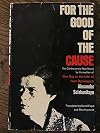
For the Good of the Cause
by Aleksandr Solzhenitsyn
On This Page
Tags
Recommendations




































Member Reviews
When I was in graduate school 30 years ago (for a degree in Slavic Languages and Literature), the only Solzhenitsyn we were required to read was "One Day in the Life of Ivan Denisovich," a literary gem. "The Gulag Archipelago" was never assigned, probably because it was seen as outside the purview of 'literature', though I did read the entire thing with fascination. It opened a whole world that was quite alien and frightening. None of his long novels were ever assigned either. I can't help but feel that it was because, despite his Nobel Prize, and world-wide acclaim, the department did not think much of his writing as 'literature'. "For the Good of the Cause" suffers considerably from this problem. Reading it now, it feels very dated show more and tendentious. Not that Solzhenitsyn is a bad writer, not at all, but his writing style, at least in this story, is not all that interesting. The gist of the tale is a technical high school, desperately in need of new facilities and having waited years for it to be built, is finally almost finished, mostly through the hard work of the (high school) students themselves, who volunteer their time and bodies to finish the job. On the eve of moving into their new facilities, the building is commandeered by party officials for a new "institute" and the students and faculty are left feeling angry, taken advantage of and lied to. There are a lot of things about the story which would be difficult for a modern student to understand without a lecture on the relationship between the Communist Party and society in Post-Stalin USSR--for example, the seemingly unanimous enthusiasm and eagerness of the students' to give up their summer for heavy physical labor without compensation is hard to comprehend, the fact that the administrators would allow students (some as young as 14) to do this work, and then that a research institute would want this facility, even though it would require extensive modifications at a very high financial cost. Still, the story asks a very pertinent question for that time: What is the "good of the cause"? This edition includes the critical article and responses that were published in "Literaturnaya Gazeta" following the publication of the story in "Novy Mir" and these articles, more than the story itself, shows us how daring Solzhenitsyn's story really was and how precarious a thing it was to tell the truth. show less
Very quick read. A sad, but likely common story of the frustrations of bureaucratic rule snuffing out genuine energy and cleverness in a building a community, in this case a local technical college, in Communist Soviet society. Solzhenitsyn was rather clever in his presentation of the story that was ultimately critical of the government process, but did it in a way that was underhanded enough to allow it to flourish in its day. My little volume also had a wonderful introduction that helped set the stage and told the author's story of his art and the price he paid for it. Also included were lively critiques of the work in Soviet literary journals of the day that very clearly lay out how the public was trying to grapple with a system they show more had been told to believe in and live for that seemed to have some disturbing consequences....very interesting. And i will likely follow up with more from him on shelf, but in fits and starts.....i believe it will all have that down-trodden depressing demeanor, and i will want to spread them out over time. show less
Interesting short story reflecting Solzhenitsyn's preoccupation with Soviet bureaucracy. More interesting, though are the letters and editorial opinions at the end demonstrating the brief intellectual ferment that flourished in the early 1960s, albeit within the confines of Soviet assumptions, before Khrushchov's ouster gave way to the dead hand of Brezhnev and the imposition of cultural as well as political uniformity.
For the Good of the Cause by Aleksandr Isaevich Solzhenitsyn
This is both a simple and a difficult book. It proved to be a much shorter story than I expected -- only 97 pages. What I liked about it was the way it opened. The entire first chapter is dialog and nothing else. The reader feels as if she were plunked down into the place, hearing many of the things, though not all, said by several people and not knowing who is saying what. The second chapter brings it into focus and we start to get to know some of the characters. Solzhenitsyn is good at making even briefly appearing characters real.
The term "right and wrong" is used several times in the story and it is clearly the point of the story, to make readers think what is right and show more what is wrong. And that's where the story becomes difficult. It's not a situation we're likely to encounter in the US. Americans will immediately side with the principal of the school. The main fuss about this is the political importance of the story. As a story, without taking into consideration the politics, it feels incomplete. It takes the reader to the climax and stops with no resolution of any sort. There are seeds for a fight to resolve the issue and there is also the sense of defeat because it's "for the good of the cause."
At first I thought that there is no point of this story with the Soviet Union no longer in existence, but upon further thought I've changed my mind. This isn't a story to be read simply for the pleasure of reading. Whether something is right or wrong is something that will always be a concern. After reading this story, our minds will debate how it ends, how it should end, how actually did/would end if it were a true story. That, I suppose it the greatest value of For the Good of the Cause. There is nothing to grasp from it that can deter the reader form the point of the story - no love story or grand adventure, just ordinary people with an relatively ordinary dilemma.
My copy of this book was published in 1974 and contains a short biography of Solzhenitsyn as a preface, and discussions from various Soviet sources as an appendix. My comments are on the the story and (since I haven't read them yet) do not take preface or appendix into consideration. show less
This is both a simple and a difficult book. It proved to be a much shorter story than I expected -- only 97 pages. What I liked about it was the way it opened. The entire first chapter is dialog and nothing else. The reader feels as if she were plunked down into the place, hearing many of the things, though not all, said by several people and not knowing who is saying what. The second chapter brings it into focus and we start to get to know some of the characters. Solzhenitsyn is good at making even briefly appearing characters real.
The term "right and wrong" is used several times in the story and it is clearly the point of the story, to make readers think what is right and show more what is wrong. And that's where the story becomes difficult. It's not a situation we're likely to encounter in the US. Americans will immediately side with the principal of the school. The main fuss about this is the political importance of the story. As a story, without taking into consideration the politics, it feels incomplete. It takes the reader to the climax and stops with no resolution of any sort. There are seeds for a fight to resolve the issue and there is also the sense of defeat because it's "for the good of the cause."
At first I thought that there is no point of this story with the Soviet Union no longer in existence, but upon further thought I've changed my mind. This isn't a story to be read simply for the pleasure of reading. Whether something is right or wrong is something that will always be a concern. After reading this story, our minds will debate how it ends, how it should end, how actually did/would end if it were a true story. That, I suppose it the greatest value of For the Good of the Cause. There is nothing to grasp from it that can deter the reader form the point of the story - no love story or grand adventure, just ordinary people with an relatively ordinary dilemma.
My copy of this book was published in 1974 and contains a short biography of Solzhenitsyn as a preface, and discussions from various Soviet sources as an appendix. My comments are on the the story and (since I haven't read them yet) do not take preface or appendix into consideration. show less
A novella by Solzhenitsyn, the last work of his to be officially published in the Soviet Union. This is a minor story, but interesting and well-written, about a technical school whose students have worked hard on a new facility they are to move into, only to have it taken away bu Party politics in favor of someone else. There is a series of critiques, responses and letters following the story from the literary magazine that published the story, from another one that is critical of the story, and debates and letters from critics and readers that do as much as the story to show the nature of the Soviet system and its willingness to suppress that which does not mirror it.
couldn't get into this.
AG-5
Nov 17, 2020Catalan
Members
- Recently Added By
Published Reviews
Author Information

351+ Works 44,555 Members
Aleksandr Solzhenitsyn was born on December 11, 1918 in Kislovodsk in the northern Caucusus Mountains. He received a degree in physics and math from Rostov University in 1941. He served in the Russian army during World War II but was arrested in 1945 for writing a letter criticizing Stalin. He spent the next decade in prisons and labor camps and, show more later, exile, before being allowed to return to central Russia, where he worked as a high school science teacher. His first novel, One Day in the Life of Ivan Denisovich, was published in 1962. In 1970, he was awarded the Nobel Prize for Literature. In 1974, he was arrested for treason and exiled following the publication of The Gulag Archipelago. He moved to Switzerland and later the U. S. where he continued to write fiction and history. When the Soviet Union collapsed, he returned to his homeland. His other works include The First Circle and The Cancer Ward. He died due to a heart ailment on August 3, 2008 at the age of 89. (Bowker Author Biography) show less
Series
Belongs to Publisher Series
Keltainen kirjasto (117)
Work Relationships
Is contained in
Common Knowledge
- Canonical title
- For the Good of the Cause
- Original title
- Для пользы дела
- Original publication date
- 1963
- First words
- "Fayina, who's got the schedule for the electrical classes?"
- Last words
- (Click to show. Warning: May contain spoilers.)The workmen went on carrying the stakes.
Classifications
- Genres
- General Fiction, Fiction and Literature
- DDC/MDS
- 891.7 — Literature & rhetoric Asian Literature East Indo-European and Celtic literatures Russian and East Slavic languages
- LCC
- PZ4 .S69 .F — Language and Literature Fiction and juvenile belles lettres Fiction and juvenile belles lettres Fiction in English
Statistics
- Members
- 336
- Popularity
- 93,988
- Reviews
- 7
- Rating
- (3.31)
- Languages
- 8 — Czech, Dutch, English, Finnish, German, Italian, Russian, Spanish
- Media
- Paper, Ebook
- ISBNs
- 12
- ASINs
- 16