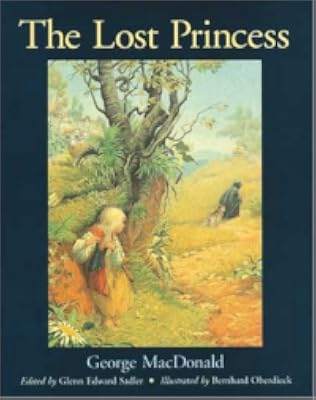
The Wise Woman, or The Lost Princess: A Double Story
by George MacDonald
On This Page
Description
A favorite author of C.S. Lewis, George MacDonald delivers another lovely tale in the story The Wise Woman. It is a story of two girls, one is a princess and the other a daughter of a shepherd; both are spoiled and self-serving. Their lives are forever changed when they encounter the Wise Woman, who undertakes to teach them virtue with an astounding balance of grace and truth. Firm and loving, the Wise Woman is everything a good parent could hope to be, and a refreshing portrayal of the show more Heavenly Parent of all. show lessTags
Recommendations
















Member Reviews
It's a princess allegory, but boys will enjoy it too. I'm reading this book out loud to my children. They enjoy and understand the exaggeration and obvious depth, the sense of humor. Macdonald didn't write down to children, but he did write for them. It does reflect the Christianity of the author, with biblical allusions and words. In some ways, the book is also an allegory of biblical child rearing, and much of the depth that will be lost on a young audience will be challenging to an older audience reading along. George Macdonald's writing was much admired by many 20th century authors (both Christian and not Christian). With so few well-written Christian books, this should be on the shelves of Christian children. It should definitely show more be read aloud; they won't likely pick it up on their own. show less
A.K.A The Wise Women: A Parable. A story of two very spoiled girls, a princess and a peasant, who are kidnapped by a strange woman for a lesson in life. They have been brought up very unwisely - so their parents need a lesson too.
I got quite irritated at this fairy tale/moral parable. The two girls are so spoiled that you really don’t want to spend time with them at all. It really takes a Wise Woman to make them grow up and be well behaved kids .
Well, it’s a parable - and I guess that's the problem - there’s little enchantment in MacDonald trying to teach us about parenting in a fairy tale. He’s much better in some of his other fairy tales.
I got quite irritated at this fairy tale/moral parable. The two girls are so spoiled that you really don’t want to spend time with them at all. It really takes a Wise Woman to make them grow up and be well behaved kids .
Well, it’s a parable - and I guess that's the problem - there’s little enchantment in MacDonald trying to teach us about parenting in a fairy tale. He’s much better in some of his other fairy tales.
The title story is of a witch-like woman who kidnaps spoiled and unmanageable children and tries to teach them to be good. Nicely weird, has got a very strong Mary Poppins vibe to it. Ending not great, not a lot of closure but overall i enjoyed my time with it.
With the promise that this was a book that CS Lewis loved, I had high hopes for it. While it did not live up to my hopes, it was still an enjoyable book, even with some of the cliché and trite snippets of themes... children should respect their elders, should appreciate life for all of the work that is needed to be able to live it fully, should not be given too much hot air to put in their own heads.
As a modern parent, there are certainly pieces of this book that I could appreciate... such as the need to teach a child that life is not all fun and games, and that respect is earned and not just given... but at the same time, MacDonald implied that children should not be praised for their little accomplishments, and I could not disagree show more more. In order to teach a child to say "Thank you" I believe that child needs to hear it. In order for a child to learn to apologize, they need to know that adults can own their mistakes as well.
This book would have gotten higher praise from me were it to concentrate more on the magic of the wise old woman and her ways of teaching the two little girls in the story how to lead a better life rather than repeating the lessons nearly verbatim over and over.
A good, fun read, and something that will likely make me look for more MacDonald, but it did not become one of my prized books. show less
As a modern parent, there are certainly pieces of this book that I could appreciate... such as the need to teach a child that life is not all fun and games, and that respect is earned and not just given... but at the same time, MacDonald implied that children should not be praised for their little accomplishments, and I could not disagree show more more. In order to teach a child to say "Thank you" I believe that child needs to hear it. In order for a child to learn to apologize, they need to know that adults can own their mistakes as well.
This book would have gotten higher praise from me were it to concentrate more on the magic of the wise old woman and her ways of teaching the two little girls in the story how to lead a better life rather than repeating the lessons nearly verbatim over and over.
A good, fun read, and something that will likely make me look for more MacDonald, but it did not become one of my prized books. show less
Ratings
Members
- Recently Added By
Lists

Kidnapping -- children's/young adult fiction
598 works; 3 members

CCE 1000 Good Books List
1,033 works; 12 members

Books We Love to Reread
695 works; 298 members

HMS: Make Your Child a Lover of Books, Ages 9 & up
111 works; 2 members
Author Information

384+ Works 38,928 Members
George MacDonald was born on December 10, 1824 in Huntley, Aberdeenshire, Scotland. He attended University in Aberdeen in 1840 and then went on to Highbury College in 1848 where he studied to be a Congregational Minister, receiving his M. A. After being a minister for several years, he became a lecturer in English literature at Kings College in show more London before becoming a full-time writer. He wrote fiction, non-fiction, and poetry. In 1955, he wrote his first important original work, a long religious poem entitled Within and Without. He is best known for his fantasy novels Phantastes, The Princess and the Goblin, At the Back of the North Wind, and Lilith and fairy tales including The Light Princess, The Golden Key, and The Wise Woman. In 1863, he published David Eiginbrod, the first of a dozen novels that were set in Scotland and based on the lives of rural Scots. He died on September 18. 1905. (Bowker Author Biography) show less
Some Editions
Series
Belongs to Publisher Series
Work Relationships
Common Knowledge
- Canonical title
- The Wise Woman, or The Lost Princess: A Double Story
- Alternate titles
- The Lost Princess; The Lost Princess: A Double Story; A Double Story
- Original publication date
- 1874; 1875; 1895
- First words
- There was a certain country where things used to go rather oddly.
- Disambiguation notice
- "The Wise Woman, or The Lost Princess: A Double Story" was serialized under the title "A Double Story" in Good Things (1874); also published as "Princess Rosamond" and "The Lost Princess" (1895).
Classifications
Statistics
- Members
- 566
- Popularity
- 52,449
- Reviews
- 4
- Rating
- (3.95)
- Languages
- English
- Media
- Paper, Audiobook, Ebook
- ISBNs
- 55
- ASINs
- 23