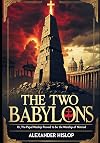
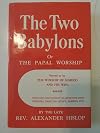
The Two Babylons
by Alexander Hislop
On This Page
Description
The Two Babylons was an anti-Catholic religious pamphlet produced, initially by the Scottish theologian and Protestant Presbyterian Alexander Hislop in 1853. It is, a must-read for anyone interested in Church history. There is this great difference between, the works of men and the works of God, that the same, minute and searching investigation, which displays the defects and imperfections of the one, brings out also the beauties of the other. This Hislop work is, based on the concept that show more numerous traditions of Roman Catholicism came directly, from a mysterious religion largely focused on Nimrod and his family. show lessTags
Recommendations


















Member Recommendations
hnau Woodrow wrote 'The Babylon Connection?' to refute 'The Two Babylons', and even his own book, 'Babylon Mystery Religion'.
20
Member Reviews
A quick perusal of online reviews reveals the hilarious fact that there are 21st-century Protestants who take this book to be an effective indictment of Roman Catholicism! Certainly that is what author Hislop intended.
Thelemites, by contrast, consider that the text -- to the quite incomplete extent that it is true -- reflects positively on the modern Roman custodianship of ancient traditions. Rather than a sinister conspiracy to perpetuate the alleged villainy of ancient Babylon, the many centuries of cultural and organizational development of traditional Christian rites and churches have organically incorporated the religious lives of communities which they have conquered and/or absorbed, integrating them into a Christianity which was show more ab origine a synthesis of Hellenistic, Hebrew, and other ancient traditions, and never as innovative as its proponents have insisted.
This book may possibly have been a persuasive influence on the occultist Charles Stansfeld Jones (Frater Achad) in his adult conversion to Catholicism. show less
Thelemites, by contrast, consider that the text -- to the quite incomplete extent that it is true -- reflects positively on the modern Roman custodianship of ancient traditions. Rather than a sinister conspiracy to perpetuate the alleged villainy of ancient Babylon, the many centuries of cultural and organizational development of traditional Christian rites and churches have organically incorporated the religious lives of communities which they have conquered and/or absorbed, integrating them into a Christianity which was show more ab origine a synthesis of Hellenistic, Hebrew, and other ancient traditions, and never as innovative as its proponents have insisted.
This book may possibly have been a persuasive influence on the occultist Charles Stansfeld Jones (Frater Achad) in his adult conversion to Catholicism. show less
Oh, the classic nineteenth century piece of polemic against the Catholic Church. It is amazing how much of this information crops up today still. Now, I'm no big fan of the Catholic Church, I have problems with some aspects of their theology, teachings, and church government, but I still believe that Catholics are Christians. This old work by a Scots Presbyterian shows wide research, but the connections made between facts (and outdated "facts") would make your most idiotic New Age "historian" blush. This is David Icke (look him up on Wikipedia) before the internet age. Still, it is one of those books an old Baptist like me should have on his shelf. For kicks.
I guess I want to start off with saying, there are some connections and claims in this book that have proved to be false. The author also had biased intentions. This book should be taken with a grain of salt, but I did also find interesting and informative.
Hislop writes this book to make the claim that Catholicism is the reincarnation of pagan practices that originated with worship of Nimrod. This false worship was started with the Babylonian "mysteries" and has since spread to all civilizations in some form or fashion after the confusion of the languages at the tower of Babel. Christianity incorporated many of these practices into their teachings and customs to convert pagans to Christian, if in name only.
I did enjoy seeing a show more similarity across civilizations in beliefs as well as corroborated history of Nimrod and early biblical civilization. There is evidence through history of pagan celebrations influencing and infiltrating Christian practices and teachings. I looked up a lot of information while reading this book. It seems the biggest fault Hislop had was trying to use language and translation to connect everything back to the same original words and meanings. Many of those points have been proven false. He also states some connections as fact that does not seem to have strong or any historical evidence, such as Nimrod's wife. But, if take with a grain of salt and used as guide to do further research on teachings and practices, this book is an interesting find. show less
Hislop writes this book to make the claim that Catholicism is the reincarnation of pagan practices that originated with worship of Nimrod. This false worship was started with the Babylonian "mysteries" and has since spread to all civilizations in some form or fashion after the confusion of the languages at the tower of Babel. Christianity incorporated many of these practices into their teachings and customs to convert pagans to Christian, if in name only.
I did enjoy seeing a show more similarity across civilizations in beliefs as well as corroborated history of Nimrod and early biblical civilization. There is evidence through history of pagan celebrations influencing and infiltrating Christian practices and teachings. I looked up a lot of information while reading this book. It seems the biggest fault Hislop had was trying to use language and translation to connect everything back to the same original words and meanings. Many of those points have been proven false. He also states some connections as fact that does not seem to have strong or any historical evidence, such as Nimrod's wife. But, if take with a grain of salt and used as guide to do further research on teachings and practices, this book is an interesting find. show less
Alexander Hislop reveals that many Roman Catholic teachings did not originate with Christ or the Bible, but were adopted from ancient pagan Babylonian religion, and given Christian names.Although difficult reading, this book accurately provides a fascinating historical in-depth examination of the shocking similarities between the practices of ancient Babylonian religion and those of today's Roman Catholic church.
This book was endorsed by mainline protestant theologians upon publication; many would not endorse this book now. I believe the book uses faulty historical data and draws bizarre conclusions not supported by scripture. While this book provided much fodder during non-ecumenical times its current value is limited - at best- if not worthless.
A fantastic read. Many indisputable elements, though erroneous at times: Some of the research is bad, but still the assertions must be assessed through reason, not on the character of the author or any other citation.
A little conspiratorial, but many of the dots shall connect if any reasonable man finds himself questioning the traditional dictates of Christianity as a whole.
A little conspiratorial, but many of the dots shall connect if any reasonable man finds himself questioning the traditional dictates of Christianity as a whole.
An excellent and thorough evaluation on the origins of Romanism and their traditions.
Members
- Recently Added By
Author Information

6 Works 675 Members
Work Relationships
Is replied to in
Common Knowledge
- Original publication date
- 1916
- People/Characters
- Nimrod, son of Cush; Astarte; Mary, mother of Jesus
- Important places
- Rome, Italy; Babylon, the Tower of Babel (Genesis 11:1-9); Edinburgh, Scotland, UK
Classifications
Statistics
- Members
- 648
- Popularity
- 44,981
- Reviews
- 9
- Rating
- (3.45)
- Languages
- English, French, Spanish
- Media
- Paper, Audiobook, Ebook
- ISBNs
- 50
- ASINs
- 22