On This Page
Description
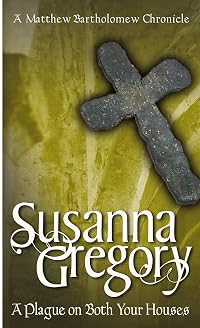
In the tradition of Ellis Peters, A Plague on Both Your Houses introduces the physician Matthew Bartholomew, whose unorthodox but effective treatment of his patients frequently draws accusations of heresy from his more traditional colleagues. Besides his practice, Bartholomew is teacher of Medicine at Michaelhouse, part of the fledgling University of Cambridge. In 1348, the inhabitants of Cambridge live under the shadow of a terrible pestilence that has ravaged Europe and is travelling show more relentlessly eastward towards England. Bartholomew, however, is distracted by the sudden and inexplicable death of the Master of Michaelhouse - a death the University authorities do not want investigated. When three more scholars die in mysterious circumstances, Bartholomew defies the University and begins his own enquiry. His pursuit for the truth leads him into a complex tangle of lies and intrigue that causes him to question the innocence of his closest friends, and even his family. And then the Black Death finally arrives and Bartholomew is dragged deeper and deeper into a quagmire which threatens not only his life, but the continued existence of the University and the future of the town. show lessTags
Recommendations





Member Recommendations
Member Reviews
Strange things are taking place in the fall of 1348 at Michaelhouse, one of Cambridge's colleges. First the Master took his own life in a very unusual way. Then an elderly former teacher dies after warning of evil and sin afoot in the college. Physician and teacher of medicine Matthew Bartholomew suspects murder upon his examination of the body. Bartholomew learns that there are secret factions operating within the University and within his own college, but he doesn't know which side his friends and colleagues support. The safest course is to keep his suspicions to himself and keep his eyes and ears open. Then the plague reaches Cambridge, and Bartholomew and the handful of other physicians have their hands full. Surely this will put an show more end to the murders and intrigue...except it doesn't. Bartholomew's survival may depend on his ability to discern which of his friends and colleagues he can trust, and which ones are wolves in sheep's clothing.
I got off to a slow start with this book. For the first 50 or so pages I had to constantly refer to the maps at the front of the book since geographical and spatial details are important to the plot. At some point I became familiar with the book's landscape and the book became a page-turner. Bartholomew is perhaps a bit unrealistic since his methods are so different from most medical practitioners of the era. For instance, he insists on cleanliness and refuses to use leeches. However, he is as puzzled as the rest of the medical and religious community as to why some people became sick with the plague and others didn't, and why some people survived and others died. There are a few too many subplots for everything to resolve neatly. However, this is a very strong start for a series that should appeal to most historical mystery fans. show less
I got off to a slow start with this book. For the first 50 or so pages I had to constantly refer to the maps at the front of the book since geographical and spatial details are important to the plot. At some point I became familiar with the book's landscape and the book became a page-turner. Bartholomew is perhaps a bit unrealistic since his methods are so different from most medical practitioners of the era. For instance, he insists on cleanliness and refuses to use leeches. However, he is as puzzled as the rest of the medical and religious community as to why some people became sick with the plague and others didn't, and why some people survived and others died. There are a few too many subplots for everything to resolve neatly. However, this is a very strong start for a series that should appeal to most historical mystery fans. show less
Matthew Bartholomew is a physician and instructor at Michaelhouse, one of the Colleges at the young Cambridge University. His views of medicine are rather unorthodox for the 14th century, and he is viewed with suspicion by other doctors. On the eve of the Black Death, in the summer of 1348, the Master of Michaelhouse, Sir John, turns up dead. Everyone assumes it must be suicide, but Bartholomew has his doubts—especially since more bodies turn up. Bartholomew’s investigation leads him to something much better—a potential plot by Oxford scholars to undermine the credibility of Cambridge, perhaps?
Bartholomew is one of the more interesting and complicated detectives I’ve come across in a long while. He’s not limited by the medical show more practices of the period (as we’re told early on, his training was unorthodox, too), so he does seem a bit too modern at times (for example, in addition to being a physician, he also practices surgery, which at that time was practiced by barbers). I liked the plot; and as some who studied the 14th century as a student (even wrote a paper on the Black Death), I was interested by Bartholomew’s appraisal of the pestilence. He may have been trained by eastern doctors, but Bartholomew is just as in the dark about the bubonic plague as anybody else is in 14th century England. My interest was in the effect the plague had on the medieval mindset, so I was interested to see how people reacted: from self-flagellation, to going stark, staring mad, to throwing caution to the wind and enjoying full-tilt the pleasures of life, it’s all seen in this novel. Well done, there.
There are a lot of anachronisms, though: during the riot at the beginning of the book, the townspeople are referred to as “townies: (a mid-19th century invention); the author has her characters refer to themselves as “medieval”; the characters call the Black Death the “Death,” when people of the time would have called it pestilence (the term “Black Death” is 19th century in origin). Another character arrives” in the nick of time” to save our hero, hostels are arranged into “cartels,” and doctor are referred to repeatedly as “medics.” Bartholomew also expresses surprise when a tinker’s widow tells him she can’t read or write. The author seems a little bit confused by the medieval difference between a surgeon and a physician, and for a doctor, Bartholomew is awfully squeamish about the human body. Also, Bartholomew himself admits that he doesn’t know what brought the pestilence in, but he has a strange fascination with the rats scurrying about in the College…. these anachronisms aren’t obscure, a simple search in the OED will give you the origins of most of these words. But other than the anachronisms, I really enjoyed the plot of the novel, and look forward to seeing more of Matthew Bartholomew. show less
Bartholomew is one of the more interesting and complicated detectives I’ve come across in a long while. He’s not limited by the medical show more practices of the period (as we’re told early on, his training was unorthodox, too), so he does seem a bit too modern at times (for example, in addition to being a physician, he also practices surgery, which at that time was practiced by barbers). I liked the plot; and as some who studied the 14th century as a student (even wrote a paper on the Black Death), I was interested by Bartholomew’s appraisal of the pestilence. He may have been trained by eastern doctors, but Bartholomew is just as in the dark about the bubonic plague as anybody else is in 14th century England. My interest was in the effect the plague had on the medieval mindset, so I was interested to see how people reacted: from self-flagellation, to going stark, staring mad, to throwing caution to the wind and enjoying full-tilt the pleasures of life, it’s all seen in this novel. Well done, there.
There are a lot of anachronisms, though: during the riot at the beginning of the book, the townspeople are referred to as “townies: (a mid-19th century invention); the author has her characters refer to themselves as “medieval”; the characters call the Black Death the “Death,” when people of the time would have called it pestilence (the term “Black Death” is 19th century in origin). Another character arrives” in the nick of time” to save our hero, hostels are arranged into “cartels,” and doctor are referred to repeatedly as “medics.” Bartholomew also expresses surprise when a tinker’s widow tells him she can’t read or write. The author seems a little bit confused by the medieval difference between a surgeon and a physician, and for a doctor, Bartholomew is awfully squeamish about the human body. Also, Bartholomew himself admits that he doesn’t know what brought the pestilence in, but he has a strange fascination with the rats scurrying about in the College…. these anachronisms aren’t obscure, a simple search in the OED will give you the origins of most of these words. But other than the anachronisms, I really enjoyed the plot of the novel, and look forward to seeing more of Matthew Bartholomew. show less
Matthew Bartholomew is a physician in 14th century Cambridge. The University is in its early days and relations between town and gown are tense. Members of the university colleges start to die and the Master of Michaelhouse is found dead in bizarre circumstances. Bartholomew tries to investigate the deaths and to uncover a complex plot but then the bubonic plague hits the country.
A dense plot which is a little unsatisfying in its unravelling does not detract from a really entertaining book.
A dense plot which is a little unsatisfying in its unravelling does not detract from a really entertaining book.
I felt like I slogged through this book. As I was reading, I felt like I was constantly sitting on the precipice of something that I would find terribly interesting and a story that would draw me in, but I never quite got there. Even as I got to the end of the story, I felt that there were just too many side plots and diversions that made the story too convoluted and lost my interest.
Now having said that I'll likely pick up the second book in the series to see if the author picks up the pace in the next tale.
Now having said that I'll likely pick up the second book in the series to see if the author picks up the pace in the next tale.
A Plague on Both Your Houses introduces physician Matthew Bartholomew, whose unorthodox but effective treatment of his patients frequently draws accusations of heresy from his more traditional colleagues. Besides his practice, Bartholomew teaches medicine at Michaelhouse, part of the fledgling University of Cambridge. In 1348, the inhabitants of Cambridge live under the shadow of a terrible pestilence that has ravaged Europe and is travelling relentlessly towards England. Bartholomew, however, is distracted by the sudden and inexplicable death of the Master of Michaelhouse, a death University authorities do not want investigated. His pursuit of the truth leads him into a complex tangle of lies and intrigue that forces him to question show more the innocence of his closest friends, even his family. And then the Black Death finally arrives.
I am in two minds about this book - I do like a decent Mystery book, and have read much of my fair share of books set in the 13th - 15th centuries. The detail of the plague, and the fear of disease paralysing whole communities was good, and a novel tale on the story of this era, where people dont know about the spreading of germs and overall hygiene.
However, there seemed to be a cast of thousands, making if difficult to remember who has what relation to whom. In some ways it had quite a modern feel about it = o cant give any examples as to what I mean........
There are plenty of deaths, some as a result of the plague, but there's one or more people around, who take their opportunity to murder members of the colleges. Matthew is confronted with the deaths and doesnt know who he can trust - can he even trust his sister, nephew or brother in law. There's another thread running through the story about Matt's girlfriend and her brother, a case of mistaken identity and money. show less
I am in two minds about this book - I do like a decent Mystery book, and have read much of my fair share of books set in the 13th - 15th centuries. The detail of the plague, and the fear of disease paralysing whole communities was good, and a novel tale on the story of this era, where people dont know about the spreading of germs and overall hygiene.
However, there seemed to be a cast of thousands, making if difficult to remember who has what relation to whom. In some ways it had quite a modern feel about it = o cant give any examples as to what I mean........
There are plenty of deaths, some as a result of the plague, but there's one or more people around, who take their opportunity to murder members of the colleges. Matthew is confronted with the deaths and doesnt know who he can trust - can he even trust his sister, nephew or brother in law. There's another thread running through the story about Matt's girlfriend and her brother, a case of mistaken identity and money. show less
First in the series set in the fledging university of Cambridge. Matthew Bartholomew is a doctor and teacher in the University at the time of the plague. There have been a series of unsettling deaths in the University recenrtly, culminating in the supposed suicide of the master of Michaelhouse college and the murder of three of its fellows. Bartholomew sets out to find out what's happened, in the midst of trying to cure the plague, which has also descended on the town. He's not the most talented detective in literature, and that, in part, is it's charm. He's just trying to spot things and string facts together. It all gets a bit complicated, but not so difficult to follow - although you do finish wondering if anyone could have got to show more the bottom of it all earlier. show less
A Plague on Both Your Houses
3 Stars
The Black Death is slowly making its way across Europe and toward England. At the same time, a series of mysteries deaths at Cambridge University arouses the suspicions of Matthew Bartholomew, a doctor and scholar at Michaelhouse college. As Bartholomew investigates, he uncovers a horrific web of lies and intrigue that makes him question those closest to him and may result in the destruction of the university itself.
The history of the rivalry between Oxford and Cambridge and the descriptions of the advent of the plague in England (symptoms and treatments) are particularly interesting. Unfortunately, the mystery is not as compelling as it becomes overly complex with several convoluted threads and an show more abundance of characters with a mish-mash of motivations and agendas.
Aside from Bartholomew, none of the characters are fleshed out well and it is difficult to become attached to any of them. Thus, the inevitable deaths due to the plague or murder fails to evoke an emotional response and there is very little tension or suspense.
All in all, a decent enough historical mystery and I may continue with the series, but it isn’t a priority. show less
3 Stars
The Black Death is slowly making its way across Europe and toward England. At the same time, a series of mysteries deaths at Cambridge University arouses the suspicions of Matthew Bartholomew, a doctor and scholar at Michaelhouse college. As Bartholomew investigates, he uncovers a horrific web of lies and intrigue that makes him question those closest to him and may result in the destruction of the university itself.
The history of the rivalry between Oxford and Cambridge and the descriptions of the advent of the plague in England (symptoms and treatments) are particularly interesting. Unfortunately, the mystery is not as compelling as it becomes overly complex with several convoluted threads and an show more abundance of characters with a mish-mash of motivations and agendas.
Aside from Bartholomew, none of the characters are fleshed out well and it is difficult to become attached to any of them. Thus, the inevitable deaths due to the plague or murder fails to evoke an emotional response and there is very little tension or suspense.
All in all, a decent enough historical mystery and I may continue with the series, but it isn’t a priority. show less
Members
- Recently Added By
Lists

I Could Live There
185 works; 12 members

BingoDOG - Books With Natural Disasters: Fiction
39 works; 11 members

Books Read in 2017
4,249 works; 129 members

Best Mysteries With a Historical Setting
292 works; 160 members
Author Information

59+ Works 6,357 Members
Some Editions
Series

Belongs to Publisher Series
Narrativa [Nord] (288)
TEAdue [TEA] (1710)
Work Relationships
Is contained in
Common Knowledge
- Canonical title
- A Plague on Both Your Houses
- Original title
- A Plague on Both Your Houses
- Original publication date
- 1996-07-04
- People/Characters
- Matthew Bartholomew; Brother Michael; Thomas Wilson; Giles Abigny; Father Aelfrith
- Important places
- Cambridge, Cambridgeshire, England, UK
- Important events
- Reign of Edward III, King of England (1327-01-25 | 1377-06-21); Black Death
- Dedication
- To my husband for his
encouragement and
enthusiasm - First words
- The scholar waited in the black shadows of the churchyard trees for the Sheriff's night patrol to pass by, trying to control his breathing.
- Last words
- (Click to show. Warning: May contain spoilers.)'Come on, old friend,' he said, tugging Bartholomew's sleeve to make him move, 'or you will make me miss my dinner.'
Classifications
Statistics
- Members
- 662
- Popularity
- 43,552
- Reviews
- 24
- Rating
- (3.56)
- Languages
- English, German, Italian, Spanish
- Media
- Paper, Audiobook, Ebook
- ISBNs
- 14
- ASINs
- 8