On This Page
Description
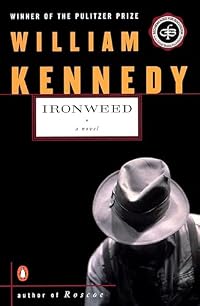
This tale, set during the Depression, tells about Francis Phelan and other inhabitants of skid row in Albany, New York. Ironweed, winner of the Pulitzer Prize, is the best-known of William Kennedy's three Albany-based novels. Francis Phelan, ex-ballplayer, part-time gravedigger, full-time drunk, has hit bottom. Years ago he left Albany in a hurry after killing a scab during a trolley workers' strike; he ran away again after accidentally - and fatally - dropping his infant son. Now, in 1938, show more Francis is back in town, roaming the old familiar streets with his hobo pal, Helen, trying to make peace with the ghosts of the past and the present. Chronicles the final wanderings of a one-time ballplayer turned down-and-out murderer. show lessTags
Recommendations








































Member Reviews
Wow. Ironweed certain pulls some emotional punches. Francis Phelan is an alcoholic bum. He left his family after an unfortunate accident which was pretty much all his fault, and now sleeps among the weeds. He is haunted by the ghosts of his past, which can become confusing as one minute someone is dead, then they are talking to Francis. He's hallucinating.Reading this book takes work, as some of it is written in stream-of-concious style, but once the confusion has past, Kennedy's prose reads like poetry. Kennedy presents Francis's regrets and life laments in such a stunning way. For instance, "No way for Francis to ever get a real good look past the sunset, for he's the kind of fella just kept runnin' when things went bust; never had show more the time to stop anyplace easy just to die." This book left me feeling like a shell, just emotionally drained. It's strange, but I like when a book can do that to me. I mean usually when I set a book down, I think hmmm that was good, what shall I read next? I don't pause to continue thinking about the characters. Ironweed, however, will haunt me. show less
Hauntings need not involve dark corners and unexplained noises. The most frightening spirit, the one that lingers and taunts, slips into the human heart with obsessive regret and self-debasement. William Kennedy quickened such spirits in his Pulitzer Prize winning novel [Ironweed].
Francis Phelan lives on the fringe of life, living literally by the drop. His vagrant life began over twenty years before when he dropped his infant son in the midst of a drunken stupor and the boy died. Haunted daily by the spirits of the dead in his life, those who passed naturally and those whom he helped along, Francis runs, hoping to outdistance the guilt and shame he feels. But the course of his flight circles back to Albany, NY, and Francis finds show more himself employed for the day at the cemetery where his parents and his child are buried. Here, standing over the dark, musty soil of his son’s grave, Francis finally begins to confront the taunting spirits of his past deeds
[Ironweed] is the third book in Kennedy’s “Albany Cycle.” The books that make up the continuing story feature many of the same characters but none of the other books ever reached the same level of critical or popular acclaim.
The success of this haunted story over the others may well owe to the rare poignancy and dark melancholy Kennedy achieves. His examination of blind self-pity and morose guilt gets to the heart of a truly haunted soul. Francis has spoiled his own heart to the point that he believes he deserves the life he lives rather than having chosen it out of fear and shame. At one point he learns that his wife never told anyone, not even their family, that he dropped his infant son. When Francis begins to confess the event to others, he decides that he is cheapening the value of his sin and concludes:
“In the deepest part of himself that could draw an unutterable conclusion, he told himself: My guilt is all that I have left. If I lose it, I have stood for nothing, done nothing, been nothing.”
Kennedy taps into a dark spot in the human heart by drawing a character who looks at life through such a distorted lens. As foreign as Francis and his life may be to most readers, his thoughts are frightening familiar.
Kennedy’s spare and colorful writing adds another reason for the book’s success. He never wastes a word. This character introduction, though only one sentence, describes the man with such force that he seems to claw his way off the page, dripping in sweat and pulsing with anger:
“Francis pushed open the door and confronted the man, who was short, filthy, and sixtyish, a figure of visible sinew, moon-faced, bald, and broad-chested, with fingers like the roots of an oak tree.”
When he describes a fire, he ignores none of the senses in making the event real:
It rose in its own sphere, in an uprush into fire’s own protection, and great flames violated the sky. Then, as Francs and Rosskam halted behind the trucks and cars, Rosskam’s horse snorty and balky with elemental fear, the fire touched some store of thunder and the side of the warehouse blew out in a great rising cannon blossom of black smoke, with the wind carried toward them. Motorists rolled up their windows, but the vulnerable lights of Francis, Rosskam, and the horse smarted with the evil fumes.
Kennedy expertly balances all of the elements of great literature, character, story, and prose. He creates interesting and deeply conflicted characters with but a few words, allowing a look into their internal life without ever seeming disjointed. He tells a story obviously destined for tragedy but that still urges the reader along to the end. And most importantly, by tapping into feelings so common in the human soul, he manages to haunt not just his characters but the reader also.
5 bones!!!!!
A new addition to the all-time favorite list, and certainly a favorite for the year. show less
Francis Phelan lives on the fringe of life, living literally by the drop. His vagrant life began over twenty years before when he dropped his infant son in the midst of a drunken stupor and the boy died. Haunted daily by the spirits of the dead in his life, those who passed naturally and those whom he helped along, Francis runs, hoping to outdistance the guilt and shame he feels. But the course of his flight circles back to Albany, NY, and Francis finds show more himself employed for the day at the cemetery where his parents and his child are buried. Here, standing over the dark, musty soil of his son’s grave, Francis finally begins to confront the taunting spirits of his past deeds
[Ironweed] is the third book in Kennedy’s “Albany Cycle.” The books that make up the continuing story feature many of the same characters but none of the other books ever reached the same level of critical or popular acclaim.
The success of this haunted story over the others may well owe to the rare poignancy and dark melancholy Kennedy achieves. His examination of blind self-pity and morose guilt gets to the heart of a truly haunted soul. Francis has spoiled his own heart to the point that he believes he deserves the life he lives rather than having chosen it out of fear and shame. At one point he learns that his wife never told anyone, not even their family, that he dropped his infant son. When Francis begins to confess the event to others, he decides that he is cheapening the value of his sin and concludes:
“In the deepest part of himself that could draw an unutterable conclusion, he told himself: My guilt is all that I have left. If I lose it, I have stood for nothing, done nothing, been nothing.”
Kennedy taps into a dark spot in the human heart by drawing a character who looks at life through such a distorted lens. As foreign as Francis and his life may be to most readers, his thoughts are frightening familiar.
Kennedy’s spare and colorful writing adds another reason for the book’s success. He never wastes a word. This character introduction, though only one sentence, describes the man with such force that he seems to claw his way off the page, dripping in sweat and pulsing with anger:
“Francis pushed open the door and confronted the man, who was short, filthy, and sixtyish, a figure of visible sinew, moon-faced, bald, and broad-chested, with fingers like the roots of an oak tree.”
When he describes a fire, he ignores none of the senses in making the event real:
It rose in its own sphere, in an uprush into fire’s own protection, and great flames violated the sky. Then, as Francs and Rosskam halted behind the trucks and cars, Rosskam’s horse snorty and balky with elemental fear, the fire touched some store of thunder and the side of the warehouse blew out in a great rising cannon blossom of black smoke, with the wind carried toward them. Motorists rolled up their windows, but the vulnerable lights of Francis, Rosskam, and the horse smarted with the evil fumes.
Kennedy expertly balances all of the elements of great literature, character, story, and prose. He creates interesting and deeply conflicted characters with but a few words, allowing a look into their internal life without ever seeming disjointed. He tells a story obviously destined for tragedy but that still urges the reader along to the end. And most importantly, by tapping into feelings so common in the human soul, he manages to haunt not just his characters but the reader also.
5 bones!!!!!
A new addition to the all-time favorite list, and certainly a favorite for the year. show less
In the town where I live, as in so many cities across the country, there are a lot of homeless people who roam the streets with nowhere to go. I would like to say that I think seriously about their plights, but I don’t suppose that I really do. In fact, aside from offering an occasional handout, I seldom engage these men and women in any meaningful way. Who are they and how did they wind up where they are? Are their situations the result of bad luck or bad choices (or maybe both)? Are their situations temporary or will they spend the rest of their lives enduring their present conditions? Those are questions to which I don’t have answers, mainly because I have never bothered to ask them in the first place.
In Ironweed, William Kennedy show more fills in the details of one such man’s journey. Francis Phelan, the hero of this deeply affecting novel, has been on the run his whole life, first from an abusive mother and then to follow his career as a professional baseball player, until he finally leaves his home and family for good after a tragic accident for which he takes responsibility. Now, at 58, Francis has grown weary of the road and is trying to find his way back in his hometown of Albany, New York. However, he has descended so far—he has even begun having alcohol-induced hallucinations in which he sees the ghosts of long-dead friends and enemies—that he really has no idea of how, or even if, he can do it.
Set in the late fall of 1938, Ironweed is a spare and unflinching look at the often tragic lives of people who find themselves “on the bum”. To be sure, this is a grim tale, replete with considerable fear, sorrow, and violence, but with very little hope. However, it is also a story that is beautifully told and one that perfectly captures one man’s perspective on the challenges of trying to survive on the streets in Depression-era America. In Francis, the author has created one of the more complex and memorable characters I’ve encountered: strong but vulnerable, violent yet tender and thoughtful, disciplined but occasionally spontaneous. There is little in this novel that will make the reader feel good, but there is much to savor nonetheless, mainly because Kennedy has bothered to ask the right questions. show less
In Ironweed, William Kennedy show more fills in the details of one such man’s journey. Francis Phelan, the hero of this deeply affecting novel, has been on the run his whole life, first from an abusive mother and then to follow his career as a professional baseball player, until he finally leaves his home and family for good after a tragic accident for which he takes responsibility. Now, at 58, Francis has grown weary of the road and is trying to find his way back in his hometown of Albany, New York. However, he has descended so far—he has even begun having alcohol-induced hallucinations in which he sees the ghosts of long-dead friends and enemies—that he really has no idea of how, or even if, he can do it.
Set in the late fall of 1938, Ironweed is a spare and unflinching look at the often tragic lives of people who find themselves “on the bum”. To be sure, this is a grim tale, replete with considerable fear, sorrow, and violence, but with very little hope. However, it is also a story that is beautifully told and one that perfectly captures one man’s perspective on the challenges of trying to survive on the streets in Depression-era America. In Francis, the author has created one of the more complex and memorable characters I’ve encountered: strong but vulnerable, violent yet tender and thoughtful, disciplined but occasionally spontaneous. There is little in this novel that will make the reader feel good, but there is much to savor nonetheless, mainly because Kennedy has bothered to ask the right questions. show less
He sees dead people. And he talks to them. He lives a life on the edge of society, in an alternate society of bums and drunks and prostitutes and hobos. Some exist who take pity on him and help him and others who have reviled him. He has murdered to protect his own life.
William Kennedy, in this 1984 Pulitzer Prize winner, has captured the humanity of people who actually do live on the edge of "normal" society. He has given it a name, a story, a life. Within these that polite society shun as almost animal, he has restored humanity. Returned them to the realm of being another group of people. How they survive. How they support one another.
At the start of the novel, my first reaction was 'I wonder if this is where the Pulitzer requirement show more of "being weird" actually started'. But as I progressed through the book, that which seemed weird at first was actually clarified as the musings of a mind broken by alcohol struggling through a life during the depression.
Excellent book and well written enough it should be a classic. Highly recommended. show less
William Kennedy, in this 1984 Pulitzer Prize winner, has captured the humanity of people who actually do live on the edge of "normal" society. He has given it a name, a story, a life. Within these that polite society shun as almost animal, he has restored humanity. Returned them to the realm of being another group of people. How they survive. How they support one another.
At the start of the novel, my first reaction was 'I wonder if this is where the Pulitzer requirement show more of "being weird" actually started'. But as I progressed through the book, that which seemed weird at first was actually clarified as the musings of a mind broken by alcohol struggling through a life during the depression.
Excellent book and well written enough it should be a classic. Highly recommended. show less
A soft pick as I've grown weary of this testosterone-soaked writing style. This is a bleak novel in which punishments are self-inflicted and permanent, in which a little self-reflection and humility would derail the entire plot. It is also a beautifully written novel and an honest portrayal of how people sabotage themselves.
As I began reading this I was at some level aware of the story. I had never watched the movie, but I was aware when the movie came out and I must have seen a trailer or read something about the story at that time. And I had read some GR reviews that described enough of the tone of the novel to confirm my other impressions. I wasn't expecting to love this story. I was thinking it would be dark and depressing. Well, that preliminary impression was not far off, but it didn't matter. I thought the writing was wonderful, and the characters were crisp and vivid. Yes, there was a lot of violence, and there was frustration for me because the characters didn't have to be in the position they found themselves. But that was an integral part of the show more story. It wasn't all bad luck. There were choices made, and recognition by the characters of those choices. They knew themselves such that their lives were inevitable. That inevitability made the thoroughly enjoyable and engrossing nature of the story that much more impressive. show less
Why I Stopped Reading on p. 20: Some of the writing in that first chapter intrigues me, and I wanted to connect with the story of Francis Phelan, a man who is broken by guilt and unable to go home, who becomes a hobo during the Great Depression. What I wasn't prepared for (and through which I can't seem to persevere)--the omniscient point of view being used to hop into the heads of ghosts who are watching Francis from their graves, then back into Francis's head with a stream-of-consciousness that slips in and out of second person (the "you" being Francis to himself). It's clear all these elements are deliberate style choices by the author, but it doesn't work for me.
Members
- Recently Added By
Lists

Pulitzer Prize Winners for Fiction
102 works; 54 members

20th Century Literature
1,161 works; 54 members
Best Family Stories
241 works; 22 members

Books Set in New York State
65 works; 11 members

Pulitzer Prize-Winning Books
42 works; 9 members
Harold Bloom - The Western Canon: D. The Chaotic Age
833 works; 24 members

Books Featured on Gilmore Girls
307 works; 21 members
The American Experience
173 works; 18 members
The Modern Library's 100 Best Novels: The Board's List
85 works; 6 members

Pen/Faulkner Winners and Finalists
178 works; 9 members

New Authors to Read
21 works; 3 members
Best of American Literature
146 works; 9 members
American Lit for Eng 11 Research Project
368 works; 6 members

Recommended Reading : 600 Classics Reviewed, Editors of Salem Press, 2015
634 works; 6 members

The Complete Rory Gilmore Reading List
506 works; 5 members
Modern Library's 100 Best Novels
100 works; 2 members
Author Information

19+ Works 5,648 Members
Awards and Honors
Awards
Distinctions
Series

Belongs to Publisher Series
Work Relationships
Common Knowledge
- Canonical title*
- Ironweed
- Original title
- Ironweed
- Alternate titles*
- Железный бурьян
- Original publication date
- 1983
- People/Characters
- Francis Phelan; Helen Archer
- Important places
- Albany, New York, USA
- Important events
- Great Depression
- Related movies
- Ironweed (1987 | IMDb)
- Epigraph
- To course o'er better waters now hoists sail the little bark of my wit, leaving behind her a sea so cruel. --Dante, Purgatorio
- Dedication
- This book is for four good men:
Bill Segarra, Tom Smith, Harry Staley, and Frank Trippett. - First words
- Riding up the winding road of Saint Agnes Cemetery in the back of the rattling old truck, Francis Phelan became aware that the dead, even more than the living, settled down in neighborhoods.
- Last words
- (Click to show. Warning: May contain spoilers.)It was a mighty nice little room.
- Blurbers
- Grumbach, Doris; Lurie, Alison
- Original language
- English
*Some information comes from Common Knowledge in other languages. Click "Edit" for more information.
Classifications
Statistics
- Members
- 2,652
- Popularity
- 7,011
- Reviews
- 52
- Rating
- (3.80)
- Languages
- 10 — Dutch, English, Finnish, French, German, Italian, Norwegian (Bokmål), Portuguese, Spanish, Swedish
- Media
- Paper, Audiobook, Ebook
- ISBNs
- 41
- UPCs
- 3
- ASINs
- 19