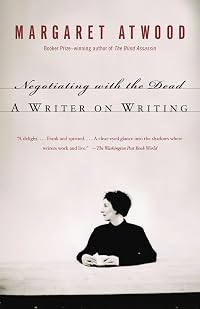
On Writers and Writing
by Margaret Atwood
On This Page
Description
What is the role of the writer? Prophet? High Priest of Art? Court Jester? Or witness to the real world? Looking back on her own childhood and writing career, Margaret Atwood examines the metaphors which writers of fiction and poetry have used to explain - or excuse! - their activities, looking at what costumes they have assumed, what roles they have chosen to play. In her final chapter she takes up the challenge of the title: if a writer is to be seen as 'gifted', who is doing the giving show more and what are the terms of the gift? Margaret Atwood's wide reference to other writers is balanced by anecdotes from her own experiences, both in Canada and on the international scene. The lightness of her touch is underlined by a seriousness about the purpose and the pleasures of writing, and by a deep familiarity with the myths and traditions of Western literature. show lessTags
Recommendations



Member Recommendations
Member Reviews
I started this book before, and had trouble getting into it. All I can say about that is, the timing must have been wrong. I loved every word of it this time. Margaret Atwood writes about writing. How could it NOT be wonderful? (The only Atwood novel I have read---or even been tempted to read---is Alias Grace. I admired it, enjoyed it, and wished the subject matter of Atwood's other fiction was more to my taste, because her writing was exquisite.) This book grew out of a series of lectures Ms. Atwood gave at Cambridge in 2000. There were six lectures, so there are six chapters in the book, each dealing with a different aspect of the writerly existence. Roughly translated and conflated a bit, the topics are "what is a writer, anyway?", show more "the duplicity of being a writer", "who or what are you writing for", and "the writer's quest for immortality". Or, as Atwood says, with a wit that delighted me throughout the book, "Perhaps I have reached the age at which those who have been through the wash-and-spin cycle a few times become seized by the notion that their own experience in the suds maybe relevant to others." Despite her disclaimer that she is "not a scholar or a literary theoretician", she knows an awful lot, and dispenses a good bit of that knowledge in Negotiating With the Dead, in a manner both enlightening and entertaining. I expect I will return again and again to this collection, and that I will, notwithstanding my general aversion to dystopian fiction, read another Atwood novel before too long.
Review written January 2015 show less
Review written January 2015 show less
Very interesting, learned, but easy to read and funny at times. I’d recommend this to anyone who habitually reads.
Atwood opens quite innocuously with a memoir and description of the literary scene in mid-20th C Canada. There’s an interesting discussion of the relationship between the author and the reader (pretty much like in Stephen King’s Misery) and also of the writer’s relationship with themselves (as in The Dark Half). She also discusses the religious aspects of writing. The final chapter is actually rather profound.
So a book about the art of writing is also itself a work of art. Bloody typical of Atwood to do something like that.
Atwood opens quite innocuously with a memoir and description of the literary scene in mid-20th C Canada. There’s an interesting discussion of the relationship between the author and the reader (pretty much like in Stephen King’s Misery) and also of the writer’s relationship with themselves (as in The Dark Half). She also discusses the religious aspects of writing. The final chapter is actually rather profound.
So a book about the art of writing is also itself a work of art. Bloody typical of Atwood to do something like that.
A wide-ranging, perceptive and sometimes hilarious look at becoming a writer, being a writer, wrestling with the art and commerce of writing and more. If you have thought it as a writer, Atwood has -- and likely she captures it better on paper. If you've done it (even the scary or shameful stuff) -- ditto. And if you've navigated, or wanted to, the scary gap between creation and commerce, Atwood can pen BTDT in a way that will still break your heart.
2.5**
Alternate or Subtitle: A Writer on Writing
Atwood was asked to give the Empson lectures at Cambridge University in 2000. The series of six presentations were intended for scholars, students and the general public. This book is the result of that experience.
Somehow, I’ve found myself reading books about writing this past year. I read Ray Bradbury’s Zen in the Art of Writing last month and am just about to finish listening to Stephen King’s On Writing: A Memoir of the Craft. I cannot help but compare them, and I find this one better than Bradbury’s, but not so helpful (or entertaining) as King’s
Atwood clearly gave a lot of thought into the lecture series and she references many writers and books in a range of genres, show more though she does tend to rely most on classics / literary fiction and poetry. She does have some very interesting points to make, and questions to ask. For example, this excerpt:
In what ways, if any, does talent set you apart? Does it exempt you from the duties and responsibilities expected of others? Or does it load you up with even more duties and responsibilities, but of a different kind? Are you to be a detached observer…? Or ought you to be a dedicated spokesperson for the downtrodden of this earth…?
However, the style seemed stilted and detached. Dryly academic. I found myself anxious for her to get her point made and move on. show less
Alternate or Subtitle: A Writer on Writing
Atwood was asked to give the Empson lectures at Cambridge University in 2000. The series of six presentations were intended for scholars, students and the general public. This book is the result of that experience.
Somehow, I’ve found myself reading books about writing this past year. I read Ray Bradbury’s Zen in the Art of Writing last month and am just about to finish listening to Stephen King’s On Writing: A Memoir of the Craft. I cannot help but compare them, and I find this one better than Bradbury’s, but not so helpful (or entertaining) as King’s
Atwood clearly gave a lot of thought into the lecture series and she references many writers and books in a range of genres, show more though she does tend to rely most on classics / literary fiction and poetry. She does have some very interesting points to make, and questions to ask. For example, this excerpt:
In what ways, if any, does talent set you apart? Does it exempt you from the duties and responsibilities expected of others? Or does it load you up with even more duties and responsibilities, but of a different kind? Are you to be a detached observer…? Or ought you to be a dedicated spokesperson for the downtrodden of this earth…?
However, the style seemed stilted and detached. Dryly academic. I found myself anxious for her to get her point made and move on. show less
Negotiating with the Dead: A Writer on Writing by Margaret Atwood intertwines philosophy, memoir, and examples to explore the writing life. Atwood weaves together seemingly disparate parts of life to demonstrate how interconnected every aspect of life and writing are. Atwood discusses the writer's relationship to life, living, truth, deception, and shadows and the interpretation of all of these in the works they write complete with examples from a slew of writers. She explores how writers use those interpretations to communicate with the readers for whom they write. Atwood's descriptions of her journey to become and remain a writer offer glimmers of hope and inspiration for writers on their writing journey. I found concepts, show more experiences, and emotions to which I could definitely relate; however, there were also parts to which I couldn't relate. This is the nature of being a writer reading another writer's experience in the same way that it is the nature of being a human reading another human's experience. show less
This book grew out of the series of Empsom lectures that prize-winning novelist Atwood gave at the University of Cambridge in 2000. In it, she addresses a number of fundamental questions: not how to write but the basic position of the writer, why a writer writes, "and for whom? And what is this writing anyway?" Wearing her learning lightly, Atwood allows her wit to shine on almost every page. She probes her life and work along with those of many other writers and brings in myths, fairy tales, movies whatever feeds her themes. Following an initial autobiographical chapter, Atwood addresses major issues: the duplicity evidently inherent in writing; the problems of art vs. money; the problems of art vs. social relevance; the nature of the show more triangular relationship of writer, reader, and book; and, in the final title chapter, the provocative idea that "all writing of the narrative kind, and perhaps all writing, is motivated, deep down, by a fear of and a fascination with mortality by a desire to make the risky trip to the Underworld, and to bring something or someone back from the dead." Atwood is not looking to provide answers or solutions but to explore the parameters of some interesting questions. The result is engaging food for thought for all who care about writers and writing. show less
The short book, Negotiating with the Dead, is a collection of six lectures Margaret Atwood gave on writing. This is not a typical writing handbook, dispensing now-cliched advice like "write what you know" and "show, don't tell." Rather, Atwood tackles the question of what does it mean to "be a writer." What is the writer, anyway, and why are writers compelled to write? She ends up posing more questions than she answers.
The six lectures each address a different aspect of the Writer. Using examples from literature, poetry, and mythology, Atwood positions the writer as six archetypes. Atwood's insights are unusual but will ring true to anyone who has felt the urge to write, or indeed, to any creator, I suspect.
Additional notes on each show more lecture are on my blog. show less
The six lectures each address a different aspect of the Writer. Using examples from literature, poetry, and mythology, Atwood positions the writer as six archetypes. Atwood's insights are unusual but will ring true to anyone who has felt the urge to write, or indeed, to any creator, I suspect.
Additional notes on each show more lecture are on my blog. show less
Members
- Recently Added By
Lists

Books Read in 2016
4,666 works; 197 members

Best Books on Writing for Writers
36 works; 19 members

Books Read in 2022
5,226 works; 112 members
Author Information

291+ Works 199,837 Members
Margaret Atwood was born on November 18, 1939 in Ottawa, Canada. She received a B.A. from Victoria College, University of Toronto in 1961 and an M.A. from Radcliff College in 1962. Her first book of verse, Double Persephone, was published in 1961 and was awarded the E. J. Pratt Medal. She has published numerous books of poetry, novels, story show more collections, critical work, juvenile work, and radio and teleplays. Her works include The Journals of Susanna Moodie, Power Politics, Cat's Eye, The Robber Bride, Morning in the Buried House, the MaddAdam trilogy, and The Heart Goes Last. She has won numerous awards including the Prince of Asturias Award for Literature, the Booker Prize in 2000 for The Blind Assassin, the Giller Prize and the Premio Mondello for Alias Grace, and the Governor General's Award in 1966 for The Circle Game and in 1986 for The Handmaid's Tale, which also won the very first Arthur C. Clarke Award in 1987. She won the PEN Pinter prize in 2016 for her political activism. She was awarded the 2016 PEN Pinter Prize for the outstanding literary merit of her body of work. (Bowker Author Biography) show less
Awards and Honors
Series
Belongs to Publisher Series
Loomingu Raamatukogu 2020 (37-40)
Common Knowledge
- Canonical title
- On Writers and Writing
- Original title
- On Writers and Writing
- Alternate titles
- Negotiating with the Dead: A Writer on Writing
- Original publication date
- 2002
- People/Characters
- Margaret Atwood
- Epigraph
- As they were all sitting at table, one guest suggested that each of them should relate a tale. Then the bridegroom said to the bride: "Come, my dear, do you know nothing? Relate something to us, like the others." She said: "T... (show all)hen I will relate a dream." -- "The Robber Bridegroom," collected by the Brothers Grimm
...I moot reherce
Hir tales alle, be they bettre or werse,
Or elles falsen som of my mateere.
And therefore, whoso list it nat yheere,
Turne over the leef and chese another tale...
--Geoffrey Chaucer, The Ca... (show all)nterbury Tales
And now in imagination he has climbed
another planet, the better to look
with single camera view upon this earth--
its total scope, and each afflated tick,
its talk, its trick, its tracklessness--and this,
this... (show all) he would like to write down in a book!
--A.M. Klein, "Portrait of the Poet as Landscape" - Dedication
- For the others
- First words
- When I was a student of English literature, in the early 1960s, we all had to read an important critical text called Seven Types of Ambiguity (1930).
- Quotations
- Every life lived is also an inner life, a life created.
- Last words
- (Click to show. Warning: May contain spoilers.)I will give the last word to the poet Ovid, who has the Sibyl of Cumae speak, not only for himself, but also--we suspect--for him, and for the hopes and fates of all writers: But still, the fates will leave me my voice, and by my voice I shall be known.
- Blurbers
- Pakenham, Michael
- Original language
- English
Classifications
- Genres
- Literature Studies and Criticism, Nonfiction, Biography & Memoir
- DDC/MDS
- 808.3 — Literature & rhetoric Literature, rhetoric & criticism Rhetoric and collections of literary texts from more than two literatures Rhetoric of fiction
- LCC
- PR9199.3 .A8 .N44 — Language and Literature English English Literature English literature: Provincial, local, etc.
- BISAC
Statistics
- Members
- 1,652
- Popularity
- 13,652
- Reviews
- 29
- Rating
- (3.75)
- Languages
- 9 — Chinese, English, German, Greek, Italian, Polish, Portuguese, Swedish, Turkish
- Media
- Paper, Audiobook, Ebook
- ISBNs
- 23
- ASINs
- 10