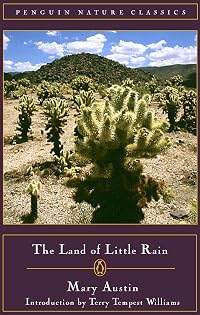
The Land of Little Rain
by Mary Austin
On This Page
Description
"Between the high Sierras south from Yosemite--east and south over a very great assemblage of broken ranges beyond Death Valley, and on illimitably into the Mojave Desert" is the territory that Mary Austin calls the Land of Little Rain. In this classic collection of meditations on the wonders of this region, Austin generously shares "such news of the land, of its trails and what is astir in them, as one lover of it can give to another." Her vivid writings capture the landscape--from burnt show more hills to sun-baked mesas--as well as the rich variety of plant and animal life, and the few human beings who inhabit the land, including cattlemen, miners, and Paiute Indians. This Modern Library Paperback Classic is set from the original 1903 edition. show lessTags
Recommendations














Member Reviews
This was my grandmother's book. Lovely writing about the deserts and southern Sierras of California, along with some of the people who were there in the very early 1900s. Austin writes a beautiful picture of things one may have noticed in nature before, but never really "seen." She noticed the secret things and wrote about them in such a way that it moves our spirits as we see them through her eyes.
If you can, choose to read the 1950 edition of The Land of Little Rain. It has 48 photographs taken by Ansel Adams.
California’s sparsely populated Owens Valley is the geographic heart of this volume, a place familiar to seekers of high-altitude trips in the eastern Sierra Nevada or access to the state’s northernmost desert lands. Mary Hunter Austin lived there during the late 19th and early 20th centuries but the valley she wrote about in 1903 isn’t the same as ours. After diversion of much of its water supply to Los Angeles it couldn’t be. This gives her book even more interest, and there’s plenty to enjoy and consider, in the valley or elsewhere, as she writes of Indians, long-time Mexican residents, miners, wildlife, and show more natural wonders all about.
Austin’s prose has a disposition:
“Somehow the rawness of the land favors the sense of personal relations to the supernatural…All this begets…a state that passes explanation unless you will accept an explanation that passes belief…it represents the courage to sheer off what is not worth while. Beyond that it endures without sniveling, renounces without self-pity, fears no death, rates itself not too great in the scheme of things; so do beasts, so did St. Jerome in the desert, so also in the elder day did gods. Life, its performance, cessation, is no new thing to gape and wonder at.”
And while she doesn’t strain after poetic effects, sometimes it can’t be helped: “If the fine vibrations which are the golden-violet glow of spring twilights were to tremble into sound, it would be just that mellow double note [of the burrowing owl] breaking along the blossom tops.” She must enjoy her thoughts too, to write this: “Very likely if he knew how hawk and crow dog him for dinners, he would resent it. But the badger is not very well contrived for looking up or far to either side.”
Each short chapter is an individual undertaking, aware of the others but its own self entire. One or more will be a favorite, and if you’re like me each will seem to have said something new, even if just in a passing observation. show less
California’s sparsely populated Owens Valley is the geographic heart of this volume, a place familiar to seekers of high-altitude trips in the eastern Sierra Nevada or access to the state’s northernmost desert lands. Mary Hunter Austin lived there during the late 19th and early 20th centuries but the valley she wrote about in 1903 isn’t the same as ours. After diversion of much of its water supply to Los Angeles it couldn’t be. This gives her book even more interest, and there’s plenty to enjoy and consider, in the valley or elsewhere, as she writes of Indians, long-time Mexican residents, miners, wildlife, and show more natural wonders all about.
Austin’s prose has a disposition:
“Somehow the rawness of the land favors the sense of personal relations to the supernatural…All this begets…a state that passes explanation unless you will accept an explanation that passes belief…it represents the courage to sheer off what is not worth while. Beyond that it endures without sniveling, renounces without self-pity, fears no death, rates itself not too great in the scheme of things; so do beasts, so did St. Jerome in the desert, so also in the elder day did gods. Life, its performance, cessation, is no new thing to gape and wonder at.”
And while she doesn’t strain after poetic effects, sometimes it can’t be helped: “If the fine vibrations which are the golden-violet glow of spring twilights were to tremble into sound, it would be just that mellow double note [of the burrowing owl] breaking along the blossom tops.” She must enjoy her thoughts too, to write this: “Very likely if he knew how hawk and crow dog him for dinners, he would resent it. But the badger is not very well contrived for looking up or far to either side.”
Each short chapter is an individual undertaking, aware of the others but its own self entire. One or more will be a favorite, and if you’re like me each will seem to have said something new, even if just in a passing observation. show less
This is the first Penguin Nature Classic that I have read, and it sets a high standard for the others to meet.
Mary Austin was an early 20th century naturalist, described by Terry Tempest Williams in the Introduction to this edition: “… a woman, candid and direct, who was utterly focused on her vision, and her vision was focused on the arid lands of the American West”. Tempest describes her as cantankerous, but then goes on to say that Austin’s writing conveys “… an abiding and enduring compassion and humility that came through the rigors of her disciplined eye toward nature.”
I found Austin’s narrative anecdotal; more travelogue than natural science essay. She conveyed wonderfully the contrast between sparseness and show more abundance in the turn of the desert seasons. Tempest ascribed to Austin “… a Victorian diction written through the perceptions of a radical spirit.” For me, Austin’s prose, while not simple, does not suffer from the weight of Victorian complexity. For me, her prose sings: It tiptoes the edge of poetry from time to time; it is gorgeous. It has the rhythm, song and repetitions of traditional storytelling. I fell in love with it, starting with the third paragraph in the first essay, the one that begins: “This is the nature of that country. There are hills, rounded, blunt, burned, squeezed up out of chaos, chrome and vermillion painted, aspiring to the snow line.”
Passionate about the desert, Austin was also clear-eyed about the realities of the life and lives she loved. While she referred to animals as if they were another kind of person and members of her larger family, she did so with the respect you might expect of a St. Francis and not with the cutesy fantasy of a Disney. She was also reassuringly clear that sheep are breathtakingly dim. Sadly, she was also prescient about the impact of western migration on the health and wellbeing of her desert and its denizens.
I loved it and will reread it with pleasure. show less
Mary Austin was an early 20th century naturalist, described by Terry Tempest Williams in the Introduction to this edition: “… a woman, candid and direct, who was utterly focused on her vision, and her vision was focused on the arid lands of the American West”. Tempest describes her as cantankerous, but then goes on to say that Austin’s writing conveys “… an abiding and enduring compassion and humility that came through the rigors of her disciplined eye toward nature.”
I found Austin’s narrative anecdotal; more travelogue than natural science essay. She conveyed wonderfully the contrast between sparseness and show more abundance in the turn of the desert seasons. Tempest ascribed to Austin “… a Victorian diction written through the perceptions of a radical spirit.” For me, Austin’s prose, while not simple, does not suffer from the weight of Victorian complexity. For me, her prose sings: It tiptoes the edge of poetry from time to time; it is gorgeous. It has the rhythm, song and repetitions of traditional storytelling. I fell in love with it, starting with the third paragraph in the first essay, the one that begins: “This is the nature of that country. There are hills, rounded, blunt, burned, squeezed up out of chaos, chrome and vermillion painted, aspiring to the snow line.”
Passionate about the desert, Austin was also clear-eyed about the realities of the life and lives she loved. While she referred to animals as if they were another kind of person and members of her larger family, she did so with the respect you might expect of a St. Francis and not with the cutesy fantasy of a Disney. She was also reassuringly clear that sheep are breathtakingly dim. Sadly, she was also prescient about the impact of western migration on the health and wellbeing of her desert and its denizens.
I loved it and will reread it with pleasure. show less
5
Originally published in 1903, these essays vary in location from Fort Tejon up through the Owens Valley. She originally moved to the southern San Joaquin Valley unwillingly, with her mother and two brothers, sometime before 1889. This book, her first book-length work, describes and examines residents, flora, and climate of this area before Los Angeles's aqueduct took water from Owens Lake (it was built 1908-1913), and in fact before Los Angeles was barely a city at all (the city had just over 100,000 people in 1900).
I especially liked the essays that included details about the flora of the areas. However, all of these essays are interesting in that they represent places and ways of life that no longer exist--but they did still exist show more when she was writing these pieces.
The introduction is copyright 2003 by Robert Hass, former poet laureate, a chancellor of the American Academy of Poets, and professor as Cal. This introduction is...problematic. Interestingly he calls out Austin's 1923 works as trying to appropriate Native American oral traditions. I cannot comment on the validity of that, but in this introduction he calls her daughter a "damaged child" (she was born mentally disabled as explained in the author-less author bio). He also twice calls the southern San Joaquin Valley the San Fernando Valley (pages xiii and xviii)--how this made it into print is mind-boggling to me.
This is the second nonfiction classic I had read in the last few years that has an introduction written by a poet--and both have egregious, sloppy, embarrassing errors. show less
I especially liked the essays that included details about the flora of the areas. However, all of these essays are interesting in that they represent places and ways of life that no longer exist--but they did still exist show more when she was writing these pieces.
The introduction is copyright 2003 by Robert Hass, former poet laureate, a chancellor of the American Academy of Poets, and professor as Cal. This introduction is...problematic. Interestingly he calls out Austin's 1923 works as trying to appropriate Native American oral traditions. I cannot comment on the validity of that, but in this introduction he calls her daughter a "damaged child" (she was born mentally disabled as explained in the author-less author bio). He also twice calls the southern San Joaquin Valley the San Fernando Valley (pages xiii and xviii)--how this made it into print is mind-boggling to me.
This is the second nonfiction classic I had read in the last few years that has an introduction written by a poet--and both have egregious, sloppy, embarrassing errors. show less
Mary Austin wrote about nature, specifically in the American Southwest. The Land of Little Rain is a collection of essays celebrating the California desert, an area many would consider a formidable, unforgiving landscape. She brings it to life, describing the flora and fauna in minute detail. Even Scavengers, an essay about buzzards, makes for fascinating reading as she shows how the birds help keep the desert clean -- except, of course, from the litter left by careless humans.
This book was published in 1903, and Austin's language takes some getting used to. In the introduction, Terry Tempest Williams writes about recording these essays as an audiobook, and initially
missing her voice completely. It was only in hearing the text out loud show more that I realized the era that held Mary Austin. It was a Victorian diction written through the perceptions of a radical spirit. Mary Austin wrote through the lace of her age. (p. xiv)
Reading this book piqued my interest in Mary Austin, en early feminist who worked tirelessly for Native American rights and what we now call "sustainability." I'm saving these essays for a re-read after I learn more about this fascinating woman. show less
This book was published in 1903, and Austin's language takes some getting used to. In the introduction, Terry Tempest Williams writes about recording these essays as an audiobook, and initially
missing her voice completely. It was only in hearing the text out loud show more that I realized the era that held Mary Austin. It was a Victorian diction written through the perceptions of a radical spirit. Mary Austin wrote through the lace of her age. (p. xiv)
Reading this book piqued my interest in Mary Austin, en early feminist who worked tirelessly for Native American rights and what we now call "sustainability." I'm saving these essays for a re-read after I learn more about this fascinating woman. show less
"Mary Austin was convinced that the valley [Owens Valley*] had died when it sold its first water right to Los Angeles--that city would never stop until it owned the whole river and all of the land. One day, in Los Angeles for an interview with Mulholland, she told him so. After she had left, a subordinate came into his office and found him staring at the wall. "By God, " Mulholland reportedly said, "that woman is the only one who has brains enough to see where this is going." [Cadillac Desert, by Marc Reisner]
Savvy about early 20th century CA water rights and politics and steeped in 19th century Transcendentalism, Mary Austin is best known for these exquisitely written vignettes that describe the landscape and the inhabitants of the show more Owens Valley. Her lyricism is finely tempered by acute observation. The book closes with an imperative: "Come away, you who are so obsessed with your own importance in the scheme of things, and have got nothing you did not sweat for, come away by the brown valleys and full-bosomed hills to the even-breathing days, to the kindliness, earthiness, ease of El Pueblo de Las Uvas." Come away, indeed.
*[from Wikipedia: "Owens Valley is the arid valley of the Owens River in eastern California in the United States, to the east of the Sierra Nevada and west of the White Mountains and Inyo Mountains on the west edge of the Great Basin section. The mountain peaks on either side (including Mount Whitney) reach above 14,000 feet in elevation, while the floor of the Owens Valley is at 4,000 feet, making the valley one of the deepest in the United States. The Sierra Nevada casts the valley in a rain shadow. The bed of Owens Lake, now a predominantly dry endorheic alkali flat, sits on the southern end of the valley. The valley provides water to the Los Angeles Aqueduct, the source of half of the water for Los Angeles, and is infamous as the scene of one of the fiercest and longest running episodes of the California Water Wars."] show less
Savvy about early 20th century CA water rights and politics and steeped in 19th century Transcendentalism, Mary Austin is best known for these exquisitely written vignettes that describe the landscape and the inhabitants of the show more Owens Valley. Her lyricism is finely tempered by acute observation. The book closes with an imperative: "Come away, you who are so obsessed with your own importance in the scheme of things, and have got nothing you did not sweat for, come away by the brown valleys and full-bosomed hills to the even-breathing days, to the kindliness, earthiness, ease of El Pueblo de Las Uvas." Come away, indeed.
*[from Wikipedia: "Owens Valley is the arid valley of the Owens River in eastern California in the United States, to the east of the Sierra Nevada and west of the White Mountains and Inyo Mountains on the west edge of the Great Basin section. The mountain peaks on either side (including Mount Whitney) reach above 14,000 feet in elevation, while the floor of the Owens Valley is at 4,000 feet, making the valley one of the deepest in the United States. The Sierra Nevada casts the valley in a rain shadow. The bed of Owens Lake, now a predominantly dry endorheic alkali flat, sits on the southern end of the valley. The valley provides water to the Los Angeles Aqueduct, the source of half of the water for Los Angeles, and is infamous as the scene of one of the fiercest and longest running episodes of the California Water Wars."] show less
Enjoyable read on the natural and cultural history or desert California. Writing style is definitely indicative of the time, and a bit stilted in parts. But easily overlooked for me due to the fascinating subject matter.
Members
- Recently Added By
Lists

500 Great Books by Women
507 works; 60 members

Recommended Nature Writing
346 works; 180 members
Author Information

33+ Works 984 Members
Some Editions
Awards and Honors
Series
Belongs to Publisher Series
Common Knowledge
- Canonical title
- The Land of Little Rain
- Original publication date
- 1903; 1974 [A Zia Book]
- Dedication
- TO EVE
"THE COMFORTRESS OF UNSUCCESS" - First words
- East away from the Sierras, south from Panamint and Amargosa, east and south many an uncounted mile, is the Country of Lost Borders.
[Preface] I confess to a great liking for the Indian fashion of name-giving: every man known by that phrase which best expresses him to whoso names him. - Last words
- (Click to show. Warning: May contain spoilers.)[Preface] But if you ever come beyond the borders as far as the town that lies in a hill dimple at the foot of Kearsarge, never leave it until you have knocked at the door or the brown house under the willow-tree at the end of the village street, and there you shall have such news of the land, of its trails and what is astir in them, as one lover of it can give to another.
(Click to show. Warning: May contain spoilers.)Come away you who are obsessed with your own importance in the scheme of things, and have got nothing you did not sweat for, come away by the brown valleys and full-bosomed hills to the even-breathing days, to the kindliness, earthiness, ease of El Pueblo de Las Uvas. - Original language
- English
Classifications
Statistics
- Members
- 709
- Popularity
- 40,323
- Reviews
- 15
- Rating
- (3.89)
- Languages
- English, French, Spanish
- Media
- Paper, Audiobook, Ebook
- ISBNs
- 64
- UPCs
- 3
- ASINs
- 24