
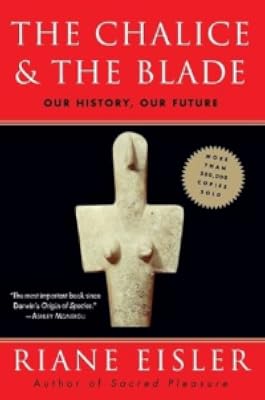
The Chalice and The Blade
by Riane Eisler
On This Page
Description
Now with an updated epilogue celebrating the 30th anniversary of this groundbreaking and increasingly relevant book. The Chalice and the Blade tells a new story of our cultural origins. It shows that warfare and the war of the sexes are neither divinely nor biologically ordained. It provides verification that a better future is possible-and is in fact firmly rooted in the haunting dramas of what happened in our past.Tags
Recommendations

























Member Reviews
The premise of The Chalice and the Blade is intriguing: author Riane Eisner posits that there were peaceful, egalitarian, Goddess-worshiping cultures before recorded history, but these exemplary societies were wiped out by cruel, male-dominated hordes that worshiped warlike, masculine gods. Eisner relies on a few archaeologists and a lot of conjecture to make her case. She equates Goddess worship with elevated status for women, and ignores examples from non-Western cultures such as Japan, China, and India, where goddesses are venerated but the position of actual women is low.
I don’t have enough knowledge of ancient civilizations to refute Eisner's thesis, but it seems to me to be oversimplified and based on too many unsupported show more assumptions and generalizations. If I had read this book as an idealistic young adult, I would have eaten it up, but now it just doesn't ring true to me. show less
I don’t have enough knowledge of ancient civilizations to refute Eisner's thesis, but it seems to me to be oversimplified and based on too many unsupported show more assumptions and generalizations. If I had read this book as an idealistic young adult, I would have eaten it up, but now it just doesn't ring true to me. show less
I enjoyed this book more than I expected to. First of all, it did NOT insist - in fact, it refuted - the notion of a matriarchal prehistory. It said nice things about the life of Jesus. But it showed what living in a hierarchal culture has done to our species and our world in very blunt terms. It also ended on a hopeful note. I would read more by this author.
A seminal, life-changing book. I cannot recommend it enough. Recent archaeology shows that during and before Crete (7000 to 3500 BC) we were a peaceful, nurturing, partnership society. Mostly vegan. Women had high status and often ruled. The great Goddess was worshipped.
Then the barbarians from the edges [like north of the Black Sea] invaded. They brought with them a dominator culture with warfare, slavery, meat eating, rule by men only and the dark ages. Women became property, like cattle. Our culture has been the same ever since.
Eisler makes a convincing argument that until we address women's issues, nothing else will improve. Similar arguments are made in _The World Peace Diet-, but he blames everything on the culture of eating meat.
Then the barbarians from the edges [like north of the Black Sea] invaded. They brought with them a dominator culture with warfare, slavery, meat eating, rule by men only and the dark ages. Women became property, like cattle. Our culture has been the same ever since.
Eisler makes a convincing argument that until we address women's issues, nothing else will improve. Similar arguments are made in _The World Peace Diet-, but he blames everything on the culture of eating meat.
When I read this it was my first encounter with revisionist feminist anthropology. Eisler makes the case women and men enjoyed equal status in Neolithic times. To support her thesis she looks at designs on ancient pottery and cave drawings. Maybe as a layperson unfamiliar with her field of study and that of her critics, I can more easily accept her theories since I don't have a vested interest in protecting any similar scholarship, as tends to happen in academic circles. Her theories are refreshing and encouraging and support the refreshing notion that women haven't always been subjugated by men but were at one time actually revered and respected.
I am grateful to have been given the opportunity to read this book. A lot of what I read in its pages changed my entire worldview and caused me to reevaluate the history of the world as I knew it through a feminist lense and to change how I felt and thought about that history. There was a lot in this book that I didn’t completely agree with but there were many parts that I was glad to have read and have reached a deeper and richer understanding of the world because of it.
The Chalice and the Blade is a book divided into two basic parts. The lion's share of the book is devoted to a detailed history of human kind comparing and contrasting the two different basic types of worship: god worship and goddess worship, worship of a dominating show more war-like god and worship of a nurturing loving goddess. The societies that practiced these are taken apart and examined and a lot of history is re-evaluated along these lines of dominator societies and equality societies.
The beginning was fascinating to read about, to hear about these societies that practiced worship of a female goddess that were run by a semi-democratic government with women making up the majority of the leadership. To hear about the research and archaeological work on these sites, the fact that they had paved roads, irrigation systems, drainage systems, and probably lived in better and cleaner cities than some people in third and fourth world countries today can boast of, eight thousand years before the birth of Christ was absolutely stunning to read about. To hear about their destruction at the hands of dominator societies, heartbreaking.
A lot of history starts to make sense once you read the beginning chapters of this book. How do we learn such amazing things and then "forget" them for centuries on end? Why does our society seem to stagnate for thousands of years at a time? What happened to the goddesses of long ago? These and more are answered and the answers make this book worth the read in my opinion.
Some of this book seems very anti-christian and anti-semitic. Those parts were a little uncomfortable to read about. It does explain why the first half of the bible is filled with war and hate and the second half peace and love. If you can hold on until chapter nine the answers will surprised you. This author is not anti-religion, just anti-hate. Jesus Christ was actually one of the first recorded, and definitely the loudest, speaker for the support of love and equality of all people. After reading the chapters that came before, you realize how amazing it is that he spoke the way he did in the time and society that he did. It was pure blasphemy.
A lot of the coverage of the more recent history I didn't really agree with. This happened a few times in the earlier chapters but it happened a lot later. It seemed like the author just went too far and tried to draw the lines of comparison too much and in places where they didn't belong. Was there a hatred that sparked Jesus' disciples to try and oust the women placed in positions of leadership in the church? Yes. Was the same hatred of women and their gaining of equality and rights what helped spark World War I and II? Not so much. Her expertise is clearly with the former and not the later.
In spite of that and the ending, which seemed to me to have lost its way, this was a powerful and enlightening book. Read it for the first three quarters if nothing else. The new insight and the new worldview you will gain about the history of god and goddess worshiping cultures makes it worth it. Just be prepared to switch gears once she gets beyond her realm of expertise as she does stumble in the last few chapters, and by the end finds that while this new understanding can change how we view our past not even she can come up with a way for it to help guide our future. Many questions are answered in this book, but some we just have to answer for ourselves. show less
The Chalice and the Blade is a book divided into two basic parts. The lion's share of the book is devoted to a detailed history of human kind comparing and contrasting the two different basic types of worship: god worship and goddess worship, worship of a dominating show more war-like god and worship of a nurturing loving goddess. The societies that practiced these are taken apart and examined and a lot of history is re-evaluated along these lines of dominator societies and equality societies.
The beginning was fascinating to read about, to hear about these societies that practiced worship of a female goddess that were run by a semi-democratic government with women making up the majority of the leadership. To hear about the research and archaeological work on these sites, the fact that they had paved roads, irrigation systems, drainage systems, and probably lived in better and cleaner cities than some people in third and fourth world countries today can boast of, eight thousand years before the birth of Christ was absolutely stunning to read about. To hear about their destruction at the hands of dominator societies, heartbreaking.
A lot of history starts to make sense once you read the beginning chapters of this book. How do we learn such amazing things and then "forget" them for centuries on end? Why does our society seem to stagnate for thousands of years at a time? What happened to the goddesses of long ago? These and more are answered and the answers make this book worth the read in my opinion.
Some of this book seems very anti-christian and anti-semitic. Those parts were a little uncomfortable to read about. It does explain why the first half of the bible is filled with war and hate and the second half peace and love. If you can hold on until chapter nine the answers will surprised you. This author is not anti-religion, just anti-hate. Jesus Christ was actually one of the first recorded, and definitely the loudest, speaker for the support of love and equality of all people. After reading the chapters that came before, you realize how amazing it is that he spoke the way he did in the time and society that he did. It was pure blasphemy.
A lot of the coverage of the more recent history I didn't really agree with. This happened a few times in the earlier chapters but it happened a lot later. It seemed like the author just went too far and tried to draw the lines of comparison too much and in places where they didn't belong. Was there a hatred that sparked Jesus' disciples to try and oust the women placed in positions of leadership in the church? Yes. Was the same hatred of women and their gaining of equality and rights what helped spark World War I and II? Not so much. Her expertise is clearly with the former and not the later.
In spite of that and the ending, which seemed to me to have lost its way, this was a powerful and enlightening book. Read it for the first three quarters if nothing else. The new insight and the new worldview you will gain about the history of god and goddess worshiping cultures makes it worth it. Just be prepared to switch gears once she gets beyond her realm of expertise as she does stumble in the last few chapters, and by the end finds that while this new understanding can change how we view our past not even she can come up with a way for it to help guide our future. Many questions are answered in this book, but some we just have to answer for ourselves. show less
I guess it's a sign of how well these ideas have been disseminated since this book was published that I found nothing all that new to me here. (Or maybe it's just because I live in Northern California...)But it's always welcome to hear evidence that human history hasn't just been a straight line of organized violence from the African savannah to Pax Americana.
While I do not agree with all the exact speculations and facts Eisler presents in this book, she does an excellent job of exploring certain themes I am very interested in at the moment. In other words, this book has gifted me with the vocabulary to properly discuss (probably mostly with myself) the problems I have with society at large, and for that I am thankful.
Members
- Recently Added By
Published Reviews
An ambitious new synthesis....[Eisler's] rigorous research... traces the unseen forces that shape human culture.
added by Jayfeather55
Validates a belief in humanity's capacity for benevolence and cooperation in the face of so much... destruction. Eisler has brought the scope of feminist scholarship out of the ghetto.
added by Jayfeather55
The greatest murder mystery and cover-up of all time
added by Jayfeather55
Lists

Books Read in 2017
4,249 works; 129 members

Books That Changed Our Perspective
423 works; 168 members

Healing resources for women
587 works; 1 member
Author Information

22+ Works 2,766 Members
Riane Eisler is president of the Center for Partnership Studies and author of The Chalice and the Blade, Sacred Pleasure, Tomorrow's Children, and The Power of Partnership
Some Editions
Awards and Honors
Notable Lists
Common Knowledge
- Canonical title
- The Chalice and The Blade
- Original title
- The Chalice and the Blade: Our History, Our Future
- Original publication date
- 1987
- Dedication
- To David Loye,
my partner in life and work - First words
- Preserved in a cave sanctuary for over twenty thousand years, a female figure speaks to us about the minds of our early Western ancestors.
- Quotations
- We alone can imagine and realize new realities, and so are partners in our own evolution. [xiv]
The story of Jesus' birth, death, and resurrection bears a striking resemblance to those of earlier 'mystery cults' revolving around a divine Mother and her son...or daughter as in Demeter and Kore.[xvi].
When our ancestors began to ask the eternal questions (Where do we come from before we are born? Where do we go after we die?), they must have noted that life emerges from the body of a woman. [xvi]
From re-examining human society from a gender-holistic perspective, a new theory of cultural evolution is necessary....Cultural Transformation theory, with two basic models: (1) Dominator -- involves ranking humanity, (2) Par... (show all)tnership--in which linking is the principle.
In this model--beginning with the most fundamental difference in our species, between male and female--diversity is not equated with either inferiority or superiority.[xviii]
We now stand at a potentially decisive branching point. At a time when the lethal power of the Blade--amplified a millionfold by megatons of nuclear warheads--threatens to put an end to all human culture…. [xviii]
Movements for social justice are part of an underlying thrust for transformation of a dominator to a partnership system. These movements may be seen as part of our species' evolutionary thrust for survival. [xx]
We stand again at a cross-road. The roots of our present global crises go back to the fundamental shift in our prehistory that brought enormous changes not only in social structure but also in technology. [xx] - Last words
- (Click to show. Warning: May contain spoilers.)And after the bloody detour of androcratic history, both women and men will at last find out what being human can mean.
- Blurbers
- Montagu, Ashley; Gimbutas, Marija; Platon, Nicolas; Tilly, Charles; Miller, Jean Baker; Walker, Barbara (show all 14); Stone, Merlin; Laszlo, Ervin; Wilshire, Bruce; Orenstein, Gloria; Muller, Robert; Capra, Fritjof; Bernard, Jessie; Ellsberg, Daniel
- Original language
- English
Classifications
- Genres
- Anthropology, Nonfiction, Sexuality and Gender Studies, General Nonfiction, History, Religion & Spirituality
- DDC/MDS
- 305.309 — Society, government, & culture Social sciences, sociology & anthropology Social group - Age, Gender, Ethnicity People by gender or sex Biography and History by Region
- LCC
- HQ1075 .E57 — Social sciences The family. Marriage, Women and Sexuality The Family. Marriage. Women Sex role
- BISAC
Statistics
- Members
- 2,038
- Popularity
- 10,228
- Reviews
- 34
- Rating
- (3.93)
- Languages
- 10 — English, Finnish, French, German, Italian, Norwegian (Bokmål), Norwegian, Portuguese, Spanish, Swedish
- Media
- Paper, Audiobook, Ebook
- ISBNs
- 26
- ASINs
- 10