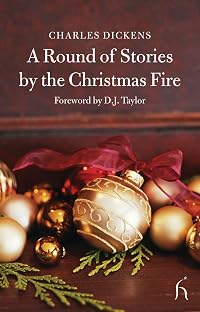
A Round of Stories by the Christmas Fire
by Charles Dickens, Edmund Saul Dixon, Elizabeth Gaskell, Eliza Griffiths, Harriet Martineau, Edmund Ollier, Samuel Sidney, William Moy Thomas
Christmas Number (1852)
On This Page
Description
Published in its entirety for the first time since 1852, this shining collection of Christmas tales was originally selected by Charles Dickens for his periodical Household Words. Each story varies in theme and tone, with scenes of romance, theft, justice, and heart-warming family reunions set alongside haunting tales and chilling ghost stories, while topics addressed range from the meaning of Christmas to disability and race. Contributing authors include Elizabeth Gaskell, Edmund Saul Dixon, show more Edmund Oliver, and of course Dickens himself, making this a brilliant example of Victorian storytelling and an insightful reflection on the holiday season during the 19th century. show lessTags
Recommendations















Member Reviews
I read these over the last couple weeks and wasn't super impressed with most of them. I think I could have liked the Gaskell one but kept falling asleep due to sheer exhaustion of the holidays. Perhaps that would have been the case with the others, too, had I tried a little harder to stay awake! Most of these are not centered around Christmas so can actually be enjoyed any time of year without needed to be in the "Christmas spirit". I'll give it another go in later years, I'm sure.
Ratings
Members
- Recently Added By
Author Information

2,578+ Works 313,139 Members
Charles Dickens, perhaps the best British novelist of the Victorian era, was born in Portsmouth, Hampshire, England on February 7, 1812. His happy early childhood was interrupted when his father was sent to debtors' prison, and young Dickens had to go to work in a factory at age twelve. Later, he took jobs as an office boy and journalist before show more publishing essays and stories in the 1830s. His first novel, The Pickwick Papers, made him a famous and popular author at the age of twenty-five. Subsequent works were published serially in periodicals and cemented his reputation as a master of colorful characterization, and as a harsh critic of social evils and corrupt institutions. His many books include Oliver Twist, David Copperfield, Bleak House, Great Expectations, Little Dorrit, A Christmas Carol, and A Tale of Two Cities. Dickens married Catherine Hogarth in 1836, and the couple had nine children before separating in 1858 when he began a long affair with Ellen Ternan, a young actress. Despite the scandal, Dickens remained a public figure, appearing often to read his fiction. He died in 1870, leaving his final novel, The Mystery of Edwin Drood, unfinished. (Bowker Author Biography) show less
4 Works 69 Members

231+ Works 30,509 Members
Elizabeth Gaskell was born on September 29, 1810 to a Unitarian clergyman, who was also a civil servant and journalist. Her mother died when she was young, and she was brought up by her aunt in Knutsford, a small village that was the prototype for Cranford, Hollingford and the setting for numerous other short stories. In 1832, she married William show more Gaskell, a Unitarian clergyman in Manchester. She participated in his ministry and collaborated with him to write the poem Sketches among the Poor in 1837. Our Society at Cranford was the first two chapters of Cranford and it appeared in Dickens' Household Words in 1851. Dickens liked it so much that he pressed Gaskell for more episodes, and she produced eight more of them between 1852 and 1853. She also wrote My Lady Ludlow and Lois the Witch, a novella that concerns the Salem witch trials. Wives and Daughters ran in Cornhill from August 1864 to January 1866. The final installment was never written but the ending was known and the novel exists now virtually complete. The story centers on a series of relationships between family groups in Hollingford. Most critics agree that her greatest achievement is the short novel Cousin Phillis. Gaskell was also followed by controversy. In 1853, she offended many readers with Ruth, which explored seduction and illegitimacy that led the "fallen woman" into ostracism and inevitable prostitution. The novel presents the social conduct in a small community when tolerance and morality clash. Critics praised the novel's moral lessons but Gaskell's own congregation burned the book and it was banned in many libraries. In 1857, The Life of Charlotte Brontë was published. The biography was initially praised but angry protests came from some of the people it dealt with. Gaskell was against any biographical notice of her being written during her lifetime. After her death on November 12, 1865, her family refused to make family letters or biographical data available. (Bowker Author Biography) show less
2+ Works 39 Members

112+ Works 823 Members
Martineau, from a devout and strict Unitarian family in Norwich, was born without the sense either of taste or of smell and, by the age of 12, showed signs of severe deafness. Throughout the early years of her life, she battled poverty and illness. At her mother's insistence, Martineau was educated, at first at home by her brothers and then for a show more short time at school. Because her loss of hearing became worse, she was sent home. Within a space of about three years during the late 1820's, Martineau's favorite brother, Thomas, died; her father lost his fortune and died; and her fiance became insane and died. By 1829, the last of the family money was gone, and she was reduced to helping support her mother and sisters with her needlework. At about this time, she began to review for the Unitarian periodical The Monthly Repository and in 1831 won all three prizes in the magazine's contest for the best essays on the conversion of Catholics, Jews, and Muslims. During 1832-33,she published the tales "Illustrations of Political Economy" and its sequel, "Poor Laws and Paupers," in monthly parts. Despite their pointed didacticism, the works were a tremendous success. Other works of fiction followed. In 1839, she published her first novel, "Deerbrook," and, three years later, her fictionalized biography of Toussaint L'Ouverture, "The Hour and the Man," appeared. Despite her forays into fiction, however, Martineau is better known today for her historical, political, and philosophical writings. Early in her career, she was influenced by the classical economies of David Ricardo and Thomas Malthus. She was friends with Edwin Chadwick and James Kay-Shuttleworth, and acquainted with John Stuart Mill. A strong, often radical proponent of utilitarian reform, early in her career she wrote a number of instructive texts that advocated the same curriculum for men and women. By the mid 1840's, Martineau had completely thrown off her Unitarianism and in 1851, published her antitheological "Laws of Man's Social Nature." Some good work has been done on Martineau's life and writings, especially on the political aspects of her public life. Books on Martineau as a literary artist are scarcer; Deirdre David's "Intellectual Women and Victorian Patriarchy" (1987) contains an excellent discussion of Martineau, and Valerie Sanders's "Reason over Passion" (1986) discusses Martineau as a novelist. One of the most insightful books on Martineau, and one of the most readable, is her own Autobiography (1877). (Bowker Author Biography) show less
16+ Works 67 Members
8 Works 89 Members
2+ Works 38 Members
Some Editions
Series

Belongs to Publisher Series
Work Relationships
Common Knowledge
- Canonical title
- A Round of Stories by the Christmas Fire
- Original publication date
- 1852
Classifications
Statistics
- Members
- 37
- Popularity
- 780,267
- Reviews
- 1
- Rating
- (3.36)
- Languages
- English
- Media
- Paper, Ebook
- ISBNs
- 4