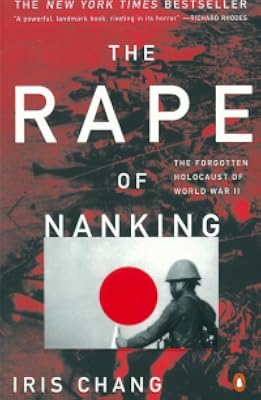
The Rape of Nanking
by Iris Chang
On This Page
Description
In December 1937, one of the most brutal massacres in the long annals of wartime barbarity occurred in the capital of China. The Japanese army swept into Nanking and not only looted and burned the defenseless city but systematically raped, tortured, and murdered half of the city's remaining population, some 300,000 Chinese civilians. Amazingly, the account of this atrocity was denied by the Japanese government. The Rape of Nanking tells the story from three perspectives: that of the Japanese show more soldiers who performed it, of the Chinese civilians who endured it, and finally, that of a group of Europeans and Americans who refused to abandon the city and were able to create a safety zone that saved almost 300,000 Chinese. Among these was John Rabe, the tireless German leader of the rescue effort, whom Iris Chang called the "Oskar Schindler of China.". show lessTags
Recommendations







Member Recommendations

Member Reviews
For far too long I held off reading this seminal work. I didn't know whether I could stomach the violence and pain. I also thought the book would be much longer. On both counts, I was wrong. Chang expertly manages to convey the murderous brutality of the Japanese soldiers and their commanders in a way that shocks your conscience but doesn't turn your stomach. In its little more than 200 pages of actual text, it is a masterwork of concision that supplies just the right amount of information to follow the chain of events, to present the actors, their victims and, most importantly, the bystanders in situ and abroad.
Chang pays tribute to the heroic efforts of the local expatriates community and reporters, especially the good Nazi John Rabe, show more the intrepid Americans doctor Robert Wilson and school mistress Minnie Vautrin (I recommend the 2009 biopic "John Rabe" with Ulrich Tukur and Steve Buscemi). In contrast to the UN safe area at Srebrenica in 1995, the International Nanking Safety Zone (barely and insufficiently) protected most of the local population which managed to reach it, stay within its borders and evade Japanese intruders. The Japanese level of atrocities and the bestial brutality in their execution is truly shocking.
Still more shocking is the fact that the perpetrators mostly managed to evade justice, while the victims and their helpers did not receive justice and compensation. The Rape of Nanking is but one among a large number of massacres the world chose to look away and not hold the perpetrators accountable for their war crimes. For the over 200.000 deaths, only two people were convicted in the International Military Tribunal for the Far East. Four more were convicted in the Nanjing War Crimes Tribunal (one the convicted was sheltered after the trial by Chiang Kai-Shek!). Chang shows in the Japanese case that "Looking forward, not backward" is a bad strategy in dealing with war crimes (also supported by the lack of accountability caused by the much less vigorous denazification policies in Austria compared to Germany). Amazingly, Japan never paid any war reparations to both Chinas.
A must read. show less
Chang pays tribute to the heroic efforts of the local expatriates community and reporters, especially the good Nazi John Rabe, show more the intrepid Americans doctor Robert Wilson and school mistress Minnie Vautrin (I recommend the 2009 biopic "John Rabe" with Ulrich Tukur and Steve Buscemi). In contrast to the UN safe area at Srebrenica in 1995, the International Nanking Safety Zone (barely and insufficiently) protected most of the local population which managed to reach it, stay within its borders and evade Japanese intruders. The Japanese level of atrocities and the bestial brutality in their execution is truly shocking.
Still more shocking is the fact that the perpetrators mostly managed to evade justice, while the victims and their helpers did not receive justice and compensation. The Rape of Nanking is but one among a large number of massacres the world chose to look away and not hold the perpetrators accountable for their war crimes. For the over 200.000 deaths, only two people were convicted in the International Military Tribunal for the Far East. Four more were convicted in the Nanjing War Crimes Tribunal (one the convicted was sheltered after the trial by Chiang Kai-Shek!). Chang shows in the Japanese case that "Looking forward, not backward" is a bad strategy in dealing with war crimes (also supported by the lack of accountability caused by the much less vigorous denazification policies in Austria compared to Germany). Amazingly, Japan never paid any war reparations to both Chinas.
A must read. show less
This was one book that I had avoided reading for as long as I’ve known of its existence – having small amounts of personal history intertwined in its contents. Alas, the time has arrived, and the book does not disappoint.
I do thank Iris Chang (and probably her editor) in the thoughtful and careful layout of book. By first providing selected Japanese cultural history, this book unfolded in a logical flow: addressing the events chronologically, providing viewpoints on motives, describing the key players – before, during, and after whenever possible, and denoting the history that was known or not known by the world and challenged by various countries’ government. While I have known selected details, the atrocities still proved to show more be horrifying, the courage uplifting, and the denial despicable.
I won’t attempt to simplify the amazing details in the book nor will I repeat the gruesome killings, tortures, rapes of women, and experimental ‘medical’ research. Instead, I’ll note other areas:
From Oxford historian Rana Mitter – a bit on ‘why’:
“There was a deep ambivalence in Japanese society about China. It was not all racist contempt, as it was for the Koreans: on the one hand, they recognized China as a source of culture that they had drawn on heavily; on the other, they were exasperated by the mess that China was in by the early twentieth century.”
The order to eliminate all Chinese captives:
“There was a ruthless logic to the order. The captives could not be fed, so they had to be destroyed. Killing them would not only eliminate the food problem but diminish the possibility of retaliation. Moreover, dead enemies could not form up into guerrilla forces.”
Many who were never punished – wtf! (Can I say that in a book review?):
“Unlike their Nazi counterparts, who have mostly perished in prisons and before execution squads or, if alive, are spending their remaining days as fugitives from the law, many of the Japanese war criminals are still alive, living in peace and comfort, protected by the Japanese government.” -- including the entire Imperial Hirohito family, who were given immunity from war responsibility. (wtf again)
Desensitization training:
“New candidate officers underwent intensive training to stiffen their endurance for war. In the program an instructor had pointed to a thin, emaciated Chinese in a detention center and told the officers: ‘These are the raw materials for your trial of courage.’ Day after day the instructor taught them how to cut off heads and bayonet living prisoners.”
From R. J. Rummel, “one of the world’s greatest authority on democide (a term he coined to include both genocide and government mass murder)”. These words ringed so loudly in so many aspects of history:
“Power kills, and absolute power kills absolutely.”
I also applaud the book for thoroughly addressing the Safety Zone that was created and protected by a mere 22 foreigners. What incredible courage and strength! For some, the horror they witnessed never stopped haunting them.
Her Introduction ended with the American Philosopher, George Santayana’s quote: Those who cannot remember the past are condemned to repeat it (from "Life of Reason I"). Her book now serves as an important monument in our historical timeline – to prevent similar history from repeating itself. Coincidentally, this is one of my favorite quotes. show less
I do thank Iris Chang (and probably her editor) in the thoughtful and careful layout of book. By first providing selected Japanese cultural history, this book unfolded in a logical flow: addressing the events chronologically, providing viewpoints on motives, describing the key players – before, during, and after whenever possible, and denoting the history that was known or not known by the world and challenged by various countries’ government. While I have known selected details, the atrocities still proved to show more be horrifying, the courage uplifting, and the denial despicable.
I won’t attempt to simplify the amazing details in the book nor will I repeat the gruesome killings, tortures, rapes of women, and experimental ‘medical’ research. Instead, I’ll note other areas:
From Oxford historian Rana Mitter – a bit on ‘why’:
“There was a deep ambivalence in Japanese society about China. It was not all racist contempt, as it was for the Koreans: on the one hand, they recognized China as a source of culture that they had drawn on heavily; on the other, they were exasperated by the mess that China was in by the early twentieth century.”
The order to eliminate all Chinese captives:
“There was a ruthless logic to the order. The captives could not be fed, so they had to be destroyed. Killing them would not only eliminate the food problem but diminish the possibility of retaliation. Moreover, dead enemies could not form up into guerrilla forces.”
Many who were never punished – wtf! (Can I say that in a book review?):
“Unlike their Nazi counterparts, who have mostly perished in prisons and before execution squads or, if alive, are spending their remaining days as fugitives from the law, many of the Japanese war criminals are still alive, living in peace and comfort, protected by the Japanese government.” -- including the entire Imperial Hirohito family, who were given immunity from war responsibility. (wtf again)
Desensitization training:
“New candidate officers underwent intensive training to stiffen their endurance for war. In the program an instructor had pointed to a thin, emaciated Chinese in a detention center and told the officers: ‘These are the raw materials for your trial of courage.’ Day after day the instructor taught them how to cut off heads and bayonet living prisoners.”
From R. J. Rummel, “one of the world’s greatest authority on democide (a term he coined to include both genocide and government mass murder)”. These words ringed so loudly in so many aspects of history:
“Power kills, and absolute power kills absolutely.”
I also applaud the book for thoroughly addressing the Safety Zone that was created and protected by a mere 22 foreigners. What incredible courage and strength! For some, the horror they witnessed never stopped haunting them.
Her Introduction ended with the American Philosopher, George Santayana’s quote: Those who cannot remember the past are condemned to repeat it (from "Life of Reason I"). Her book now serves as an important monument in our historical timeline – to prevent similar history from repeating itself. Coincidentally, this is one of my favorite quotes. show less
A well-researched and thorough history of one of history's lesser known war crimes. It is now somewhat dated, as I think the events in Nanking after the Japanese invasion of 1937 are more widely known and acknowledged, thanks in large part to Chang's work. While the details of the mass murder and rapes are harrowing, I found her examination of Japanese denials and refusal to admit wrong-doing more interesting (and less traumatic to read about).
Why did I never learn about this in school? How come the first I ever heard of “The Rape of Nanking” was when I happened to stumble across the book title on my Goodreads recommendations?
It disheartens me to learn that this part of history is heavily censored and covered up in other countries - but I was freely educated in America and it didn’t seem to make a difference.
This book eventually found its way to me, yes, but only because I happen to actively seek out history books - friends and family have never heard of this.
In school we learn plenty about the Holocaust, so why do I not remember learning anything about Japanese war crimes and atrocities during WWII that horrified even the Nazis?
Perhaps it is because Germany show more actively acknowledges and tries to make amends for their past, whereas Japan still refuses to admit any wrongdoing. Why are we still letting it slip through the cracks?
This book is very (emotionally) difficult to read, more so as a woman, and I had to pace myself through it. I vividly remember lying in bed with my eyes squeezed shut, listening to the audiobook, body fully tensed, and mentally whispering/praying to myself “Jesus, Jesus, Jesus…” as the tears slipped out. Because there are just no other words. show less
It disheartens me to learn that this part of history is heavily censored and covered up in other countries - but I was freely educated in America and it didn’t seem to make a difference.
This book eventually found its way to me, yes, but only because I happen to actively seek out history books - friends and family have never heard of this.
In school we learn plenty about the Holocaust, so why do I not remember learning anything about Japanese war crimes and atrocities during WWII that horrified even the Nazis?
Perhaps it is because Germany show more actively acknowledges and tries to make amends for their past, whereas Japan still refuses to admit any wrongdoing. Why are we still letting it slip through the cracks?
This book is very (emotionally) difficult to read, more so as a woman, and I had to pace myself through it. I vividly remember lying in bed with my eyes squeezed shut, listening to the audiobook, body fully tensed, and mentally whispering/praying to myself “Jesus, Jesus, Jesus…” as the tears slipped out. Because there are just no other words. show less
This book describes one of the most brutal massacres of innocent civilians and unarmed soldiers in the history of modern warfare. In December of 1937, before the official start date of World War 2, Japan had already begun it's attempt to create what it called the Greater East Asia Co Prosperity Sphere - or a Japanese Empire, by invading mainland China and it's invading armies had entered into the city of Nanking. The city was abandoned but not everyone had the time to get out before the arrival of the Japanese troops. With the capture of the city and tens of thousands of surrendered Chinese soldiers, the Japanese decided to eliminate the prisoners in a vast orgy of murder, gang rape, torture, and the most appalling scene of sadism show more possibly imaginable.
From a prewar population of about 1.2 million people, it is estimated that about half escaped the city before the
Japanese arrived. About half of who was left found shelter, more or less, in an area of Nanking marked off by American and German diplomats as a safety zone (remember, this was before we entered the war). But before the killings subsided, it is estimated that the Japanese slaughtered about 300,000 people, men, women, and children. Re-read that statistic again. Of the roughly 600,000 left in the city, some 300,000 found refuge in the Safety Zone and some 300,000 were killed. The author estimates that during the entire war with China (1937 - 1945) Japan was responsible for killing about 19 million Chinese.
At the time that Iris Chang began to research this book, Japan had not apologized for these killings and in many instances had not even acknowledged that it had occurred. The Japanese public during the war and even afterwards were not informed of it, and to publicize this action was one goal. "In the early 1990s a newspaper article quoted a Japanese high school teacher who claimed that his students were surprised to learn that Japan had been at war with the United States. The first thing they wanted to know was who won." (p.205). Hence the subtitle:"The Forgotten Holocaust of World War II." However, by the time the book was published in 1997, that had begun to change which she acknowledged in her Epilogue.
She also insists that Japan needs to apologize in order to fully take her place among the nations of the world today. Again, since she began research on this book, Japan has, of sorts, done so, especially beginning in 1995, although few specifically mention by name the city of Nanking: https://en.wikipedia.org/wiki/List_of_war_apology_statements_issued_by_Japan
She specifically credits certain American newspaper reporters operating within the International Safety Zone for reporting to the world, at great risks to their own lives, the massacre as it was in progress. This was in contrast to the strictly controlled newspaper releases by state operated news outlets of the Japanese. I mention this now because of the importance of maintaining a press free from government censure or even pressure to conform to governmental expectations (fake news - not the right answer, etc).
After the war, Japanese war criminals were divided into three classes - A, B, and C, with "A" being the worst. Very few Class A criminals were executed and Emperor Hirohito himself was left unmolested and as a figurehead Emperor. The reason for this was, of course, the looming Cold War with Communism and the Soviet Union. Japan's strategic position was viewed with importance and her post war friendship was courted. This angered many, many people, especially among the Chinese. But Americans and Japanese became buddy-buddies, and, after 1949, Americans and Chinese became enemies following their Communist revolution. If politics makes strange bed-fellows, International politics makes even stranger bed-fellows.
If you decide to read this book be advised, it is a gut-wrenching read. I had to stop several times just to breathe. show less
From a prewar population of about 1.2 million people, it is estimated that about half escaped the city before the
Japanese arrived. About half of who was left found shelter, more or less, in an area of Nanking marked off by American and German diplomats as a safety zone (remember, this was before we entered the war). But before the killings subsided, it is estimated that the Japanese slaughtered about 300,000 people, men, women, and children. Re-read that statistic again. Of the roughly 600,000 left in the city, some 300,000 found refuge in the Safety Zone and some 300,000 were killed. The author estimates that during the entire war with China (1937 - 1945) Japan was responsible for killing about 19 million Chinese.
At the time that Iris Chang began to research this book, Japan had not apologized for these killings and in many instances had not even acknowledged that it had occurred. The Japanese public during the war and even afterwards were not informed of it, and to publicize this action was one goal. "In the early 1990s a newspaper article quoted a Japanese high school teacher who claimed that his students were surprised to learn that Japan had been at war with the United States. The first thing they wanted to know was who won." (p.205). Hence the subtitle:"The Forgotten Holocaust of World War II." However, by the time the book was published in 1997, that had begun to change which she acknowledged in her Epilogue.
She also insists that Japan needs to apologize in order to fully take her place among the nations of the world today. Again, since she began research on this book, Japan has, of sorts, done so, especially beginning in 1995, although few specifically mention by name the city of Nanking: https://en.wikipedia.org/wiki/List_of_war_apology_statements_issued_by_Japan
She specifically credits certain American newspaper reporters operating within the International Safety Zone for reporting to the world, at great risks to their own lives, the massacre as it was in progress. This was in contrast to the strictly controlled newspaper releases by state operated news outlets of the Japanese. I mention this now because of the importance of maintaining a press free from government censure or even pressure to conform to governmental expectations (fake news - not the right answer, etc).
After the war, Japanese war criminals were divided into three classes - A, B, and C, with "A" being the worst. Very few Class A criminals were executed and Emperor Hirohito himself was left unmolested and as a figurehead Emperor. The reason for this was, of course, the looming Cold War with Communism and the Soviet Union. Japan's strategic position was viewed with importance and her post war friendship was courted. This angered many, many people, especially among the Chinese. But Americans and Japanese became buddy-buddies, and, after 1949, Americans and Chinese became enemies following their Communist revolution. If politics makes strange bed-fellows, International politics makes even stranger bed-fellows.
If you decide to read this book be advised, it is a gut-wrenching read. I had to stop several times just to breathe. show less
”Almost all people have this potential for evil, which would be unleashed only under certain dangerous social circumstances.”
A beloved European friend, who’s currently living in Changzhou, has been pestering me to read this book for months. I was unwilling. Of course, History is my greatest love and I was extremely familiar with the tragedy of Nanjing the capital of China at the time- through documentaries and films. This is exactly why I hadn’t read Iris Chang’s book. I couldn’t bear to visualize the scenes of destruction and utter brutality in my mind. Even the Wikipedia page narrating the slaughters is a place of horror. However, I thought that maybe the time had finally come and I ventured…
What kind of review can I show more possibly write now? There are times that I feel my words lose all meaning…The book chronicles the atrocities committed by the Japanese invaders after the fall of the city on 13/12/1937. The estimated victims? 300,000 people over a period of six weeks….The writing is detailed, powerful, razor-sharp. The horror comes through the pages not because the writer intended to shock but because the events described have no need for embellishment or sensationalist language. The violence, the ordeal, the brutality of the attacks, the behaviour of the monsters, the paranoia. Women and children, innocent civilians, meeting a fate and an end that no one is able to imagine. I feel that each sentence I am writing falls short, remains meaningless, devoid of any substance. It is impossible to enclose and communicate the feelings caused in me while I was reading Chang’s book. The anger, the hatred, the despair…It’s like a journey to a Hell that no religion has ever conceived, a pit of blood and madness that leaves you hopeless, empty, frozen….
And in the end? And now? So many eulogies, so many times mankind has uttered ”never again”. And the result? Nothing. Purely nothing. We loudly and wildly proclaim ”never another Holocaust, another Somme, another Vietnam, another Nanjing…”’ Empty words and evil deeds are the banes of History. I often feel the human race has learnt nothing from its darkest moments. We live through endless repetitions of horrors (in various degrees and forms), watching today’s ”elected” dictators giving speeches, ruling lives….I don’t care about political or religious issues, I don’t care about political correctness. This isn’t about power or international relationships. This is about the sheer brutality that lives in every human being, waiting for a chance to come forth and attack and the natural tendencies exploited by those in power all over the world, throughout the course of History. How can one stop this? The answer is yet to be found…. show less
A beloved European friend, who’s currently living in Changzhou, has been pestering me to read this book for months. I was unwilling. Of course, History is my greatest love and I was extremely familiar with the tragedy of Nanjing the capital of China at the time- through documentaries and films. This is exactly why I hadn’t read Iris Chang’s book. I couldn’t bear to visualize the scenes of destruction and utter brutality in my mind. Even the Wikipedia page narrating the slaughters is a place of horror. However, I thought that maybe the time had finally come and I ventured…
What kind of review can I show more possibly write now? There are times that I feel my words lose all meaning…The book chronicles the atrocities committed by the Japanese invaders after the fall of the city on 13/12/1937. The estimated victims? 300,000 people over a period of six weeks….The writing is detailed, powerful, razor-sharp. The horror comes through the pages not because the writer intended to shock but because the events described have no need for embellishment or sensationalist language. The violence, the ordeal, the brutality of the attacks, the behaviour of the monsters, the paranoia. Women and children, innocent civilians, meeting a fate and an end that no one is able to imagine. I feel that each sentence I am writing falls short, remains meaningless, devoid of any substance. It is impossible to enclose and communicate the feelings caused in me while I was reading Chang’s book. The anger, the hatred, the despair…It’s like a journey to a Hell that no religion has ever conceived, a pit of blood and madness that leaves you hopeless, empty, frozen….
And in the end? And now? So many eulogies, so many times mankind has uttered ”never again”. And the result? Nothing. Purely nothing. We loudly and wildly proclaim ”never another Holocaust, another Somme, another Vietnam, another Nanjing…”’ Empty words and evil deeds are the banes of History. I often feel the human race has learnt nothing from its darkest moments. We live through endless repetitions of horrors (in various degrees and forms), watching today’s ”elected” dictators giving speeches, ruling lives….I don’t care about political or religious issues, I don’t care about political correctness. This isn’t about power or international relationships. This is about the sheer brutality that lives in every human being, waiting for a chance to come forth and attack and the natural tendencies exploited by those in power all over the world, throughout the course of History. How can one stop this? The answer is yet to be found…. show less
* Any comments regarding politics will be dealt with. Flagged, blocked, accompanied by one of my endlessly innovative insults. Take your political opinions elsewhere, the few of you who think this is bloody Facebook. I'm not interested.
”Almost all people have this potential for evil, which would be unleashed only under certain dangerous social circumstances.”
A beloved European friend, who’s currently living in Changzhou, has been pestering me to read this book for months. I was unwilling. Of course, History is my greatest love and I was extremely familiar with the tragedy of Nanjing the capital of China at the time- through documentaries and films. This is exactly why I hadn’t read Iris Chang’s book. I couldn’t bear to show more visualize the scenes of destruction and utter brutality in my mind. Even the Wikipedia page narrating the slaughters is a place of horror. However, I thought that maybe the time had finally come and I ventured…
What kind of review can I possibly write now? There are times that I feel my words lose all meaning…The book chronicles the atrocities committed by the Japanese invaders after the fall of the city on 13/12/1937. The estimated victims? 300,000 people over a period of six weeks….The writing is detailed, powerful, razor-sharp. The horror comes through the pages not because the writer intended to shock but because the events described have no need for embellishment or sensationalist language. The violence, the ordeal, the brutality of the attacks, the behaviour of the monsters, the paranoia. Women and children, innocent civilians, meeting a fate and an end that no one is able to imagine. I feel that each sentence I am writing falls short, remains meaningless, devoid of any substance. It is impossible to enclose and communicate the feelings caused in me while I was reading Chang’s book. The anger, the hatred, the despair…It’s like a journey to a Hell that no religion has ever conceived, a pit of blood and madness that leaves you hopeless, empty, frozen….
And in the end? And now? So many eulogies, so many times mankind has uttered ”never again”. And the result? Nothing. Purely nothing. We loudly and wildly proclaim ”never another Holocaust, another Somme, another Vietnam, another Nanjing…”’ Empty words and evil deeds are the banes of History. I often feel the human race has learnt nothing from its darkest moments. We live through endless repetitions of horrors (in various degrees and forms), watching today’s ”elected” dictators giving speeches, ruling lives….I don’t care about political or religious issues, I don’t care about political correctness. This isn’t about power or international relationships. This is about the sheer brutality that lives in every human being, waiting for a chance to come forth and attack and the natural tendencies exploited by those in power all over the world, throughout the course of History. How can one stop this? The answer is yet to be found….
My reviews can also be found on https://theopinionatedreaderblog.wordpress.com show less
”Almost all people have this potential for evil, which would be unleashed only under certain dangerous social circumstances.”
A beloved European friend, who’s currently living in Changzhou, has been pestering me to read this book for months. I was unwilling. Of course, History is my greatest love and I was extremely familiar with the tragedy of Nanjing the capital of China at the time- through documentaries and films. This is exactly why I hadn’t read Iris Chang’s book. I couldn’t bear to show more visualize the scenes of destruction and utter brutality in my mind. Even the Wikipedia page narrating the slaughters is a place of horror. However, I thought that maybe the time had finally come and I ventured…
What kind of review can I possibly write now? There are times that I feel my words lose all meaning…The book chronicles the atrocities committed by the Japanese invaders after the fall of the city on 13/12/1937. The estimated victims? 300,000 people over a period of six weeks….The writing is detailed, powerful, razor-sharp. The horror comes through the pages not because the writer intended to shock but because the events described have no need for embellishment or sensationalist language. The violence, the ordeal, the brutality of the attacks, the behaviour of the monsters, the paranoia. Women and children, innocent civilians, meeting a fate and an end that no one is able to imagine. I feel that each sentence I am writing falls short, remains meaningless, devoid of any substance. It is impossible to enclose and communicate the feelings caused in me while I was reading Chang’s book. The anger, the hatred, the despair…It’s like a journey to a Hell that no religion has ever conceived, a pit of blood and madness that leaves you hopeless, empty, frozen….
And in the end? And now? So many eulogies, so many times mankind has uttered ”never again”. And the result? Nothing. Purely nothing. We loudly and wildly proclaim ”never another Holocaust, another Somme, another Vietnam, another Nanjing…”’ Empty words and evil deeds are the banes of History. I often feel the human race has learnt nothing from its darkest moments. We live through endless repetitions of horrors (in various degrees and forms), watching today’s ”elected” dictators giving speeches, ruling lives….I don’t care about political or religious issues, I don’t care about political correctness. This isn’t about power or international relationships. This is about the sheer brutality that lives in every human being, waiting for a chance to come forth and attack and the natural tendencies exploited by those in power all over the world, throughout the course of History. How can one stop this? The answer is yet to be found….
My reviews can also be found on https://theopinionatedreaderblog.wordpress.com show less
Members
- Recently Added By
Lists

Books about World War II
241 works; 22 members

Books Read in 2022
5,168 works; 114 members

Florida's Book Bans and Challenges
311 works; 4 members

THE WAR ROOM
813 works; 24 members

Club Read's Recommended Nonfiction Written by Women
618 works; 30 members

Books Read in 2024
4,623 works; 126 members

The China Project Book List
100 works; 2 members

"the china pill"
96 works; 2 members
Talk Discussions
Past Discussions
April-June Theme Read: War and Regions in Conflict in Reading Globally (February 2024)
Author Information

4 Works 4,715 Members
Iris Chang was born in China, but emigrated to the United States with her parents while she was still a child. She graduated from the University of Illinois at Urbana-Champaign, where her parents were professors, and received a masters degree from Johns Hopkins University. She is a freelance writer who regularly works with The Chicago Tribune, The show more New York Times, and the Associated Press Chang's books include Thread of the Silkworm and The Rape of Nanking: The Forgotten Holocaust of World War II. The Rape of Nanking, in particular, involved extensive research both in the United States and abroad. It recounts the Japanese rape and slaughter of the captive population of Nanking, China, in December, 1937 and the early part of 1938. Through the book and her lectures on the subject, Chang has been instrumental in helping the world remember the atrocities of Nanking. (Bowker Author Biography) show less
Awards and Honors
Common Knowledge
- Canonical title
- The Rape of Nanking
- Original title
- The Rape of Nanking: The Forgotten Holocaust of World War II
- Original publication date
- 1997
- Important places
- Nanking, China
- Important events
- World War II (1939 | 1945); Rape of Nanking (1937)
- Dedication
- To the hundreds of thousands of victims in the Rape of Nanking.
- First words
- On December 13, 1937, Nanking, the capital city of Nationalist China, fell to the Japanese
- Quotations
- There are several important lessons to be learned from Nanking, and one is that civilization itself is tissue-thin.
Apparently some quirk in human nature allows even the most unspeakable acts of evil to become banal within minutes, provided only that they occur far enough away to pose no personal threat. - Last words
- (Click to show. Warning: May contain spoilers.)These long-overdue steps are crucial for Japan if it expects to deserve respect from the international community--and to achieve closure on a dark chapter that stained its history.
- Blurbers
- Cheng, Nien; Terrill, Ross; Wakeman, Frederic; Bartlett, Beatrice S.; Tong, Nancy
- Canonical DDC/MDS
- 951.042
- Canonical LCC
- DS796.N2
Classifications
Statistics
- Members
- 4,062
- Popularity
- 3,821
- Reviews
- 95
- Rating
- (4.13)
- Languages
- 10 — Danish, English, Estonian, Finnish, French, Italian, Polish, Spanish, Swedish, Chinese, traditional
- Media
- Paper, Audiobook, Ebook
- ISBNs
- 40
- ASINs
- 11