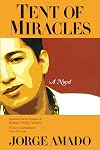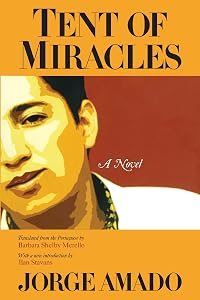
Tent of Miracles
by Jorge Amado
On This Page
Description
The Wisconsin edition is not for sale in the British Commonwealth (excluding Canada), the Republic of Ireland, or South Africa.Tags
Recommendations

























Member Recommendations
Member Reviews
Reason read: May 2025 botm. This book is from Brazil, translated from the Portuguese by Barbara Shelby. Ir looks at the life of Pedro Archanjo, a mulatto writer and anthropologist, who becomes a posthumous hero when his writings are rediscovered by an American scholar. The story intertwines Archanjo's life with the present day, highlighting his advocacy for racial mixing and his connection to the marginalized community in Bahia, Brazil. The novel satirizes the racism and social dynamics of Brazilian society, while also celebrating the rich culture of Bahia's African and mestizo population. The atmosphere is rich with color, noise, music, dance.
Quotes:
"I never was able to fix the line between reality and fantasy, fact and invention." pg show more 14
"Never again did a student abuse Archanjo's patience by touching on the subject of race, nor even twenty years later, when Gobinesau's shadow fell over the Terreiro de Jesus and Aryanism came into fashion as official doctrine at the School of Medicine." pg 113
"...the Brazilian solution to the problem of race; fusion, mixing, crossbreeding, miscegenation." pg 124.
"It was a sorry era, in which medical writers were more interested in the rules of grammar than the laws of science, better at placing pronouns correctly than handling scalpels and microbes instead of fighting disease. They did battle against French idioms, and instead of investigating and combatting the causes of endemic illness they invented neologisms. People would be obliged to wear anhydropodotecas instead of galoshes". pg 160
"On the contrary, those who have stopped to the dirtiest tricks are the very ones who insist on the highest standards of decency and integrity -- in others, of course. They pose as incorruptible and proclaim their own spotless virtue; their mouths are always full of words like "dignity" and "conscience," and they are fierce, implacable judges of other people's conduct." pg 328 show less
Quotes:
"I never was able to fix the line between reality and fantasy, fact and invention." pg show more 14
"Never again did a student abuse Archanjo's patience by touching on the subject of race, nor even twenty years later, when Gobinesau's shadow fell over the Terreiro de Jesus and Aryanism came into fashion as official doctrine at the School of Medicine." pg 113
"...the Brazilian solution to the problem of race; fusion, mixing, crossbreeding, miscegenation." pg 124.
"It was a sorry era, in which medical writers were more interested in the rules of grammar than the laws of science, better at placing pronouns correctly than handling scalpels and microbes instead of fighting disease. They did battle against French idioms, and instead of investigating and combatting the causes of endemic illness they invented neologisms. People would be obliged to wear anhydropodotecas instead of galoshes". pg 160
"On the contrary, those who have stopped to the dirtiest tricks are the very ones who insist on the highest standards of decency and integrity -- in others, of course. They pose as incorruptible and proclaim their own spotless virtue; their mouths are always full of words like "dignity" and "conscience," and they are fierce, implacable judges of other people's conduct." pg 328 show less
Read this. But not if it is summer; wait until winter and the coldest day of the year and read it then, when it will warm you through and make you fall in love with ritual and words and love and drums. Absolutely beautiful. "Some sorrows can only be cured by suicide or a sonnet."
An American Professor, from Columbia University, no less, shows up in Bahia, Brazil, pursuing an interest in a deceased Local writer. One level of the book has to do with the tizzy among the local intellectual establishment as they try to concoct background materials that will not offend the great American public. The novel also enters the mind of the deceased writer, as he tries to deal with all the problems and joys that made him the writer he was. There's a great deal of conflict presented here, and good stuff about the difference between the colonized world, and what the colonial power might think "proper' presentation of a local figure. The dead writer is very Brazilian, and really not too acceptable to Mid-America. It's a book show more about accepting the real, if the reader can do that. show less
This novel takes as its theme the strength of the racial mixture that is Brazil, more specifically Bahia, the region to which most of the enslaved Africans were taken -- or, as it was called at end of the 19th and the beginning of the 20th century when much of the action takes place, miscegenation. It has two, unequal, strands: the story of Pedro Archanjo, a self-educated anthropologist who wrote about the African roots, especially candomblé and racial mixing, of Bahian culture while remaining an important and beloved member of the community, and the story of the modern Bahians who, spurred on by the enthusiasm of a Nobel Prize-winning Columbia University professor for Archanjo's work, embark on the celebration of the centennial of his show more birth in 1968. The modern section is a broad satire while Archanjo's own story is lively and frequently moving, although unfortunately occasionally a tad too politically didactic. But perhaps that is attributable to the book being written in 1969.
Although Archanjo's story begins with his death (and funeral attended by all the poor people of the community), Amado quickly turns to his birth when the midwife, who arrived after the fact, recognizes him as Ojuobá, the Eyes of Xangô. And Archanjo goes on, through his life, to act as the eyes of the community, recognizing his obligations to the leaders of the ceremonies and participating in them, but also recording what is taking place. The novel is the story of the entire community, and Archango's relationships with a variety of unforgettable characters: with his closest friend Lidio, with whom he collaborates on a whole variety of projects; with a multiplicity of women, primarily Rosa and Doroteia; with his godson Tadeu who is assumed to be his real son; with an aging countess who has a zest for life and the snooty and racist family of Tadeu's fiancée; with the varied professors at the university where he works as a messenger for the medical school and encounters both virulent racists and supporters who help guide his work; and with many more. It is filled with candomblé ceremonies, drinking, bawdiness, and the struggle to survive and be productive. In a way, Archanjo is a symbol of the entire mulitracial, multicultural community and its ongoing struggle to be recognized as the strength of Bahia and Brazil.
I am glad I read the wonderful Showdown before I read this book; although it has its strong points, especially the wonderful characters, it was marred, as noted above, by a tendency towards preachiness and by the modern sections which, while entertaining, couldn't stand up to the story of Archanjo. I will definitely be reading more books by Amado. show less
Although Archanjo's story begins with his death (and funeral attended by all the poor people of the community), Amado quickly turns to his birth when the midwife, who arrived after the fact, recognizes him as Ojuobá, the Eyes of Xangô. And Archanjo goes on, through his life, to act as the eyes of the community, recognizing his obligations to the leaders of the ceremonies and participating in them, but also recording what is taking place. The novel is the story of the entire community, and Archango's relationships with a variety of unforgettable characters: with his closest friend Lidio, with whom he collaborates on a whole variety of projects; with a multiplicity of women, primarily Rosa and Doroteia; with his godson Tadeu who is assumed to be his real son; with an aging countess who has a zest for life and the snooty and racist family of Tadeu's fiancée; with the varied professors at the university where he works as a messenger for the medical school and encounters both virulent racists and supporters who help guide his work; and with many more. It is filled with candomblé ceremonies, drinking, bawdiness, and the struggle to survive and be productive. In a way, Archanjo is a symbol of the entire mulitracial, multicultural community and its ongoing struggle to be recognized as the strength of Bahia and Brazil.
I am glad I read the wonderful Showdown before I read this book; although it has its strong points, especially the wonderful characters, it was marred, as noted above, by a tendency towards preachiness and by the modern sections which, while entertaining, couldn't stand up to the story of Archanjo. I will definitely be reading more books by Amado. show less
Amado never fails to entertainingly portray the world of Bahia. This work tells of many different goings on surrounding the sacred afro-diasporan religion of candomble.
Baía destilada!
Looking forward to reading this as I have loved everything else by this author.
Members
- Recently Added By
Lists

1001 Books You Must Read Before You Die
1,448 works; 1,133 members

1,001 BYMRBYD Concensus
723 works; 27 members

My TBR
371 works; 3 members
Author Information

154+ Works 10,846 Members
Jorge Amado, August 10, 1912 - August 6, 2001 Elected to the Brazilian Academy of Letters, Jorge Amado possesses a talent for storytelling as well as a deep concern for social and economic justice. He was born in Bahia, Brazil, in 1912. Some critics claim that his early works suffer from his politics. Others commonly express reservations show more concerning Amado's sentimentality and erotico-mythic stereotyping. In the works represented in English translation, his literary merits prevail. The Violent Land (1942) chronicles the development of Brazilian territory and struggles for its resources, memorializing the deeds of those who built the country. Gabriela, Clove and Cinnamon (1958), which achieved critical and popular success in both Brazil and the United States, tells a sensual love story of a Syrian bar owner and his beautiful cook. Home Is the Sailor (1962) introduces Captain Vasco Moscoso de Aragao, a comic figure in the tradition of Don Quixote. In Dona Flor and Her Two Husbands (1966), Amado introduced the folk culture of shamans and Yorube gods. The protagonists of Shepherds of the Night (1964) are Bahia's poor. (Bowker Author Biography) Jorge Amado has been called the greatest twentieth-century Brazilian novelist. He was born in 1912 in Ilheus, in the northeastern-most state of Bahai. This area serves as the backdrop for most of Amado's work, which reflects a deep appreciation of the Brazilian essence. Amado's works have made him a national figure in Brazil. Amado's early novels were shaped by a belief in Marxism, and relate the sufferings of humble fishermen and cocoa plantation workers. By the 1950s, he had turned his attention to the plight of middle-class Bahains. This more jovial approach brought him worldwide acclaim, and his keen comic sense and appreciation of the common man have drawn comparisons to the novels of Charles Dickens. Music, cuisine, and passion figure prominently in Amado's literary output. Amado's works have been translated from Portuguese into more than forty languages, have sold over fifty million copies worldwide, and have been reworked for film, television, and stage. His portraits of commanding female characters, including Gabriela from Gabriela, Clove and Cinnamon, and Dona Flor from Dona Flor and Her Two Husbands, have been adapted to the screen, and actress Sonia Braga earned her initial success in these roles. Other titles include The Sand Captains; Memory of a Child; The War of the Saints; and Home Is the Sailor. (Bowker Author Biography) show less
Some Editions
Awards and Honors
Series
Belongs to Publisher Series
Work Relationships
Is contained in
Common Knowledge
- Canonical title
- Tent of Miracles
- Original title
- Tenda dos Milagres
- Alternate titles*
- Werkstatt der Wunder
- Original publication date
- 1969
- Important places
- Bahia, Brazil
- Dedication*
- Für Zélia, die Rose und die Hexerei.
- Original language*
- Portugiesisch
*Some information comes from Common Knowledge in other languages. Click "Edit" for more information.
Classifications
- Genres
- Fiction and Literature, General Fiction, Romance
- DDC/MDS
- 813 — Literature & rhetoric American literature in English American fiction in English
- LCC
- PQ9697 .A647 .T3513 — Language and Literature French, Italian, Spanish and Portuguese literatures Portuguese literature Provincial, local, colonial, etc. Brazil
- BISAC
Statistics
- Members
- 541
- Popularity
- 55,150
- Reviews
- 10
- Rating
- (3.76)
- Languages
- 10 — English, Finnish, French, German, Hungarian, Italian, Portuguese (Portugal), Russian, Spanish, Turkish
- Media
- Paper, Ebook
- ISBNs
- 39
- ASINs
- 11