
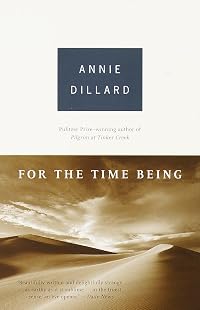
For the Time Being
by Annie Dillard
On This Page
Description
National Bestseller "Beautifully written and delightfully strange...as earthy as it is sublime...in the truest sense, an eye-opener." --Daily News From Annie Dillard, the Pulitzer Prize-winning author of Pilgrim at Tinker Creek and one of the most compelling writers of our time, comes For the Time Being, her most profound narrative to date. With her keen eye, penchant for paradox, and yearning for truth, Dillard renews our ability to discover wonder in life's smallest--and often show more darkest--corners. Why do we exist? Where did we come from? How can one person matter? Dillard searches for answers in a powerful array of images: pictures of bird-headed dwarfs in the standard reference of human birth defects; ten thousand terra-cotta figures fashioned for a Chinese emperor in place of the human court that might have followed him into death; the paleontologist and theologian Teilhard de Chardin crossing the Gobi Desert; the dizzying variety of clouds. Vivid, eloquent, haunting, For the Time Being evokes no less than the terrifying grandeur of all that remains tantalizingly and troublingly beyond our understanding. "Stimulating, humbling, original--. [Dillard] illuminate[s] the human perspective of the world, past, present and future, and the individual's relatively inconsequential but ever so unique place in it."--Rocky Mountain News show lessTags
Recommendations









Member Reviews
This is the kind of book that makes me grateful I learned how to read.
Annie Dillard has a deeply associative mind. She gathers like as magpie by observing attentively and reading voraciously, then combines her finds in illuminating ways. In this book, she interweaves threads as diverse as birth defects, clouds, sand, Teilhard de Chardin in the Gobi desert, and the Hasidim. Some readers may be confused or put off by the structure, but it worked for me.
One of the many aspects of her writing that I admire is the way that she breaks up dense discussions with asides to the reader. For instance: “Some few wandering Hasids go into exile in order ‘to suffer exile with the Shekinah,’ the presence of God in the world — which is, as you show more have doubtless noticed, lost or strayed” (p. 129).
That sentence also gets to the heart of what unites the diverse topics of this book: It’s all about a category of inquiry that theologians and philosophers call “theodicy,” which in plain English could be rendered “the justification of God.” You might think that philosophy is remote from our lives, but not this question. It’s implicit in many of the lurid headlines you see while waiting to check out at the market. If God is good, how did [fill in latest tragedy here] happen?
Dillard doesn’t provide a direct answer to this, as if it were something you could fold into your pocket and move on to the next item that stokes your curiosity. Instead, it’s the ground tone, the figured bass, that accompanies any thinking person throughout life as our curiosity takes us from wonder to awe. We are here “for the time being,” as Dillard reminds us in this book’s title and throughout. In her clear-eyed view, this demands we face the horrors of tyrants and natural disaster unflinchingly and at the same time register and respond to the miracle that is life. We are here now, and “there never was a more holy age than ours, and never a less” (p. 88).
A spiritual classic for our time. show less
Annie Dillard has a deeply associative mind. She gathers like as magpie by observing attentively and reading voraciously, then combines her finds in illuminating ways. In this book, she interweaves threads as diverse as birth defects, clouds, sand, Teilhard de Chardin in the Gobi desert, and the Hasidim. Some readers may be confused or put off by the structure, but it worked for me.
One of the many aspects of her writing that I admire is the way that she breaks up dense discussions with asides to the reader. For instance: “Some few wandering Hasids go into exile in order ‘to suffer exile with the Shekinah,’ the presence of God in the world — which is, as you show more have doubtless noticed, lost or strayed” (p. 129).
That sentence also gets to the heart of what unites the diverse topics of this book: It’s all about a category of inquiry that theologians and philosophers call “theodicy,” which in plain English could be rendered “the justification of God.” You might think that philosophy is remote from our lives, but not this question. It’s implicit in many of the lurid headlines you see while waiting to check out at the market. If God is good, how did [fill in latest tragedy here] happen?
Dillard doesn’t provide a direct answer to this, as if it were something you could fold into your pocket and move on to the next item that stokes your curiosity. Instead, it’s the ground tone, the figured bass, that accompanies any thinking person throughout life as our curiosity takes us from wonder to awe. We are here “for the time being,” as Dillard reminds us in this book’s title and throughout. In her clear-eyed view, this demands we face the horrors of tyrants and natural disaster unflinchingly and at the same time register and respond to the miracle that is life. We are here now, and “there never was a more holy age than ours, and never a less” (p. 88).
A spiritual classic for our time. show less
I pretty much love everything written by Annie Dillard (though I feel I should add that I am not blinded by admiration here), and I still haven’t read The Maytrees or Living By Fiction, but this book didn’t particularly knock me over like Pilgrim at Tinker Creek or Holy the Firm. It’s still a profound and arresting work, but it just felt slightly more diffuse than her other works.
There’s a lot going on in this book. It explores, among other things, the description of clouds (I liked these), the origin of sand, horrific birth defects, ancient soldiers who were buried alive, torture meted out to humans by other humans, the letters and other writings by paleontologist/theologian Teilhard de Chardin, geologic time, numbers (mostly show more relating to human populations), the idea of evilness, the paradox of humanity. It also delves into both science and spirituality with a bit of anthropology added to the mix, and, of course, inevitably, God and religion, mainly Christianity (Catholicism) and Judaism (Hasidism).
Again, like most everything she writes, Dillard addresses the philosophy and questions inherent in works devoted to the meaning of life. Lofty? No. I don’t think so. She writes like a painter paints – detailed, with reverence for the light and dark, freely, like wordless poetry. I also loved her playfulness she intersperses with the gravity of some pretty heavy subjects; she remains humble/humbled, jocular. I wish she had written a hundred more books. show less
There’s a lot going on in this book. It explores, among other things, the description of clouds (I liked these), the origin of sand, horrific birth defects, ancient soldiers who were buried alive, torture meted out to humans by other humans, the letters and other writings by paleontologist/theologian Teilhard de Chardin, geologic time, numbers (mostly show more relating to human populations), the idea of evilness, the paradox of humanity. It also delves into both science and spirituality with a bit of anthropology added to the mix, and, of course, inevitably, God and religion, mainly Christianity (Catholicism) and Judaism (Hasidism).
Again, like most everything she writes, Dillard addresses the philosophy and questions inherent in works devoted to the meaning of life. Lofty? No. I don’t think so. She writes like a painter paints – detailed, with reverence for the light and dark, freely, like wordless poetry. I also loved her playfulness she intersperses with the gravity of some pretty heavy subjects; she remains humble/humbled, jocular. I wish she had written a hundred more books. show less
For the Time Being is a carefully crafted assemblage of stories, facts, and spiritual and philosophical musings, which builds in impact over the course of the book until, by the end, the total effect is astounding. Even when musing in a desultory way about her most abstract and complicated topics, her writing is so clear that she is simply pointing at something right in front of you.
This one will stay with me.
This one will stay with me.
Have you ever been to the surround theater at Walt Disney World – the one where you stand in an enormous room while majestic vistas are projected in panorama? I remember walking out feeling dizzy. Annie Dillard’s, For the Time Being, had the same effect.
Reading Dillard made me feel infinitesimally small, teetering on the edge of insignificant. She tracks the journey of a grain of sand to a beach, the mass extinction of animals, and inexplicable “acts of god” challenging my delusions of self importance. I am small. And chances are this period of time I am in is not the most critical of all times as I secretly believe. In fact, does my life matter at all?
I had to read the last quarter of the book slowly, digesting each notion, show more each sentence, and sometimes each word for the beauty and wonder. And though there are universes in every phrase, I did not find her ideas of God to align with my worldview. I do not agree that “God is out of the physical loop” or “God’s hands are tied;” however, Dillard made me think about my existence and perhaps, adjusted my inflated view of self importance.
An excellent read for the quirky awe she inspires. show less
Reading Dillard made me feel infinitesimally small, teetering on the edge of insignificant. She tracks the journey of a grain of sand to a beach, the mass extinction of animals, and inexplicable “acts of god” challenging my delusions of self importance. I am small. And chances are this period of time I am in is not the most critical of all times as I secretly believe. In fact, does my life matter at all?
I had to read the last quarter of the book slowly, digesting each notion, show more each sentence, and sometimes each word for the beauty and wonder. And though there are universes in every phrase, I did not find her ideas of God to align with my worldview. I do not agree that “God is out of the physical loop” or “God’s hands are tied;” however, Dillard made me think about my existence and perhaps, adjusted my inflated view of self importance.
An excellent read for the quirky awe she inspires. show less
Annie was slightly irked when this book won the PEN Diamond-Vogelstein Award for "book of essays" because it's not a book of essays. On her website she calls it "a nonfiction something-or-other, mostly narrative." Annie seems particularly sensitive to her nonfiction narrative books being referred to as "collections of essays." I can see her point: there's a big difference between writing a bunch of essays on different topics at different times and then publishing them together and writing a series of interconnected pieces of narrative nonfiction. In For the Time Being she takes various themes, tied together under the overarching question of God's nature and involvement in the world, and alternates running commentary on them, with the show more aid of quotes from various individuals. I found this to be one of her most difficult narrative nonfiction books to read, if only because I think her roaming style can turn circuitous and hard to follow in a longer book. Most of her books written in this style are shorter and easier to digest. Still, it's classic Annie Dillard, and as such, is not to be missed. show less
i was pretty distracted while reading this, which is no fault of the author's. what i take from it, among its many themes, is this question of individuality and the masses. how they are both (if they are) meaningful in the world.
"Ours is a planet sown in beings. Our generations overlap like shingles. We don't fall in rows like hay, but we fall. Once we get here, we spend forever on the globe, most of it tucked under. While we breathe, we open time like a path in the grass. We open time as a boat's stem slits the crest of the present."
"Ours is a planet sown in beings. Our generations overlap like shingles. We don't fall in rows like hay, but we fall. Once we get here, we spend forever on the globe, most of it tucked under. While we breathe, we open time like a path in the grass. We open time as a boat's stem slits the crest of the present."
Ashamedly, this is the first Dillard book I have read, but reading it definitely affected my reading list. This book should be read more viscerally than cerebrally—to do otherwise would leave a reader without an impression. This quilting together of science, Judaism, Catholicism, clouds, and stardust is consistent with purpose of the book. It creates a sense of impermanence in the earth’s ongoing processes and reminds the reader of the human limitation. Dillard's prose finds a profound and subtle way to speak of the cosmos—at least for the time being.
Members
- Recently Added By
Lists

Mo's Reading List
218 works; 1 member

Mo's Reading List (Abridged)
75 works; 1 member
Author Information

31+ Works 22,101 Members
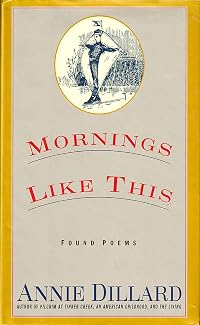
Annie Dillard was born Annie Doak in Pittsburgh, Pennsylvania on April 30, 1945. She received a B.A and an M.A. in English from Hollins College. She writes both fiction and nonfiction books including Tickets for a Prayer Wheel, Holy the Firm, Teaching a Stone to Talk, The Living, and Mornings Like This: Found Poems. She won the 1975 Pulitzer Prize show more for General Nonfiction for Pilgrim at Tinker Creek. She wrote an autobiography entitled An American Childhood. Her work also has appeared in such periodicals as The Atlantic, Harper's Magazine, The Christian Science Monitor, and Cosmopolitan. She taught for 21 years in the English department of Wesleyan University. (Bowker Author Biography) show less
Awards and Honors
Common Knowledge
- Original publication date
- 1999
- Epigraph
- The legend of the Traveler appears in every civilization, perpetually assuming new forms, afflictions, powers, and symbols. Through every age he walks in utter solitude toward penance and redemption. Should I mark more than ... (show all)shining hours? I have agreed to paint a narrative on the city walls. I have now been at work many years, there is so much to be told. Evan S. Connell Jr. Notes from a Bottle FOund on the Beach at Carmel
- Dedication
- For Lee Smith
- First words
- I have in my hands the standard manual of human birth defects.
Classifications
Statistics
- Members
- 1,382
- Popularity
- 17,112
- Reviews
- 21
- Rating
- (4.15)
- Languages
- Dutch, English, French, German
- Media
- Paper, Audiobook, Ebook
- ISBNs
- 23
- ASINs
- 6