7 Greeks
by Guy Davenport (Translator)
On This Page
Description
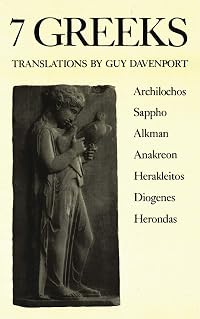
Here is a colorful variety pf works by seven Greek poets and philosophers who lived from the eighth to the third centuries BC. Salvaged from shattered pottery vases and tattered scrolls of papyrus, everything decipherable from the remains of these ancient authors is assembled here. From early to later, the collection contains: Archilochos; Sappho; Alkman; Anakreon; the philosophers Herakleitos and Diogenes; and Herondas. This composite of fragments translated by Guy Davenport is the most show more complete collection of its kind ever to appear in one volume. show lessTags
Recommendations















Member Reviews
Spanning from the eighth to the third century B.C., included here are four poets (Archilochos, Sappho, Alkman and Anakreon), two philosophers (Herakleitos and Diogenes, the Cynic philospher), and Herondas, who wrote comic skits. Almost all of the above survive only in fragments found in pot shards, scraps of papyrus used to wrap mummies and quotations by grammarians and others. Davenport puts brackets in the gaps where missing and illegible words were found. Some fragments consist of only one word: rhinoceros, nightingale, imposter, grape, plums, naked. It lends a poignancy to many of these ruins of once magnificent structures.
Among the poets represented I regret most those gaps with Archilochos and Sappho. Both of them despite the show more fragmentary nature of what survived come through as personalities and amazing poets--in what couldn't be a wider contrast. Archilochos was a mercenary with what Davenport calls a "nettle tongue;" there was a legend wasps hovered over his grave. I definitely can see the soldier here--often biting, crude, lewd, blunt. The most striking (and possibly complete) poem, Number 43 is comic and frankly erotic at once. Sappho is the great lyric poet of antiquity. Plato called her the "tenth muse." She's Archilochos opposite pole, vernal, refined--but like him at times frank in speaking of desire.
Both philosophers were standouts, despite that all that Davenport can provide are a couple of lines or short passages. Herakeitos, according to Karl Popper a forerunner of Plato, wrote on the theme of change. His sayings remind me of Ecclesiastes, or a Buddhist sage: One cannot step twice into the same river, for the water into which you first stepped has flowed on. And I loved, loved, loved Diogenes, who often made me smile madly with delight. What he said about, and to, such people as Plato and Alexander the Great! ("I've seen Plato's cups and table, but not his cupness and tableness.")
I wasn't impressed with the 7 complete and fragments of skits by Herondas, and the verse of Alkman and Anakreon didn't speak to me the way those of Archilochos and Sappho did. But this is definitely a book I consider a keeper. show less
Among the poets represented I regret most those gaps with Archilochos and Sappho. Both of them despite the show more fragmentary nature of what survived come through as personalities and amazing poets--in what couldn't be a wider contrast. Archilochos was a mercenary with what Davenport calls a "nettle tongue;" there was a legend wasps hovered over his grave. I definitely can see the soldier here--often biting, crude, lewd, blunt. The most striking (and possibly complete) poem, Number 43 is comic and frankly erotic at once. Sappho is the great lyric poet of antiquity. Plato called her the "tenth muse." She's Archilochos opposite pole, vernal, refined--but like him at times frank in speaking of desire.
Both philosophers were standouts, despite that all that Davenport can provide are a couple of lines or short passages. Herakeitos, according to Karl Popper a forerunner of Plato, wrote on the theme of change. His sayings remind me of Ecclesiastes, or a Buddhist sage: One cannot step twice into the same river, for the water into which you first stepped has flowed on. And I loved, loved, loved Diogenes, who often made me smile madly with delight. What he said about, and to, such people as Plato and Alexander the Great! ("I've seen Plato's cups and table, but not his cupness and tableness.")
I wasn't impressed with the 7 complete and fragments of skits by Herondas, and the verse of Alkman and Anakreon didn't speak to me the way those of Archilochos and Sappho did. But this is definitely a book I consider a keeper. show less
Ratings
Members
- Recently Added By
Author Information

Author, artist, literary critic and translator Guy Davenport was born on November 23, 1927 in Anderson, South Carolina. He received his Bachelor of Arts degree from Duke University in 1948 and was selected as a Rhodes Scholar. He earned a Bachelor of Literature from Merton College, Oxford University in 1950 and a Doctor of Philosophy from Harvard show more University in 1961. He taught English at several universities from 1951 until his retirement in 1990. He received numerous awards including the O. Henry Award for short stories, the 1981 Morton Douwen Zabel award for fiction from the American Academy and Institute of Arts and Letters, and translation awards from PEN and the Academy of American Poets. He died on January 4, 2005 in Lexington, Kentucky. (Bowker Author Biography) show less
All Editions
Awards and Honors
Series
Belongs to Publisher Series
New Directions Paperbook (799)
Classifications
- Genres
- Poetry, Fiction and Literature
- DDC/MDS
- 881.0108 — Literature & rhetoric Classical & modern Greek literatures Classical Greek poetry Different categories of Greek classical poetry Philosophy and Theory Archaic
- LCC
- PA3621 .A13 — Language and Literature Greek language and literature. Latin language and literature Greek literature Translations
- BISAC
Statistics
- Members
- 207
- Popularity
- 157,817
- Reviews
- 1
- Rating
- (4.14)
- Languages
- English
- Media
- Paper, Ebook
- ISBNs
- 3
- ASINs
- 1