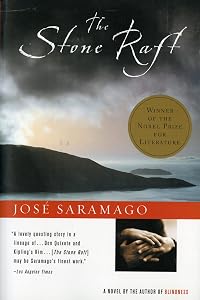
The Stone Raft
by José Saramago
On This Page
Description
A “marvelously amusing” political fable in which part of the European continent breaks off and drifts away on its own ( Publishers Weekly , starred review). A Nobel Prize winner who has been called “the García Márquez of Portugal” ( New Statesman ) chronicles world events on a human scale in this exhilarating allegorical novel. One day, quite inexplicably, the Iberian Peninsula simply breaks free from the European continent and begins to drift as if it were a sort of stone show more raft. Panic ensues as residents and tourists attempt to escape, while crowds gather on cliffs to watch the newly formed island sail off into the sea. Meanwhile, five people on the island are drawn together—first by a string of surreal events and then by love. Taking to the road to explore the limits of their now finite land, they find themselves adrift in a world made new by this radical shift in perspective. As bureaucrats ponder what to do about their unusual predicament, the intertwined lives of these five strangers are clarified and forever changed by a physical, spiritual, and sexual voyage to an unknown destination. At once an epic adventure and a profound fable about the state of the European project, The Stone Raft is a “hauntingly lyrical narrative with political, social, and moral underpinnings” ( Booklist ) that “may be Saramago’s finest work” ( Los Angeles Times ). Translated from the Portuguese by Giovanni Pontiero show lessTags
Recommendations




















Member Reviews
This has to be one of the most unusual and creative books I have ever read. The Iberian Peninsula breaks off from Europe and becomes a traveling island. It threatens to crash into the Azores. The storyline focuses on three men and two women that feel a sense of responsibility, expressed in terms of magical realism, for the breakaway. They are joined by a dog and two horses. They travel around Spain and Portugal, witnessing the responses to this unexpected event.
Saramago examines the social and geopolitical ramifications of profound change, while inserting a good dose of dry humor, especially with regard to how governments (Spain, Portugal, France, US, Russia) respond to the crisis. It is written in a literary style, with Saramago’s show more standard long sentences and embedded dialogue. I am not sure I took away all the author intended, but I did find thought-provoking observations about the roles of coincidence and interconnectedness in life.
Memorable passages:
“Life is full of little episodes that seem unimportant, while others at a certain moment absorb all our attention, when we reappraise them later, in the light of their consequences, we find that our memory of the latter has faded while the former have come to seem decisive or, at least, a link in a chain of successive and meaningful events…”
“No journey is but one journey, each journey comprises a number of journeys, and if one of them seems so meaningless that we have no hesitation in saying it was not worthwhile, our common sense, were it not so often clouded by prejudice and idleness, would tell us that we should verify whether the journeys within that journey were not of sufficient value to have justified all the trials and tribulations.” show less
Saramago examines the social and geopolitical ramifications of profound change, while inserting a good dose of dry humor, especially with regard to how governments (Spain, Portugal, France, US, Russia) respond to the crisis. It is written in a literary style, with Saramago’s show more standard long sentences and embedded dialogue. I am not sure I took away all the author intended, but I did find thought-provoking observations about the roles of coincidence and interconnectedness in life.
Memorable passages:
“Life is full of little episodes that seem unimportant, while others at a certain moment absorb all our attention, when we reappraise them later, in the light of their consequences, we find that our memory of the latter has faded while the former have come to seem decisive or, at least, a link in a chain of successive and meaningful events…”
“No journey is but one journey, each journey comprises a number of journeys, and if one of them seems so meaningless that we have no hesitation in saying it was not worthwhile, our common sense, were it not so often clouded by prejudice and idleness, would tell us that we should verify whether the journeys within that journey were not of sufficient value to have justified all the trials and tribulations.” show less
[The Stone Raft] by José Saramago, translated into English from Portugese by Giovanni Pontiero, is entertaining, insightful and, at times, intense. The translator's note informs the reader that Saramago limits his punctuation to full stops and commas. This appears peculiar at first but it works well.
Saramago believed that what has been spoken is destined to be heard and he wrote this novle with a rhythm and with the intention that his words would have the same impact as music. Not reading this in the original Portugese I cannot comment on how well he succeeded in this objective but I can say the translator certainly produced prose that have an energy and a continuous flow that brings the narrative to life. While the long sentences show more which include multiple sides of conversations may seem strange, they do work and they work well if you imagine yourself listening to the conversational flow rather than reading it.
The story itself is driven by the events surrounding the Iberian Penninsula breaking away from Europe and drifting into the Atlantic. The event itself is unimportant as it is simply the tool used to set the characters in motion and to create an environment in which human reactions and motivations, from the personal to the global politics level, are exposed and commented upon.
This book is about highlighting the peculiarities and contraditions of social order at all levels. Saramago presents his arguments and philosophies in a humerous fashion and with a deep understanding of human nature.
Those of you familiar with the BBC TV series, Yes Minister, will recognise some similarities between the humour of that series and the actions of the various public bodies in The Stone Raft. We have local authorities getting together to address a local issue followed by the national governments overruling the local entities with governments coming together urgently to take action and the action being the formation of a commission of investigation that will meet to organise investigations and discussions aimed at deciding what should be done with all possible haste. National governments, the EU, NATO and other bodies all come in for ridicule with meaningless communiqués being issued by various agencies and equally meaningless speeches being made by national presidents and world leaders.
This is a very clever book but I suspect the prose style could tire some people out. I have a couple more of Saramago's works and I will be reading them some time soon. show less
Saramago believed that what has been spoken is destined to be heard and he wrote this novle with a rhythm and with the intention that his words would have the same impact as music. Not reading this in the original Portugese I cannot comment on how well he succeeded in this objective but I can say the translator certainly produced prose that have an energy and a continuous flow that brings the narrative to life. While the long sentences show more which include multiple sides of conversations may seem strange, they do work and they work well if you imagine yourself listening to the conversational flow rather than reading it.
The story itself is driven by the events surrounding the Iberian Penninsula breaking away from Europe and drifting into the Atlantic. The event itself is unimportant as it is simply the tool used to set the characters in motion and to create an environment in which human reactions and motivations, from the personal to the global politics level, are exposed and commented upon.
This book is about highlighting the peculiarities and contraditions of social order at all levels. Saramago presents his arguments and philosophies in a humerous fashion and with a deep understanding of human nature.
Those of you familiar with the BBC TV series, Yes Minister, will recognise some similarities between the humour of that series and the actions of the various public bodies in The Stone Raft. We have local authorities getting together to address a local issue followed by the national governments overruling the local entities with governments coming together urgently to take action and the action being the formation of a commission of investigation that will meet to organise investigations and discussions aimed at deciding what should be done with all possible haste. National governments, the EU, NATO and other bodies all come in for ridicule with meaningless communiqués being issued by various agencies and equally meaningless speeches being made by national presidents and world leaders.
This is a very clever book but I suspect the prose style could tire some people out. I have a couple more of Saramago's works and I will be reading them some time soon. show less
This has to be one of the most unusual and creative books I have ever read. The Iberian Peninsula breaks off from Europe and becomes a traveling island. It threatens to crash into the Azores. The storyline focuses on three men and two women that feel a sense of responsibility, expressed in terms of magical realism, for the breakaway. They are joined by a dog and two horses. They travel around Spain and Portugal, witnessing the responses to this unexpected event.
Saramago examines the social and geopolitical ramifications of profound change, while inserting a good dose of dry humor, especially with regard to how governments (Spain, Portugal, France, US, Russia) respond to the crisis. It is written in a literary style, with Saramago’s show more standard long sentences and embedded dialogue. I am not sure I took away all the author intended, but I did find thought-provoking observations about the roles of coincidence and interconnectedness in life.
Memorable passages:
“Life is full of little episodes that seem unimportant, while others at a certain moment absorb all our attention, when we reappraise them later, in the light of their consequences, we find that our memory of the latter has faded while the former have come to seem decisive or, at least, a link in a chain of successive and meaningful events…”
“No journey is but one journey, each journey comprises a number of journeys, and if one of them seems so meaningless that we have no hesitation in saying it was not worthwhile, our common sense, were it not so often clouded by prejudice and idleness, would tell us that we should verify whether the journeys within that journey were not of sufficient value to have justified all the trials and tribulations.” show less
Saramago examines the social and geopolitical ramifications of profound change, while inserting a good dose of dry humor, especially with regard to how governments (Spain, Portugal, France, US, Russia) respond to the crisis. It is written in a literary style, with Saramago’s show more standard long sentences and embedded dialogue. I am not sure I took away all the author intended, but I did find thought-provoking observations about the roles of coincidence and interconnectedness in life.
Memorable passages:
“Life is full of little episodes that seem unimportant, while others at a certain moment absorb all our attention, when we reappraise them later, in the light of their consequences, we find that our memory of the latter has faded while the former have come to seem decisive or, at least, a link in a chain of successive and meaningful events…”
“No journey is but one journey, each journey comprises a number of journeys, and if one of them seems so meaningless that we have no hesitation in saying it was not worthwhile, our common sense, were it not so often clouded by prejudice and idleness, would tell us that we should verify whether the journeys within that journey were not of sufficient value to have justified all the trials and tribulations.” show less
Jose Saramago is a brilliant novelist who manages to observe and write about people sympathetically and is so observant of the way people act with each other that he constantly amazes me. He writes about the small moments of joy and sorrow between good friends and couples with skill and wit.
This is a book about journeys; the journey of the Stone Raft of Portugal and Spain travelling across the Atlantic, the journey of the five people and a dog and the journey of people's lives and changes to those lives as circumstances change.
As others have said, the novel moves slowly at first, as the cracks appear in the Pyrenees and the tourists leave for more stable countries. Coincidences or not, the five people and a dog are drawn together show more through peculiar circumstances and feel a need to travel through Portugal and Spain to see the Pyrenees and the sea. They travel firstly in a 2CV and then in a horse and cart, so this continues to be an ambling sort of a novel but there is plenty of interest among the characters to keep the reader engaged.
In addition, Saramago's cynicism of leaders and politicians is clear, as they try to deal with the unfolding situation and his observations here are particularly amusing, as the cracks in alliances appear as the crack across the French-Spanish border gets bigger.
I agree with others that this isn't his very best novel but then Jose Saramago on a bad day is still fantastic and worth taking the time to read. It is an ambitious topic, but then he never tackles anything easy. show less
This is a book about journeys; the journey of the Stone Raft of Portugal and Spain travelling across the Atlantic, the journey of the five people and a dog and the journey of people's lives and changes to those lives as circumstances change.
As others have said, the novel moves slowly at first, as the cracks appear in the Pyrenees and the tourists leave for more stable countries. Coincidences or not, the five people and a dog are drawn together show more through peculiar circumstances and feel a need to travel through Portugal and Spain to see the Pyrenees and the sea. They travel firstly in a 2CV and then in a horse and cart, so this continues to be an ambling sort of a novel but there is plenty of interest among the characters to keep the reader engaged.
In addition, Saramago's cynicism of leaders and politicians is clear, as they try to deal with the unfolding situation and his observations here are particularly amusing, as the cracks in alliances appear as the crack across the French-Spanish border gets bigger.
I agree with others that this isn't his very best novel but then Jose Saramago on a bad day is still fantastic and worth taking the time to read. It is an ambitious topic, but then he never tackles anything easy. show less
I'm not really sure what to make of this book, but I enjoyed reading it very much. I think the pleasure in reading it must come mostly from Saramago's unique narrative style, the subtle mix of story and digression, the delicate satire in the background story contrasted with his warm affection for the central characters.
I suppose it's an affirmation of the strength of basic human values in the face of challenges that reason, knowledge and authority can't cope with. The Iberian peninsula breaks free from the Pyrenees and roams around the Atlantic ocean, much to the consternation of the authorities, whilst a little group of anarchic individuals brought together by illogical events roam around the ex-peninsula, first in a Deux Chevaux and show more then in an actual two-horse cart. It's a similar sort of idea to Blindness, but much more upbeat and optimistic in its mood. The central characters are cut off from their past lives, like those in Blindness, but this time they all have names and backgrounds and are clearly meant to be individuals, not types. The imagery is very concerned with land and fertility: it's a predominantly rural novel, with only brief ventures into the city. show less
I suppose it's an affirmation of the strength of basic human values in the face of challenges that reason, knowledge and authority can't cope with. The Iberian peninsula breaks free from the Pyrenees and roams around the Atlantic ocean, much to the consternation of the authorities, whilst a little group of anarchic individuals brought together by illogical events roam around the ex-peninsula, first in a Deux Chevaux and show more then in an actual two-horse cart. It's a similar sort of idea to Blindness, but much more upbeat and optimistic in its mood. The central characters are cut off from their past lives, like those in Blindness, but this time they all have names and backgrounds and are clearly meant to be individuals, not types. The imagery is very concerned with land and fertility: it's a predominantly rural novel, with only brief ventures into the city. show less
The epigraph and the illustration before the first chapter sort of takes you by hand, makes you sit, start and read... hoping for another tour de force by an excellent author.
(after reading):
And so it proves to be. Apart from the political themes that this book evokes, the heart of the story (as always) is in the exact place that you would see Saramago himself placing: within the human experience of togetherness, universal mystery and the belief in the inseparability of truth from fantasy.
Memorable characters tread the ground in this work of fantastical truths. One would love to accompany them on any journey undertaken. One by one, Saramago not just populates his canvas wit fascinating characters, but evokes emotions out of Nature show more itself.
Undoubtedly one of the difficult books to write, there are themes aplenty to appreciate and connect with. The raft is travelling because it is inhabited by living souls. show less
(after reading):
And so it proves to be. Apart from the political themes that this book evokes, the heart of the story (as always) is in the exact place that you would see Saramago himself placing: within the human experience of togetherness, universal mystery and the belief in the inseparability of truth from fantasy.
Memorable characters tread the ground in this work of fantastical truths. One would love to accompany them on any journey undertaken. One by one, Saramago not just populates his canvas wit fascinating characters, but evokes emotions out of Nature show more itself.
Undoubtedly one of the difficult books to write, there are themes aplenty to appreciate and connect with. The raft is travelling because it is inhabited by living souls. show less
This early novel can be seen as the precursor or model for Saramago's later surreal modern parables Blindness, Seeing, and Death at Intervals, all of which explore the consequences of changing one of the natural laws society takes for granted. It has a similar mixture of philosophy, humour and the political and personal. As in all of his novels, Saramago's style is idiosyncratic, with long and apparently rambling sentences broken only by occasional commas.
This time the starting point occurs when a crack opens up along the French border in the Pyrenees, and the Iberian peninsula starts moving into the Atlantic towards the Azores. The first section brings together a group of people all of whom have been touched by apparently miraculous show more events at the same time as the gap appeared. This personal story, which has elements of the picaresque, is set against a wider imagining of the political, geographical and social consequences of such an upheaval. Once again Saramago places little faith in the governments he portrays, and his imagination spans both big ideas and quotidian details.
The oddly assorted group of three men, two women (three Portuguese and two Spanish) and a dog travel round the new island on a desultory quest, initially by car and later in a horse drawn wagon (both Deux Chevaux). To say much more would spoil the book for new readers, and this one stands comparison with Saramago's best books. show less
This time the starting point occurs when a crack opens up along the French border in the Pyrenees, and the Iberian peninsula starts moving into the Atlantic towards the Azores. The first section brings together a group of people all of whom have been touched by apparently miraculous show more events at the same time as the gap appeared. This personal story, which has elements of the picaresque, is set against a wider imagining of the political, geographical and social consequences of such an upheaval. Once again Saramago places little faith in the governments he portrays, and his imagination spans both big ideas and quotidian details.
The oddly assorted group of three men, two women (three Portuguese and two Spanish) and a dog travel round the new island on a desultory quest, initially by car and later in a horse drawn wagon (both Deux Chevaux). To say much more would spoil the book for new readers, and this one stands comparison with Saramago's best books. show less
Members
- Recently Added By
Lists

Magic Realism
371 works; 52 members

Stream of Consciousness
87 works; 8 members

EU Fiction: 1950-2022
223 works; 70 members
Author Information

240+ Works 53,188 Members
José Saramago was born on November 16, 1922. He spent most of his childhood on his parent's farm, except while attending school in Lisbon. Before devoting himself exclusively to writing novels in 1976, he worked as a draftsman, a publisher's reader, an editor, translator, and political commentator for Diario de Lisboa. He is indisputably show more Portugal's best-known literary figure and his books have been translated into more than 25 languages. Although he wrote his first novel in 1947, he waited some 35 years before winning critical acclaim for work such as the Memorial do Convento. His works include The Year of the Death of Ricardo Reis, The Stone Raft, Baltasar and Blimunda, The History of the Siege of Lisbon, The Gospel According to Jesus Christ, and Blindness. At age 75, he was awarded the Nobel Prize for Literature in 1998 for his work in which "parables sustained by imagination, compassion and irony, continually enables us to apprehend an elusory reality." He died from a prolonged illness that caused multiple organ failure on June 18, 2010 at the age of 87. (Bowker Author Biography) show less
Some Editions
Series
Belongs to Publisher Series
Work Relationships
Common Knowledge
- Canonical title
- The Stone Raft
- Original title
- A jangada de pedra
- Original publication date
- 1986
- Important places
- Portugal; Spain; France
- Related movies
- La balsa de piedra (2002)
- Epigraph
- "Todo futuro es fabuloso" Alejo Capentier
- Publisher's editor
- Luciana Stegagno Picchio
- Original language
- Portuguese
Classifications
- Genres
- Fiction and Literature, General Fiction, Romance
- DDC/MDS
- 869.342 — Literature & rhetoric Spanish Literature Literatures of Portuguese and Galician languages Portuguese fiction 20th Century 1945-1999
- LCC
- PQ9281 .A66 .J313 — Language and Literature French, Italian, Spanish and Portuguese literatures Portuguese literature Individual authors, 1961-2000
- BISAC
Statistics
- Members
- 1,675
- Popularity
- 13,326
- Reviews
- 29
- Rating
- (3.72)
- Languages
- 15 — Danish, Dutch, English, Finnish, French, German, Greek, Hebrew, Hungarian, Italian, Norwegian (Bokmål), Portuguese, Romanian, Spanish, Turkish
- Media
- Paper, Audiobook, Ebook
- ISBNs
- 67
- UPCs
- 1
- ASINs
- 18