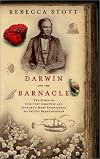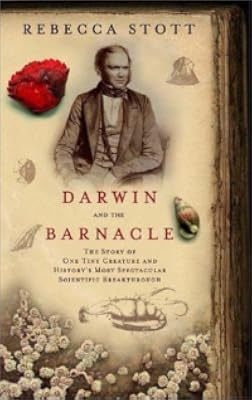
Darwin and the Barnacle: The Story of One Tiny Creature and History's Most Spectacular Scientific Breakthrough
by Rebecca Stott
On This Page
Description
Tells the story of the part played by Darwin's eight-year study of barnacles and how the examination of this tiny marine organism contributed to the development of his theory of evolution. Pairing Charles Darwin and a rare species of barnacle as her unlikely protagonists, Rebecca Stott has written an absorbing work of history that guides the reader through the treacherous shoals of nineteenth-century biology. Beginning her narrative in the 1820s, even before Darwin's Beagle voyage, Stott show more examines the mystery of why Darwin waited over two decades before revealing his pivotal theory of natural selection. In 1846, as Stott relates, Charles Darwin already possessed a secret: an essay, sealed in an envelope and locked in his secret drawer. The essay would later overturn human understanding of time and nature forever. But for almost thirty years Darwin kept it locked away. Following Darwin's thoughts through thousands of letters he wrote during these years, Stott re-creates Darwin's investigations of the tiny barnacle he found on the shores of southern Chile - a specimen that didn't fit into any established definitions or accepted archetypes. As these letters reveal, Darwin promises himself a month or so to study this creature, but eight years later, his study filled with hundred of barnacle specimens in labeled pillboxes sent from around the world, Darwin's eyes are fixed to a microscope, his mind preoccupied with the evolutionary and anatomical history of these bizarre sea creatures. In a gripping narrative, Stott shows how Darwin in time would shock Victorian society not only with his presentation of evolutionary theories but also with his suggestion that man was indeed closely linked with thousands of other species, including the lowly barnacle. Drawing on a glittering cast of nineteenth-century scientists and literary characters, including George Eliot, Jean Baptiste Lamarck, T.H. Huxley, and Louis Agassiz, Stott vividly portrays the fierce intellectual atmosphere of Victorian England. Lavishly illustrated, beautifully written, and superbly told, Darwin and the Barnacle is the fascinating story of how genius sometimes proceeds through indirection - and how one small item of curiousity contributed to history's most spectacular scientific breakthrough. -- from dust jacket. show lessTags
Recommendations





Member Reviews
An outstanding treatment of Darwin's "Barnacle Years" by Rebecca Stott. Filled with neat little details and contextual elements, as well as not pulling any punches when it comes to the nitty-gritty of barnacle classification (some seriously taxing taxonomy). Very enjoyable armchair natural history.
Loved it. Primary sources throughout,letters used to provide humanizing details so that the great scientist can be seen as the husband and father as well. Enough detail on the barnacles to help a layman understand how they shaped Darwin’s thinking, without being too dry or technical for the non-specialist
I thought this was fab. Disclaimer. I am a Darwin enthusiast or addict. Or as my wife would say, nutter.
Enthralling history and some perceptive insights into the man and his work.
Enthralling history and some perceptive insights into the man and his work.
Having read this and found out some of Darwin's skills and meticulousness as a researcher into the family of the barnacle; I was a little disappointed not to have found out more about how it prepared him for publishing his Origin of the Species. A lot is surmised about his scientific endeavour although there are some good insights into his personal character and the manner in which he lived and brought up his children. The author also succeeded in describing mid Victorian Britain especially the Great Exhibition ; I think that is where her skills are greatest and not in the science per se.
However on balance this book has persuaded me to read more about Darwin as a person and to pull out my battered copy of the Voyage of the Beagle and show more reread that knowing what I now know about his later scientific endeavours. show less
However on balance this book has persuaded me to read more about Darwin as a person and to pull out my battered copy of the Voyage of the Beagle and show more reread that knowing what I now know about his later scientific endeavours. show less
This book covers a part of Darwin's life that all too often gets relegated to a footnote or a sidebar - the years he spent with the humble barnacle, learning about classification, morphology, and taxonomy, preparatory to writing his "big species book". This book examines how that period shaped Darwin's later years, and the role that it played in development of his trademark theory. A really good introduction to how science is done.
Ratings
Members
- Recently Added By
Author Information

18+ Works 3,361 Members
Rebecca Stott is an affiliated scholar in the Department of History and Philosophy of Science at Cambridge University.
Awards and Honors
Common Knowledge
- People/Characters
- Charles Darwin [Charles Robert: 1809-1882]
Classifications
Statistics
- Members
- 282
- Popularity
- 114,936
- Reviews
- 5
- Rating
- (3.81)
- Languages
- English
- Media
- Paper, Ebook
- ISBNs
- 5
- ASINs
- 2