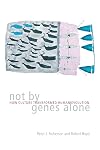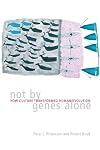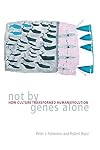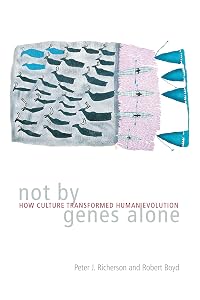
Not by Genes Alone: How Culture Transformed Human Evolution
by Peter J. Richerson
On This Page
Description
"Not by Genes Alone offers a radical interpretation of human evolution, arguing that our ecological dominance and our singular social systems stem from a psychology uniquely adapted to create complex culture. Richerson and Boyd illustrate here that culture is neither superorganic nor the handmaiden of the genes. Rather, it is essential to human adaptation, as much a part of human biology as bipedal locomotion. Drawing on work in the fields of anthropology, political science, sociology, and show more economics - and building their case with such examples as kayaks, corporations, clever knots, and yams that require twelve men to carry them - Richerson and Boyd demonstrate that culture and biology are inextricably linked, and they show us how to think about their interaction in a way that yields a richer understanding of human nature."--Jacket. show lessTags
Recommendations








Member Reviews
Slogged through about 4/7 of this (the first half, the last chapter lightly). Despite the fact that the authors kept saying 'intuition is wrong' everything I could manage to glean did sound like common sense. They kept defining terminology, but not in a way that I could make sense of. The nits they picked seemed like imaginary ones to me....
I mean, does anyone really say otherwise than what they claim (by chapter titles) that culture is essential, exists, evolves, is an adaptation, is maladaptive, and coevolves with genes? The last chapter, "Nothing about culture makes sense except in the light of evolution" could be seen to be a little bit provocative given it's apparent contrast with the title of the book, but to me everything seemed show more to be only a trivial matter of ivory tower semantic BS.
I guess academia does tend to create specialists, and any prof. who thinks beyond the confines of his or niche thinks that their thoughts are revolutionary. However, if the authors read popular science, or literature, or looked around the world at real people, they'd realize that no matter what fancy words you use to frame it, the question remains the same. How do nature and nurture interact upon each other, the individual, the population, the species, and (what this book apparently didn't consider) the world?
And ultimately that's all Richerson and Boyd apparently did. They defined the question, using analyses of field work and experience from mostly other researchers, and justified it. But they didn't even attempt an answer; every guess they made they qualified with "more study needed."
I did use one book dart, which perfectly illustrates the authors' tendency to hazard guesses:
"Little Phyllis apparently abhors Democrats partly because she inherited genes from her parents that predispose her to adopt conservative views...." show less
I mean, does anyone really say otherwise than what they claim (by chapter titles) that culture is essential, exists, evolves, is an adaptation, is maladaptive, and coevolves with genes? The last chapter, "Nothing about culture makes sense except in the light of evolution" could be seen to be a little bit provocative given it's apparent contrast with the title of the book, but to me everything seemed show more to be only a trivial matter of ivory tower semantic BS.
I guess academia does tend to create specialists, and any prof. who thinks beyond the confines of his or niche thinks that their thoughts are revolutionary. However, if the authors read popular science, or literature, or looked around the world at real people, they'd realize that no matter what fancy words you use to frame it, the question remains the same. How do nature and nurture interact upon each other, the individual, the population, the species, and (what this book apparently didn't consider) the world?
And ultimately that's all Richerson and Boyd apparently did. They defined the question, using analyses of field work and experience from mostly other researchers, and justified it. But they didn't even attempt an answer; every guess they made they qualified with "more study needed."
I did use one book dart, which perfectly illustrates the authors' tendency to hazard guesses:
"Little Phyllis apparently abhors Democrats partly because she inherited genes from her parents that predispose her to adopt conservative views...." show less
Ratings
Members
- Recently Added By
Lists

Books Read in 2016
4,666 works; 197 members

Books Cited in Blueprint by Nicholas Christakis
261 works; 1 member
Author Information

6+ Works 419 Members
Classifications
- Genres
- Anthropology, Science & Nature, Nonfiction, General Nonfiction
- DDC/MDS
- 306 — Society, government, & culture Social sciences, sociology & anthropology Social Behavior - Dating, Marriage, Divorce
- LCC
- GN360 .R5 — Geography, Anthropology and Recreation Anthropology Anthropology Ethnology. Social and cultural anthropology Culture and cultural processes
- BISAC
Statistics
- Members
- 259
- Popularity
- 125,706
- Reviews
- 1
- Rating
- (3.63)
- Languages
- Czech, English, Finnish, Italian
- Media
- Paper, Ebook
- ISBNs
- 6
- ASINs
- 1