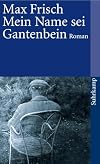
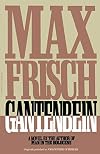
Gantenbein
by Max Frisch
On This Page
Description
A playfully postmodern novel exploring questions of identity from a major Swiss writer. A man walks out of a bar and is later found dead at the wheel of his car. On the basis of a few overheard remarks and his own observations, the narrator of this novel imagines the story of this stranger, or rather two alternative stories based on two identities the narrator has invented for him, one under the name of Enderlin, the other under the name Gantenbein.Tags
Recommendations










Member Recommendations
Member Reviews
This was Frisch's third mature novel, written after his break-up with Ingeborg Bachmann, a complicated exploration of fiction and role-playing as they enter into both real life and the occupation of storytelling.
The "I" figure of the book works through a baffling and contradictory series of possible scenarios involving himself and a character called Enderlin, who sometimes seems to be himself and sometimes a separate person. Enderlin in turn imagines himself as Gantenbein, a man who is pretending to be blind, and in that capacity marries the actress Lila, who seems to be (but isn't necessarily) identical with a woman Enderlin (or possibly "I") has met on a business trip to another city. Gantenbein also makes friends with a woman called show more Camilla Huber: his assumed blindness allows him not to notice that her pretended occupation of manicurist is just a front for prostitution, so he gives her pleasure by going to have his nails done whilst telling her stories. These stories are the only parts of the book in the past tense — everything else is narrated in the present or future/conditional/subjunctive ("But what if...?").
The idea seems to be that social identity is always a kind of pretence, or at least that we can never be sure that we experience an interaction or a relationship in the same way as others do. Frisch talked about truth as the absence that is left when we have explored all the fictions. I'm not sure! What stuck with me from this book was not so much all the sophisticated stuff about men in suits and women in smart costumes who spend most of their time in airports and business hotels and are obsessed with getting their smoking behaviour and whisky-drinking right, but the weird, untethered stories that open and close the book: an unidentified man who has left a hospital in panic, wearing only spectacles and a wrist-watch, runs through the centre of Zürich; the body of an unknown man floats serenely down the Limmat pursued by the police who have inexpertly been trying to fish it out, and does not come to rest until it has left the city centre altogether. show less
The "I" figure of the book works through a baffling and contradictory series of possible scenarios involving himself and a character called Enderlin, who sometimes seems to be himself and sometimes a separate person. Enderlin in turn imagines himself as Gantenbein, a man who is pretending to be blind, and in that capacity marries the actress Lila, who seems to be (but isn't necessarily) identical with a woman Enderlin (or possibly "I") has met on a business trip to another city. Gantenbein also makes friends with a woman called show more Camilla Huber: his assumed blindness allows him not to notice that her pretended occupation of manicurist is just a front for prostitution, so he gives her pleasure by going to have his nails done whilst telling her stories. These stories are the only parts of the book in the past tense — everything else is narrated in the present or future/conditional/subjunctive ("But what if...?").
The idea seems to be that social identity is always a kind of pretence, or at least that we can never be sure that we experience an interaction or a relationship in the same way as others do. Frisch talked about truth as the absence that is left when we have explored all the fictions. I'm not sure! What stuck with me from this book was not so much all the sophisticated stuff about men in suits and women in smart costumes who spend most of their time in airports and business hotels and are obsessed with getting their smoking behaviour and whisky-drinking right, but the weird, untethered stories that open and close the book: an unidentified man who has left a hospital in panic, wearing only spectacles and a wrist-watch, runs through the centre of Zürich; the body of an unknown man floats serenely down the Limmat pursued by the police who have inexpertly been trying to fish it out, and does not come to rest until it has left the city centre altogether. show less
A real brain-twister! I didn't succeed in following every line but it was compelling with interesting musings on identity and perception. Of the two imagined identities, I found Gantenbein more intelligible than Enderlin. Definitely one for re-reading. I prefer the original title, A Wilderness of Mirrors.
Update: Second Reading
If any book deserves a second look it's this one. I was startled on first reading, but it becomes much clearer now. The narrative mirrors the process of invention as the narrator comes up with the possible identities of a mysterious suicide he is witness to. The twin identities eventually overlap as the story progresses and the social self is contrasted with other possible identities in a way that reminded me of show more Pirandello. It's a fascinating book and compares favourably with his more famous novels. There's a dark humour throughout and a mercurial quality to the layout of the narrative while still remaining accessible. show less
Update: Second Reading
If any book deserves a second look it's this one. I was startled on first reading, but it becomes much clearer now. The narrative mirrors the process of invention as the narrator comes up with the possible identities of a mysterious suicide he is witness to. The twin identities eventually overlap as the story progresses and the social self is contrasted with other possible identities in a way that reminded me of show more Pirandello. It's a fascinating book and compares favourably with his more famous novels. There's a dark humour throughout and a mercurial quality to the layout of the narrative while still remaining accessible. show less
Well, if ever a person was unprepared for "Gantenbein", it was me. Even having read that one reviewer referred to it as an "anti-novel or non-novel", I was still flummoxed. First let's give credit where credit is due. "Gantenbein" is an exceptionally well written work. The author captures persons, situations, and relationships with precision and insight. The work is also incredibly inventive as reviewers have observed. The plot, yes the plot. There's the rub. The work contains numerous sometimes parallel, sometimes perpendicular stories. The book is like a whirlpool floating down a river. It moves along but what that "it" actually is, is ever allusive. At one point the author refers to an experience in search of a narrative. Overall the show more work tests the limits of "story" itself. But, the work is in no sense absurdist. It is also not "post modern" in the sense we usually understand. One could say it is a work that plays with creativity itself.
So, is it a proverbial "good read" in my eyes? The book can certainly be tedious at times. Once the reader gets the idea of what the author is doing with his "story" there is a tendency to say "enough already, I get it". Another aspect that can get irksome is the content of many of the topics of external and internal conversations. The book was written in the mid 1960's and, at times, that shows. That's a not so delicate way of saying it is a tad dated.
Should you read it? At the risk of being trite, I would say it's worth the experience. Also, if you are student of literature (or just very interested) it certainly is a work that has a place in the development of the modern novel.
You decide! show less
So, is it a proverbial "good read" in my eyes? The book can certainly be tedious at times. Once the reader gets the idea of what the author is doing with his "story" there is a tendency to say "enough already, I get it". Another aspect that can get irksome is the content of many of the topics of external and internal conversations. The book was written in the mid 1960's and, at times, that shows. That's a not so delicate way of saying it is a tad dated.
Should you read it? At the risk of being trite, I would say it's worth the experience. Also, if you are student of literature (or just very interested) it certainly is a work that has a place in the development of the modern novel.
You decide! show less
I want to trust my judgement and that's putting me between a rock and a hard place.
The rock is my respect for Frisch: if he wrote it, I'm going to read it.
The hard place is my 'arrggghhhhhhhhhhhhhh, it's an experimental novel. Even worse, it's an anti-novel. Stop it, stop reading it right now.'
I bought two books this morning I'd really like to start on...but first I'm going to pick this up again for the first time in a week.
I'm up to page -
? Does it matter in a book like this? Page somewhere.
The rock is my respect for Frisch: if he wrote it, I'm going to read it.
The hard place is my 'arrggghhhhhhhhhhhhhh, it's an experimental novel. Even worse, it's an anti-novel. Stop it, stop reading it right now.'
I bought two books this morning I'd really like to start on...but first I'm going to pick this up again for the first time in a week.
I'm up to page -
? Does it matter in a book like this? Page somewhere.
I want to trust my judgement and that's putting me between a rock and a hard place.
The rock is my respect for Frisch: if he wrote it, I'm going to read it.
The hard place is my 'arrggghhhhhhhhhhhhhh, it's an experimental novel. Even worse, it's an anti-novel. Stop it, stop reading it right now.'
I bought two books this morning I'd really like to start on...but first I'm going to pick this up again for the first time in a week.
I'm up to page -
? Does it matter in a book like this? Page somewhere.
The rock is my respect for Frisch: if he wrote it, I'm going to read it.
The hard place is my 'arrggghhhhhhhhhhhhhh, it's an experimental novel. Even worse, it's an anti-novel. Stop it, stop reading it right now.'
I bought two books this morning I'd really like to start on...but first I'm going to pick this up again for the first time in a week.
I'm up to page -
? Does it matter in a book like this? Page somewhere.
I want to trust my judgement and that's putting me between a rock and a hard place.
The rock is my respect for Frisch: if he wrote it, I'm going to read it.
The hard place is my 'arrggghhhhhhhhhhhhhh, it's an experimental novel. Even worse, it's an anti-novel. Stop it, stop reading it right now.'
I bought two books this morning I'd really like to start on...but first I'm going to pick this up again for the first time in a week.
I'm up to page -
? Does it matter in a book like this? Page somewhere.
The rock is my respect for Frisch: if he wrote it, I'm going to read it.
The hard place is my 'arrggghhhhhhhhhhhhhh, it's an experimental novel. Even worse, it's an anti-novel. Stop it, stop reading it right now.'
I bought two books this morning I'd really like to start on...but first I'm going to pick this up again for the first time in a week.
I'm up to page -
? Does it matter in a book like this? Page somewhere.
Members
- Recently Added By
Lists

German Literature
514 works; 50 members

Quirky Characters
24 works; 7 members
Author Information

Max Frisch was born in Switzerland in 1911. He attended the University of Zurich and spent six years in the Swiss Army. He also worked as a freelance writer and an architect. Frisch is most famous for writing the novel I'm Not Stiller and the play The Firebugs. Both works explore one of Frisch's major themes: the problematic nature of living life show more without a true understanding of one's identity. Many of his works feature explore this theme, including the plays The Chinese Wall, Andorra: A Play in Twelve Scenes, and Don Juan; or the Love of Geometry. He has also written several other novels, including Homo Faber: A Report, and Man in the Holocene. Frisch was awarded the International Neustadt Prize for Literature in 1987. He died in 1991 in Zurich. (Bowker Author Biography) show less
Some Editions
Awards and Honors
Series
Belongs to Publisher Series
Work Relationships
Is contained in
Common Knowledge
- Canonical title
- Gantenbein
- Original title
- Mein Name sei Gantenbein
- Alternate titles
- A Wilderness of Mirrors
- Original publication date
- 1964
- People/Characters*
- Theo Gantenbein
- Important places*
- Zürich, Zürich, Schweiz
- First words*
- Die dabei gewesen sind, die letzen, die ihn noch gesprochen haben, Bekannte durch Zufall, sagen, dass er an diesem Abend nicht anders war als sonst, munter, nicht übermütig.
- Quotations*
- (Manchmal scheint mir auch, daß jedes Buch, so es sich nicht befaßt mit der Verhinderung des Krieges, mit der Schaffung einer besseren Gesellschaft und so weiter, sinnlos ist, müßig, unverantwortlich, langweilig, nicht we... (show all)rt, daß man es liest, unstatthaft. Es ist nicht die Zeit für Ich-Geschichten. Und doch vollzieht es sich das menschliche Leben oder verfehlt sich am einzelnen Ich, nirgends sonst.)
Man muß einen anderen verlassen, Entschluß ist Entschluß und unerschütterlich, aber damit ist die Trennung noch nicht vollstreckt, man möchte die Vollstreckung in Würde, aber die Würde hindert die Vollstreckung; einer ... (show all)der beiden Partner kann´s nicht fassen, so lange die Würde gewahrt bliebt, und liebt wie noch nie; eines Abends steht er wieder da; man kann Abschiede nicht durch Briefe vollstrecken - Gantenbein zeigte, als nichts andres übrigblieb, volles stilles Verständnis dafür, daß sie einander wiedersehen mußten... - Last words*
- (Click to show. Warning: May contain spoilers.)ich greife mit der Hand um die Flasche, prüfend, ob der Wein (Verdicchio) auch kalt sei, Durst, dann Hunger, Leben gefällt mir -
- Blurbers*
- Blöcker, Günter
- Original language*
- Deutsch
- Disambiguation notice
- (The Russian edition contains other Frisch novels and is not the same work.)
*Some information comes from Common Knowledge in other languages. Click "Edit" for more information.
Classifications
- Genres
- Fiction and Literature, General Fiction
- DDC/MDS
- 830 — Literature & rhetoric German & related literatures German literature and literatures of related languages
- LCC
- PT2611 .R814 .M413 — Language and Literature German, Dutch and Scandinavian literatures German literature Individual authors or works 1860/70-1960
- BISAC
Statistics
- Members
- 717
- Popularity
- 39,367
- Reviews
- 9
- Rating
- (3.89)
- Languages
- 14 — Danish, Dutch, English, Finnish, French, German, Italian, Lithuanian, Norwegian (Bokmål), Polish, Romanian, Russian, Spanish, Turkish
- Media
- Paper, Audiobook, Ebook
- ISBNs
- 37
- ASINs
- 19