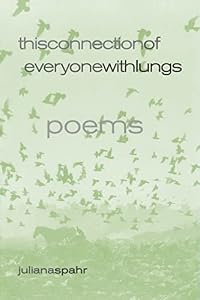
This Connection of Everyone with Lungs: Poems
by Juliana Spahr
On This Page
Description
Part planetary love poem, part 24/7 news flash, the hypnotic poems of This Connection of Everyone with Lungs wrap with equal, angular grace around lovers and battleships. These poems hear the tracer fire in a bird's song and capture cell division and troop deployments in the same expansive thought. They move through concentric levels of association and embrace -from the space between the hands to the mesosphere and back again-touching everything in between. The book's focus shifts between show more local and global, public and private, individual and social. Everything gets in: through all five senses, through windows, between your sheets, under your skin. show lessTags
Recommendations






























Member Reviews
I love the first poem, which is a conceptual piece on breath. The repetition and slow building are effective and hypnotic. I found the remaining pieces, mainly collections of snippets from the news, tiresome, heavy-handed, and preachy.
Wow. This can't be representative work. Because it's awful. I read a poem of her's I liked called "Narrative" and a colleague raved about this book. She's got so much buzz. I'm mystified. This book is astonishingly and depressingly self-congratulatory, one dimensional, and opportunistic. The levels of un intentional irony are pretty staggering.
http://imaginaryyear.com/raccoon/books/spahr.html
OK, so for a while now I've been wanting to talk about Juliana Spahr's new book, This Connection of Everyone With Lungs, as an example of what I've been calling an "Everything Device," a structure, framework, or system which positions disparate information into a meaningful relationship.
We can get a sense that the book is going to do this from its title alone, a phrase drawn from the opening poem: "Poem Written After September 11, 2001." This poem's central task is to articulate the model of radical interconnectedness upon which the rest of the book depends. Over its eight pages it performs this task through what essentially amounts to a slow zoom-out, from the microscopic level ("cells, show more the movement of cells and the division of cells") all the way out to global scope ("the space of the cities and the space of the regions and the space of the nations and the space of the continents and islands"). To call oneself a "global citizen" is slightly pollyanna-ish, but this poem still functions as a lovely vision: the way it is made elegiac by its positioning as a "post-9/11" poem feels slightly predictable, but that makes the elegy no less real. One of the more "important" poems in recent memory (let's set aside, for now, the question of whether poetry should aspire to importance).
More interesting and important still is the book's remainder, a single long poem (broken into discrete chunks), entitled "Poem Written From November 30, 2002, to March 27, 2003." (The first bit of it lives over at Shampoo, you can go check it out if you're so inclined.) I think this poem is more interesting because it's doing the thornier work of dealing with the consequences of the first poem: if "everyone with lungs" is connected in a "lovely [and] doomed" global matrix, then what does this mean? If we can successfully expand our consciousness to the point where it encompasses the whole earth as a system, then what does it mean when part of that system (including but not limited to "our part") is attempting to kill another part of that system (including but not limited to "their part")? Is it possible to love humanity all-encompassingly when some of the humans that we're connected to behave so, well, shittily? Is a person killed in the Burij refugee camps important? What about someone killed in the Monoko-Zohi civil war? What about Justin Timberlake? How important is the weather? If you can make your own bed a place of "connected loving" and "pleasure" and "agency," what relevance does this have to the rest of the world, if any? How can you consider these questions seriously in a world at war without going insane or succumbing to crippling grief?
I don't think that the book answers these questions, but I think they're the right ones to be asking, and any book that represents a sustained attempt to address them (lyrically no less!) gets my recommendation.
PS: When I first wrote about Spahr's project I said that the high lyrical voice and the sometimes "newsy" details made it seem like "Walt Whitman doing NPR's Morning Edition," and it still seems possible to say that Spahr's project is to represent the newspaper in the form of a poem. I don't think this is necessarily a bad thing, and it has its own storied tradition: the avant-garde has been attempting to beat the newspaper as a model for radically discontinuous juxtaposition at least since Mallarme. show less
OK, so for a while now I've been wanting to talk about Juliana Spahr's new book, This Connection of Everyone With Lungs, as an example of what I've been calling an "Everything Device," a structure, framework, or system which positions disparate information into a meaningful relationship.
We can get a sense that the book is going to do this from its title alone, a phrase drawn from the opening poem: "Poem Written After September 11, 2001." This poem's central task is to articulate the model of radical interconnectedness upon which the rest of the book depends. Over its eight pages it performs this task through what essentially amounts to a slow zoom-out, from the microscopic level ("cells, show more the movement of cells and the division of cells") all the way out to global scope ("the space of the cities and the space of the regions and the space of the nations and the space of the continents and islands"). To call oneself a "global citizen" is slightly pollyanna-ish, but this poem still functions as a lovely vision: the way it is made elegiac by its positioning as a "post-9/11" poem feels slightly predictable, but that makes the elegy no less real. One of the more "important" poems in recent memory (let's set aside, for now, the question of whether poetry should aspire to importance).
More interesting and important still is the book's remainder, a single long poem (broken into discrete chunks), entitled "Poem Written From November 30, 2002, to March 27, 2003." (The first bit of it lives over at Shampoo, you can go check it out if you're so inclined.) I think this poem is more interesting because it's doing the thornier work of dealing with the consequences of the first poem: if "everyone with lungs" is connected in a "lovely [and] doomed" global matrix, then what does this mean? If we can successfully expand our consciousness to the point where it encompasses the whole earth as a system, then what does it mean when part of that system (including but not limited to "our part") is attempting to kill another part of that system (including but not limited to "their part")? Is it possible to love humanity all-encompassingly when some of the humans that we're connected to behave so, well, shittily? Is a person killed in the Burij refugee camps important? What about someone killed in the Monoko-Zohi civil war? What about Justin Timberlake? How important is the weather? If you can make your own bed a place of "connected loving" and "pleasure" and "agency," what relevance does this have to the rest of the world, if any? How can you consider these questions seriously in a world at war without going insane or succumbing to crippling grief?
I don't think that the book answers these questions, but I think they're the right ones to be asking, and any book that represents a sustained attempt to address them (lyrically no less!) gets my recommendation.
PS: When I first wrote about Spahr's project I said that the high lyrical voice and the sometimes "newsy" details made it seem like "Walt Whitman doing NPR's Morning Edition," and it still seems possible to say that Spahr's project is to represent the newspaper in the form of a poem. I don't think this is necessarily a bad thing, and it has its own storied tradition: the avant-garde has been attempting to beat the newspaper as a model for radically discontinuous juxtaposition at least since Mallarme. show less
This is one of my favorite poetry collections that focuses on poetry of witness. She writes of events as both a love poem but also of fear and meditation on humanity. I think her wording is lovely but it is also harrowing and dark. This book is filled with the deaths of those unknown and how that impact changes the everyday. It is a very moving piece of writing.
Truly connected. Amazing. An act of courage and resistance. A poetics of the moment.
Ratings
Members
- Recently Added By
Author Information

38+ Works 527 Members
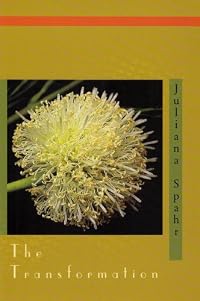
Juliana Spahr is a poet, scholar, and editor. She is the recipient of the 2009 O.B. Hardison Poetry Prize awarded by the Folger Shakespeare Library. Among her previous works are Response (Sun and Moon Press, 1996), for which she received the National Poetry Series Award; This Connection of Everyone with Lungs (University of California, 2005); and show more The Transformation (Atelos Press, 2007). show less
Common Knowledge
- Canonical title
- This Connection of Everyone with Lungs: Poems
Classifications
Statistics
- Members
- 130
- Popularity
- 250,487
- Reviews
- 6
- Rating
- (3.58)
- Languages
- English, Norwegian (Nynorsk)
- Media
- Paper, Ebook
- ISBNs
- 5
- ASINs
- 1