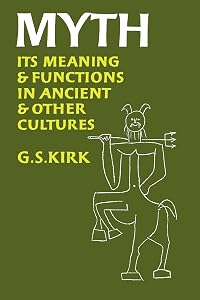
Myth: Its Meaning and Functions in Ancient and Other Cultures
by G. S. Kirk
Sather Classical Lectures (40)
On This Page
Description
This book attempts to come to grips with a set of widely ranging but connected problems concerning myths: their relation to folktales on the one hand, to rituals on the other; the validity and scope of the structuralist theory of myth; the range of possible mythical functions; the effects of developed social institutions and literacy; the character and meaning of ancient Near-Eastern myths and their influence on Greece; the special forms taken by Greek myths and their involvement with show more rational modes of thought; the status of myths as expressions of the unconscious, as allied with dreams, as universal symbols, or as accidents of primarily narrative aims. Almost none of these problems has been convincingly handled, even in a provisional way, up to the present, and this failure has vitiated not only such few general discussions as exist of the nature, meanings and functions of myths but also, in many cases, the detailed assessment of individual myths of different cultures. The need for a coherent treatment of these and related problems, and one that is not concerned simply to propagate a particular universalistic theory, seems undeniable. How far the present book will satisfactorily fill such a need remains to be seen. At least it makes a beginning, even if in doing so it risks the criticism of being neither fish nor fowl. Sociologists and folklorists may find it, from their specialized viewpoints, a little simplistic in places; and a few classical colleagues will not forgive me for straying far beyond Greek myths, even though these can hardly be understood in isolation or solely in the light of studies in cult and ritual. Others may find it less easy than anthropologists, sociologists, historians of thought or students of French and English literature to accept the relevance of Levi-Strauss to some of these matters; but his theory contains the one important new idea in this field since Freud, it is complicated and largely untested, and it demands careful attention from anyone attempting a broad understanding of the subject. The beliefs of Freud and Jung, on the other hand, are a more familiar element in the situation and have given rise to an enormous secondary literature, much of it arbitrary and some of it absurd. The author has tried to isolate the crucial ideas and subject them to a pointed, if too brief, critique; so too with those of Ernst Cassirer. show lessTags
Recommendations
































Member Reviews
This is an academic book written in a very ponderous and somewhat arrogant style. If it has any value, it is historical, as a text that helps us to understand the state of mythological studies towards the tail end of the 1960s if that matters to you.
While Kirk can be almost snidely brutal about other academics and there is the prevailing scent of old battles of little current importance, his primary interest is in responding (favourably if cautiously) to the emergence in France of Levy-Strauss' structuralist approach to myth.
This element in the book has some small value but it has to be said that, by the end of the book, after 285 pages of argument, I was still no wiser as to the meaning or function of myth. Occasional insights had show more scarcely made the effort of reading it worthwhile. It stays in the library - but only just. show less
While Kirk can be almost snidely brutal about other academics and there is the prevailing scent of old battles of little current importance, his primary interest is in responding (favourably if cautiously) to the emergence in France of Levy-Strauss' structuralist approach to myth.
This element in the book has some small value but it has to be said that, by the end of the book, after 285 pages of argument, I was still no wiser as to the meaning or function of myth. Occasional insights had show more scarcely made the effort of reading it worthwhile. It stays in the library - but only just. show less
Spends too much time trash talking the systems of deeper thinkers and better writers, but still makes some good points about the variety of possible origins and functions ("narrative, operative or validatory, and speculative or explanatory") of myth, its nuance, arguments for the localized social meaning of many mythic stories, but also generally a seriousness of purpose, a recurrence of themes, and a connection to a radically different concept of time than the historical/chronological.
Ratings
Members
- Recently Added By
Lists

Books in the Bibliography of The History of Hell by Alice K. Turner
155 works; 1 member
Author Information

30+ Works 1,935 Members
Series

Common Knowledge
- Canonical title
- Myth: Its Meaning and Functions in Ancient and Other Cultures
- Original publication date
- 1970
- People/Characters
- Apollo; Athena; Émile Durkheim; Enki; Enlil; Sigmund Freud (show all 24); Gilgamesh; Heracles; Hesiod; Homer; Inanna; Ishtar; Thorkild Jacobsen; Kronos; Chronos; Claude Lévi-Strauss; Odysseus; Ouranos; Persephone; Perseus; Prometheus; Typhon; Utnapishtim; Zeus
- Important places
- Akkad, Mesopotamia; Babylon; Ancient Egypt; Ancient Greece; Hades; Mesopotamia (show all 9); Sumeria; Thebes, Greece; Uruk, Mesopotamia
- Important events
- Creation
- First words
- Preface
This book attempts to come to grips with a set of widely ranging but connected problems concerning myths: their relation to folktales on the one hand, to rituals on the other; the validity and scope of the structur... (show all)alist theory of myth; the range of possible mythical functions; the effects of developed social institutions and literacy; the character and meaning of ancient Near-Eastern myths and their influence on Greece; the special forms taken by Greek myths and their involvement with rational modes of thought; the status of mythos as expressions of the unconscious, as allied with dreams, as universal symbols, or as accidents of primarily narrative aims. - Last words
- (Click to show. Warning: May contain spoilers.)In this respect the cultures of the ancient world are at least as important as those of modern tribal societies.
- Blurbers
- Goody, Jack; Kermode, Frank; Momigliano, Arnaldo; Richardson, N. J.; Verity, A. C. F.; Brunner, Hélène
Classifications
- Genres
- Anthropology, Nonfiction, General Nonfiction, History, Religion & Spirituality
- DDC/MDS
- 398 — Society, government, & culture Customs, etiquette & folklore Folklore & Folktales
- LCC
- BL311 .K55 — Philosophy, Psychology and Religion Religions. Mythology. Rationalism Religions. Mythology. Rationalism The myth. Comparative mythology
- BISAC
Statistics
- Members
- 229
- Popularity
- 142,333
- Reviews
- 2
- Rating
- (3.60)
- Languages
- English, Hungarian, Spanish
- Media
- Paper, Ebook
- ISBNs
- 11
- ASINs
- 3