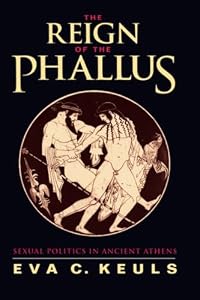
The Reign of the Phallus: Sexual Politics in Ancient Athens
by Eva C. Keuls
On This Page
Description
At once daring and authoritative, this book offers a profusely illustrated history of sexual politics in ancient Athens.The phallus was pictured everywhere in ancient Athens: painted on vases, sculpted in marble, held aloft in gigantic form in public processions, and shown in stage comedies. This obsession with the phallus dominated almost every aspect of public life, influencing law, myth, and customs, affecting family life, the status of women, even foreign policy.This is the first book to show more draw together all the elements that made up the "reign of the phallus"-men's blatant claim to general dominance, the myths of rape and conquest of women, and the reduction of sex to a game of dominance and submission, both of women by men and of men by men.In her elegant and lucid text Eva Keuls not only examines the ideology and practices that underlay the reign of the phallus, but also uncovers an intense counter-movement-the earliest expressions of feminism and antimilitarism.Complementing the text are 345 reproductions of Athenian vase paintings. Some have been reproduced in a larger format and gathered in an appendix for easy reference and closer study. These revealing illustrations are a vivid demonstration that classical Athens was more sexually polarized and repressive of women than any other culture in Western history. show lessTags
Recommendations

















Member Recommendations


Member Reviews
Part archaeology, part mystery! Who's been breaking off the willies on the Herms in Ancient Athens? Keuls has an answer with compelling arguments. Oh, how I wish it were true! Chalk one up for the mad Maenads! Anyway, it certainly is interesting if only for the photos of kalices etc. that are usually hidden in the back rooms of museums for propriety's sake. Hmmm, I wonder if my fingerprints are still on file at the Metropolitan?
Recent reread:
I certainly plowed through it in record time for a second read, even having to flip pages back and forth to keep up with the illustrations.
It's a thoughtful book, backing up ancient art with contemporary history (such as Thucydides) and literature (Aristophanes, et alia). The author has an show more interesting theory of how lots of willies got knocked off the Hermes statues that stood outside Athenian homes that makes more sense than the airy accusation I read recently that it was inveterate bad-boy Alcibiades. Why the general who was most insistent on the mission to Sicily would jeopardize it by mutilating images of the god of travelers makes no sense. No one knew who did it back then and no clear case against any culprits has developed since. I like Keuls's idea, but it may be too much to hope for.
I don't like the interpretation of Socrates' last words as much as I like the one about the sacrifice of a cock to Asclepius being for the healing of Plato - who wasn't there to witness anything of the death because he was ill. We can never know these things, but there is the fun of speculation.
The women of sixth and fifth centuries Athens lived in purdah, unless they were foreigners or prostitutes. They had no freedom and were good for nothing but producing male heirs and maybe a little light household management. The ultimate accolade was to never have been seen by any man other than her husband. And apparently precious little by him. The women's quarters were kept apart from the rest of the house, behind a closed door. The dining room was only for husbands and their male friends - and guest prostitutes. Education for women was discouraged as it would only make their evil propensities worse.
This only lightened up after the Spartan defeat of Athens leading to the death and enslavement of the soldiers. Very few returned to Athens and, well, someone had to get the work done. This reminded me of the book I read in the 70s about women during the Revolutionary War in America and how they had to step up and run farms and businesses, with wildly varying success, while their men were away. Abigail Adams enjoined her husband to remember the ladies when Congress made laws, which he scoffed at with condescension. Maybe it was her dodgy spelling. She had been running their farm while he was away.
It was nice to read that Socrates was relatively feminist. No wonder he had to be executed. Keuls claims that the Roman Stoic, Musonius Rufus, has been sidelined over the centuries because of his feminism but (and this is about 40 years after publishing) I found plenty of material in multiple formats on or by him online. Aristotle was not only misogynistic, but totally wrong about conception. I haven't gotten to that part of Aristotle because I get mired in the philology.
Now I have to read Aristophanes' "Thesmophoriazousai" because I have no memory of it. show less
Recent reread:
I certainly plowed through it in record time for a second read, even having to flip pages back and forth to keep up with the illustrations.
It's a thoughtful book, backing up ancient art with contemporary history (such as Thucydides) and literature (Aristophanes, et alia). The author has an show more interesting theory of how lots of willies got knocked off the Hermes statues that stood outside Athenian homes that makes more sense than the airy accusation I read recently that it was inveterate bad-boy Alcibiades. Why the general who was most insistent on the mission to Sicily would jeopardize it by mutilating images of the god of travelers makes no sense. No one knew who did it back then and no clear case against any culprits has developed since. I like Keuls's idea, but it may be too much to hope for.
I don't like the interpretation of Socrates' last words as much as I like the one about the sacrifice of a cock to Asclepius being for the healing of Plato - who wasn't there to witness anything of the death because he was ill. We can never know these things, but there is the fun of speculation.
The women of sixth and fifth centuries Athens lived in purdah, unless they were foreigners or prostitutes. They had no freedom and were good for nothing but producing male heirs and maybe a little light household management. The ultimate accolade was to never have been seen by any man other than her husband. And apparently precious little by him. The women's quarters were kept apart from the rest of the house, behind a closed door. The dining room was only for husbands and their male friends - and guest prostitutes. Education for women was discouraged as it would only make their evil propensities worse.
This only lightened up after the Spartan defeat of Athens leading to the death and enslavement of the soldiers. Very few returned to Athens and, well, someone had to get the work done. This reminded me of the book I read in the 70s about women during the Revolutionary War in America and how they had to step up and run farms and businesses, with wildly varying success, while their men were away. Abigail Adams enjoined her husband to remember the ladies when Congress made laws, which he scoffed at with condescension. Maybe it was her dodgy spelling. She had been running their farm while he was away.
It was nice to read that Socrates was relatively feminist. No wonder he had to be executed. Keuls claims that the Roman Stoic, Musonius Rufus, has been sidelined over the centuries because of his feminism but (and this is about 40 years after publishing) I found plenty of material in multiple formats on or by him online. Aristotle was not only misogynistic, but totally wrong about conception. I haven't gotten to that part of Aristotle because I get mired in the philology.
Now I have to read Aristophanes' "Thesmophoriazousai" because I have no memory of it. show less
Keuls’ book uses ancient Greek vases as a source for understanding the sexual politics of ancient Athens. She argues that Athens were a “phallocracy” in which phallic symbols dominated the life of the polis. Her book is really interesting, because she talks about prostitution, concubines, pederasty, marriage, myth, tragedy, and other juicy subjects. I suspect she is right that the writing of social history of ancient Athens has ignored artistic sources, but then again, reading this book, I can understand why; artwork is too vague to often be of much help. Often I found myself wondering, how the heck did she get a particular conclusion from a particular vase? Still, she raises a lot of good questions and writes very provocatively, show more even if her conclusions often seem stretched. show less
Ratings
Members
- Recently Added By
Author Information

6+ Works 283 Members
Awards and Honors
Awards
Common Knowledge
- Original publication date
- 1985
Classifications
- Genres
- Nonfiction, History, General Nonfiction, Art & Design, Religion & Spirituality
- DDC/MDS
- 306.7 — Society, Government, and Culture Social sciences, sociology & anthropology Social Behavior - Dating, Marriage, Divorce Sexual relations
- LCC
- HQ1134 .K48 — Social sciences The family. Marriage, Women and Sexuality The Family. Marriage. Women Women. Feminism
- BISAC
Statistics
- Members
- 265
- Popularity
- 121,645
- Reviews
- 2
- Rating
- (3.91)
- Languages
- English
- Media
- Paper, Ebook
- ISBNs
- 6