On This Page
Description
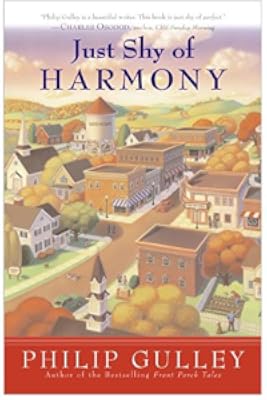
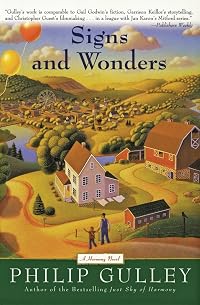
Philip Gulley's critically acclaimed Harmony series has invited comparisons to Jan Karon's best-selling Mitford series. Taking readers into the life of a small midwestern town, Gulley fills this book with quirky and eccentric residents and an extra helping of kindly spirit. Just Shy of Harmony is a beautiful novel of mysteries and miracles. With an entertaining narration by Norman Dietz, both Gulley fans and first-time listeners are in for a real treat.Tags
Recommendations
















Member Reviews
This second book in the Harmony series is another entertaining read that weaves in comedy as it addresses an assortment of serious issues. I'd say the novel likely has as much humor as the first.
(And it was a smart move to switch to third-person narration for this book. Sam's first-person narration in the previous novel was all right in the scenes involving him, but it didn't make sense that he somehow had the omniscient knowledge to also narrate the scenes about the other townsfolk's lives.)
Granted, given my frame of mind, I didn't chuckle as much this time, what with my frustration with several of the characters. It's a laughable but crying shame how much the satirical picture the author paints does indeed reflect the church—how show more certain professing Christians, confident that they're doing great services/favors for the Lord, have really just made a religion out of being indifferent, ignorant, or straight-up horrible to other people, in the (misappropriated) name of "righteousness."
Eeesh. It was an utter relief at one point to finally encounter a little compassion and kindness from a particular cluster of characters.
Now, in light of one repeated idea in a main thread of the novel, I just gotta give my take: If you're dealing with a crumbling marriage, you don't try to rebuild it because "you owe it to the kids." Kids, even as important as they are, are third parties. They aren't the basis of a marriage relationship. The kids didn't make the marriage vows and sign the marriage license or contract, and in a few years, once they grow up and go off to lead their own lives, you'll be left with the person you're married to. Hence, if you're looking to heal your marriage at the root, you and the person you're married to should be the two key people you're doing it for.
Also in light of the story, I'd say similar sentiments can apply if you base your relationship with God on third parties. But anyhow.
Having the chance to process some frustration may be the reason I actually enjoyed this book as much as the first. Fiction serves various purposes, after all. I'm looking forward to continuing the series. show less
(And it was a smart move to switch to third-person narration for this book. Sam's first-person narration in the previous novel was all right in the scenes involving him, but it didn't make sense that he somehow had the omniscient knowledge to also narrate the scenes about the other townsfolk's lives.)
Granted, given my frame of mind, I didn't chuckle as much this time, what with my frustration with several of the characters. It's a laughable but crying shame how much the satirical picture the author paints does indeed reflect the church—how show more certain professing Christians, confident that they're doing great services/favors for the Lord, have really just made a religion out of being indifferent, ignorant, or straight-up horrible to other people, in the (misappropriated) name of "righteousness."
Eeesh. It was an utter relief at one point to finally encounter a little compassion and kindness from a particular cluster of characters.
Now, in light of one repeated idea in a main thread of the novel, I just gotta give my take: If you're dealing with a crumbling marriage, you don't try to rebuild it because "you owe it to the kids." Kids, even as important as they are, are third parties. They aren't the basis of a marriage relationship. The kids didn't make the marriage vows and sign the marriage license or contract, and in a few years, once they grow up and go off to lead their own lives, you'll be left with the person you're married to. Hence, if you're looking to heal your marriage at the root, you and the person you're married to should be the two key people you're doing it for.
Also in light of the story, I'd say similar sentiments can apply if you base your relationship with God on third parties. But anyhow.
Having the chance to process some frustration may be the reason I actually enjoyed this book as much as the first. Fiction serves various purposes, after all. I'm looking forward to continuing the series. show less
From the book jacket:Master storyteller Philip Gulley returns to the winsome ways of Harmony, Indiana, … [and] follows the happenings of an eventful year spanning two Easters, in which Quaker pastor Sam Gardner and the members of his flock discover surprising answers to life’s challenging mysteries.
My reactions
This is book 2 in the Harmony Series, and I just love them. They are gentle stories with a good sprinkling of humor, and a few life lessons learned, but without being preachy. I have to admit that Dale Hinshaw does tax my patience … but his schemes for bringing THE WORD to heathens are ever entertaining.
My reactions
This is book 2 in the Harmony Series, and I just love them. They are gentle stories with a good sprinkling of humor, and a few life lessons learned, but without being preachy. I have to admit that Dale Hinshaw does tax my patience … but his schemes for bringing THE WORD to heathens are ever entertaining.
Sam Gardner, pastor of the Harmony Friends Meeting, continues his second year of ministry in Philip Gulley's Just Shy of Harmony, the second book in his Harmony series. As Sam reacclimates to his hometown, he continues trying to support the quirky and loving people through their joys and challenges.
In the midst of these challenges, ranging from the humorous -- the elder who decides to evangelize the world by producing chicken eggs with Biblical verses inside -- to the tragic -- a young mother in a life-and-death struggle with leukemia -- Sam faces his own personal challenge, the loss of his faith.
This adds a layer of melancholy to the life-affirming tales that Gulley spins in this charming book. In fact, Gulley's careful balancing of show more life's basic emotions, the good and the challenging, undergirds the resonance of his stories. He sees the humor in the self-absorption of some of his characters, who never quite understand why others don't see the world as they do, but he also sees their humanity.
Consider Bob Miles, the newspaper editor, who appears a few times in this novel. In one chapter, he is excited to realize that he's writing his 1,000 column ("The Bobservation Post") for the newspaper, and hopes to find someone to share that happiness with; soon thereafter, however, he is depressed by the fact that he seems to have written the same column 1,000 times.
As usual, Gulley, himself a pastor, has a keen understanding of small-town church people. He offers glimpses of their stubbornness to change, sometimes funny and sometimes poignant, but he also shows the essential love for others that they demonstrate in other ways. These are the people in many churches (I know -- like Gulley, I am a pastor too).
In his humorous and touching, never condescending, way, Gulley shows us the best of ourselves. He shows a good man struggling to regain his faith, and the loving and impractical support he receives from others who don't understand quite what he's talking about. He shows people coping with illness and family problems with courage and decency. He shows a church where the members sometimes miss the big picture, but just as often surpass anyone's expectations in how they reach out to others. show less
In the midst of these challenges, ranging from the humorous -- the elder who decides to evangelize the world by producing chicken eggs with Biblical verses inside -- to the tragic -- a young mother in a life-and-death struggle with leukemia -- Sam faces his own personal challenge, the loss of his faith.
This adds a layer of melancholy to the life-affirming tales that Gulley spins in this charming book. In fact, Gulley's careful balancing of show more life's basic emotions, the good and the challenging, undergirds the resonance of his stories. He sees the humor in the self-absorption of some of his characters, who never quite understand why others don't see the world as they do, but he also sees their humanity.
Consider Bob Miles, the newspaper editor, who appears a few times in this novel. In one chapter, he is excited to realize that he's writing his 1,000 column ("The Bobservation Post") for the newspaper, and hopes to find someone to share that happiness with; soon thereafter, however, he is depressed by the fact that he seems to have written the same column 1,000 times.
As usual, Gulley, himself a pastor, has a keen understanding of small-town church people. He offers glimpses of their stubbornness to change, sometimes funny and sometimes poignant, but he also shows the essential love for others that they demonstrate in other ways. These are the people in many churches (I know -- like Gulley, I am a pastor too).
In his humorous and touching, never condescending, way, Gulley shows us the best of ourselves. He shows a good man struggling to regain his faith, and the loving and impractical support he receives from others who don't understand quite what he's talking about. He shows people coping with illness and family problems with courage and decency. He shows a church where the members sometimes miss the big picture, but just as often surpass anyone's expectations in how they reach out to others. show less
Not as funny as the first one, and I miss the humor of the first-person narration, but it has a very moving and well-crafted plot concerning Sam's struggle with faith. This sequel may be even deeper than the original.
This was quite dissapointing. I read the first book of the series on a whim, and loved the heartfelt, realistic, hilarious and touching stories of a Quaker congregation portrayed in it. I picked up this, and expected the same. Instead, everything felt exaggerated, forced, unreal, and almost sacrilegious at times. Quite dissapointing. The few bright spots were Sam's storyline. Nicely done, about the only realistic part of the book. Also, Wayne, Deena, Miriam, Sally, and Ellis were all very sweet characters. The storyline with Wayne, Deena and Sally was very sweet, and had me guessing.
Overall, not recommended. Read the first book and call it good.
Overall, not recommended. Read the first book and call it good.
Sequel to 'Home to Harmony', this is another sequence of anecdotes surrounding the life of Quaker pastor Sam. In this book he becomes rather cynical, feeling that he's lost his faith, and decides to stop preaching for a while, allowing his elders to speak instead. One of them is convinced the Lord has led him to feed his chickens with Scripture verses, to pass out eggs for evangelism...
There's humour in this book, there are also some quite moving scenes. There's not a whole lot of plot, just several stories as time moves forward in the lives of the mixed bunch who interact with Sam. Slightly annoying that the tense changes apparently randomly from past to present and back again, but overall this is very enjoyable light reading that show more gently manages to explore issues of faith and hope, of church unity and struggles, of the priorities that are - or perhaps should be - part of the Christian life, and in the end, an awareness that God can work through the most unexpected of circumstances.
Not for everyone, but for those who like the Jan Karon style of small town American church anecdotes, this is recommended. show less
There's humour in this book, there are also some quite moving scenes. There's not a whole lot of plot, just several stories as time moves forward in the lives of the mixed bunch who interact with Sam. Slightly annoying that the tense changes apparently randomly from past to present and back again, but overall this is very enjoyable light reading that show more gently manages to explore issues of faith and hope, of church unity and struggles, of the priorities that are - or perhaps should be - part of the Christian life, and in the end, an awareness that God can work through the most unexpected of circumstances.
Not for everyone, but for those who like the Jan Karon style of small town American church anecdotes, this is recommended. show less
This book, second in a series, covers a year in the life of a congregation in Harmony, Indiana. (It says it's in Indiana on the book cover; I don't remember seeing the state mentioned anywhere in the book.) In this installment of the Harmony saga, Sam Gardner is becoming discouraged in his second year of ministry there. His congregation is entrenched in its ways, and those ways aren't always very mission-oriented. His frustration takes a toll on his faith as he grapples with various issues facing the people of his congregation.
I'm not sure what to say about this book. On the one hand, it's an easy, lightweight read. On the other, it gave me some things to think about. Harmony, Indiana is populated with rather exaggerated versions of the show more folks we often encounter in churches -- the kind, the self-righteous, the selfish, the generous, the zealous, the well-meaning, the power-hungry, the afflicted, the faithful, etc. I recognized many of them from my own life (though, thankfully, we haven't had to deal with many of the really unpleasant ones lately; and the ones we've dealt with recently have been on the periphery of our church ministry, or had only mild cases of the negative traits.)
As I said, the characters -- a few of them really odd birds -- are a bit exaggerated. And the time-span of the narrative makes for some gaps. But the story is told with humor (sometimes zany) and and honesty -- even the difficult people have their good points (hard as they are to see sometimes) and the good people have their bad points. Gulley does a good job of capturing some of the nuances of small-town life, both good and bad. And there are a few surprises along the way to shake up attitudes a bit. But the book is not "preachy," in my opinion.
This book is certainly not great literature, but I enjoyed it. I may take another trip to Harmony in the near future. I might especially recommend it for those who have been stung by experiences with church people who didn't always behave in what would be considered a "Christian" manner -- and I suspect that's most of us (at one time or another) who have been active in church. show less
I'm not sure what to say about this book. On the one hand, it's an easy, lightweight read. On the other, it gave me some things to think about. Harmony, Indiana is populated with rather exaggerated versions of the show more folks we often encounter in churches -- the kind, the self-righteous, the selfish, the generous, the zealous, the well-meaning, the power-hungry, the afflicted, the faithful, etc. I recognized many of them from my own life (though, thankfully, we haven't had to deal with many of the really unpleasant ones lately; and the ones we've dealt with recently have been on the periphery of our church ministry, or had only mild cases of the negative traits.)
As I said, the characters -- a few of them really odd birds -- are a bit exaggerated. And the time-span of the narrative makes for some gaps. But the story is told with humor (sometimes zany) and and honesty -- even the difficult people have their good points (hard as they are to see sometimes) and the good people have their bad points. Gulley does a good job of capturing some of the nuances of small-town life, both good and bad. And there are a few surprises along the way to shake up attitudes a bit. But the book is not "preachy," in my opinion.
This book is certainly not great literature, but I enjoyed it. I may take another trip to Harmony in the near future. I might especially recommend it for those who have been stung by experiences with church people who didn't always behave in what would be considered a "Christian" manner -- and I suspect that's most of us (at one time or another) who have been active in church. show less
Members
- Recently Added By
Author Information

34+ Works 5,706 Members
Philip Gulley is a Quaker minister, writer, husband, and father. He and his wife, Joan, live in Indiana with their sons, Spencer and Sam
Series

Common Knowledge
- People/Characters
- Sam Gardner; Barbara Gardner; Dale Hinshaw
- Important places
- Harmony, Indiana, USA; USA; Indiana, USA
- Dedication
- To Joan and my sons, Spencer and Sam
- First words
- Sam Gardner sat on the porch the Monday after Easter. It was early in the morning. The Grant kids were walking past on their way to school.
- Last words
- (Click to show. Warning: May contain spoilers.)"Isn't God good," Deena said. It was a declaration, not a question.
Sam smiled and nodded his head in agreement. God is good, he thought. Bewildering, but good.
Classifications
Statistics
- Members
- 474
- Popularity
- 64,110
- Reviews
- 17
- Rating
- (3.83)
- Languages
- English, Swedish
- Media
- Paper, Audiobook, Ebook
- ISBNs
- 16
- ASINs
- 5