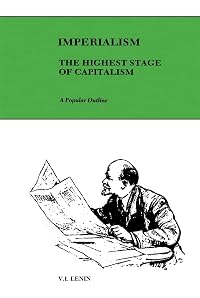
Imperialism, the Highest Stage of Capitalism
by Vladimir Ilʹič Lenin
On This Page
Description
Imperialism, the Highest Stage of Capitalism, by Lenin, describes the function of financial capital in generating profits from imperial colonialism, as the final stage of capitalist development to ensure greater profits. The essay is a synthesis of Lenin's modifications and developments of economic theories that Karl Marx formulated in "Das Kapital". Lenin's book greatly influenced the Core-Periphery model of global capitalist development, as well as World-systems theory and Dependency theory.Tags
Recommendations





















Member Reviews
Cai de paraquedas nesse livro, e posso dizer que é uma boa leitura, em que o autor convincentemente conceitua imperialismo como o estágio monopolista do capitalismo em que o capital financeiro e as operações de financeirização passam a dominar o cenário mundial. Assim, através da livre competição chega-se nos anti-mercados do meio do século XX (os cartéis, as fusões, a influência generalizada do financeiro), caracterizados pela enorme concentração de renda e capital bancário dos grupos importantes, com a conjunta divisão do mundo entre os que tem colônias e os que são colônias. Cheio de dados e citações de economistas não-marxistas, há aqui o trabalho de explicitar o que foi escondido, esfumaçado e omitido show more "ingenuamente" nas descrições do desenvolvimento capitalista. Há socialização da produçã, similar à da própria Rússia, como Lenin pontua, mas sem distribuição nenhuma, e a oligarquia financeira passa a ter um poder enorme de ingerência; a exportação passa a ser tipicamente de capital e não de produtos, fato que o colonialismo prepara. O que é importante é a tendência geral do sistema de enredar tudo isso, ao mesmo tempo que permite a continuidade da exploração, no aprofundamento da desigualdade social e nas relações entre oligopólios que operam acordos mais que ações de competição. Que isso não resulte num monopólio mundial à pax romana e que o bem de todos via planejamento total não seja alcançado são duas coisas que hoje afirmamos, mas que Lenin já afirmava, talvez muito precocemente, nos anos 10, mais de um século atrás. show less
Penguin Great Ideas editions are so convenient to carry around when you know there will be a waiting period. I saved this one for just such a situation. Writing in 1916, Lenin builds upon Marx to propose a theory of imperialism as the most recent (at the time) stage of capitalism. The interplay between capitalism and colonialist imperialism is a lively topic in the context of climate change these days, considered in [b:The Nutmeg's Curse: Parables for a Planet in Crisis|57331880|The Nutmeg's Curse Parables for a Planet in Crisis|Amitav Ghosh|https://i.gr-assets.com/images/S/compressed.photo.goodreads.com/books/1623551679l/57331880._SX50_.jpg|89724924] by Amitav Ghosh and [b:White Skin, Black Fuel: On the Danger of Fossil show more Fascism|56708410|White Skin, Black Fuel On the Danger of Fossil Fascism|Andreas Malm|https://i.gr-assets.com/images/S/compressed.photo.goodreads.com/books/1623412638l/56708410._SY75_.jpg|88659555] by Andreas Malm & the Zetkin Collective for example. Lenin considers the key characteristic to be consolidation of massive monopolies, which capture primary commodities, are facilitated by the financial speculation of vast banks, and follow the shape of colonial empires. He notes that imperialism existed before capitalism, and indeed different forms of imperialism coexisted with earlier forms of capitalism. What he describes is specific: 'the colonial policy of finance capital'.
Lenin is at pains to point out that this reduction in competition leads to greater labour exploitation and does not reduce the instability and tendency to crisis in capitalism; indeed the opposite. As the First and Second World Wars demonstrated, imperialist and economic rivalries can encourage catastrophic conflicts.
[b:Imperialism: The Highest Stage of Capitalism|179609|Imperialism The Highest Stage of Capitalism|Vladimir Lenin|https://i.gr-assets.com/images/S/compressed.photo.goodreads.com/books/1431981127l/179609._SY75_.jpg|173526] is both of historical interest and continued relevance. It describes globalisation, albeit not by that name, and the increasing consolidation of the banking industry into monopolies that are heavily interdependent with big corporations and governments. That certainly hasn't changed and led to the 2007/8 financial crisis. Moreover, the independence of former colonies has not freed them from financial exploitation by rich countries, often their former colonisers. This certainly has contemporary resonance:
Lenin foresaw that, given the instability of globalised capitalism, the economically dominant counties would change over time. He already saw Britain as in decline and of course China has become a huge economic power in the past 40 years. The monopolistic and parasitic structure of the global economy that he describes is still useful, although capitalism has taken destructive new turns over the subsequent century. The detailed and ill-tempered refutation of Kautsky's alternative definition of imperialism has less relevance, other than historical. Lenin ends by acknowledging the difficulty of countering imperialist capitalism, due to 'opportunism' i.e. worker solidarity being undermined by incorrect theories, political policies that create a minority of privileged workers, nationalism, etc. I found [b:Imperialism: The Highest Stage of Capitalism|179609|Imperialism The Highest Stage of Capitalism|Vladimir Lenin|https://i.gr-assets.com/images/S/compressed.photo.goodreads.com/books/1431981127l/179609._SY75_.jpg|173526] a quick and interesting read, one notable for describing economic phenomena that were freshly redicovered and critiqued in the nineties and noughties. RIP V.I. Lenin, you would have loved analysing platform enshittification as a consequence of monopolistic surveillance capitalism. show less
Lenin is at pains to point out that this reduction in competition leads to greater labour exploitation and does not reduce the instability and tendency to crisis in capitalism; indeed the opposite. As the First and Second World Wars demonstrated, imperialist and economic rivalries can encourage catastrophic conflicts.
[b:Imperialism: The Highest Stage of Capitalism|179609|Imperialism The Highest Stage of Capitalism|Vladimir Lenin|https://i.gr-assets.com/images/S/compressed.photo.goodreads.com/books/1431981127l/179609._SY75_.jpg|173526] is both of historical interest and continued relevance. It describes globalisation, albeit not by that name, and the increasing consolidation of the banking industry into monopolies that are heavily interdependent with big corporations and governments. That certainly hasn't changed and led to the 2007/8 financial crisis. Moreover, the independence of former colonies has not freed them from financial exploitation by rich countries, often their former colonisers. This certainly has contemporary resonance:
But if capitalism did these things it would not be capitalism; for uneven development and wretched conditions of the masses are fundamental and inevitable conditions and premises of this mode of production. As long as capitalism remains what it is, surplus capital will never be utilised for the purpose of raising the standard of living of the masses in a given country, for this would mean a decline in profits for the capitalists; it will be used for the purpose of increasing those profits by exporting the capital abroad to the backward countries. In these backward [now known by euphemisms like 'less developed' or 'developing'] countries profits are unusually high, for capital is scarce, the price of land is relatively low, wages are low, raw materials are cheap.
Lenin foresaw that, given the instability of globalised capitalism, the economically dominant counties would change over time. He already saw Britain as in decline and of course China has become a huge economic power in the past 40 years. The monopolistic and parasitic structure of the global economy that he describes is still useful, although capitalism has taken destructive new turns over the subsequent century. The detailed and ill-tempered refutation of Kautsky's alternative definition of imperialism has less relevance, other than historical. Lenin ends by acknowledging the difficulty of countering imperialist capitalism, due to 'opportunism' i.e. worker solidarity being undermined by incorrect theories, political policies that create a minority of privileged workers, nationalism, etc. I found [b:Imperialism: The Highest Stage of Capitalism|179609|Imperialism The Highest Stage of Capitalism|Vladimir Lenin|https://i.gr-assets.com/images/S/compressed.photo.goodreads.com/books/1431981127l/179609._SY75_.jpg|173526] a quick and interesting read, one notable for describing economic phenomena that were freshly redicovered and critiqued in the nineties and noughties. RIP V.I. Lenin, you would have loved analysing platform enshittification as a consequence of monopolistic surveillance capitalism. show less
Best for:
People interested in a sense of what the Marxist philosophers were saying in the 1900s. Admittedly a niche market at this point (for now, anyway).
In a nutshell:
The title basically nails it - Lenin argues that Imperialism is Capitalism at its end.
Worth quoting:
“..for both uneven development and a semi-starvation level of existence of the masses are fundamental and inevitable conditions and constitute premises of this mode of production.”
Why I chose it:
It was assigned as part of the Marxist book club I’m in.
Review:
My how my life has changed. Never thought I’d be reading and reviewing Lenin, but here we are.
This fairly short book serves as a surprisingly relevant discussion of imperialism, and specifically how capitalism show more fuels the colonialist actions of nations. Lenin lays out the development of monopolies (along the way refuting the idea of truly free markets, as they eventually evolve into monopolies), the major role that banks play in consolidating wealth and capital, and how the need to further feed these monopolies needs nations and corporations to seek out further raw materials and financing.
In the book, the primary areas discussed are oil and coal, but substitute pretty much anything modern and its clear that monopolies have not gone anywhere, and imperialism is alive and well, though perhaps not in the exact same way. Amazon.com doesn’t invade countries and claim their land, but they do take over cities, making those cities dependent on them to survive (*cough* Seattle *cough*). Something like 40% of the box office in 2019 were came from Disney studios. Companies — and countries — continue to seek new customers and new materials for their products, further consolidating until all those ‘choices’ we think we have are just different ways of our money going to the same few individuals.
Some people may not find this disturbing. As long as they get their next season of Stranger Things, or their favorite shampoo arriving on their doorstep 24 hours after they order it, they don’t much care. And frankly, much of the time, when I’m not thinking about it, I don’t care either. But then I look at how Amazon treats their warehouse employees. In some places that might be the ‘best’ job available, but it’s still crap, and Amazon can get away with it because they’re the only game in town. Monopolies like this are harmful to nearly everyone in some way (except the people diving into their vault of cash, Scrooge McDuck-style).
There are a couple of areas that I picked up on that don’t seem to have held up (or at least, haven’t necessarily come to pass on the time line of 100+ years). At one point Lenin talks about how the Stock Markets have become less important and I get the impression that he thinks they will eventually fade away. However, in the US we can see that while Stock Markets are playing around with essentially fake value, how those markets move drives so much of the commentary about how ‘healthy’ the economy is. A company can lose millions of dollars in ‘value’ in the stock market in one day because of a news story, and that’s what’s reported. The overall value of the market is still shared at the end of newscasts. People care about it, even if it shouldn’t matter.
The other area (which may be the result of me not fully understanding the book) that I found didn’t quite hold up is the assumption that this imperialism is the last stage of capitalism, and that necessarily capitalism is decaying. To me this implies that soon after this writing (in the early 1900s), Lenin believed that capitalism would cease to be. Obviously that hasn’t held, but perhaps his other writings clarify this point or provide detail on what would need to happen to speed up this decay.
Keep it / Pass to a Friend / Donate it / Toss it:
Toss it (I read a printout of a PDF, and as its in the public domain, anyone can read it online.) show less
People interested in a sense of what the Marxist philosophers were saying in the 1900s. Admittedly a niche market at this point (for now, anyway).
In a nutshell:
The title basically nails it - Lenin argues that Imperialism is Capitalism at its end.
Worth quoting:
“..for both uneven development and a semi-starvation level of existence of the masses are fundamental and inevitable conditions and constitute premises of this mode of production.”
Why I chose it:
It was assigned as part of the Marxist book club I’m in.
Review:
My how my life has changed. Never thought I’d be reading and reviewing Lenin, but here we are.
This fairly short book serves as a surprisingly relevant discussion of imperialism, and specifically how capitalism show more fuels the colonialist actions of nations. Lenin lays out the development of monopolies (along the way refuting the idea of truly free markets, as they eventually evolve into monopolies), the major role that banks play in consolidating wealth and capital, and how the need to further feed these monopolies needs nations and corporations to seek out further raw materials and financing.
In the book, the primary areas discussed are oil and coal, but substitute pretty much anything modern and its clear that monopolies have not gone anywhere, and imperialism is alive and well, though perhaps not in the exact same way. Amazon.com doesn’t invade countries and claim their land, but they do take over cities, making those cities dependent on them to survive (*cough* Seattle *cough*). Something like 40% of the box office in 2019 were came from Disney studios. Companies — and countries — continue to seek new customers and new materials for their products, further consolidating until all those ‘choices’ we think we have are just different ways of our money going to the same few individuals.
Some people may not find this disturbing. As long as they get their next season of Stranger Things, or their favorite shampoo arriving on their doorstep 24 hours after they order it, they don’t much care. And frankly, much of the time, when I’m not thinking about it, I don’t care either. But then I look at how Amazon treats their warehouse employees. In some places that might be the ‘best’ job available, but it’s still crap, and Amazon can get away with it because they’re the only game in town. Monopolies like this are harmful to nearly everyone in some way (except the people diving into their vault of cash, Scrooge McDuck-style).
There are a couple of areas that I picked up on that don’t seem to have held up (or at least, haven’t necessarily come to pass on the time line of 100+ years). At one point Lenin talks about how the Stock Markets have become less important and I get the impression that he thinks they will eventually fade away. However, in the US we can see that while Stock Markets are playing around with essentially fake value, how those markets move drives so much of the commentary about how ‘healthy’ the economy is. A company can lose millions of dollars in ‘value’ in the stock market in one day because of a news story, and that’s what’s reported. The overall value of the market is still shared at the end of newscasts. People care about it, even if it shouldn’t matter.
The other area (which may be the result of me not fully understanding the book) that I found didn’t quite hold up is the assumption that this imperialism is the last stage of capitalism, and that necessarily capitalism is decaying. To me this implies that soon after this writing (in the early 1900s), Lenin believed that capitalism would cease to be. Obviously that hasn’t held, but perhaps his other writings clarify this point or provide detail on what would need to happen to speed up this decay.
Keep it / Pass to a Friend / Donate it / Toss it:
Toss it (I read a printout of a PDF, and as its in the public domain, anyone can read it online.) show less
An excellent discussion of imperialism and capitalism. It's short so it only provides a sketch but it highlights many points which are essential to grasp for leftists today and are often ignored (the inevitability of imperialism, uneven development, labour aristocracy etc). I'm rating it 5 because, even though it's not as developed as you might hope for various reasons and it could obviously be better, it is clear about the important details of capitalist development - it's perceptive, clear and easy to read and doesn't outstay its welcome. I recommend it to people thinking about capitalism now - in my opinion the ideas it talks about are absolutely essential.
One criticism is that he's not as unequivocal about the misery inflicted by show more exploitation of dependent countries. Maybe a little superficial but still. show less
One criticism is that he's not as unequivocal about the misery inflicted by show more exploitation of dependent countries. Maybe a little superficial but still. show less
Vladimir Lenin wrote Imperialism: The Highest Stage of Capitalism in exile during the spring of 1916. He argues, “Capitalism has grown into a world system of colonial oppression and of the financial strangulation of the overwhelming majority of the people of the world by a handful of ‘advanced’ countries. And this ‘booty’ is shared between two or three powerful world marauders armed to the teeth (America, Great Britain, Japan [Lenin used Japan to stand-in for tsarist Russia in order to slip past the Russian censors]), who involve the whole world in their war over the sharing of their booty” (pg. 5). Lenin extensively studies the assets of corporations, monopolies, and banks in his analysis, backing up his arguments with show more detailed financial data. He writes, “The countries which export capital are nearly always able to obtain ‘advantages,’ the character of which throws light on the peculiarities of the epoch of finance capital and monopoly” (pg. 78). Lenin continues, “The principal feature of modern capitalism is the domination of monopolist combines of the big capitalists. These monopolies are most firmly established when all the sources of raw materials are controlled by the one group. And we have seen with what zeal the international capitalist combines exert every effort to make it impossible for their rivals to compete with them” (pg. 101). He further writes, “If it were necessary to give the briefest possible definition of imperialism we should have to say that imperialism is the monopoly stage of capitalism” (pg. 110). This leads into Lenin’s next major argument: that the Great War of 1914 – 1918 was an expansionist war in support of capitalist and imperialist ambitions. He argues that the uneven distribution of infrastructure, specifically electricity and railways in the time he wrote, advanced capitalism, enriched monopolies, and helped fuel imperialist wars (pg. 121). Finally, Lenin spends time castigating Karl Kautsky for espousing Marxism while supporting bourgeois society (pgs. 112-117, 139-155). Lenin’s Imperialism: The Highest Stage of Capitalism will primarily appeal to philosophy students and those studying the history of Marxist thought. This Penguin Great Ideas edition is a nice edition for those looking to add Lenin to their personal bookshelves. show less
Lenin's style here is Aesopean by which he means he needs to write in an indirect manner in order to pass muster with Czarist censors. He leans heavily (pp. 7, 15) on J. A. Hobson's, Imperialism (1902) in order to counter the Kautskyian anti-Revolutionary movement which works for change within the democratic system.
This is a short Marxist tract, heavy on Marxist jargon turgidly written, which nonetheless does not fail to communicate Lenin's profound understanding of how capitalism functions.
This is a short Marxist tract, heavy on Marxist jargon turgidly written, which nonetheless does not fail to communicate Lenin's profound understanding of how capitalism functions.
Written by Lenin under censorship of the tsar, so it deals more with economics than politics, as much as the two can be divorced. Nonetheless an important read in understanding how imperialism is a natural extension and consequence of capitalism.
Members
- Recently Added By
Lists

Hakim's Marxist Book List
46 works; 3 members

Top Five Books of 2024
795 works; 264 members

2025-2026
8 works; 1 member

2025
42 works; 1 member

Economics
16 works; 1 member
Author Information

Creator of the former Soviet Union, Vladimir Ilyich Lenin (family name Ulianov) was born on April 10, 1870 in Simbirsk (later Ulianovsk), Russia, the son of a schools inspector. Lenin received upper class education and obtained a law degree in 1891, but he was moved to oppose the czarist Russian government, partly due to the execution of his show more brother, Alexander, who had participated in a plot to assassinate the Russian emperor. For taking part in revolutionary activities, Lenin was eventually imprisoned, publishing his work, The Development of Capitalism in Russia, from prison in 1899. Three years later, his pamphlet "What Is to Be Done" became the model for Communist philosophy. Lenin helped the Bolshevist movement that overthrew the czarist government and brought an end to Russia's war against Germany. As head of the new government, he put land in the hands of the peasants and brought industry under government control. An assassination attempt in 1918 wounded him, and two strokes in 1922 forced him to severely curtail government duty. He retreated to his country home in Gorki, where he died on January 21, 1924. (Bowker Author Biography) show less
Some Editions
Awards and Honors
Notable Lists
Series
Belongs to Publisher Series
Work Relationships
Common Knowledge
- Canonical title
- Imperialism, the Highest Stage of Capitalism
- Original title
- Империализм как высшая стадия капитализма
- Original publication date
- 1916
Classifications
Statistics
- Members
- 1,396
- Popularity
- 17,116
- Reviews
- 15
- Rating
- (4.05)
- Languages
- 18 — Amharic, Czech, Dutch, English, Finnish, French, German, Galician, Italian, Japanese, Norwegian (Nynorsk), Norwegian (Bokmål), Polish, Russian, Spanish, Swedish, Turkish, Portuguese (Portugal)
- Media
- Paper, Audiobook, Ebook
- ISBNs
- 77
- ASINs
- 52