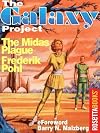
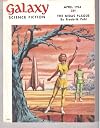
The Midas Plague [short fiction]
by Frederik Pohl
On This Page
Description
Although the three part serial beginning in the June 1952 issue in collaboration with Cyril Kornbluth had established Frederik Pohl as a formidable contributor, this novelette in the April 1954 issue was his first solo contribution and marked him as an important addition to the growing roster of social satirists enlisted by Horace Gold, the editor of GALAXY magazine. The audacious and patchwork concept underlying this story (the richer you are the less you are forced to consume; the greatest show more poverty is involved with the aggregation of goods) was Horace Gold's and according to Pohl he had offered it to almost all of his regular contributors, asking for a story centered on the idea. The idea lacks all credibility, everyone (including Pohl) told him and everyone refused to write something so patently unbelievable until, according to Pohl, Horace browbeat him into an attempt and Pohl decided that it was less trouble to deliver something than continue to resist. To his utter shock, the story was received by Gold and his readership with great glee, was among the most popular GALAXY ever published (or Pohl) and one of the most anthologized. Whether this demonstrated the audacity and scope of Gold's unreason or whether it confirmed Gold's genius (or both) Pohl was utterly unable to decide. The sculpted consumer-obsessed society was used again by Pohl a few years later in the novelette THE MAN WHO ATE THE WORLD which was far more credible (consumption-obsession as a kind of personal tyranny) and, perhaps for that very reason, much less successful, barely remembered.. show less
Tags
Recommendations








Member Reviews
Rating: 3* of five
The Publisher Says: Although the three part serial beginning in the June 1952 issue in collaboration with Cyril Kornbluth had established Frederik Pohl as a formidable contributor, this novelette in the April 1954 issue was his first solo contribution and marked him as an important addition to the growing roster of social satirists enlisted by Horace Gold, the editor of GALAXY magazine.
The audacious and patchwork concept underlying this story (the richer you are the less you are forced to consume; the greatest poverty is involved with the aggregation of goods) was Horace Gold’s and according to Pohl he had offered it to almost all of his regular contributors, asking for a story centered on the idea. The idea lacks show more all credibility, everyone (including Pohl) told him and everyone refused to write something so patently unbelievable until, according to Pohl, Horace browbeat him into an attempt and Pohl decided that it was less trouble to deliver something than continue to resist.
To his utter shock, the story was received by Gold and his readership with great glee, was among the most popular GALAXY ever published (or Pohl) and one of the most anthologized. Whether this demonstrated the audacity and scope of Gold’s unreason or whether it confirmed Gold’s genius (or both) Pohl was utterly unable to decide. The sculpted consumer-obsessed society was used again by Pohl a few years later in the novelette THE MAN WHO ATE THE WORLD which was far more credible (consumption-obsession as a kind of personal tyranny) and, perhaps for that very reason, much less successful, barely remembered.
My Review: Rather entertaining, in a simple way. But as I read on, I had this chill of terror...after all, in a world where there are "old" Kindles and iPhones and Galaxy tablets made in 2012, how far are we from the dystopia of this tale?
Thanks to LibraryThing Fred, I read this antique, sixty-year-old tale of consumerism's most appalling subtext writ large. It's hard not to see how this 12,000 or so word novelette would benefit from either more or less space. It would, in hands more skilled, have been side-splittingly funny. Pohl wasn't really up to it in 1954. But honestly, it was an hour spent smiling and frowning at the same time, as I processed the implications of the fact that people saw what was happening in the wake of consumerism in 1954...and did nothing.
That chilled me.
At $2.99 (or free for the Unlimited user), and an hour or so of time, this felt like a break-even investment. I was hoping for a positive return of laughs, and got the smiles instead. But overall I'd say it's a good way to spend an afternoon. Very worthwhile for the Unlimited folks, less so for the money-spenders.
This work is licensed under a Creative Commons Attribution-NonCommercial-ShareAlike 3.0 Unported License. show less
The Publisher Says: Although the three part serial beginning in the June 1952 issue in collaboration with Cyril Kornbluth had established Frederik Pohl as a formidable contributor, this novelette in the April 1954 issue was his first solo contribution and marked him as an important addition to the growing roster of social satirists enlisted by Horace Gold, the editor of GALAXY magazine.
The audacious and patchwork concept underlying this story (the richer you are the less you are forced to consume; the greatest poverty is involved with the aggregation of goods) was Horace Gold’s and according to Pohl he had offered it to almost all of his regular contributors, asking for a story centered on the idea. The idea lacks show more all credibility, everyone (including Pohl) told him and everyone refused to write something so patently unbelievable until, according to Pohl, Horace browbeat him into an attempt and Pohl decided that it was less trouble to deliver something than continue to resist.
To his utter shock, the story was received by Gold and his readership with great glee, was among the most popular GALAXY ever published (or Pohl) and one of the most anthologized. Whether this demonstrated the audacity and scope of Gold’s unreason or whether it confirmed Gold’s genius (or both) Pohl was utterly unable to decide. The sculpted consumer-obsessed society was used again by Pohl a few years later in the novelette THE MAN WHO ATE THE WORLD which was far more credible (consumption-obsession as a kind of personal tyranny) and, perhaps for that very reason, much less successful, barely remembered.
My Review: Rather entertaining, in a simple way. But as I read on, I had this chill of terror...after all, in a world where there are "old" Kindles and iPhones and Galaxy tablets made in 2012, how far are we from the dystopia of this tale?
Thanks to LibraryThing Fred, I read this antique, sixty-year-old tale of consumerism's most appalling subtext writ large. It's hard not to see how this 12,000 or so word novelette would benefit from either more or less space. It would, in hands more skilled, have been side-splittingly funny. Pohl wasn't really up to it in 1954. But honestly, it was an hour spent smiling and frowning at the same time, as I processed the implications of the fact that people saw what was happening in the wake of consumerism in 1954...and did nothing.
That chilled me.
At $2.99 (or free for the Unlimited user), and an hour or so of time, this felt like a break-even investment. I was hoping for a positive return of laughs, and got the smiles instead. But overall I'd say it's a good way to spend an afternoon. Very worthwhile for the Unlimited folks, less so for the money-spenders.
This work is licensed under a Creative Commons Attribution-NonCommercial-ShareAlike 3.0 Unported License. show less
Ratings
Members
- Recently Added By
Author Information

636+ Works 42,727 Members
Frederik Pohl was born in New York City on November 26, 1919. More interested in writing than in school, he dropped out of high school in his senior year and took a job with a publishing company. After serving as a public relations officer in the United States Army from 1943 to 1945, he returned to publishing as copywriter for Popular Science, a show more literary agent for several sci-fi writers, and the editor for the magazines Galaxy and If from 1959 until 1969, with If winning three successive Hugo awards. His first published work, a poem entitled Elegy to a Dead Satellite: Luna, was printed in Amazing Stories magazine in 1937 under the pen name Elton Andrews. His first science fiction novels were published in the mid 1960's, some written in collaboration with other writers, others created alone. During his lifetime, he won over 16 major awards for his writing (much of which was published pseudonymously) including six Hugo Awards and three Nebula Awards. His works include Gateway, which won the Campbell Memorial, Hugo, Locus SF, and Nebula Awards, Beyond the Blue Event Horizon, and Jem, which won the National Book Award in 1979. He also embraced blogging in his later years, using his online journal as an ongoing sequel to his autobiography, The Way the Future Was. He died on September 2, 2013 at the age 93. (Bowker Author Biography) show less
Series
Belongs to Publisher Series
Work Relationships
Is contained in
The Science Fiction Hall of Fame, Volume Two B: The Greatest Science Fiction Novellas of All Time by Ben Bova
Common Knowledge
- Canonical title
- The Midas Plague [short fiction]
- Original title
- The Midas Plague [novella]
- Original publication date
- 1954-04
- People/Characters*
- Morey Frey; Cherry Frey
- First words*
- Und so wurden sie getraut.
- Last words*
- (Click to show. Warning: May contain spoilers.)"Liebling!" schrie er. "Warum hast du mir das denn nicht gesagt?"
*Some information comes from Common Knowledge in other languages. Click "Edit" for more information.
Classifications
Statistics
- Members
- 48
- Popularity
- 622,805
- Reviews
- 1
- Rating
- (3.91)
- Languages
- English, German, Italian
- Media
- Paper, Ebook
- ISBNs
- 5
- ASINs
- 4