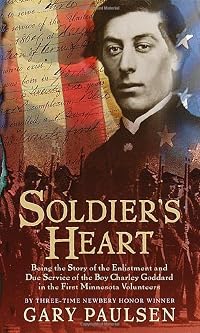
Soldier's Heart
by Gary Paulsen
On This Page
Description
Eager to enlist, fifteen-year-old Charley has a change of heart after experiencing both the physical horrors and mental anguish of Civil War combat.Tags
Recommendations






Member Reviews
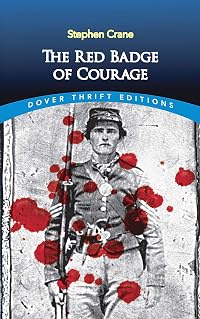
My wife’s middle school class reads this for part of the year, so I wanted to check it out. It’s a fictionalized true story of a Minnesota man who enlisted in the Civil War, his training, and the battles he went through. And it’s by Gary Paulsen, who’s no slouch. It’s pretty heartbreaking. Doesn’t shy away from the brutality of war and keeps it very simple. Middle grade is the term, I believe. And even then, it’s quite bloody. This is not Red Badge of Courage. This is the bloody badge of PTSD (before there was such a term).
“There was going to be a shooting war… the excitement was so high Charley had seen girls faint at the meetings...It was better than a circus.” Such was the mood in Minnesota on the eve of the Civil War, and such is the mood in the beginning of the historical fiction novel, Soldier’s Heart: Being the Story of the Enlistment and Due Service of the Boy Charley Goddard in the First Minnesota Volunteers. Charley, only 15 years old, but planning to lie about his age, sets off for the war on foot, taking only some bread, cold potatoes and half a roast chicken wrapped in cotton. The simplicity of Charley’s life is established early in the book.
Charley learns quickly of warfare, eventually excelling in the art of “kill or be show more killed.” Gary Paulsen does not shy from revealing the abominations of war. Charley's journey takes him into the fray of some of the war’s bloodiest battles – Bull Run and Gettysburg. The horrors of war are apparent as the young boy stops at a creek to drink and fill his canteen. Only after he has slaked his thirst does he realize that the water is tinged with pink from the blood of dead and dying bodies lying upstream. He tries to vomit, but can’t. Later, bloodied in an engagement, he is sent to the battlefield surgeon. The surgeon cannot operate in the wind and freezing cold. Charley is put to work constructing a windbreak using the only available materials – frozen dead bodies. He piles them five feet high and thirty feet wide; then sleeps, exhausted in the lee.
He returns to Winona, Minnesota, but he is not the same boy who left.
The Author’s Note reveals that although the book is historical fiction, Charley Goddard was a real soldier. Many of the events in the book, including the dead man’s wall are factual. A selected list of resources follows the Author’s Note. On the cover and frontispiece, photographs of Charley add interest and authenticity to the story. A map illustration helps the reader to follow his journey.
A foreward explains “Soldier’s Heart,” the Civil War era term to describe what later was known as shell shock, battle fatigue, and finally post traumatic stress disorder. Sadly, this story is still relevant today as the United States is embroiled in the Iraq war. The horrors of war do not change with the passing of time, only the manner of death changes. This YA title is an excellent glimpse into the visceral side of armed conflict. The use of a young protagonist, particularly a true life character, renders the story more believable and more disturbing. It is sure to provoke thought.
Connections:
Suggested fiction books for children interested in this topic:
The Red Badge of Courage by Stephen Crane
Bull Run by Paul Fleischman
Suggested nonfiction titles:
Secrets Of A Civil War Submarine: Solving The Mysteries Of The H. L. Hunley by Sally M. Walker (BCCB Blue Ribbon Nonfiction Book Award)
Lincoln: In His Own Wordsby Milton Meltzer (1994 Orbis Pictus Award)
Lincoln: A Photobiography by Russell Freedman (1988 Newbery Award)
For public library patrons, suggest The Civil War, Ken Burns' 2002 documentary for PBS. show less
Charley learns quickly of warfare, eventually excelling in the art of “kill or be show more killed.” Gary Paulsen does not shy from revealing the abominations of war. Charley's journey takes him into the fray of some of the war’s bloodiest battles – Bull Run and Gettysburg. The horrors of war are apparent as the young boy stops at a creek to drink and fill his canteen. Only after he has slaked his thirst does he realize that the water is tinged with pink from the blood of dead and dying bodies lying upstream. He tries to vomit, but can’t. Later, bloodied in an engagement, he is sent to the battlefield surgeon. The surgeon cannot operate in the wind and freezing cold. Charley is put to work constructing a windbreak using the only available materials – frozen dead bodies. He piles them five feet high and thirty feet wide; then sleeps, exhausted in the lee.
He returns to Winona, Minnesota, but he is not the same boy who left.
The Author’s Note reveals that although the book is historical fiction, Charley Goddard was a real soldier. Many of the events in the book, including the dead man’s wall are factual. A selected list of resources follows the Author’s Note. On the cover and frontispiece, photographs of Charley add interest and authenticity to the story. A map illustration helps the reader to follow his journey.
A foreward explains “Soldier’s Heart,” the Civil War era term to describe what later was known as shell shock, battle fatigue, and finally post traumatic stress disorder. Sadly, this story is still relevant today as the United States is embroiled in the Iraq war. The horrors of war do not change with the passing of time, only the manner of death changes. This YA title is an excellent glimpse into the visceral side of armed conflict. The use of a young protagonist, particularly a true life character, renders the story more believable and more disturbing. It is sure to provoke thought.
Connections:
Suggested fiction books for children interested in this topic:
The Red Badge of Courage by Stephen Crane
Bull Run by Paul Fleischman
Suggested nonfiction titles:
Secrets Of A Civil War Submarine: Solving The Mysteries Of The H. L. Hunley by Sally M. Walker (BCCB Blue Ribbon Nonfiction Book Award)
Lincoln: In His Own Wordsby Milton Meltzer (1994 Orbis Pictus Award)
Lincoln: A Photobiography by Russell Freedman (1988 Newbery Award)
For public library patrons, suggest The Civil War, Ken Burns' 2002 documentary for PBS. show less
Charley goes to war a boy, and returns a changed man, crippled by what he has seen. In this captivating tale Paulsen vividly shows readers the turmoil of war through one boy's eyes and one boy's heart, and gives a voice to all the anonymous young men who fought in the Civil War.
A little too descriptive of the horrors of war for my taste. But I also never got a feel for the main character, or any other character. It's a quick read, and it describes the battles Charley Goddard was in, but you never feel fully in sympathy with him.
A very short (103-minute) audiobook that includes an interview with the author. Partly fiction but based on a real person, with good details, intense feelings, and battle drama. I liked the portrayal of Charlie's evolving attitude about war, how he loved the idea of marching and drills and cheering ladies, and lied about his age to join. Then he had to face the real war and was never the same.
Well done.
Well done.
Paulsen says that he spent 8 years researching before he quickly wrote this "based on facts and real characters" novel, but it was too succinct for any character development. I'm sure that it's historically accurate and would be a great title for a reluctant reader who is really into war, especially the Civil War, but I was emotionally detached to the whole story. Ineffective for me, someone who loves to read and wants an engaging and powerful story that in some way challenges my perspective. It could be a good intro to war lit, but is a punch in a pillow compared to longer and better stories like "Things They Carried."
This is a well written novela for tweens about the horrors of war, most especially the Civil War. I'm a fan of Paulsen's work, both his adult and young adult books, and I enjoyed this book, which carries an important and obvious message, but felt there was a lot missing. I wanted much more of Charley's back story, especially his relationship with his father and mother. I also wanted to know more about his "after" life at the end of the war. I didn't find Charley's eagerness to join the fight because he feared it would be over before he got there to be believable. I know that was a common thought by young men of his time, but Charley was the "head of the family" and would have felt the crush of those responsibilities. Even if he didn't, show more surely his mother would have impressed them on him to keep him from going. I felt it was totally unbelievable that she would so seemingly cavalierly let her eldest go off to war without fighting to make him stay. I wanted to know how the town received him afterward, how they helped him (or not) with his injuries, both mental and physical. Why didn't he return to the farm? Had his brother taken it over in his absence? Had his mother been forced to sell it or lost it because Charley wasn't there to work it. What were the every day challenges presented to Charley in the area he settled in. What this book had was good, just not enough for me. show less
Members
- Recently Added By
Author Information

235+ Works 100,228 Members
Gary Paulsen was born on May 17, 1939 in Minnesota. He was working as a satellite technician for an aerospace firm in California when he realized he wanted to be a writer. He left his job and spent the next year in Hollywood as a magazine proofreader. His first book, Special War, was published in 1966. He has written more than 175 books for young show more adults including Brian's Winter, Winterkill, Harris and Me, Woodsong, Winterdance, The Transall Saga, Soldier's Heart, This Side of Wild, and Guts: The True Stories Behind Hatchet and the Brian Books. Hatchet, Dogsong, and The Winter Room are Newbery Honor Books. He was the recipient of the 1997 Margaret A. Edwards Award for his lifetime achievement in writing for young adults. (Bowker Author Biography) show less
Awards and Honors
Awards
Distinctions
Notable Lists
Work Relationships
Has as a student's study guide
Common Knowledge
- Canonical title
- Soldier's Heart
- Original title
- Soldier's Heart: Being the Story of the Enlistment and Due Service of the Boy Charley Goddard in the First Minnesota Volunteers
- Original publication date
- 1998
- People/Characters
- Charley Goddard
- Important places
- Winona, Minnesota, USA
- Important events
- American Civil War
- Dedication
- Dedicated to Mike Magee - friend, sailor, and one who understands...
- First words
- Foreward: War is always, in all ways, appalling.
He heard it all, Charley did; heard the drums and songs and slogans knew what everybody and his rooster was crowing. - Last words
- (Click to show. Warning: May contain spoilers.)He eased the hammer down with his thumb and laid the pistol back on the rock next to the cheese and then sat, listening to the ripple of the river, watching the water go by, thinking of all the pretty things.
- Original language*
- Amerikanisch
*Some information comes from Common Knowledge in other languages. Click "Edit" for more information.
Classifications
- Genres
- Fiction and Literature, Tween
- DDC/MDS
- 808.0683 — Literature & rhetoric Literature, rhetoric & criticism Rhetoric and collections of literary texts from more than two literatures Rhetoric and anthologies By Type Of Writing Children's literature
- LCC
- PZ7 .P2843 .S — Language and Literature Fiction and juvenile belles lettres Fiction and juvenile belles lettres Juvenile belles lettres
- BISAC
Statistics
- Members
- 1,393
- Popularity
- 16,990
- Reviews
- 45
- Rating
- (3.80)
- Languages
- English
- Media
- Paper, Audiobook, Ebook
- ISBNs
- 17
- ASINs
- 6