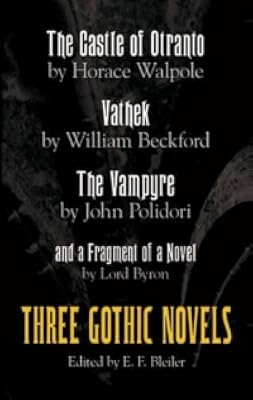
Three Gothic Novels: The Castle of Otranto; Vathek; The Vampyre; and a Fragment of a Novel
by Horace Walpole (Contributor), William Beckford (Contributor), Lord Byron (Contributor), John William Polidori (Contributor)
On This Page
Description
Full texts "Castle of Otranto," Walpole; "Vathek," Beckford; "The Vampyre," Polidori; "Fragment of a Novel," Lord Byron.Tags
Recommendations



























Member Reviews
Originally read this as part of a Gothic novel class thirtysome year ago.
The Walpole story is an enjoyable piece of Romantic-period trash. Denizens of the titular Castle are disturbed by manifestations of a giant helmet, a giant leg, and so forth. A knight arrives with a giant sword to match. Characters are variouly revealed to be former nobility or the children of nobility, women enter convents since they don't have the right to vote, and so on.
Vathek chronicles the downfall of a Caliph, as he gets seduced from a life of simple material luxury to the pursuit of occult knowledge. All for the most part a bit silly, as Beckford's limited imagination did not allow him to conceive of truly horrific or diabolical acts. The downfall at the show more end, while rushed, is quite striking - though apparently Beckford stole the depiction from a preceding work.
Polidori, better known as "the other one" at the party-of-four that resulted in the writing of Frankenstein, contributes a vampire tale which will disappoint fans of the genre, but still has its interesting moments. There is perhaps some unintended humor in the naive rich boy who befriends a man noted for ruining the lives of naive rich boys, but what is unique in this story is the charming-yet-evil character of the vampyre himself. Lord Ruthven refuses charity to those in need, but grants it to those in seed, as it were: the drunkard or gambler or prostitute was certain of his generosity. Yet he spurned their company, preferring instead the innocent and naive, whose lives he took great delight in ruining - always by association, leading them astray rather than working directly to destroy them. The fact that Polidori does so little with this characterization (based, purportedly, on his association with Lord Byron) is not surprising, but one would expect it to crop up in the one or two vampire novels written in the centuries since.
Lord Byron's fragment ... goes nowhere and says nothing. It's clear "The Vampyre" stole a pivotal scene from this fragment, but it's not clear that Byron had in mind anything as ambitious as Polodori's tale. show less
The Walpole story is an enjoyable piece of Romantic-period trash. Denizens of the titular Castle are disturbed by manifestations of a giant helmet, a giant leg, and so forth. A knight arrives with a giant sword to match. Characters are variouly revealed to be former nobility or the children of nobility, women enter convents since they don't have the right to vote, and so on.
Vathek chronicles the downfall of a Caliph, as he gets seduced from a life of simple material luxury to the pursuit of occult knowledge. All for the most part a bit silly, as Beckford's limited imagination did not allow him to conceive of truly horrific or diabolical acts. The downfall at the show more end, while rushed, is quite striking - though apparently Beckford stole the depiction from a preceding work.
Polidori, better known as "the other one" at the party-of-four that resulted in the writing of Frankenstein, contributes a vampire tale which will disappoint fans of the genre, but still has its interesting moments. There is perhaps some unintended humor in the naive rich boy who befriends a man noted for ruining the lives of naive rich boys, but what is unique in this story is the charming-yet-evil character of the vampyre himself. Lord Ruthven refuses charity to those in need, but grants it to those in seed, as it were: the drunkard or gambler or prostitute was certain of his generosity. Yet he spurned their company, preferring instead the innocent and naive, whose lives he took great delight in ruining - always by association, leading them astray rather than working directly to destroy them. The fact that Polidori does so little with this characterization (based, purportedly, on his association with Lord Byron) is not surprising, but one would expect it to crop up in the one or two vampire novels written in the centuries since.
Lord Byron's fragment ... goes nowhere and says nothing. It's clear "The Vampyre" stole a pivotal scene from this fragment, but it's not clear that Byron had in mind anything as ambitious as Polodori's tale. show less
The Castle of Otranto by Horace Walpole is a great huge mess of a story, one that is hard to tell just how seriously to take. According to the introductions, it's all meant to be taken seriously, but how a 21st century reader can do so, is beyond me.
The story opens with an impending wedding. Manfred's son, Conrad, a "homely and sickly youth" is to marry Isabella when suddenly a giant helmet falls from the sky smashing him to bits. (I am not making this up, Mr. Walpole is.) Frederic, a handsome peasant boy, is suspected of causing the death through sorcery and is imprisoned underneath the helmet; it is really big after all. Manfred then decides he should divorce his wife Hippolita and marry Isabella, who is now available. Isabella is show more horrified and runs off to the nearby convent via a secret tunnel. Inside the tunnel she finds Frederic who has escaped the helmet because its great weight broke through the floor of the courtyard into the secret tunnel. At the convent he discovers that the local priest, Father Jerome, is really his father.
Then things get really complicated. There is a painting that turns into a ghost, and ancient curse, a giant, and some other stuff too numerous to mention.
The Castle of Otranto was first published in 1764 and created quite a stir. There had not been anything quite like it before so it is credited with starting the trend of supernatural Gothic novels and with reigniting interest in the middle ages. It must have really set readers on end in its day and it is still an amusing read today, though for different reasons. I can't say that you'll find anything moving in The Castle of Otranto or even anything frightening, but it is still a fun read and at under 100 pages it can be an afternoon's amusement.
I'm giving The Castle of Otranto by Horace Walpole three out of five stars. show less
The story opens with an impending wedding. Manfred's son, Conrad, a "homely and sickly youth" is to marry Isabella when suddenly a giant helmet falls from the sky smashing him to bits. (I am not making this up, Mr. Walpole is.) Frederic, a handsome peasant boy, is suspected of causing the death through sorcery and is imprisoned underneath the helmet; it is really big after all. Manfred then decides he should divorce his wife Hippolita and marry Isabella, who is now available. Isabella is show more horrified and runs off to the nearby convent via a secret tunnel. Inside the tunnel she finds Frederic who has escaped the helmet because its great weight broke through the floor of the courtyard into the secret tunnel. At the convent he discovers that the local priest, Father Jerome, is really his father.
Then things get really complicated. There is a painting that turns into a ghost, and ancient curse, a giant, and some other stuff too numerous to mention.
The Castle of Otranto was first published in 1764 and created quite a stir. There had not been anything quite like it before so it is credited with starting the trend of supernatural Gothic novels and with reigniting interest in the middle ages. It must have really set readers on end in its day and it is still an amusing read today, though for different reasons. I can't say that you'll find anything moving in The Castle of Otranto or even anything frightening, but it is still a fun read and at under 100 pages it can be an afternoon's amusement.
I'm giving The Castle of Otranto by Horace Walpole three out of five stars. show less
A fantastic introduction to the origins of gothic literature. While the quality of the writing itself is largely questionable, the roots which this publication symbolizes is highly important in gothic studies. From the first English gothic tale to the first English vampire novella, the reading of this text is an experience worth enduring.
Vathek was by far the best novella out of the three.
Ratings
Members
- Recently Added By
Author Information

Horace Walpole was born in London on September 24, 1717 and educated at Eton College and Kings College, Cambridge. Upon his return from college, Walpole was elected to Parliament and served until 1768. He was the youngest son of British Prime Minister, Robert Walpole. He was known as The Earl of Orford. Walpole opened a private press that show more published his own works and that of his friends. He is well known for his Gothic romance novel, The Castle of Otranto. Horace Walpole died in London on March 2, 1797, after which his title became extinct since he never married or had children. (Bowker Author Biography) show less

All Editions
Work Relationships
Common Knowledge
- Canonical title
- Three Gothic Novels: The Castle of Otranto; Vathek; The Vampyre; and a Fragment of a Novel
- Original publication date
- 1966
- Disambiguation notice
- This is Three Gothic Novels: The Castle of Otranto, Vathek, and Polidori's The Vampyre, published by Dover, ISBN: 0486212327 9780486212326.
Three Gothic Novels, published by Penguin, containing The Castle of Otranto, ... (show all)Vathek, and Shelley's Frankenstein, is a separate work.
Classifications
Statistics
- Members
- 292
- Popularity
- 110,439
- Reviews
- 4
- Rating
- (3.62)
- Languages
- English
- Media
- Paper, Ebook
- ISBNs
- 2
- UPCs
- 1
- ASINs
- 6