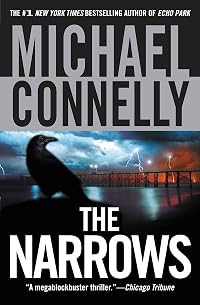
The Narrows
by Michael Connelly
Cassie Black (2), Rachel Walling (2), Terry McCaleb (3), Harry Bosch (10), Harry Bosch Universe (14)
On This Page
Description
FBI agent Rachel Walling finally gets the call she's dreaded for years, the one that tells her the Poet has surfaced. She has never forgotten the serial killer who wove lines of poetry in his hideous crimes--and apparently he has not forgotten her. Former LAPD detective Harry Bosch gets a call, too--from the widow of an old friend. Her husband's death seems natural, but his ties to the hunt for the Poet make Bosch dig deep. Arriving at a derelict spot in the California desert where the feds show more are unearthing bodies, Bosch joins forces with Rachel. Now the two are at odds with the FBI...and squarely in the path of the Poet, who will lead them on a wicked ride out of the heat, through the narrows of evil, and into a darkness all his own... show lessTags
Recommendations

Member Reviews
Having read multiple entries from Michael Connelly’s Harry Bosch series, I approached The Narrows with high expectations, and for the most part, it didn’t disappoint. As one of the later books in the series, the tone is darker, more introspective, and delves into an older Bosch trying to adjust to life after the LAPD, all while being drawn into a chilling case involving a serial killer.
The plot kicks off with Bosch investigating the death of a friend’s husband, which also links FBI agent Rachel Walling to the resurgence of a notorious killer. Connelly’s deft plotting shines through, as the story unspools with a quiet, steady tension that kept me flipping pages. There's a masterful blend of investigation and emotional weight, show more particularly as we see Bosch juggle the demands of the case with his tangled personal life, especially his fractured relationship with his daughter.
What elevates The Narrows beyond a simple police procedural is its subtle exploration of Bosch’s internal struggles. “As a character, Bosch here feels weighed down by his years of service.” The walls are closing in on him in many ways, and at times, the book takes on a meditative tone as Bosch confronts his past choices and his identity outside the badge.
In comparison to some of Connelly’s other novels, such as The Lincoln Lawyer, which favours a more fast-paced, courtroom-drama style, The Narrows is slower, more methodical. While the story has its share of action, it’s not relentless, instead giving space for character reflection—and that’s where the novel truly shines.
Though predictable at moments, the book offers a layered story with tension, driven by Bosch's relentless pursuit of justice.
Four stars out of five.
Blog | Facebook | Twitter | Mastodon | Instagram | Pinterest | Medium | Matrix | Tumblr
Ceterum censeo Putin esse delendam show less
The plot kicks off with Bosch investigating the death of a friend’s husband, which also links FBI agent Rachel Walling to the resurgence of a notorious killer. Connelly’s deft plotting shines through, as the story unspools with a quiet, steady tension that kept me flipping pages. There's a masterful blend of investigation and emotional weight, show more particularly as we see Bosch juggle the demands of the case with his tangled personal life, especially his fractured relationship with his daughter.
What elevates The Narrows beyond a simple police procedural is its subtle exploration of Bosch’s internal struggles. “As a character, Bosch here feels weighed down by his years of service.” The walls are closing in on him in many ways, and at times, the book takes on a meditative tone as Bosch confronts his past choices and his identity outside the badge.
In comparison to some of Connelly’s other novels, such as The Lincoln Lawyer, which favours a more fast-paced, courtroom-drama style, The Narrows is slower, more methodical. While the story has its share of action, it’s not relentless, instead giving space for character reflection—and that’s where the novel truly shines.
Though predictable at moments, the book offers a layered story with tension, driven by Bosch's relentless pursuit of justice.
Four stars out of five.
Blog | Facebook | Twitter | Mastodon | Instagram | Pinterest | Medium | Matrix | Tumblr
Ceterum censeo Putin esse delendam show less
With book 10 in the Harry Bosch series I continue my exploration of the “uncharted lands” of this character, as opposed to what I’ve experienced so far in the seven seasons of the TV show inspired by it, which means that on top of the skilled storytelling I’ve come to expect from Michael Connelly I can now enjoy totally new investigations, an element that adds more spice to these engaging stories.
The Narrows starts with two apparently unrelated narrative threads: one concerns the return of the serial killer protagonist of the novel The Poet, and of FBI agent Rachel Walling, who was far from convinced that her quarry had died in the final shootout that ended the chase; the other features Bosch as he’s contacted by the widow of show more former FBI agent Terry McCaleb (encountered in A Darkness More than Night), because she’s convinced that the heart attack that ended her husband’s life was far from a natural occurrence, and needs Bosch’s help to uncover the truth.
As events unfold, it becomes clear that the two investigations are strictly linked, so that Bosch and Walling must combine their skills to catch the killer and end his reign of terror, while dealing with several obstacles on their path: Walling, who was sent to a dead-end assignment after the debacle with the Poet, is chafing under the restraints imposed by her role as a mere observer, and feels that the team leader is more preoccupied with the political implications of the chase, rather than with the success of the mission. Bosch, for his part, is even more keenly aware that without a badge many doors are closed to him, and the long-standing rivalry between law enforcement agencies is clipping his proverbial wings, leaving him with little room to maneuver. And on top of it all, he and Walling are both strong, determined people, and cooperation does not come too easy to either of them, reducing their field effectiveness when they really need it at full strength.
The Narrows is truly what many like to call a “page turner”, blending the chase for a dangerously intelligent serial killer with a fascinating collection of clues that paint the whole picture through a logical progression that nonetheless proves both exciting and distressing, thanks to the many red herrings that take characters and readers off track so that it’s almost impossible to predict what will come next. By now I’ve acquired enough familiarity with Michael Connelly’s “modus operandi” to know that I need to pay attention to the smallest detail he lays down, because sooner or later it will fit into the bigger picture, offering a deeper understanding of the story. It’s worth mentioning how the narrative is split between the first person when the author deals with Harry Bosch (a trend initiated with the previous novel) and the third person with the other characters: it gives the story a very peculiar quality and at the same time is reminiscent of the classic noir novels where the P.I. protagonists (the role Harry is playing now) offered their point of view as a form of internal monologue.
The background - again the cities of Los Angeles and Las Vegas are front and center here - comes alive through the author’s descriptions and becomes another character of the story, enhancing it with a cinematic quality that alternates the glamorous and the gritty in a very balanced blend. The best example is offered by the titular Narrows, which is a man-made channel created to funnel the excess of rainwater and avoid the flooding of the city of Los Angeles. Bosch mentions it in passing:
[...] the river. Trapped between those walls. When I was a kid we called it ‘the narrows’. When it rains like this the water moves fast. It’s deadly. When it rains you stay away from the narrows.
offering a foreshadowing for future events that I found very intriguing - on hindsight.
Where the story is the frame, characters are its true substance: from the minor roles - like the unpleasantly entitled FBI team leader, or the other agents, or again McCaleb’s grieving widow and his partner in the boating operation - to the two protagonists, Bosch and Walling, everyone is clearly defined no matter how much page space they occupy, and in the case of these two we can see the evolution from the last time we met them. Walling is disillusioned after her posting in a remote location where her investigative skills are hardly necessary, but she is far from beaten, and her determination in catching the Poet is quite admirable, even when she chooses to go against the rules: in this she is the perfect complement for Bosch, who never cared much for authority, so that I was delighted to observe these two unlikely “partners in crime” as they pursued the leads with little or no concern for the consequences.
As for Bosch, while he’s still the proverbial dog with a bone with every case that catches his attention, he’s a very different private person: discovering the existence of his 4-years old daughter changed his perspective on life, and even managed to soften him in his personal approach. The man who can relentlessly pursue bad guys is also able to sit down and read stories to his child, reveling in the joy of her closeness and the candor of her affection; the reality of this daughter whose existence he ignored until a short while ago forces him to consider his actions - and their consequences - for the long-range effects they might have. Where Bosch used to be a loner, he now has a very important focus in his life, one that certainly informs his choices for the present and the future.
[…] the innocence of a child will bring you back and give the shield of joy with which to protect yourself.
Along with these changes in Bosch’s personal life, more might be forthcoming in his profession, thanks to the offer he receives to participate in a newly-formed division of the LAPD dealing with cold cases: the pull of these forgotten victims might be strong enough to make him go back to his old job, giving voice to those who cannot do it for themselves anymore. Once again, I can only look forward to what awaits me down the road with this very intriguing character. show less
The Narrows starts with two apparently unrelated narrative threads: one concerns the return of the serial killer protagonist of the novel The Poet, and of FBI agent Rachel Walling, who was far from convinced that her quarry had died in the final shootout that ended the chase; the other features Bosch as he’s contacted by the widow of show more former FBI agent Terry McCaleb (encountered in A Darkness More than Night), because she’s convinced that the heart attack that ended her husband’s life was far from a natural occurrence, and needs Bosch’s help to uncover the truth.
As events unfold, it becomes clear that the two investigations are strictly linked, so that Bosch and Walling must combine their skills to catch the killer and end his reign of terror, while dealing with several obstacles on their path: Walling, who was sent to a dead-end assignment after the debacle with the Poet, is chafing under the restraints imposed by her role as a mere observer, and feels that the team leader is more preoccupied with the political implications of the chase, rather than with the success of the mission. Bosch, for his part, is even more keenly aware that without a badge many doors are closed to him, and the long-standing rivalry between law enforcement agencies is clipping his proverbial wings, leaving him with little room to maneuver. And on top of it all, he and Walling are both strong, determined people, and cooperation does not come too easy to either of them, reducing their field effectiveness when they really need it at full strength.
The Narrows is truly what many like to call a “page turner”, blending the chase for a dangerously intelligent serial killer with a fascinating collection of clues that paint the whole picture through a logical progression that nonetheless proves both exciting and distressing, thanks to the many red herrings that take characters and readers off track so that it’s almost impossible to predict what will come next. By now I’ve acquired enough familiarity with Michael Connelly’s “modus operandi” to know that I need to pay attention to the smallest detail he lays down, because sooner or later it will fit into the bigger picture, offering a deeper understanding of the story. It’s worth mentioning how the narrative is split between the first person when the author deals with Harry Bosch (a trend initiated with the previous novel) and the third person with the other characters: it gives the story a very peculiar quality and at the same time is reminiscent of the classic noir novels where the P.I. protagonists (the role Harry is playing now) offered their point of view as a form of internal monologue.
The background - again the cities of Los Angeles and Las Vegas are front and center here - comes alive through the author’s descriptions and becomes another character of the story, enhancing it with a cinematic quality that alternates the glamorous and the gritty in a very balanced blend. The best example is offered by the titular Narrows, which is a man-made channel created to funnel the excess of rainwater and avoid the flooding of the city of Los Angeles. Bosch mentions it in passing:
[...] the river. Trapped between those walls. When I was a kid we called it ‘the narrows’. When it rains like this the water moves fast. It’s deadly. When it rains you stay away from the narrows.
offering a foreshadowing for future events that I found very intriguing - on hindsight.
Where the story is the frame, characters are its true substance: from the minor roles - like the unpleasantly entitled FBI team leader, or the other agents, or again McCaleb’s grieving widow and his partner in the boating operation - to the two protagonists, Bosch and Walling, everyone is clearly defined no matter how much page space they occupy, and in the case of these two we can see the evolution from the last time we met them. Walling is disillusioned after her posting in a remote location where her investigative skills are hardly necessary, but she is far from beaten, and her determination in catching the Poet is quite admirable, even when she chooses to go against the rules: in this she is the perfect complement for Bosch, who never cared much for authority, so that I was delighted to observe these two unlikely “partners in crime” as they pursued the leads with little or no concern for the consequences.
As for Bosch, while he’s still the proverbial dog with a bone with every case that catches his attention, he’s a very different private person: discovering the existence of his 4-years old daughter changed his perspective on life, and even managed to soften him in his personal approach. The man who can relentlessly pursue bad guys is also able to sit down and read stories to his child, reveling in the joy of her closeness and the candor of her affection; the reality of this daughter whose existence he ignored until a short while ago forces him to consider his actions - and their consequences - for the long-range effects they might have. Where Bosch used to be a loner, he now has a very important focus in his life, one that certainly informs his choices for the present and the future.
[…] the innocence of a child will bring you back and give the shield of joy with which to protect yourself.
Along with these changes in Bosch’s personal life, more might be forthcoming in his profession, thanks to the offer he receives to participate in a newly-formed division of the LAPD dealing with cold cases: the pull of these forgotten victims might be strong enough to make him go back to his old job, giving voice to those who cannot do it for themselves anymore. Once again, I can only look forward to what awaits me down the road with this very intriguing character. show less
Terry McCaleb and Rachel Walling, both FBI with one retired and one active, are tow of my least favorite recurring characters in the Bosch universe. McCaleb features here, with yet another resurrection of the serial killer investigation from [The Poet]. McCaleb, thankfully, buys the farm near the beginning of the book, which is why puts Bosch into the mix. He feels somewhat responsible after leaving things on poor terms and behaving toward McCaleb badly at the end of [A Darkness More than Night]. With Walling's help, Bosch retraces McCaleb's investigation and eventually they corner The Poet. Given the return of characters I don't particularly like, this is not my favorite. Perhaps part of the reason I don't like these characters is show more because they bring out the worst in Bosch - maybe that's why Connelly uses them.
4 bones!!!! show less
4 bones!!!! show less
I have read so many books in the saga of Hieronymus Bosch, and I am thinking that this one may be the best! Foolishly, I read this before I have read The Poet, as this is a sequel; also, it is a sequel to Blood Work and A Darkness More Than Night, so I was up to speed therein. I once told the author that while Bosch was a great character, an even greater protagonist was the City of the Angels and that both of them held their own. But LA shares center stage here with the Mojave Desert, an area of natural beauty that fits in well inside the ravaged persona of Bosch himself. A personal oddity: (no spoilers here), but weeks ago I finished TC Boyle's Tortilla Curtain, and both books have similar endings! And speaking of endings, when the show more reader is done with this, pick up The Great Gatsby to compare its last paragraph with The Narrows. Well played, Mr Connelly! show less
I found this one to be solid and unpredictable. Bosch is asked to look into the death of an old colleague by his wife and his discoveries lead him in an unexpected direction. He becomes involved on the periphery of an FBI investigation of a serial killer who has resurfaced. Twists and turns follow. Really well crafted work. I enjoyed it.
It's hard to say exactly who the main protagonist of The Narrows actually is. The story intertwines three of the protagonists from Connelly's previous works: the inimitable, unstoppable Harry Bosch of some 10 previous books, the cold, analytical Rachel Walling of The Poet, and in the background, overshadowing all of the thoughts of the other two, is the insight and spirit of Terry McCaleb from Blood Work. Rachel Walling is called out of her FBI purgatory of the Dakotas because her ex-mentor/ex-boss and current serial killer dubbed "The Poet" is on the loose again and he's pulling the FBI's strings to force her into the case. Bosch, far away in LA, is called to investigate the suspicious death of Terry McCaleb. As he follows the clues show more that McCaleb left for him and as Rachel tries to piece together the hints left by her old mentor, their paths cross and they join forces to hunt down The Poet.
I've always felt that Bosch was much more suited for PI work than police work, so it's a pleasure to see him in this role. I like Bosch, even though I find significant flaws in his character, I really appreciate that Connelly also sees the same flaws. My issue is that although Bosch himself recognizes these flaws, he never, ever learns from his mistakes. His tendency for cowboy justice repeatedly endangers others and often gets them killed, yet he never changes. However, as a PI, his tendency to bend the rules and flaunt authority seems more fitting. PI work also seems to have loosened him up; we get some incredibly entertaining moments when he thumbs his nose at authority, like drawing a smiley face in the dust on the top of his car so it can be seen by the FBI helicopter above. One of the touching complexities this story adds to Bosch's character is his struggles to be a good father to his newly found daughter. Of course, since this is a Bosch story, we get a "girl of the week," (which, although different in each book, is treated in the narration as The One. Ugh.) and I'll leave you to guess who that is. Of course, in this story, Bosch isn't the only protagonist; his first-person narration is interspersed with third-person narration from Rachel Walling's perspective. I don't like Rachel; somehow she seems cold and impersonal to me. I also don't understand her; after screwing up by sleeping with a person tangentially related to the case in her last story, her next logical step in this book is to hover for spoiler. Like Bosch, she has become cynical about authority and the trappings of authority, but her emotions are complexified by her desire to regain her previous role.
As in The Poet, we also get narrative snippets from the perspective of the killer. They say it's good not to get too close to your heroes, and I guess the same thing is true of your villains.
When I read The Poet I found the killer to be the absolute most terrifying character that Connelly created (except, perhaps, Bosch himself, but that's a another story for another time). The Poet was a person who reveled in control. He manipulated every situation he was in and controlled every action of his opponents effortlessly. The ultimate symbol of this was his use of hypnotism to force people at a much deeper level than simple physical force to do his will. He humiliated his victims and asserted his own supremacy in his every action: the rape, they hypnotism, the notes they were forced to write, everything. The Poet is a killer who kills for power, control, and a sense of status, and he's scary because he is so very good at manipulating people.
The Poet in this story...just isn't. Rather than using the manipulation and psychological control that made him so scary in his first story, he's much more of a thug. A clever thug, yes, but still a thug who asserts power via brutality, threats, and violence. To me at least, that is far less scary than a man who can suborn the body's will from his unwilling victims. We've seen him defeated before. His return simply feels anticlimactic, like a performer taking another bow after an unenthused call for an encore. I thought it was interesting he didn't go after Jack and that he felt no need for revenge upon him. Yes, I know the real reason is that Connelly felt that Jack got too close to home and didn't want to write about him anymore. But one can also make a case psychologically; in The Poet, he has Jack completely under his control and power. The humiliation, the assertion of superiority, has already been performed. The only thing that saves Jack is Rachel, and maybe that's what's so haunting about The Poet: the killer won, made his point, "got" Jack even if he didn't finish the job.
Overall, the story felt light to me; it didn't seem to touch on some of the powerful themes that some of Connelly's works such as The Concrete Blonde and Angel's Flight so eloquently struggled with, or the deep personal emotions that its narrator brought to The Poet. It also lacked the element of mystery, since the killer's identity is, for the most part, known from the outset. For all that, it is an enjoyable read. I adored the sequences of Bosch with his daughter, and this book provides some reconciliation between Bosch and the indomitable Kiz Rider, a favorite character of mine. Above all, it was fun to see Rachel and Bosch interact and lock horns. show less
I've always felt that Bosch was much more suited for PI work than police work, so it's a pleasure to see him in this role. I like Bosch, even though I find significant flaws in his character, I really appreciate that Connelly also sees the same flaws. My issue is that although Bosch himself recognizes these flaws, he never, ever learns from his mistakes. His tendency for cowboy justice repeatedly endangers others and often gets them killed, yet he never changes. However, as a PI, his tendency to bend the rules and flaunt authority seems more fitting. PI work also seems to have loosened him up; we get some incredibly entertaining moments when he thumbs his nose at authority, like drawing a smiley face in the dust on the top of his car so it can be seen by the FBI helicopter above. One of the touching complexities this story adds to Bosch's character is his struggles to be a good father to his newly found daughter. Of course, since this is a Bosch story, we get a "girl of the week," (which, although different in each book, is treated in the narration as The One. Ugh.) and I'll leave you to guess who that is. Of course, in this story, Bosch isn't the only protagonist; his first-person narration is interspersed with third-person narration from Rachel Walling's perspective. I don't like Rachel; somehow she seems cold and impersonal to me. I also don't understand her; after screwing up by sleeping with a person tangentially related to the case in her last story, her next logical step in this book is to hover for spoiler. Like Bosch, she has become cynical about authority and the trappings of authority, but her emotions are complexified by her desire to regain her previous role.
As in The Poet, we also get narrative snippets from the perspective of the killer. They say it's good not to get too close to your heroes, and I guess the same thing is true of your villains.
When I read The Poet I found the killer to be the absolute most terrifying character that Connelly created (except, perhaps, Bosch himself, but that's a another story for another time). The Poet was a person who reveled in control. He manipulated every situation he was in and controlled every action of his opponents effortlessly. The ultimate symbol of this was his use of hypnotism to force people at a much deeper level than simple physical force to do his will. He humiliated his victims and asserted his own supremacy in his every action: the rape, they hypnotism, the notes they were forced to write, everything. The Poet is a killer who kills for power, control, and a sense of status, and he's scary because he is so very good at manipulating people.
The Poet in this story...just isn't. Rather than using the manipulation and psychological control that made him so scary in his first story, he's much more of a thug. A clever thug, yes, but still a thug who asserts power via brutality, threats, and violence. To me at least, that is far less scary than a man who can suborn the body's will from his unwilling victims. We've seen him defeated before. His return simply feels anticlimactic, like a performer taking another bow after an unenthused call for an encore. I thought it was interesting he didn't go after Jack and that he felt no need for revenge upon him. Yes, I know the real reason is that Connelly felt that Jack got too close to home and didn't want to write about him anymore. But one can also make a case psychologically; in The Poet, he has Jack completely under his control and power. The humiliation, the assertion of superiority, has already been performed. The only thing that saves Jack is Rachel, and maybe that's what's so haunting about The Poet: the killer won, made his point, "got" Jack even if he didn't finish the job.
Overall, the story felt light to me; it didn't seem to touch on some of the powerful themes that some of Connelly's works such as The Concrete Blonde and Angel's Flight so eloquently struggled with, or the deep personal emotions that its narrator brought to The Poet. It also lacked the element of mystery, since the killer's identity is, for the most part, known from the outset. For all that, it is an enjoyable read. I adored the sequences of Bosch with his daughter, and this book provides some reconciliation between Bosch and the indomitable Kiz Rider, a favorite character of mine. Above all, it was fun to see Rachel and Bosch interact and lock horns. show less
Pretty by-the-numbers Bosch offering. No surprises or twists here. The parts of the book that were told from the perspective of characters other than Bosch were utterly superfluous. Reasonably entertaining but nowhere near as good as the likes of Trunk Music or Angels Flight. I will continue to read the series in order. Next up, the Closers.
Members
- Recently Added By
Lists

Best Crime Fiction
262 works; 39 members

Crime and Mysteries to Read
746 works; 31 members

Serial Killer Thrillers
56 works; 6 members

Books Read in 2005
185 works; 7 members

Books Read in 2018
4,360 works; 110 members

Books - Connolly, Michael: Bosch
44 works; 1 member
Author Information

160+ Works 154,697 Members
Michael Connelly was born in Philadelphia, Pennsylvania on July 21, 1956. He graduated from the University of Florida in 1980 where he majored in journalism and minored in creative writing. After graduation, he worked at newspapers in Daytona Beach and Fort Lauderdale, Florida, specializing in the crime beat. In 1986, he interviewed survivors of a show more plane crash with two other reporters and the magazine story subsequently written on the crash was on the short list for the Pulitzer Prize for feature writing. This story led to a job as a crime reporter for the Los Angeles Times. After three years there, he began writing his first novel. His first novel, The Black Echo, was published in 1992 and won the Edgar Award for best first novel. He is the author of the Harry Bosch series, the Jack McEvoy series, and the Mickey Haller series. He has won numerous awards including the Anthony Award, Macavity Award, Shamus Award, Dilys Award, Nero Award, Barry Award, Ridley Award, Maltese Falcon Award (Japan), .38 Caliber Award (France), Grand Prix Award (France), Premio Bancarella Award (Italy), and the Pepe Carvalho Award (Spain). (Bowker Author Biography) show less
Some Editions
Awards and Honors
Distinctions
Series

Cassie Black
2 works (2)

Rachel Walling
6 works (2)

Terry McCaleb
3 works (3)

Harry Bosch
29 works (10)

Harry Bosch Universe
38 works (14)
Belongs to Publisher Series
Work Relationships
Is contained in
Rachel Walling Appearances: The Poet / The Narrows / Echo Park / The Overlook / The Scarecrow / The Reversal / The Black Box by Michael Connelly
Terry McCaleb Appearances: Blood Work / A Darkness More Than Night / The Narrows by Michael Connelly
The Black Echo / The Black Ice / The Concrete Blonde / The Last Coyote / The Poet / Trunk Music / Blood Work / Angels Flight / Void Moon / A Darkness More Than Night / City of Bones / Lost Light / The Narrows / The Closers / The Lincoln Lawyer / Echo Park / The Overlook / The Brass Verdict / Nine Dragons / The Reversal by Michael Connelly
Common Knowledge
- Canonical title
- The Narrows
- Original title
- The Narrows
- Original publication date
- 2004-04-30
- People/Characters
- Rachel Walling; Hieronymus 'Harry' Bosch; Cherie Dei; Graciela McCaleb; Buddy Lockridge; Robert Backus
- Important places
- Los Angeles, California, USA; Los Angeles River; Las Vegas, Nevada, USA
- Epigraph
- All they did was trade one monster for another. Instead of a dragon they now have a snake. A giant snake that sleeps in the narrows and bides its time until the moment is right and it can open its jaws and swallow someone dow... (show all)n.
-John Kinsey, father of a boy lost in the narrows. Los Angeles Times, July 21,1956 - Dedication
- In memory of Mary McEvoy Connelly Lavelle, who kept six of us out of the narrows
- First words
- I think maybe I only know one thing in this world.
- Last words
- (Click to show. Warning: May contain spoilers.)It was the kind of day you felt you could build a future on.
Classifications
Statistics
- Members
- 5,115
- Popularity
- 2,715
- Reviews
- 85
- Rating
- (3.79)
- Languages
- 14 — Czech, Danish, Dutch, English, Estonian, Finnish, French, German, Italian, Norwegian (Bokmål), Portuguese, Spanish, Swedish, Turkish
- Media
- Paper, Audiobook, Ebook
- ISBNs
- 100
- UPCs
- 3
- ASINs
- 22