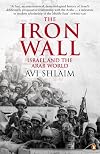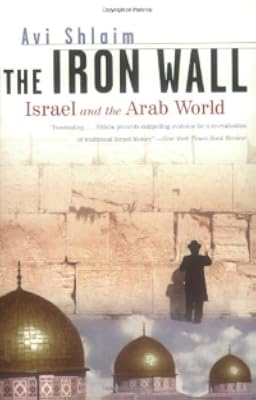
The Iron Wall: Israel and the Arab World
by Avi Shlaim
On This Page
Description
"'Fascinating... Shlaim presents compelling evidence for a revaluation of traditional Israeli history.' --New York Times Book Review. For this newly expanded edition, Avi Shlaim has added four chapters and an epilogue that address the prime ministerships from Barak to Netanyahu in the 'one book everyone should read for a concise history of Israel's relations with Arabs' (Independent). What was promulgated as an 'iron-wall' strategy--building a position of unassailable strength--was meant to show more yield to a further stage where Israel would be strong enough to negotiate a satisfactory peace with its neighbors. The goal still remains elusive, if not even further away. This penetrating study brilliantly illuminates past progress and future prospects for peace in the Middle East"-- show lessTags
Recommendations










































Member Recommendations


Member Reviews
This major work, by one of the most respected Israeli new historians, is concerned with the diplomatic history of the relations between Israel and the Arab states and the Palestinians. It shatters a good number of myths prevailing in the western world about the causes, motives, and actions of the intervening parties and personalities in this conflict. Using an impressive array of primary archival data, as well as memoirs and interviews, we are given a remarkably honest, fair-minded and compelling re-apreciation of the central players and events. The inescapable conclusion of this book is that the doctrine of "the Iron Wall", systematized by Ze'ev Jabotinsky in 1923, has become central to Israeli policies towards the Arabs, and have been show more turned into the ideological structure that informs the uncompromizing stance of the overwhelming majority of Israeli leaders and citizens (both left and rightwing, religious or secular) in their dealings with the Arabs and in their views of the conclict with the Palestinians. The preface to this paperback edition was written in September 2000, apparently a very short time before the start of the al-Aqsa intifada, and some months before one of the most extremist and ruthless partisans of the (first phase of the) Iron Wall doctrine, Ariel Sharon, became Israel's prime minister and destroyed any hope of peaceful coexistence in that part of the world for some time to come. It is indeed a great pity that books like this are not more widely read, but then it is not reasonable to expect that a six hundred pages work can compete with a small number of television sound bites; even when the book is brilliantly written, as in this case. show less
Shlaim's book is methodical and devastating, but it is also extremely even-handed. Whilst he dismantles many of the arguments that suggest Israel is a hapless victim of Arab aggression, he is also critical of many Arab governments and the roles they have played in the conflict of the past 60 years.
Unexpectedly, Shlaim also dismisses the claim that is often made that Israel started the 1967 war in order to seize land. Yes, Israel refused to give the land up, at least in part, but it did not begin the war, Shlaim argues.
The great virtue of this book is that it is so comprehensive. Shlaim chronicles the entire history of the modern state of Israel. He has had access to many of the Israeli archives, and is able to present convincing show more evidence to support many of his claims, especially where they are controversial. When he argues that Israeli intransigence is one of the main reasons why a peace deal has not been agreed, and that Israeli has acted to provoke its neighbours over and over again, his argument is all the more convincing for the research that has clearly been done.
Where the book is weaker is towards the end where this approach can no longer be used. Writing about events closer to the present day, Shlaim is covering events for which the archives have not yet been opened. He relies far more heavily on newspapers for evidence, and this part of the book is therefore weaker.
All in all, however, Shlaim's book is a great success. Over time I have little doubt that it will become the standard text used for matters relating to this conflict. show less
Unexpectedly, Shlaim also dismisses the claim that is often made that Israel started the 1967 war in order to seize land. Yes, Israel refused to give the land up, at least in part, but it did not begin the war, Shlaim argues.
The great virtue of this book is that it is so comprehensive. Shlaim chronicles the entire history of the modern state of Israel. He has had access to many of the Israeli archives, and is able to present convincing show more evidence to support many of his claims, especially where they are controversial. When he argues that Israeli intransigence is one of the main reasons why a peace deal has not been agreed, and that Israeli has acted to provoke its neighbours over and over again, his argument is all the more convincing for the research that has clearly been done.
Where the book is weaker is towards the end where this approach can no longer be used. Writing about events closer to the present day, Shlaim is covering events for which the archives have not yet been opened. He relies far more heavily on newspapers for evidence, and this part of the book is therefore weaker.
All in all, however, Shlaim's book is a great success. Over time I have little doubt that it will become the standard text used for matters relating to this conflict. show less
Five stars for its breadth and strong views. I am not always sure about the views, as this is a decidedly even handed (or even Pro) treatment of the Palestinian side of the Israeli- Arab conflict. Interestingly through the 1990ish time (1956, 1967, 1973 wars and all the in between) this read as a more typical Israeli narrative history. I did not detect a leaning- seemed pretty even handed, but as we got to the 90s and Netanyahu / Barak / Sharon / Olmert vis the PLO / Arafat / Abu Mazen, the author has strong views and pounds them out for page after page for hundreds of pages. I found this a welcome balancing view to other accounts of this time period I have read.
Scholarly account of how Israeli political and intellectual leaders interpret doctrine of Iron Wall to justify approaches to the Arab world.
2 stars instead of 1 because i did learn some history in this book. the author is so clearly biased, however, that it's hard to know how much you can really draw from it.
Une mise en perspective (très fouillée!) pertinente et intéressante.
Oct 9, 2019French
Ratings
Members
- Recently Added By
Lists

The Emergence of the Modern Middle East
289 works; 13 members

Books Referenced by Khalidi's The Hundred Years' War on Palestine
181 works; 1 member
Author Information

11+ Works 1,167 Members
Avi Shlaim is professor of international relations at St. Antony's College, Oxford University. (Bowker Author Biography)
Awards and Honors
Distinctions
Common Knowledge
- Important events
- 1948 Arab-Israel War; Six-Day War (1967-06-05 | 1967-06-10)
Classifications
- Genres
- History, Nonfiction, General Nonfiction
- DDC/MDS
- 956.04 — History & geography History of Asia Middle East Asia: Turkey, Iraq, Syria, Lebanon, Israel, Jordan Middle East 1945-1980; 20th Century
- LCC
- DS119.7 .S4762 — History of Europe, Asia, Africa and Oceania Asia History of Asia Israel (Palestine). The Jews
- BISAC
Statistics
- Members
- 520
- Popularity
- 57,623
- Reviews
- 6
- Rating
- (4.04)
- Languages
- 5 — English, French, Italian, Portuguese, Spanish
- Media
- Paper, Ebook
- ISBNs
- 13
- ASINs
- 5