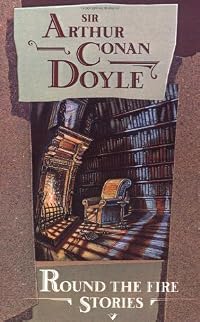
Round the Fire Stories
by Sir Arthur Conan Doyle
On This Page
Description
Fiction. Horror. Mystery. Thriller. Originally published in 1908 and out of print for more than half a century, this collection of stories, complete with a Preface by the author, presents Sir Arthur Conan Doyle at his finest. These are seventeen tales of suspense and adventure, of the mysterious and the fantastic, meant to be read "round the fire" upon a winter's night. Murder, madness, ghosts, unsolved crimes, diabolical traps, and inexplicable disappearances abound in these exciting show more accounts narrated by doctors, lawyers, genetlemen, teachers, burglars, dilettantes, and convicted criminals. The titles are inviting—"The Pot of Caviare," "The Clubfooted Grocer," "The Brazilian Cat," "The Sealed Room," and "There Fiend of the Coopergate"—and the stoires are riveting. This is a rediscovered classic by a master storyteller. show lessTags
Recommendations

















Member Reviews
I suspect the book I took out of the local public library most often during my middle school years was an edition of Sir Arthur Conan Doyle's Round the Fire Stories, first published in 1908 and reprinted several times since. I recently came across a copy of the 1991 Chronicle Books edition and bought it, knowing I'd enjoy a re-read of the stories. Conan Doyle does not disappoint. These are some of his creepiest and most suspenseful works, at times surpassing even the Sherlock Holmes stories in quality (Holmes makes a few uncredited cameo appearances in these stories, but is otherwise absent).
In the preface, Conan Doyle writes "In the present collection those [stories] have been brought together which are concerned with the grotesque and show more with the terrible - such tales as might well be read 'round the fire' upon a winter's night. This would be my ideal atmosphere for such stories, if an author might choose his time and place as an artist does the light and hanging of his picture. However, if they have the good fortune to give pleasure to anyone, at anytime or place, their author will be very satisfied." I was of course too impatient to wait for winter nights, but summer evenings sufficed just as well; if the author of these knew just how much pleasure these works have brought to me over the years, I suspect he'd be very satisfied indeed.
http://philobiblos.blogspot.com/2007/08/book-review-round-fire-stories.html show less
In the preface, Conan Doyle writes "In the present collection those [stories] have been brought together which are concerned with the grotesque and show more with the terrible - such tales as might well be read 'round the fire' upon a winter's night. This would be my ideal atmosphere for such stories, if an author might choose his time and place as an artist does the light and hanging of his picture. However, if they have the good fortune to give pleasure to anyone, at anytime or place, their author will be very satisfied." I was of course too impatient to wait for winter nights, but summer evenings sufficed just as well; if the author of these knew just how much pleasure these works have brought to me over the years, I suspect he'd be very satisfied indeed.
http://philobiblos.blogspot.com/2007/08/book-review-round-fire-stories.html show less
"I have myself, in my complex nature, a hunger after all which is bizarre and fantastic." (pg. 6)
A good and endearing collection of short stories from the prolific Sir Arthur Conan Doyle. The stories were conceived, Doyle's preface tells us, to be of the sort enjoyed by the reader round a fire on a winter's night. They meet this conception very well; Doyle, a master of popular storytelling who combines pace and flow with an everyman intelligence, provides a mildly exercising yet untaxing collection of crowd-pleasers in the mystery genre. All are between 10 and 15 pages and can be enjoyed individually or binged, ideally in front of a fireplace, in a longer session. A pleasant time will be had by all.
This vibe is enough, and a good thing show more too, for on closer inspection the stories show themselves to be lesser lights in Doyle's glittering constellation. For all the tantalising mystery and colour of the stories – macabre scenarios, exotic pets, ancient treasures and locked rooms – the solutions are usually benign or cliché – long-lost twins, men in the disguise of women's clothes, etc. It adds a slight tinge of disappointment on each story's end, but never enough to spoil the story, or the wider experience. An anonymous reference to Sherlock Holmes in 'The Lost Special', one of this collection's better stories, reminds us that Doyle's best work lies elsewhere, but Round the Fire Stories provides an uninterrupted sequence of tasty, if frivolous, treats. show less
A good and endearing collection of short stories from the prolific Sir Arthur Conan Doyle. The stories were conceived, Doyle's preface tells us, to be of the sort enjoyed by the reader round a fire on a winter's night. They meet this conception very well; Doyle, a master of popular storytelling who combines pace and flow with an everyman intelligence, provides a mildly exercising yet untaxing collection of crowd-pleasers in the mystery genre. All are between 10 and 15 pages and can be enjoyed individually or binged, ideally in front of a fireplace, in a longer session. A pleasant time will be had by all.
This vibe is enough, and a good thing show more too, for on closer inspection the stories show themselves to be lesser lights in Doyle's glittering constellation. For all the tantalising mystery and colour of the stories – macabre scenarios, exotic pets, ancient treasures and locked rooms – the solutions are usually benign or cliché – long-lost twins, men in the disguise of women's clothes, etc. It adds a slight tinge of disappointment on each story's end, but never enough to spoil the story, or the wider experience. An anonymous reference to Sherlock Holmes in 'The Lost Special', one of this collection's better stories, reminds us that Doyle's best work lies elsewhere, but Round the Fire Stories provides an uninterrupted sequence of tasty, if frivolous, treats. show less
This collection reads a bit like Doyle’s Sherlock Holmes stories, but without the infamous detective. Quite a few of the stories had a macabre style that reminded me more of Edgar Allan Poe than of Doyle’s other work. Pot of Caviar, The Sealed Room and The Brown Hand were a few of the darkest pieces.
Other tales were easily solved with some critical thinking, similar to the Holmes books, but always with fun twists along the way. One deals with a museum break-in (The Jew’s Breastplate), an unexpected death (The Black Doctor), a visit to an eccentric relative (The Brazilian Cat), and a disappearance on a train.
BOTTOM LINE: A great collection of mysteries and ghost stories for a dark night. I missed Sherlock Holmes, but it was a show more treat to read some of Doyle’s other work. show less
Other tales were easily solved with some critical thinking, similar to the Holmes books, but always with fun twists along the way. One deals with a museum break-in (The Jew’s Breastplate), an unexpected death (The Black Doctor), a visit to an eccentric relative (The Brazilian Cat), and a disappearance on a train.
BOTTOM LINE: A great collection of mysteries and ghost stories for a dark night. I missed Sherlock Holmes, but it was a show more treat to read some of Doyle’s other work. show less
A fairly interesting selection of mystery stories, a collection first published in 1908. Some of the stories are crying out to be Sherlock Holmes stories (Man with the Watches, The Black Doctor, B.24 and possibly The Japanned Box and The Beetle Hunter) while The Lost Special alluded to Holmes (as an unnamed amateur investigator who says that one must eliminate the impossible and then whatever remains is the truth, no matter how improbable), though I found the resolution of the mystery implausible in this case. Implausibility was also a feature of one or two others, such as The Jew's Breastplate. Some others were a little more pedestrian or rather predictable in their resolution (The Club-Footed Grocer, The Usher of Lea House School, The show more Brown Hand, Jelland's Voyage). Finally, some were quite horrific and Poe-esque (especially The Leather Funnel, Pot of Caviare, The Sealed Room, perhaps also The Brazilian Cat and The Fiend of the Cooperage). Finally, Playing with Fire presaged the author's own later obsession with spiritualism. A collection worth reading. show less
Bunch of short stories. Easy to read 1 or 2 at a go.
I thought it was going to be more ghost stories, and only 3 had a supernatural element and only 2 would be ghost stories.
Mostly it was complex crimes being figured out. There were 2 stories covering people preemptively committing suicide to avoid a perceived worse outcome only for their salvation to their situations immediately after.
Brazilian Cat was probably my favorite story. It was really familiar. I don't know if I have encountered it before or if it has been knockoffs. Given how familiar it was, everything fell out exactly as I expected. It was probably the least surprising of all the stories, but that wasn't a bad thing. The information was there to follow everyone's motivations show more which resulted in actions that make sense.
The elaborate crimes that baffled everyone were probably my least favorite of the options. The Missing Special was my favorite those because it was so absurd. While they were my least favorite, it was still interesting seeing how the crime together. I don't think they were supposed to be mysteries for the reader to figure out, maybe I just don't read enough mysteries.
Given that it was 17 stories and they were all short, it is a lot harder to have general comments. show less
I thought it was going to be more ghost stories, and only 3 had a supernatural element and only 2 would be ghost stories.
Mostly it was complex crimes being figured out. There were 2 stories covering people preemptively committing suicide to avoid a perceived worse outcome only for their salvation to their situations immediately after.
Brazilian Cat was probably my favorite story. It was really familiar. I don't know if I have encountered it before or if it has been knockoffs. Given how familiar it was, everything fell out exactly as I expected. It was probably the least surprising of all the stories, but that wasn't a bad thing. The information was there to follow everyone's motivations show more which resulted in actions that make sense.
The elaborate crimes that baffled everyone were probably my least favorite of the options. The Missing Special was my favorite those because it was so absurd. While they were my least favorite, it was still interesting seeing how the crime together. I don't think they were supposed to be mysteries for the reader to figure out, maybe I just don't read enough mysteries.
Given that it was 17 stories and they were all short, it is a lot harder to have general comments. show less
Ratings
Members
- Recently Added By
Author Information

3,987+ Works 169,086 Members
The most famous fictional detective in the world is Arthur Conan Doyle's Sherlock Holmes. However, Doyle was, at best, ambivalent about his immensely successful literary creation and, at worst, resentful that his more "serious" fiction was relatively ignored. Born in Edinburgh, Doyle studied medicine from 1876 to 1881 and received his M.D. in show more 1885. He worked as a military physician in South Africa during the Boer War and was knighted in 1902 for his exceptional service. Doyle was drawn to writing at an early age. Although he attempted to enter private practice in Southsea, Portsmouth, in 1882, he soon turned to writing in his spare time; it eventually became his profession. As a Liberal Unionist, Doyle ran, unsuccessfully, for Parliament in 1903. During his later years, Doyle became an avowed spiritualist. Doyle sold his first story, "The Mystery of the Sasassa Valley," to Chambers' Journal in 1879. When Doyle published the novel, A Study in Scarlet in 1887, Sherlock Holmes was introduced to an avid public. Doyle is reputed to have used one of his medical professors, Dr. Joseph Bell, as a model for Holmes's character. Eventually, Doyle wrote three additional Holmes novels and five collections of Holmes short stories. A brilliant, though somewhat eccentric, detective, Holmes employs scientific methods of observation and deduction to solve the mysteries that he investigates. Although an "amateur" private detective, he is frequently called upon by Scotland Yard for assistance. Holmes's assistant, the faithful Dr. Watson, provides a striking contrast to Holmes's brilliant intellect and, in Doyle's day at least, serves as a character with whom the reader can readily identify. Having tired of Holmes's popularity, Doyle even tried to kill the great detective in "The Final Problem" but was forced by an outraged public to resurrect him in 1903. Although Holmes remained Doyle's most popular literary creation, Doyle wrote prolifically in other genres, including historical adventure, science fiction, and supernatural fiction. Despite Doyle's sometimes careless writing, he was a superb storyteller. His great skill as a popular author lay in his technique of involving readers in his highly entertaining adventures. (Bowker Author Biography) show less

Arthur Conan Doyle has a Legacy Library. Legacy libraries are the personal libraries of famous readers, entered by LibraryThing members from the Legacy Libraries group.
Series
Belongs to Publisher Series
Work Relationships
Contains
Common Knowledge
- Canonical title*
- Histórias à Lareira
*Some information comes from Common Knowledge in other languages. Click "Edit" for more information.
Classifications
Statistics
- Members
- 200
- Popularity
- 162,772
- Reviews
- 5
- Rating
- (3.91)
- Languages
- Dutch, English, Greek
- Media
- Paper, Audiobook, Ebook
- ISBNs
- 25
- UPCs
- 1
- ASINs
- 13