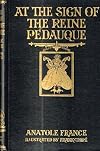
At the Sign of the Reine Pédauque
by Anatole France
On This Page
Description
I. Why I recount the singular Occurrences of my Life I. Why I recount the singular Occurrences of my LifeTags
Recommendations
























Member Reviews
An absolutely peerless writer; I doubt that I could pick a page at random and not find something pithy or witty or amazingly insightful. The story follows the adventures of Jacques Tournebroche, a young man plucked from his father’s “restaurant” in the very early 17s by a travelling monk and scholar who teaches him Latin, Greek, and the classics. The two are hired by an alchemist to translate the works of ancient authors. Throw in some depressingly antisemitic rants relating to a Jewish character whose image panders to the worst stereotypes and you have what might even be called a rousing adventure story. Much of the book is devoted to satirizing the church and religion, though the book is actually based on a 17th-century occult show more text. There are innumerable references to ancient and medieval authors, many of whom are unknown. And yet, for all its challenges, I found it to be a real page-turner. show less
Maybe I shouldn't be as self-revealing as this in front of a million and a half strangers, but after nearly seventy years of reading, in several languages, this remais my favorite of all novels, and has been so since I first found a copy in a junk-shop almost half a century ago. At some point I should probably focus this diffuse ecstasy for the benefit of those unfamiliar with the book, but I have to go talk with some sylphs.
the strangest book ever? I never read this one out though. it was too weird! even for me..! nobel laureate? this is what I remembered, I´m not 100% sure its correct so I hope someone will make a better rewiew: a man that tries to make "sun-beings" , that is, beautiful naked voluptous "angelwomen" from the sky that actually is robots? in the 1800th-century?? like the whole book is ( in a serious way!) about that dream about fetisch mechanic angelwomen. the absinth got him there. i suppose it is about something else too but I never really got it, more than thier demand and highly evolved (errr...the secret ingredience of how to put a peice of metal to a sexylifebeing-asabeautifulrobotoid-withnowill was dynamite or what was it? ) and show more veeery important and philosophical scienceing for naked angelwomen. it´s packed with fantasy ( as in good imagination) though, it´s just kind of typical that he dreamed that these "sun-beings" was voluptuos robot-women, and not men or something. are gonna give it one more try some time i guess.
i´m sure it might be about something more intellectual that I´ve missed...? otherwise, if you like this sciencedreamfantasy, maybe you should just rent ´Barbarella´ or something. I´m sure they´ve taken THAT fantasy in a way more practical way, maybe in a way that anatole would like more than his book. herr herr. oh well. perhaps not! maybe I´ve missed something. I think it has to do with something philosophical too, actually. sorry if I´ve missed something Mr Anatole. :) will read it again. fascinating at least! show less
i´m sure it might be about something more intellectual that I´ve missed...? otherwise, if you like this sciencedreamfantasy, maybe you should just rent ´Barbarella´ or something. I´m sure they´ve taken THAT fantasy in a way more practical way, maybe in a way that anatole would like more than his book. herr herr. oh well. perhaps not! maybe I´ve missed something. I think it has to do with something philosophical too, actually. sorry if I´ve missed something Mr Anatole. :) will read it again. fascinating at least! show less
Probably the most surprising, poetical, charming novel I ever read
wild illustrations
lakeside press
244/1500
244/1500
Ratings
Members
- Recently Added By
Lists

Trinity College Booklist (1951): Class Nine, Foreign Literatures
161 works; 3 members
Author Information

Anatole France was the pen name of Jacques Anatole Francois Thibault, who was born in Paris in 1844. The son of a bookseller, Thibault had a lifelong interest in literature. He worked as a schoolteacher, as a reader and editor for publishing houses, and as an assistant librarian in Paris' Senate Library, in addition to writing fiction, plays, show more poetry, criticism, and autobiographical stories. In his lifetime, Thibault was considered one of France's most beloved authors, and he received the Nobel Prize for literature in 1921. France's first novel was The Famished Cat, published in 1879. France's best-known novels include Monsieur Bergeret in Paris, The Crime of Sylvestre Bonnard, Member of the Institute (for which he received an award from the French Academy in 1881), At the Sign of the Reine Pedauque, Penguin Island, Thais (which became the basis for an opera), The Gods Are Athirst, and The Revolt of the Angels. During the late 1890s Thibault became very involved in political and social issues. He was especially committed to socialism and to the fight against anti-Semitism, mainly as a result of the Dreyfuss affair. This new awareness was reflected in his writing, particularly in books such as Penguin Island, which criticized contemporary French society, and The Revolt of the Angels, which parodied the Catholic Church. He also became the literary advisor to l'Humanitie, an influential socialist newspaper, and frequently contributed articles to it until, dissatisfied with the Communist party that had eventually evolved, he renounced all political ties to the left just before his death in 1924. (Bowker Author Biography) show less
Some Editions
Awards and Honors
Notable Lists
Series
Belongs to Publisher Series
Work Relationships
Common Knowledge
- Canonical title
- At the Sign of the Queen Pédauque; At the Sign of the Reine Pédauque
- Original title
- La Rôtisserie de la reine Pédauque
- Original publication date
- 1892
Classifications
Statistics
- Members
- 321
- Popularity
- 99,485
- Reviews
- 6
- Rating
- (3.62)
- Languages
- 13 — Czech, Danish, English, Estonian, Finnish, French, German, Hebrew, Hungarian, Italian, Polish, Spanish, Swedish
- Media
- Paper, Audiobook, Ebook
- ISBNs
- 47
- ASINs
- 45