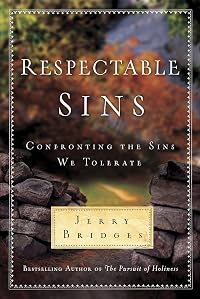
Respectable Sins
by Jerry Bridges, Jerry Bridges (Author)
On This Page
Description
As Christians, we believe that all sins are considered equal in God's eyes. Yet while evangelicals continue to decry the Big Ones--such as abortion, adultery, and violence--we often overlook more deceptive sins. It seems we have created a sliding scale where gossip, jealousy, and selfishness comfortably exist within the church. In short, some sins have simply become acceptable. Acclaimed author Jerry Bridges believes that just as culture has lost the concept of sin, the church faces the same show more danger. Throughout, Jerry encourages victory over personal sin through the gospel's transforming power. This release is perfect for readers who long to thoughtfully examine their lives and discover a deeper walk with God. show lessTags
Recommendations














Member Reviews
Bridges' book comes as a timely rebuke to a Church that has become obsessed with the sins of those outside its walls. The author does an excellent job of deal with many of the sins that we love to tolerate: ungodliness, anxiety/frustration, discontentment, unthankfulness, pride, selfishness, lack of self-control, impatience/irritability, anger, envy/jealousy, sins of the tongue and worldliness.
I have to admit that I found myself convicted by each of the chapters. I am grateful that someone has finally had the courage to address the sins that we so easily and so happily cover up. I particularly appreciated the author's chapter on ungodliness. Here is a sin that is barely ever even named, but the author names and it deals with it in a show more careful and Biblical fashion. Sections on discontentment, selfishness and impatience/irritability were also especially useful.
Not only does the author deal with the problem, he also offers remedies. Time and again it is an awareness and acknowledgement of the sovereignty of God (in all things) that is the antidote to these problem areas.
While I would heartily recommend this book to all believers (and I hope and pray it gets into the hands of millions), I was disappointed with the author's treatment of the sin of judgmentalism. In fact, I find the author contradicts himself. He says, for example, "the doctrine of Christ's substitutionary atonement for our sins and the complementary doctrine of justification by faith in Christ alone are, to me crucial doctrines." Later he admits, "We should express our disagreements, but we should do so in a way that does not degenerate into character assassination." Yet, at the beginning of the chapter it is not "character asassination" that is at issue (according to the author). Rather, he says "The person who says, for example, 'Jesus wouldn't drive an SUV,' is judgemental." Here "because the person has made a dogmatic and judgmental statement based purely on personal opinion" he/she is being judgmental. And yet, is this not what pastors/preachers/prophets are called to do? Are we not called to apply Scripture to real life issues? Perhaps the SUV is the wrong example to use. Would I be judgmental if I were to say (as I wouldn't hesitate to say) that Jesus (if he lived in America in 2009) would never wear a $10,000 watch; or if I were to say that Jesus (if he lived in America in 2009) would never drive an $80,000 car? If this is judgmentalism what a can pastor do but teach doctrine? How do we apply truth to real life scenarios if "judgmental" statements "based purely on personal opinion" are reflective of a judgmental spirit? Indeed, the author might (on this basis) be accused of a judgmental spirit for applying the truths named in each of these chapters to real life examples. Yet, is this not what we are called to do? The statement 'Jesus wouldn't drive an SUV' may actually be incorrect. But that statement (correct or incorrect) is not a fair example of judgmentalism. Character assassination is judgmentalism. Judging motives and heart intentions is another example of judgmentalism. But making a statement of opinion based on what we know of Jesus is different - that is preaching.
In our day, especially, we need to be careful how we define judgmentalism. There are so many who will not hear prophetic messages because they want their ears to be "tickled". If they can accuse their pastors of judgmentalism and thereby avoid the sting of conviction they will. This is not an insignificant issue; nor is Bridges' example of the SUV, especially in a culture that loves its toys (and sometimes in the name of the gospel). Indeed, I wish there were more who would make such a bold statements as "Jesus wouldn't..."
Still, I hope many will read this book and be challenged to grow in godliness as the confront these 'respectable sins'. I certainly have benefited from it. show less
I have to admit that I found myself convicted by each of the chapters. I am grateful that someone has finally had the courage to address the sins that we so easily and so happily cover up. I particularly appreciated the author's chapter on ungodliness. Here is a sin that is barely ever even named, but the author names and it deals with it in a show more careful and Biblical fashion. Sections on discontentment, selfishness and impatience/irritability were also especially useful.
Not only does the author deal with the problem, he also offers remedies. Time and again it is an awareness and acknowledgement of the sovereignty of God (in all things) that is the antidote to these problem areas.
While I would heartily recommend this book to all believers (and I hope and pray it gets into the hands of millions), I was disappointed with the author's treatment of the sin of judgmentalism. In fact, I find the author contradicts himself. He says, for example, "the doctrine of Christ's substitutionary atonement for our sins and the complementary doctrine of justification by faith in Christ alone are, to me crucial doctrines." Later he admits, "We should express our disagreements, but we should do so in a way that does not degenerate into character assassination." Yet, at the beginning of the chapter it is not "character asassination" that is at issue (according to the author). Rather, he says "The person who says, for example, 'Jesus wouldn't drive an SUV,' is judgemental." Here "because the person has made a dogmatic and judgmental statement based purely on personal opinion" he/she is being judgmental. And yet, is this not what pastors/preachers/prophets are called to do? Are we not called to apply Scripture to real life issues? Perhaps the SUV is the wrong example to use. Would I be judgmental if I were to say (as I wouldn't hesitate to say) that Jesus (if he lived in America in 2009) would never wear a $10,000 watch; or if I were to say that Jesus (if he lived in America in 2009) would never drive an $80,000 car? If this is judgmentalism what a can pastor do but teach doctrine? How do we apply truth to real life scenarios if "judgmental" statements "based purely on personal opinion" are reflective of a judgmental spirit? Indeed, the author might (on this basis) be accused of a judgmental spirit for applying the truths named in each of these chapters to real life examples. Yet, is this not what we are called to do? The statement 'Jesus wouldn't drive an SUV' may actually be incorrect. But that statement (correct or incorrect) is not a fair example of judgmentalism. Character assassination is judgmentalism. Judging motives and heart intentions is another example of judgmentalism. But making a statement of opinion based on what we know of Jesus is different - that is preaching.
In our day, especially, we need to be careful how we define judgmentalism. There are so many who will not hear prophetic messages because they want their ears to be "tickled". If they can accuse their pastors of judgmentalism and thereby avoid the sting of conviction they will. This is not an insignificant issue; nor is Bridges' example of the SUV, especially in a culture that loves its toys (and sometimes in the name of the gospel). Indeed, I wish there were more who would make such a bold statements as "Jesus wouldn't..."
Still, I hope many will read this book and be challenged to grow in godliness as the confront these 'respectable sins'. I certainly have benefited from it. show less
In Respectable Sins: Confronting the Sins We Tolerate, Jerry Bridges gently focuses our attention on widespread sins in the church. Not only are they common, but they also go unchecked.
1) Bridges’ confession
Before expanding on these sins, though, he makes a confession to his readers: He’s not perfect, he has committed many of these sins over the years and he doesn’t pretend to be any better or holier than the rest of us.
He makes this confession right at the start, helping readers to understand his humble attitude while writing this book, which ultimately helps us to accept what he has to say about these sins.
2) Seasoned Christians still have room to grow
Next, Bridges walks us through those familiar Bible verses about sin, show more salvation and grace. He knows he’s talking to people who’ve heard these things a million times, but he reframes them to help us see ourselves—that is, lifelong Christians who think we’ve got this faith thing all worked out—in the centre of God’s plan of salvation.
Even now, as seasoned believers, with years of Sunday services under our belts, countless worship songs sung, who knows how many prayers said, devotions read and volunteer hours logged, we're still sinners in need of God’s grace who have lots of room left to grow.
3) Down to the nitty-gritty: Sins Christians tolerate
Bridges covers everything from anger, judgmentalism, anxiety and impatience to worldliness, pride, selfishness and lack of self-control.
Sometimes we Christians purposely ignore these 'respectable' sins. Sometimes we just don't take them seriously. Gossip and materialism are a couple examples of this.
Other times these sins are winked at or they’re the subject of jokes. I can think of a few, but I’m curious which sins you (reading this review) would file under this category?
4) Bridges hits the mark
I’ve grown up in the church and consider myself to have been a believer most of my life, (You know, the ‘asked Jesus into my heart at age 6’ story), and I’ve seen each and every one of these sins in myself and in most ‘mature’ Christians around me.
Some of them, like materialism and selfishness, are shied away from in sermons, Bible studies, devotionals and especially in conversation with one another. We’re so hardwired from birth to practically idolize individualism, privacy and a citizen’s ‘rights’ to do whatever he wants with his money that we hardly distinguish them from the true sins of materialism and selfishness that God’s Word tries to guide us away from.
Other sins, like anger, are sometimes wrongly interpreted. I’ve been angered by serious sin in the church (e.g. putting personal comfort over helping a neighbor in need), and for that I have been accused of the ‘sin’ of anger. We Christians don’t know the difference between good anger (e.g. at cruel injustice) and sinful anger.
5) Bridges also missed a few biggies
Bridges really does justice to most sins that we Christians often let slide. He invites the reader, after reviewing each issue, to consider instances in our own lives where we have committed those sins and how we can return to a belief and a lifestyle more reflective of God’s desire for us, His Bride.
There are a few sins, though, I wish he had mentioned.
- Love your neighbor: We don’t do it
The second commandment, to love our neighbor as we love ourselves, seems like a biggie in Scripture. And yet, growing up I’ve witnessed countless times when Christians have refused to help a fellow Christian in need.
Not helping one’s neighbor is often made to seem acceptable with the false teaching that people must suffer in silence, without asking for help, in order to prove that they’re trusting God. Scripture, on the other hand, is full of commands and examples of Christians tangibly helping one another and that this is linked to proof of our salvation. (See John Piper’s sermon on this.)
- Church: The old boys’ club
I’ve gotta be honest. Sometimes the church resembles an old boys’ club more than a family of mature, caring believers who actually live by integrity. I’ve seen ‘mature’ Christians cover up fellow Christians’ sins and paving the way for that sin to continue. They also attacked anyone who brought those sins into the light.
Take the sexual abuse of children by clergy and other church leaders, for example. Consider the lengths to which ‘mature’ Christians have gone to cover up those sins, regardless of the fact that known pedophiles were free to continue abusing children because of the community’s collective will to keep it all quiet.
- Accountability: Who's it for anyway?
Often the church patriarchs and matriarchs consider themselves above accountability. Their age and status in the community gives them a kind of immunity from it.
Jesus and Paul’s clear instructions to deal with sin and conflict in the church (Matt. 5:23-24; Matt. 18:15-17, 1 Cor. 5: 11-13) are only applied to hot button sins (e.g. divorce, premarital sex, challenging ‘authority,’ etc.). These sins are loudly preached against and the people who committ them are publicly disciplined, cast out, or otherwise raked over the coals.
What about extreme sins, like when missionaries and elders and pastors rape children? No, we’re told, we must pray for those leaders and do nothing more. If we break the code of silence, we’re accused of the sin of judgmentalism, vengeance, anger and so forth.
You know in some ways, the Church is seriously screwed up. That’s why these are some of the very deep and dangerous sins I wish Bridges had covered in his otherwise stellar work.
6) 4.5 out of 5
Overall, the book was a huge encouragement to me, in that Bridges’ gentle treatment of these common sins paints a bright, uplifting picture of what the Church can become if we simply want to. All we need is to humble ourselves—I mean totally forget our privilege, status and years of service—and decide that our lives will not be a breeding ground for these sins anymore.
No sin is respectable.
Speaking of respect, it isn’t easy taking on the attitudes of overly comfortable Christians. I respect Jerry Bridges for the courage to share this unpopular yet urgently needed message with us.
--- Disclosure of Material Connection: I received this book free from NavPress Publishers as part of their Blogger Review Program. I was not required to write a positive review. The opinions I have expressed are my own. I am disclosing this in accordance with the Federal Trade Commision's 16 CFR, Part 255: "Guides Concerning the Use of Endorsements and Testimonials in Advertising." show less
1) Bridges’ confession
Before expanding on these sins, though, he makes a confession to his readers: He’s not perfect, he has committed many of these sins over the years and he doesn’t pretend to be any better or holier than the rest of us.
He makes this confession right at the start, helping readers to understand his humble attitude while writing this book, which ultimately helps us to accept what he has to say about these sins.
2) Seasoned Christians still have room to grow
Next, Bridges walks us through those familiar Bible verses about sin, show more salvation and grace. He knows he’s talking to people who’ve heard these things a million times, but he reframes them to help us see ourselves—that is, lifelong Christians who think we’ve got this faith thing all worked out—in the centre of God’s plan of salvation.
Even now, as seasoned believers, with years of Sunday services under our belts, countless worship songs sung, who knows how many prayers said, devotions read and volunteer hours logged, we're still sinners in need of God’s grace who have lots of room left to grow.
3) Down to the nitty-gritty: Sins Christians tolerate
Bridges covers everything from anger, judgmentalism, anxiety and impatience to worldliness, pride, selfishness and lack of self-control.
Sometimes we Christians purposely ignore these 'respectable' sins. Sometimes we just don't take them seriously. Gossip and materialism are a couple examples of this.
Other times these sins are winked at or they’re the subject of jokes. I can think of a few, but I’m curious which sins you (reading this review) would file under this category?
4) Bridges hits the mark
I’ve grown up in the church and consider myself to have been a believer most of my life, (You know, the ‘asked Jesus into my heart at age 6’ story), and I’ve seen each and every one of these sins in myself and in most ‘mature’ Christians around me.
Some of them, like materialism and selfishness, are shied away from in sermons, Bible studies, devotionals and especially in conversation with one another. We’re so hardwired from birth to practically idolize individualism, privacy and a citizen’s ‘rights’ to do whatever he wants with his money that we hardly distinguish them from the true sins of materialism and selfishness that God’s Word tries to guide us away from.
Other sins, like anger, are sometimes wrongly interpreted. I’ve been angered by serious sin in the church (e.g. putting personal comfort over helping a neighbor in need), and for that I have been accused of the ‘sin’ of anger. We Christians don’t know the difference between good anger (e.g. at cruel injustice) and sinful anger.
5) Bridges also missed a few biggies
Bridges really does justice to most sins that we Christians often let slide. He invites the reader, after reviewing each issue, to consider instances in our own lives where we have committed those sins and how we can return to a belief and a lifestyle more reflective of God’s desire for us, His Bride.
There are a few sins, though, I wish he had mentioned.
- Love your neighbor: We don’t do it
The second commandment, to love our neighbor as we love ourselves, seems like a biggie in Scripture. And yet, growing up I’ve witnessed countless times when Christians have refused to help a fellow Christian in need.
Not helping one’s neighbor is often made to seem acceptable with the false teaching that people must suffer in silence, without asking for help, in order to prove that they’re trusting God. Scripture, on the other hand, is full of commands and examples of Christians tangibly helping one another and that this is linked to proof of our salvation. (See John Piper’s sermon on this.)
- Church: The old boys’ club
I’ve gotta be honest. Sometimes the church resembles an old boys’ club more than a family of mature, caring believers who actually live by integrity. I’ve seen ‘mature’ Christians cover up fellow Christians’ sins and paving the way for that sin to continue. They also attacked anyone who brought those sins into the light.
Take the sexual abuse of children by clergy and other church leaders, for example. Consider the lengths to which ‘mature’ Christians have gone to cover up those sins, regardless of the fact that known pedophiles were free to continue abusing children because of the community’s collective will to keep it all quiet.
- Accountability: Who's it for anyway?
Often the church patriarchs and matriarchs consider themselves above accountability. Their age and status in the community gives them a kind of immunity from it.
Jesus and Paul’s clear instructions to deal with sin and conflict in the church (Matt. 5:23-24; Matt. 18:15-17, 1 Cor. 5: 11-13) are only applied to hot button sins (e.g. divorce, premarital sex, challenging ‘authority,’ etc.). These sins are loudly preached against and the people who committ them are publicly disciplined, cast out, or otherwise raked over the coals.
What about extreme sins, like when missionaries and elders and pastors rape children? No, we’re told, we must pray for those leaders and do nothing more. If we break the code of silence, we’re accused of the sin of judgmentalism, vengeance, anger and so forth.
You know in some ways, the Church is seriously screwed up. That’s why these are some of the very deep and dangerous sins I wish Bridges had covered in his otherwise stellar work.
6) 4.5 out of 5
Overall, the book was a huge encouragement to me, in that Bridges’ gentle treatment of these common sins paints a bright, uplifting picture of what the Church can become if we simply want to. All we need is to humble ourselves—I mean totally forget our privilege, status and years of service—and decide that our lives will not be a breeding ground for these sins anymore.
No sin is respectable.
Speaking of respect, it isn’t easy taking on the attitudes of overly comfortable Christians. I respect Jerry Bridges for the courage to share this unpopular yet urgently needed message with us.
--- Disclosure of Material Connection: I received this book free from NavPress Publishers as part of their Blogger Review Program. I was not required to write a positive review. The opinions I have expressed are my own. I am disclosing this in accordance with the Federal Trade Commision's 16 CFR, Part 255: "Guides Concerning the Use of Endorsements and Testimonials in Advertising." show less
Challenging read. This is a book to be slowly absorbed, and thoughtfully carried with you. The topics are presented with a gentle, humble spirit, but yet the author does not pull punches, doesn't shy away from calling us out of our lazy, complacent, self-serving version of Christianity.He defines, discusses and then offers Scriptural defense (and offense) in dealing with such sins as anxiety and frustration, discontentment, moral self-righteousness, judgmentalism, critical speech etc.I wish I could have gotten through a chapter without seeing myself described on the pages.
Isn't it strange how we fall into these little traps of sin? In the Fundamentalist Churches I grew up in, they claimed drinking and dancing were sins. When came to a different opinion, I thought very well of myself. And in so doing, committed the very same sin that they had committed -- pride.
I started this book in a small group atmosphere, and we, before starting it, thought he was going to talk about the Church's hatred of homosexuals or abortion doctors as our collective "acceptable sins." The Church tends to do that after all, to hate sinners as though we are any better because our sins are more traditional in nature. But then this group of mine started going down that pride path as well, that path that is unforgiving toward others. show more We were doing the same thing. We got tired of people condemning sinners rather than condemning sins, and so we started condemning those who condemn.
Thankfully, the book went in another direction. It hits home, and it hits close to the heart. It talks about pride and unforgiveness with conviction.
A lot of people in my group rejected it out of pride. Because of this book, I have tried to react to that reaction in faith and hope rather than pride upon pride. It takes a willing heart to hear this message, and so do not come to this book hoping that it will expose all the sins others commit. The book is written to expose that very attitude. show less
I started this book in a small group atmosphere, and we, before starting it, thought he was going to talk about the Church's hatred of homosexuals or abortion doctors as our collective "acceptable sins." The Church tends to do that after all, to hate sinners as though we are any better because our sins are more traditional in nature. But then this group of mine started going down that pride path as well, that path that is unforgiving toward others. show more We were doing the same thing. We got tired of people condemning sinners rather than condemning sins, and so we started condemning those who condemn.
Thankfully, the book went in another direction. It hits home, and it hits close to the heart. It talks about pride and unforgiveness with conviction.
A lot of people in my group rejected it out of pride. Because of this book, I have tried to react to that reaction in faith and hope rather than pride upon pride. It takes a willing heart to hear this message, and so do not come to this book hoping that it will expose all the sins others commit. The book is written to expose that very attitude. show less
This book is one of those we need to read over and over and keep close by. I found something in every chapter to help me grow closer to the image of Christ. So often we get comfortable with comparing ourselves among ourselves, that we lose sight of what our true standard should be. We begin to excuse our sins and forget that, with God, there is no "little" sin. This book clearly identifies the "respectable" sins that befall us in our day-to-day lives.
I love Jerry Bridges books and am sad that there will be no more as the author died last year. This book highlights the sins that we tend to overlook, (things like pride, covetousness, gossip etc,) whilst judging those who, in our view, are guilty of much more serious wrong-doing.
It's a challenge to each one of us and one of the author's best books. If you haven't yet read Trusting God then try this as well! [https://www.goodreads.com/review/show/1463995605]
Highly recommended!
It's a challenge to each one of us and one of the author's best books. If you haven't yet read Trusting God then try this as well! [https://www.goodreads.com/review/show/1463995605]
Highly recommended!
Respectable Sins is a book about identifying and confronting the not-so-obvious sins in our lives. Such are the sins that are not regarded as the “bad ones” like murder, adultery or homosexuality, but are the more tolerable ones such as jealousy, anger, pride and impatience.
Members
- Recently Added By
Lists

Sycamore Baptist Church Book Study Reading List
156 works; 5 members
Trinity Norman Recommended Christian Readings
170 works; 5 members

Suggested by Professors
15 works; 1 member
Author Information

128+ Works 27,511 Members
Jerry Bridges was a well-known Christian writer and speaker. His numerous books have sold over 3.5 million copies. He served on the staff of The Navigators for more than sixty years before his death in 2016. Jerry leaves behind his wife, Jane; two children; and seven grandchildren.
Common Knowledge
- Canonical title*
- Pristojni gresi
- Epigraph
- I thank my God in all my remembrance of you . . . because of your partnership in the gospel. -- Philippians 1:3-5
- Dedication
- To all those who by their prayers and financial support partner with me in ministry, this book is gratefully dedicated.
- First words
- [Preface] "He that is without sin among you, let him first cast a stone at her" (John 8:7, KJV).
The church at Corinth was all messed up, both theologically and morally. - Last words
- (Click to show. Warning: May contain spoilers.)[Preface] And above all, to God be the glory both now and forever. Amen.
(Click to show. Warning: May contain spoilers.)Finally, let me repeat the words of 1 Peter 5:5: "God opposes the proud but gives grace to the humble."
*Some information comes from Common Knowledge in other languages. Click "Edit" for more information.
Classifications
Statistics
- Members
- 2,544
- Popularity
- 7,562
- Reviews
- 13
- Rating
- (4.33)
- Languages
- English, Romanian, Croatian, Spanish
- Media
- Paper, Audiobook, Ebook
- ISBNs
- 14
- ASINs
- 9
