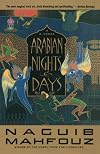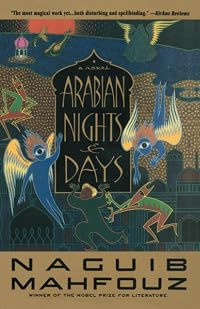
Arabian Nights and Days
by Naguib Mahfouz
On This Page
Description
Seventeen tales based on the classic, The Thousand and One Nights, but full of modern messages. In recounting his adventures, Sinbad-the-Sailor observes it is wrong to be a prisoner of tradition. The book's Egyptian author was recently the object of an assassination attempt by fundamentalists.Tags
Recommendations





















Member Recommendations
Member Reviews
This is not Naguib Mahfouz’s most well known work, but I found it a captivating introduction to a Nobel Laureate whose other novels are now high on my must read list.
Beginning where the classic One Thousand and One Nights ends, Shahrzad has concluded the stories she tells to the violent, bloodthirsty sultan, Shahriyar, in hopes of extending her life. Dandan, her father and the sultan’s vizier, is exultant to learn that the Shahriyar has decided to keep Shahrzad as his wife, as she has both given him a son and brought him a new awareness of his past evil deeds and a desire to more closely align himself with goodness.
Yet even as the sultan seeks to atone for his past deeds, the residents of his medieval Islamic city struggle with the show more greed and corruption of its most prominent citizens and government officials, leading to widespread social unrest. This is the story of a society where genies act as forces of both good and evil, and transgressions or even suspicion of such are treated harshly, often through public beheading. It follows the fates of a quick succession of characters, set in motion when the merchant, Sanaan al-Gamali, falls afoul of the genie Qumqam, who orders him to kill the governor of the quarter or incur an unknown punishment. Sanaan’s grasp on reality and moral fortitude deteriorating, he rapes and murders a girl and is beheaded. The chief of police, Gamasa al-Bulti, is the next to encounter a genie, when he accidentally frees Singam, who rewards him after also being beheaded, by granting him a new life as Abdullah the porter. The men of the city gather to discuss the events of the day at the Café of the Emirs, and one after another they are caught in the web of two mischievously evil genies, Zarmabaha and Sakhrabout. The sultan’s nocturnal wanderings, exploits of men who associate with a loose but married woman, romantic matches, a cap of invisibility, the unjust execution of Aladdin, and the return of Sinbad from his voyages all add to the fast moving and beautifully written narrative.
As one would expect from these magical fables, moral lessons abound. They are, however, utterly confounded by classic questions of whether the end justifies the means. ‘Good’ genies manipulate men to perform evil acts in order to put an end to the corruption of government officials, while ‘evil’ genies manipulate men just for the fun of it. But despite its representation of humankind as greedy and weak, I found this to be primarily a work of optimism. Each man is free to decide for himself how he will respond to the demands of the genies. Even the sultan, known for his brutality and mistrusted by his own wife, chooses to seek salvation. Abandoning his throne and family, he becomes the bridegroom of the queen in a mythical land inhabited only by women, where mortal time does not exist. But he too falls prey to weakness and one day, unable to resist the temptation of a forbidden door, finds himself back in the desert with Abdullah the porter, who offers him a place to dwell and this enigmatic advice.
This is a charming and engaging tale. Although I suspect that Mahfouz may have incorporated satirical elements related to modern day Egypt, my knowledge of that country and its history is not sufficient to have detected them. Read it as an entertaining adventure or search for something deeper. Either way, it is wonderful. show less
Beginning where the classic One Thousand and One Nights ends, Shahrzad has concluded the stories she tells to the violent, bloodthirsty sultan, Shahriyar, in hopes of extending her life. Dandan, her father and the sultan’s vizier, is exultant to learn that the Shahriyar has decided to keep Shahrzad as his wife, as she has both given him a son and brought him a new awareness of his past evil deeds and a desire to more closely align himself with goodness.
Yet even as the sultan seeks to atone for his past deeds, the residents of his medieval Islamic city struggle with the show more greed and corruption of its most prominent citizens and government officials, leading to widespread social unrest. This is the story of a society where genies act as forces of both good and evil, and transgressions or even suspicion of such are treated harshly, often through public beheading. It follows the fates of a quick succession of characters, set in motion when the merchant, Sanaan al-Gamali, falls afoul of the genie Qumqam, who orders him to kill the governor of the quarter or incur an unknown punishment. Sanaan’s grasp on reality and moral fortitude deteriorating, he rapes and murders a girl and is beheaded. The chief of police, Gamasa al-Bulti, is the next to encounter a genie, when he accidentally frees Singam, who rewards him after also being beheaded, by granting him a new life as Abdullah the porter. The men of the city gather to discuss the events of the day at the Café of the Emirs, and one after another they are caught in the web of two mischievously evil genies, Zarmabaha and Sakhrabout. The sultan’s nocturnal wanderings, exploits of men who associate with a loose but married woman, romantic matches, a cap of invisibility, the unjust execution of Aladdin, and the return of Sinbad from his voyages all add to the fast moving and beautifully written narrative.
As one would expect from these magical fables, moral lessons abound. They are, however, utterly confounded by classic questions of whether the end justifies the means. ‘Good’ genies manipulate men to perform evil acts in order to put an end to the corruption of government officials, while ‘evil’ genies manipulate men just for the fun of it. But despite its representation of humankind as greedy and weak, I found this to be primarily a work of optimism. Each man is free to decide for himself how he will respond to the demands of the genies. Even the sultan, known for his brutality and mistrusted by his own wife, chooses to seek salvation. Abandoning his throne and family, he becomes the bridegroom of the queen in a mythical land inhabited only by women, where mortal time does not exist. But he too falls prey to weakness and one day, unable to resist the temptation of a forbidden door, finds himself back in the desert with Abdullah the porter, who offers him a place to dwell and this enigmatic advice.
“I give you the words of a man of experience, who said: ‘It is an indication of truth’s jealousy that it has not made for anyone a path to it, and that it has not deprived anyone of the hope of attaining it, and it has left people running in the deserts of perplexity and drowning in the seas of doubt; and he who thinks that he has attained it, it dissociates itself from, and he who thinks that he has dissociated himself from it has lost his way. Thus there is no attaining it and no avoiding it- it is inescapable.’”
This is a charming and engaging tale. Although I suspect that Mahfouz may have incorporated satirical elements related to modern day Egypt, my knowledge of that country and its history is not sufficient to have detected them. Read it as an entertaining adventure or search for something deeper. Either way, it is wonderful. show less
The cover blurb described this as "disturbing", which was a masterful understatement. I made it better than halfway (no page numbering) but after numerous rapes, murders, suicides and executions I couldn't take any more. All of the foregoing initiated by djinn - this book should've been subtitles "Jinn Gone Wild". Dreaming of genies here was a real nightmare. The writing (and translation) was very good, and I suspect I may have missed some underlying social commentary due to a lack of familiarity, but honestly, this just ain't my cup of tea.
Arabian Nights and Days picks up where Arabian Nights left off, after the sultan Shahriyar renounces his former bloodthirsty ways and looks forward to a long married life with Shahrzad. Although she does not voice it to the sultan, Shahrzad does not meet this new attitude of Shahriyar's with unalloyed joy, since his renunciation of his past acts does not erase the bloody past. Also, his reign of terror has resulted in a city where the good, for the most part, are dead or have fled, and the remaining citizens (and their governors) have more than their fair share of corruption.
The story that follows is a struggle between the inhabitants of the town, human and genie alike, towards good or evil. Shahriyar, going beyond mere words, often show more goes out into the city in disguise at night, attempting to bring himself closer to goodness. Many of Shahrzad's stories find life in the town, and many characters from them reappear in different guise. The characters (and the readers) learn lessons of goodness, and strive (but do not always succeed) to follow them.
Mahfouz does not follow an easy path, and there are no easy answers or endings in this book. As always, his writing is beautiful and contains much to think about. There were several passages I read over again, to savor the words and the meaning behind them. This is a book I will turn to again, in hopes of understanding more. show less
The story that follows is a struggle between the inhabitants of the town, human and genie alike, towards good or evil. Shahriyar, going beyond mere words, often show more goes out into the city in disguise at night, attempting to bring himself closer to goodness. Many of Shahrzad's stories find life in the town, and many characters from them reappear in different guise. The characters (and the readers) learn lessons of goodness, and strive (but do not always succeed) to follow them.
Mahfouz does not follow an easy path, and there are no easy answers or endings in this book. As always, his writing is beautiful and contains much to think about. There were several passages I read over again, to savor the words and the meaning behind them. This is a book I will turn to again, in hopes of understanding more. show less
Naguib Mahfouz's Arabian Nights and Days is a bitterly entertaining and compelling read. In medieval age, in some unknown Islamic town, genies pulled a series of escapades that created havoc. The clash between the genies and the townspeople was evocative of inveterate, age-old struggles of virtue, corruption, despotism, injustice, and other practices purged by conscience.
Seized by a pang of guilt that pricked his heart, Sultan Shahriyar repented of his atrocious massacre of virgins and other pious, god-fearing people. Shahrzad, daughter of vizier Dandan, sacrificed her happiness and remained with the sultan in order to stem the torrent of blood.
Merchant Sanaan al-Gamali had a nightmare in which a genie would otherwise punish him if he show more refused to kill the governor, who had brought about the genie through black magic and made the genie accomplish purposes not approved by conscience. In a state of delirium and crazed fantasies, Sanaan raped and murdered a girl. When Gamali finally summoned his courage, unsheathed the dagger, aimed at the governor's heart and stabbed with a strength drawn from determination and despair, the genie abandoned Gamali to his own fate.
Gamasa al-Bulti, the chief of police, was another man whom the genie chose to be the saving of the quarter from corruption. Gamasa was despondent at the ruin of Gamali's family, which now lived in ignominy. But the chief remained aloof to Gamali's widow for fear of ruining his own position and his standing with the sultan, who regarded the blow directed against his official as being aimed against him personally. The genie confronted Gamasa as one despicable person feeding off ignominy for he protected the elite (who was just as corrupted) by prosecuting the respectable people. In "repentance", Gamasa launched a lethal blow at the neck of the governor, who gave a horrified scream as his blood spurted like a fountain. Unlike the merchant, Gamasa was spared by the genie and was given a new identity Abdullah the porter who then continued the criminal killing spree.
The above tales are just a tasteful sampling of Mahfouz's tour-de-force as a raconteur. Arabian Nights and Days is made up of stories and adventures of 1001 Nights-like characters whose lives Mahfouz deftly and seamlessly woven together and converged at the Café of the Emirs. The café was the central hangout spot of town, where the elite met the ordinary, the rich mingled with the poor. It was where Sinbad parted with the town and returned with serendipitous treasures. It was where every father of a virgin daughter felt reassured relieved and rejoiced over the news of sultan's repentance. It was where the whisperings of people regarding Aladdin's innocence originated and eventually reached the sultan's ears.
The book does not manifest a plot; rather it drifts along and presents the etched characters and their tantalizing but bitter struggles. I have to employ some patience to scrupulously keep track of the exhaustive cast of characters and their intricate relationships (newly adopted identity, remarriage of widows, merry-go-round-like change/succession of governor and police chief). Underlying the thrilling tales are Mahfouz's persistent philosophical overtones and queries. What is the "true path" to salvation? To what extent is a person responsible for his wrongdoings? How does one gauge the extent of repentance, if one is persistently pricked by guilt? To what extent does conscience permit wrongdoings, if the wrongdoing is conducted for a good cause?
The Islamic town is somehow a satirical miniature of the incorrigible society, a world of outward piety and latent corruption. The acts and conduct of the characters bespeak man's weakness that betrays trust, treats generosity with disdain, and plunges recklessly into debauchery and criminal activities. From stealing, stupid pranks to murder; we see the pitiful fall of one of the most morally righteous man in the book. Does his conscience justify his actions?
I am not sure how much I am really absorbing the philosophical message Mahfouz brings about underlying the tale, other than to know I am reading a brilliant satire and a very richly-written novel. Arabian Nights and Days is a delightful departure from Mahfouz's formulaic melancholy works chronicling his times. show less
Seized by a pang of guilt that pricked his heart, Sultan Shahriyar repented of his atrocious massacre of virgins and other pious, god-fearing people. Shahrzad, daughter of vizier Dandan, sacrificed her happiness and remained with the sultan in order to stem the torrent of blood.
Merchant Sanaan al-Gamali had a nightmare in which a genie would otherwise punish him if he show more refused to kill the governor, who had brought about the genie through black magic and made the genie accomplish purposes not approved by conscience. In a state of delirium and crazed fantasies, Sanaan raped and murdered a girl. When Gamali finally summoned his courage, unsheathed the dagger, aimed at the governor's heart and stabbed with a strength drawn from determination and despair, the genie abandoned Gamali to his own fate.
Gamasa al-Bulti, the chief of police, was another man whom the genie chose to be the saving of the quarter from corruption. Gamasa was despondent at the ruin of Gamali's family, which now lived in ignominy. But the chief remained aloof to Gamali's widow for fear of ruining his own position and his standing with the sultan, who regarded the blow directed against his official as being aimed against him personally. The genie confronted Gamasa as one despicable person feeding off ignominy for he protected the elite (who was just as corrupted) by prosecuting the respectable people. In "repentance", Gamasa launched a lethal blow at the neck of the governor, who gave a horrified scream as his blood spurted like a fountain. Unlike the merchant, Gamasa was spared by the genie and was given a new identity Abdullah the porter who then continued the criminal killing spree.
The above tales are just a tasteful sampling of Mahfouz's tour-de-force as a raconteur. Arabian Nights and Days is made up of stories and adventures of 1001 Nights-like characters whose lives Mahfouz deftly and seamlessly woven together and converged at the Café of the Emirs. The café was the central hangout spot of town, where the elite met the ordinary, the rich mingled with the poor. It was where Sinbad parted with the town and returned with serendipitous treasures. It was where every father of a virgin daughter felt reassured relieved and rejoiced over the news of sultan's repentance. It was where the whisperings of people regarding Aladdin's innocence originated and eventually reached the sultan's ears.
The book does not manifest a plot; rather it drifts along and presents the etched characters and their tantalizing but bitter struggles. I have to employ some patience to scrupulously keep track of the exhaustive cast of characters and their intricate relationships (newly adopted identity, remarriage of widows, merry-go-round-like change/succession of governor and police chief). Underlying the thrilling tales are Mahfouz's persistent philosophical overtones and queries. What is the "true path" to salvation? To what extent is a person responsible for his wrongdoings? How does one gauge the extent of repentance, if one is persistently pricked by guilt? To what extent does conscience permit wrongdoings, if the wrongdoing is conducted for a good cause?
The Islamic town is somehow a satirical miniature of the incorrigible society, a world of outward piety and latent corruption. The acts and conduct of the characters bespeak man's weakness that betrays trust, treats generosity with disdain, and plunges recklessly into debauchery and criminal activities. From stealing, stupid pranks to murder; we see the pitiful fall of one of the most morally righteous man in the book. Does his conscience justify his actions?
I am not sure how much I am really absorbing the philosophical message Mahfouz brings about underlying the tale, other than to know I am reading a brilliant satire and a very richly-written novel. Arabian Nights and Days is a delightful departure from Mahfouz's formulaic melancholy works chronicling his times. show less
Naguib Mahfouz's Arabian Nights and Days was a clever idea; a continuation from King Shahryar's cruel disposition and Shehrazad's storytelling.
But there is always a big risk involved in the project of writing a sequel to a classic: the danger lies in the expectations of the readers. The content of Arabian Nights and Days by Mahfouz lacks the one quality that made the classic that was Arabians Nights, one of the most magical, mystical and elevating books of my childhood: it doesn't evoke those macabre, violent or simply sensuous images that I remember of the classic. We don't come close to the flitting of pages of the Sage Duban, of the latter's "talking head", of the monochrome fish in the desolate enchanted city that are transformed show more into ghoulish creatures...
Weaving stories from the lives of all characters, both major and minor, was an adaptation from the classic that is Arabian Nights, but again, that was not particularly ingenious.
I felt that the ending was also quite typical: this hackneyed comment on the evanescence of the truth is commonly seen in novels, poems etc. Again therefore, I didn't think much of that.
I hope I come across better works by him. It would be a shame if I don't, because I've heard so much about him, and if it's once more a story of "much ado about nothing", then it would cast a very dark shadow on the current state of literature -- a conclusion/observation that the clear-sighted seem to make, but which I have been resisting for a long time. show less
But there is always a big risk involved in the project of writing a sequel to a classic: the danger lies in the expectations of the readers. The content of Arabian Nights and Days by Mahfouz lacks the one quality that made the classic that was Arabians Nights, one of the most magical, mystical and elevating books of my childhood: it doesn't evoke those macabre, violent or simply sensuous images that I remember of the classic. We don't come close to the flitting of pages of the Sage Duban, of the latter's "talking head", of the monochrome fish in the desolate enchanted city that are transformed show more into ghoulish creatures...
Weaving stories from the lives of all characters, both major and minor, was an adaptation from the classic that is Arabian Nights, but again, that was not particularly ingenious.
I felt that the ending was also quite typical: this hackneyed comment on the evanescence of the truth is commonly seen in novels, poems etc. Again therefore, I didn't think much of that.
I hope I come across better works by him. It would be a shame if I don't, because I've heard so much about him, and if it's once more a story of "much ado about nothing", then it would cast a very dark shadow on the current state of literature -- a conclusion/observation that the clear-sighted seem to make, but which I have been resisting for a long time. show less
ممتعه جدا و مميزه و عجبنى فيها لمحاتها السياسيه...بحس ابداعات نجيب محفوظ بيظهر فى الروايات الطويله و المتوسطه اكتر من القصص القصيره ...صحيح الف ليله مش اقوى اعماله بس حلو
اما جمصة البلطى فيحتاج دراسة ادبية منفصلة
لو عجبتك الف ليله يبقى ابدأ فى رحلات ابن فطومه....نفس الاجواء التاريخيه الجميله و اللمحات السياسيه غير الصريحه
اما جمصة البلطى فيحتاج دراسة ادبية منفصلة
لو عجبتك الف ليله يبقى ابدأ فى رحلات ابن فطومه....نفس الاجواء التاريخيه الجميله و اللمحات السياسيه غير الصريحه
اول رواية اقراها لنجيب محفوظ
اجمل رواية عربية قراتها حتى الان
النزعة الصوفية قوية جدا فى هذه الرواية
من حيث الجانب الروحانى و اعلاء قيمة الاخلاق و الاستقامة والبعد عن المعاصى
وان الخلاص الحقيقى هو حب الله حتى يرى المريد بنور البصيرة
Best arabic novel i have ever read........!!
اجمل رواية عربية قراتها حتى الان
النزعة الصوفية قوية جدا فى هذه الرواية
من حيث الجانب الروحانى و اعلاء قيمة الاخلاق و الاستقامة والبعد عن المعاصى
وان الخلاص الحقيقى هو حب الله حتى يرى المريد بنور البصيرة
Best arabic novel i have ever read........!!
Members
- Recently Added By
Lists

1980s
356 works; 23 members

Middle East Fiction
179 works; 16 members

KayStJ's to-read list
1,616 works; 11 members
Author Information

323+ Works 19,250 Members
Naguib Mahfouz was born in Cairo, Egypt on December 11, 1911. He received a degree in philosophy from the University of Cairo. He took on several civil service and government department jobs to supplement his income while writing, but retired from that career in 1971. During his lifetime, he wrote more than 30 novels including The Games of Fate, show more The Cairo Trilogy, Children of Gebelawi, The Thief and the Dogs, Autumn Quail, Small Talk on the Nile, and Miramar. He received numerous awards including the Egyptian State Prize, the Presidential Medal from the American University in Cairo, and the Nobel Prize for Literature in 1988. He died as a result of a head injury on August 30, 2006 at the age of 94. (Bowker Author Biography) show less
Some Editions
Series
Belongs to Publisher Series
Work Relationships
Common Knowledge
- Canonical title
- Arabian Nights and Days
- Original title
- LAYALI ALF LAYLA
- Original publication date
- 1982 (Arabic) (Arabic); 1995 (English translation) (English translation)
- People/Characters
- Shahryar (Shahriyar); Shahrazad (Shahrzad); Scheherazade (Shahrzad); Sheikh Abdullah al-Balkhi; Aladdin; Fadil Sanaan (show all 7); Sinbad the Sailor (Sindbad)
- Important places
- Baghdad
- First words
- Following the dawn prayer, with clouds of darkness defying the vigorous thrust of light, the vizier Dandan was called to a meeting with the sultan Shahriyar.
- Last words
- (Click to show. Warning: May contain spoilers.)Then Abdullah al-Aquil went off in the direction of the city.
- Original language*
- Arabo
- Disambiguation notice
- Original Arabic title: Layali alf lela
*Some information comes from Common Knowledge in other languages. Click "Edit" for more information.
Classifications
- Genres
- Fiction and Literature, General Fiction, Fantasy
- DDC/MDS
- 892.736 — Literature & rhetoric Literatures of other languages Afro-Asiatic literatures Arabic (Egypt, Lebanon, Palestine, Saudi Arabia, Sudan) Arabic fiction 1945–2000
- LCC
- PJ7846 .A46 .L3913 — Language and Literature Oriental languages and literatures Oriental philology and literature Arabic Arabic literature Individual authors or works
- BISAC
Statistics
- Members
- 881
- Popularity
- 30,867
- Reviews
- 14
- Rating
- (3.87)
- Languages
- 12 — Arabic, Chinese, Dutch, English, Estonian, French, German, Italian, Norwegian (Bokmål), Portuguese (Portugal), Spanish, Swedish
- Media
- Paper, Ebook
- ISBNs
- 37
- ASINs
- 2