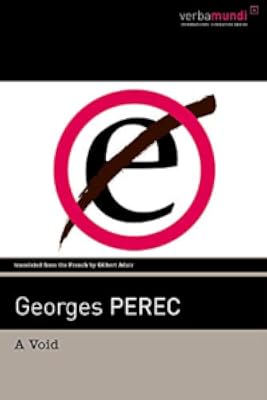
A Void
by Georges Perec
On This Page
Description
As much a masterpiece of translation as a novel, A Void contains not one single letter e anywhere in the main body of the text. This clever and unusual novel is full of plots and sub-plots, of trails in pursuit of trails and linguistic conjuring tricksTags
Recommendations




Member Recommendations
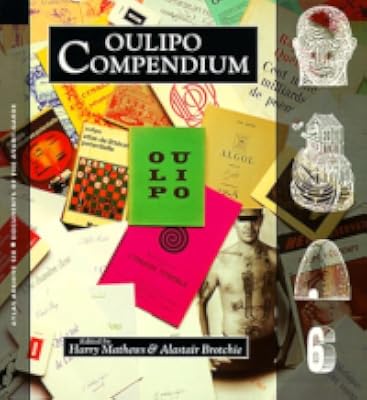
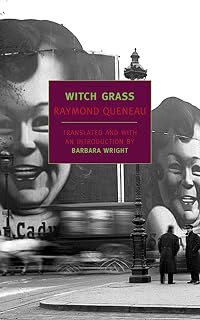
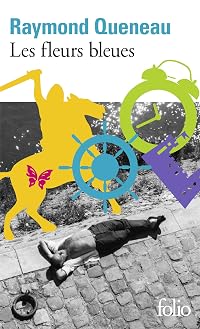
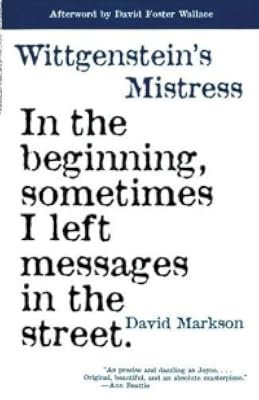
sgump Similar idea going on here. The brilliant work is a "univocal lipogram, in which each chapter restricts itself to the use of a single vowel" (103).
Member Reviews
Oulipo was mostly about writing with arbitrary constraints, and this book is mostly - no, it's probably fair to say wholly - known through its constraint. Writing without that particular glyph is tricky, but - obviously - not wholly impractical. GP also did a contrary trick in 1972 with Les Revenentes, a story that omits all non-consonants apart from that glyph that is missing from this book.
So why? Is it only a schoolboy trick to show you can do it, or did it add anything artistically? As far as I can work out - and this small trial is assisting with sharing that - constraints mostly work by blocking off such boring, standard ways of saying things as you might put into your normal work without thinking. A constraint is a way of show more pushing you as author to find original ways to put your thoughts into words. But it could also pull you towards things in your subconscious that you didn't know you would want to say. I think that's why GP brings in Albanian bandits, giant carp, bath-tubs, zahirs and so forth. In a way, it is just a fancy variant of what is going on in your mind if you pick a strict form such as haiku, tanka, ottava rima, ghazal, cinquain, and so on.
GP took a basically silly plot, a kind of parody of a whodunnit, in which a high body count and a lot of missing back-story that turns up during discussions play a big part. It also has a lot of word-play, palindromic paragraphs, parody of famous authors, a summary of Moby-Dick, and a lipogram within a lipogram. But you would not pick this book up for its story: it is always GP's linguistic acrobatics that grab you. So many spots at which it looks as though it can't work without violating his constraint, but GP always has a way out in mind. What a star, and how sad that his output was cut short so young!
* * *
OK, enough already with the lipograms. You have to do it when you review this book, if only to find out for yourself how hard it is, but it's best left to the experts. It isn't any easier in French - in principle, English should be the easier of the two, really, with a richer store of synonym pairs and fewer consistent grammar and spelling rules. In French, there are some things that are effectively ruled out altogether: adjectives for feminine nouns, for example, or the second and third person plural forms in most tenses of verbs. Perec had to do a few tricks to ensure that his characters could address each other using the informal "tu" (2nd singular),since the more usual formal "vous" always leads you to "-ez" endings. (In English, of course, you would rule out the 3rd person singular "-es" form and the past participle for all regular verbs.)
The constraint dictates the form of the book in other odd ways, too. For example, none of usual the French mealtime words passes the constraint, so you have to cheat - Perec steals lunch and collation. Characters also sometimes have the affectation of saying Thank you in English. And the Moby-Dick pastiche can't say baleine (whale) or bateau/navire (boat/ship), which results in a few complications...
And you notice how I allowed myself to be drawn into saying that La Disparition is an entirely frivolous book, because that's where the constraint led me. That's not entirely true: it definitely has a darker side. Perec's father died on war service and his mother in a concentration camp, so you have to stop and think when you realise that this is a book about children who have lost or been separated from their parents, and where a relentless, invisible killer is progressively wiping out everyone with a certain mark on the forearm. It is a joke, but it's a pretty black one. show less
So why? Is it only a schoolboy trick to show you can do it, or did it add anything artistically? As far as I can work out - and this small trial is assisting with sharing that - constraints mostly work by blocking off such boring, standard ways of saying things as you might put into your normal work without thinking. A constraint is a way of show more pushing you as author to find original ways to put your thoughts into words. But it could also pull you towards things in your subconscious that you didn't know you would want to say. I think that's why GP brings in Albanian bandits, giant carp, bath-tubs, zahirs and so forth. In a way, it is just a fancy variant of what is going on in your mind if you pick a strict form such as haiku, tanka, ottava rima, ghazal, cinquain, and so on.
GP took a basically silly plot, a kind of parody of a whodunnit, in which a high body count and a lot of missing back-story that turns up during discussions play a big part. It also has a lot of word-play, palindromic paragraphs, parody of famous authors, a summary of Moby-Dick, and a lipogram within a lipogram. But you would not pick this book up for its story: it is always GP's linguistic acrobatics that grab you. So many spots at which it looks as though it can't work without violating his constraint, but GP always has a way out in mind. What a star, and how sad that his output was cut short so young!
* * *
OK, enough already with the lipograms. You have to do it when you review this book, if only to find out for yourself how hard it is, but it's best left to the experts. It isn't any easier in French - in principle, English should be the easier of the two, really, with a richer store of synonym pairs and fewer consistent grammar and spelling rules. In French, there are some things that are effectively ruled out altogether: adjectives for feminine nouns, for example, or the second and third person plural forms in most tenses of verbs. Perec had to do a few tricks to ensure that his characters could address each other using the informal "tu" (2nd singular),since the more usual formal "vous" always leads you to "-ez" endings. (In English, of course, you would rule out the 3rd person singular "-es" form and the past participle for all regular verbs.)
The constraint dictates the form of the book in other odd ways, too. For example, none of usual the French mealtime words passes the constraint, so you have to cheat - Perec steals lunch and collation. Characters also sometimes have the affectation of saying Thank you in English. And the Moby-Dick pastiche can't say baleine (whale) or bateau/navire (boat/ship), which results in a few complications...
And you notice how I allowed myself to be drawn into saying that La Disparition is an entirely frivolous book, because that's where the constraint led me. That's not entirely true: it definitely has a darker side. Perec's father died on war service and his mother in a concentration camp, so you have to stop and think when you realise that this is a book about children who have lost or been separated from their parents, and where a relentless, invisible killer is progressively wiping out everyone with a certain mark on the forearm. It is a joke, but it's a pretty black one. show less
This is a perfect test-case for literature of constraint. Perec's constraint is tied to the content of his work (i.e., people die when they realize all the es are missing); his work is interesting independently of the constraint (i.e., it's funny and reflects on the literary tradition); in short, the *point* of the book is not the constraint itself.
I have no idea how seriously we're meant to take Perec's 'Postscript,' in which he more or less interprets the work for us. It is, he says, more or less an attempt to produce a text that is pure signifier, without signified; a structure removed from any concrete referent. He does this in order to criticize the French literature of his time, which he describes as all moralizing, show more psychologization, and a fetish for the old French 'virtues' of clarity, proportion etc... He wants to take us back to the literature of Rabelais and Tristram Shandy.
Say we take this seriously; I like most of that just fine. And yet much of this book is instantly forgettable. The spiralling plots certainly call to mind older forms of storytelling, but Perec's work lacks the basic good humor of those two older books. It feels mechanical at times; the parallels between Perec's 'characters' and other myths seem like repetitions for the sake of it rather than meaningful.
That's because Perec's book doesn't point to anything other than itself. The ridiculous plots remind me of Pynchon--whose books point out of themselves. The mania reminds me of the eighteenth century authors--ditto. I'm not the only one to feel this way; some critics argue that the missing 'es' are symbolic of the Jews murdered by Nazis et al. That's quite a stretch, but it shows the problem with this kind of literature as a whole--people like art (as distinct from entertainment) that offers them something other than itself. A Void is great entertainment, but it's also empty.
Anyway, conceptualism is one of the big trends in contemporary writing; much of it revolves around constraints. I'm skeptical, and Perec's book helped me to think through my attitude. I'll keep thinking.
On a side note, Gilbert Adair's translation is amazing. It's one thing to write a novel about whatever you want without the letter 'e' in it (impressive); it's another thing to translate a book without using the letter 'e'. He certainly deserved his prize. It's also a clinic on the difficulties of using the present tense. show less
I have no idea how seriously we're meant to take Perec's 'Postscript,' in which he more or less interprets the work for us. It is, he says, more or less an attempt to produce a text that is pure signifier, without signified; a structure removed from any concrete referent. He does this in order to criticize the French literature of his time, which he describes as all moralizing, show more psychologization, and a fetish for the old French 'virtues' of clarity, proportion etc... He wants to take us back to the literature of Rabelais and Tristram Shandy.
Say we take this seriously; I like most of that just fine. And yet much of this book is instantly forgettable. The spiralling plots certainly call to mind older forms of storytelling, but Perec's work lacks the basic good humor of those two older books. It feels mechanical at times; the parallels between Perec's 'characters' and other myths seem like repetitions for the sake of it rather than meaningful.
That's because Perec's book doesn't point to anything other than itself. The ridiculous plots remind me of Pynchon--whose books point out of themselves. The mania reminds me of the eighteenth century authors--ditto. I'm not the only one to feel this way; some critics argue that the missing 'es' are symbolic of the Jews murdered by Nazis et al. That's quite a stretch, but it shows the problem with this kind of literature as a whole--people like art (as distinct from entertainment) that offers them something other than itself. A Void is great entertainment, but it's also empty.
Anyway, conceptualism is one of the big trends in contemporary writing; much of it revolves around constraints. I'm skeptical, and Perec's book helped me to think through my attitude. I'll keep thinking.
On a side note, Gilbert Adair's translation is amazing. It's one thing to write a novel about whatever you want without the letter 'e' in it (impressive); it's another thing to translate a book without using the letter 'e'. He certainly deserved his prize. It's also a clinic on the difficulties of using the present tense. show less
This might be a book that has to be considered outside of any rating system at all. A novel without the letter "e." Written first in French, and then, perhaps even more amazingly, translated into English without using the letter "e." It's hard to read without thinking about "e"! You get lost in the story, and then think about the letter, and then get lost in the story again. It's a game, yes, and yet, it's another way of creating narrative. Creativity is spurred by a single restriction, though it's in another sense a massive restriction.
“A Void” (in French, La Disparition), written by Georges Perec in 1969 without using the vowel “e” , is probably the finest example of lipogrammatic fiction in world literature (you’ll find a short Wiki tutorial on Lipogram HERE).
The book is a kind of metaphysical thriller, following the well-acclaimed Borgesian tradition. The protagonist of the book, Anton Vowl, suddenly disappears from his residence in Paris. His friends try to solve the mystery of this strange disappearance by rummaging through Vowl’s diary, notes and letters, containing mostly his strange word plays, metaphoric writings and yes, lipograms. In the process of getting into the heart of the mystery they find themselves at the very centre of an atrocious and show more hyperbolic conspiracy which puts their own lives in danger. The book goes on unfurling plots after plots which become more and more complicated each time, involving murders, family secrets and relentless pursuit after trails. The book is also infested with Perec's notorious cross-references and red herrings. Here, amongst other things, we find a lipogrammatic version of Rimbaud's poem and that of Shelley's Ozymandias.
The pun in the title quite succinctly describes its theme—it is a book about a void as well as avoidance. The book has a void due to its strange avoidance of the vowel “e”, which, in turn, determines the fate of its characters (remember the surname of the protagonist—Vowl, a vowel without an“e”). That’s why, throughout the book we repeatedly come across a strange folio consisting of 26 volumes, out of which the 5th one is always missing. In fact, the book itself has 26 chapters but there is no 5th chapter in it, but a conspicuous blank page instead. Each of the characters in the book is a prey of an unavoidable destiny. The shadow of a past mystery runs after their lives and curiously links them up to a common misfortune. It hints at the fact that we all have a void inherent in our existence and however hard we try to avoid that, it doggedly chases after us and determines our fates. On the other hand, if we somehow manage to peep into that void, we are doomed forever. Characters in this book are in search of that void because finding it out will give a meaning to their otherwise absurd lives—that is, being mere puppets within their own socio-political milieu, without the ability to intervene or change its course. They pursue it through joining the missing links, following the faint trail of some distant possibilities and by pure coincidences, thereby trying to overcome their limitations and restrictions (it also brings forth the limitation of the book itself, the restriction of not using “e”). But at the end, all their efforts amount to a fatalistic blow, exterminating themselves. So, eventually, the book becomes a commentary on its own self, desperately trying to give a meaning to a random sequence of events, and once that is done, it has to stop, to come to an inevitable conclusion.
PS: When I first started reading the book, I was quite put off as the language appeared to me a bit phony and cumbersome. I was actually blaming Perec mentally for writing such a book after the brilliant feat of “Life: A User’s Manual”. For the initial 14 chapters, I just carried on reading as I didn’t want to add another book to my “to be read” collection and was trying to finish it as soon as possible. But my interest started building up from section IV of the book (it has six sections in total, without any section II), and after that, it was a complete literary whirlwind which didn’t allow me to put down the book once, except for that 40 winks at night (that too, chock-full of nightmares). show less
The book is a kind of metaphysical thriller, following the well-acclaimed Borgesian tradition. The protagonist of the book, Anton Vowl, suddenly disappears from his residence in Paris. His friends try to solve the mystery of this strange disappearance by rummaging through Vowl’s diary, notes and letters, containing mostly his strange word plays, metaphoric writings and yes, lipograms. In the process of getting into the heart of the mystery they find themselves at the very centre of an atrocious and show more hyperbolic conspiracy which puts their own lives in danger. The book goes on unfurling plots after plots which become more and more complicated each time, involving murders, family secrets and relentless pursuit after trails. The book is also infested with Perec's notorious cross-references and red herrings. Here, amongst other things, we find a lipogrammatic version of Rimbaud's poem and that of Shelley's Ozymandias.
The pun in the title quite succinctly describes its theme—it is a book about a void as well as avoidance. The book has a void due to its strange avoidance of the vowel “e”, which, in turn, determines the fate of its characters (remember the surname of the protagonist—Vowl, a vowel without an“e”). That’s why, throughout the book we repeatedly come across a strange folio consisting of 26 volumes, out of which the 5th one is always missing. In fact, the book itself has 26 chapters but there is no 5th chapter in it, but a conspicuous blank page instead. Each of the characters in the book is a prey of an unavoidable destiny. The shadow of a past mystery runs after their lives and curiously links them up to a common misfortune. It hints at the fact that we all have a void inherent in our existence and however hard we try to avoid that, it doggedly chases after us and determines our fates. On the other hand, if we somehow manage to peep into that void, we are doomed forever. Characters in this book are in search of that void because finding it out will give a meaning to their otherwise absurd lives—that is, being mere puppets within their own socio-political milieu, without the ability to intervene or change its course. They pursue it through joining the missing links, following the faint trail of some distant possibilities and by pure coincidences, thereby trying to overcome their limitations and restrictions (it also brings forth the limitation of the book itself, the restriction of not using “e”). But at the end, all their efforts amount to a fatalistic blow, exterminating themselves. So, eventually, the book becomes a commentary on its own self, desperately trying to give a meaning to a random sequence of events, and once that is done, it has to stop, to come to an inevitable conclusion.
PS: When I first started reading the book, I was quite put off as the language appeared to me a bit phony and cumbersome. I was actually blaming Perec mentally for writing such a book after the brilliant feat of “Life: A User’s Manual”. For the initial 14 chapters, I just carried on reading as I didn’t want to add another book to my “to be read” collection and was trying to finish it as soon as possible. But my interest started building up from section IV of the book (it has six sections in total, without any section II), and after that, it was a complete literary whirlwind which didn’t allow me to put down the book once, except for that 40 winks at night (that too, chock-full of nightmares). show less
Il fallait un grand art, un art hors du commun, pour fourbir tout un roman sans ça.' 'Ça', comprenez ce 'rond pas tout à fait clos finissant par un trait horizontal'. Il fallait substituer, combiner sans trêve et sans faillir, sans céder à la ronde tentation d'utiliser... la lettre 'e' ! 'Mais pourquoi donc ?', s'exclament les sceptiques et les désabusés. Et Perec de citer un obscur Ramun Quayno : 'L'on n'inscrit pas pour assombrir la population.' 'Qui frappe-t-on d'omission ?', demandent les offusqués et les inquisiteurs ? Le motif du tapis, le cinquième volume d'une collection d'in-folios, Anton Voyl lui-même, le protagoniste, tout, tout doit disparaître sous la plume-baguette de Perec ! Voilà qui suscite auprès dudit M. show more Voyl quelques suées kafkaïennes, des hallucinations rocambolesques et une imagination pour le moins aventurière... Après la publication des Choses, son premier roman (1965), Georges Perec rejoint l'Oulipo (Ouvroir de littérature potentielle) qui l'incite à multiplier les défis formels tels que celui de La Disparition ou de Alphabets (176 onzains hétérogrammatiques). --Laure Anciel show less
Very technically impressive, even more so for the translator Gilbert Adair than for George Perec himself. Adair surely earned his Scott Moncrieff Translation Prize by translating a book from French to English, maintaining the lack of the letter "e." It's Adair that gets this book a second star, not Perec.
The problem is that being technically impressive doesn't do anything for me unless it's matched with an interesting piece of writing- if someone writes an entire grocery store romance novel on a single grain of rice, that would be even more impressive than the feat Perec pulls off here, but the book itself would still be garbage. There is barely any story here, and what there is unfolds in a stilted manner. The restraint that Perec put show more on himself means that most sentences are awkward, and the book often falls back on just listing things in a given category that lack the letter "e." There are few characters, little descriptive imagery that's any good, and frankly the whole book was one big slog for me.
It seems to me that a gimmick that detracts from the story and writing is a gimmick that should be discarded. Instead Perec stuck with his gimmick. If he wanted to prove to himself that he could do it that's fine, it's when he had it published so that other people would read it that I started to have a problem. This is a technically impressive terrible book, and you should read something else instead. show less
The problem is that being technically impressive doesn't do anything for me unless it's matched with an interesting piece of writing- if someone writes an entire grocery store romance novel on a single grain of rice, that would be even more impressive than the feat Perec pulls off here, but the book itself would still be garbage. There is barely any story here, and what there is unfolds in a stilted manner. The restraint that Perec put show more on himself means that most sentences are awkward, and the book often falls back on just listing things in a given category that lack the letter "e." There are few characters, little descriptive imagery that's any good, and frankly the whole book was one big slog for me.
It seems to me that a gimmick that detracts from the story and writing is a gimmick that should be discarded. Instead Perec stuck with his gimmick. If he wanted to prove to himself that he could do it that's fine, it's when he had it published so that other people would read it that I started to have a problem. This is a technically impressive terrible book, and you should read something else instead. show less
I worship at this translator's altar for being able to render the entire novel without the letter "e". Good job, Gilbert Adair! The story was pretty interesting too, although I have to admit I kept scanning to see if I could find a wayward "e". Nope, it's a success.
Members
- Recently Added By
Lists

The Guardian's 1000 Novels Everyone Must Read
1,005 works; 547 members

1001 Books You Must Read Before You Die
1,448 works; 1,133 members

Experimental Literature
141 works; 18 members

1,001 BYMRBYD Concensus
723 works; 27 members

Books Read in 2023
5,547 works; 145 members

Gimmicks
56 works; 12 members
Author Information

150+ Works 13,577 Members
Georges Perec was born in Paris on March 7, 1936 and was educated in Claude-Bernard and Geoffroy-Saint-Hilaire. Perec was a parachutist in the French Military before he began publishing his writing in magazines like Partisans. Perec also wrote the book, Life: A Users Manual. Perec is noted for his constrained writing: his 300-page novel La show more disparition (1969) is a lipogram, written without ever using the letter "e". Perec won the Prix Renaudot in 1965, the Prix Jean Vigo in 1974, the Prix Médicis in 1978. Georges Perec died on March 3, 1982. (Bowker Author Biography) show less
Some Editions
Awards and Honors
Series
Belongs to Publisher Series
Work Relationships
Is contained in
Common Knowledge
- Canonical title
- A Void
- Original title
- La disparition
- Alternate titles
- A Vanishing; Vanish'd!
- Original publication date
- 1969 (original French) (original French); 1994 (English translation) (English translation)
- First words
- Introduction: Today, by radio, and also on giant hoardings, a rabbi, an admiral notorious for his links to Masonry, a trio of cardinals, a trio, too, of insignificant politicians (bought and paid for by a rich and co... (show all)rrupt Anglo-Canadian banking corporation), inform us all of how our country now risks dying of starvation.
- Last words
- (Click to show. Warning: May contain spoilers.)". . . a void brings our story to its conclusion."
- Original language
- French
Classifications
Statistics
- Members
- 1,723
- Popularity
- 12,842
- Reviews
- 44
- Rating
- (3.71)
- Languages
- 11 — Dutch, English, Finnish, French, German, Italian, Japanese, Croatian, Spanish, Swedish, Turkish
- Media
- Paper, Ebook
- ISBNs
- 29
- ASINs
- 6