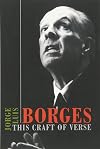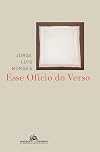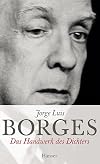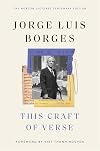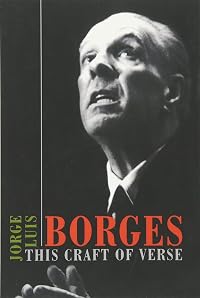
This Craft of Verse
by Jorge Luis Borges
On This Page
Description
Through a twist of fate that the author of Labyrinths himself would have relished, these lost lectures given in English at Harvard in 1967-1968 by Jorge Luis Borges return to us now, a recovered tale of a life-long love affair with literature and the English language.Tags
Recommendations




Member Reviews
Most years since 1925, Harvard University has invited an accomplished writer or artist to give a series of lectures regarding “poetry in the broadest sense.” Speakers have included T.S. Eliot, Czeslaw Milosz, Aaron Copland, and John Cage. In 1967, they chose one of my favorite writers: Jorge Luis Borges. These six lectures sat in the Harvard audio archives for 30 years before they were found and transcribed for the next generation. His series, entitled “This Craft of Verse,” illustrates not only a theory of poetry, but also Borges’s connection to his readers and the world.
Each of the six lectures takes on a different aspect of both poetry itself and Borges’s interaction with it. He deals with engagement, metaphor, show more translation, epicness, philosophy, and finally, his own approach to writing and poetry. He speaks (we have to keep in mind that these were lectures when they were first presented) in two minds. The first is of one who has been reading and writing for the last five decades; the second is someone who is always tentative when approaching great literature and great writing.
Even though he was 66 years old at the time, his lectures always seem to have a sense of deference to the material he talks about. He constantly mentions that his knowledge and ability are nowhere near those he has read. He laments the loss in the collective memory of so many past writers—the Spanish poet Rafael Cansinos-Assens, Byron, Keat—and how these great voices still play in his mind.
Many times during this book, I imagined myself as one of the bright-eyed scholars of Harvard, sitting in the audience and receiving the wisdom of a great author. I hoped that a few people in attendance were able to get something out of his words. He says of poetry: “[M]eaning is not important—what is important is a certain music, a certain way of saying things. Maybe, though the music may not be there, you will feel it. Or rather, since I know you are very kind, you will invent it for me.”
There is a tremendous sense of grandfatherly love in the lectures, as if he spent his entire figuring out one small piece of the world and is trying to tell us all about it. I could read this book over and over. I consumed this book; if I could, I would have clawed at the pages for more. Borges’s language is simple but still, much like the truth, resists simplicity. A definite five-star read. show less
Each of the six lectures takes on a different aspect of both poetry itself and Borges’s interaction with it. He deals with engagement, metaphor, show more translation, epicness, philosophy, and finally, his own approach to writing and poetry. He speaks (we have to keep in mind that these were lectures when they were first presented) in two minds. The first is of one who has been reading and writing for the last five decades; the second is someone who is always tentative when approaching great literature and great writing.
Even though he was 66 years old at the time, his lectures always seem to have a sense of deference to the material he talks about. He constantly mentions that his knowledge and ability are nowhere near those he has read. He laments the loss in the collective memory of so many past writers—the Spanish poet Rafael Cansinos-Assens, Byron, Keat—and how these great voices still play in his mind.
Many times during this book, I imagined myself as one of the bright-eyed scholars of Harvard, sitting in the audience and receiving the wisdom of a great author. I hoped that a few people in attendance were able to get something out of his words. He says of poetry: “[M]eaning is not important—what is important is a certain music, a certain way of saying things. Maybe, though the music may not be there, you will feel it. Or rather, since I know you are very kind, you will invent it for me.”
There is a tremendous sense of grandfatherly love in the lectures, as if he spent his entire figuring out one small piece of the world and is trying to tell us all about it. I could read this book over and over. I consumed this book; if I could, I would have clawed at the pages for more. Borges’s language is simple but still, much like the truth, resists simplicity. A definite five-star read. show less
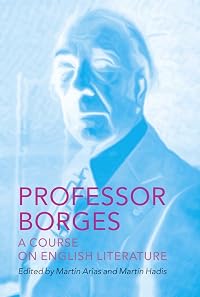
Every Borges lecture is always a treat (see also the superb lecture collection Professor Borges: A Course on English Literature), so thankfully this recent transcription of a series of rediscovered lectures Borges gave at Harvard in the 60s has been made available to us. Not only was he one of the greatest writers of all time, but such a generous reader and riveting speaker that it's impossible to not want to immediately jump on everything he references. I do think his modesty is often comical, as in his occasional phrasings of "oh, I may have forgotten this minor detail", when the reader knows full well that he delivered these multilingual, polyphonic, omnierudite lectures based solely on memory without any notes at all, but his humble show more and self-effacing demeanor is so sincere, and his passion for literature so genuine, that it would be crazy to not give him the same charity as he gives his audience. Even the titles of the half-dozen lectures here are intriguing - "The Riddle of Poetry", "The Metaphor", "The Telling of the Tale", "Word: Music and Translation", "Thought and Poetry", and "A Poet's Creed" - but to actually read them (or hear them; the whole thing is on YouTube) is to be transported into the presence of someone who is overflowing with pleasure at the inexhaustible joys that come from the simple act of reading really fine literature. Here are some choice quotes that I enjoyed in the course of reading it, but the thing has to be experienced in its completeness because there's insights on every page:
Sometimes, looking at the many books I have at home, I feel I shall die before I come to the end of them, yet I cannot resist the temptation of buying new books. Whenever I walk into a bookstore and find a book on one of my hobbies - for example, Old English or Old Norse poetry - I say to myself, "What a pity I can't buy that book, for I already have a copy at home."
If we think of the novel and the epic, we are tempted into thinking that the chief difference lies in the difference between verse and prose, in the difference between singing something and stating something. But I think there is a greater difference. The difference lies in the fact that the important thing about the epic is the hero - a man who is a pattern for all men. While, as Mencken pointed out, the essence of most novels lies in the breaking down of a man, in the degeneration of character.
Walter Pater wrote that all art aspires to the condition of music. The obvious reason (I speak as a layman of course) would be that, in music, form and substance cannot be torn asunder. Melody, or any piece of music, is a pattern of sounds and pauses unwinding itself in time, a pattern that I do not suppose can be torn. The melody is merely the pattern, and the emotions it sprang from, and the emotions it awakens. The Austrian critic Hanslick wrote that music is a language that we can use, that we can understand, but that we are unable to translate.
Remember that Alfred North Whitehead wrote that, among the many fallacies, there is the fallacy of the perfect dictionary - the fallacy of thinking that for every perception of the senses, for every statement, for every abstract idea, one can find an exact counterpart, an exact symbol, in the dictionary.
When I speak of night, I am inevitably - and happily for us, I think - reminded of the last sentence of the first book in Finnegans Wake, wherein Joyce speaks of "the rivering waters of, hitherandthithering waters of. Night!" This is an extreme example of an elaborate style. We feel that such a line could have been written only after centuries of literature. We feel that the line is an invention, a poem - a very complex web, as Stevenson would have had it. And yet I suspect there was a moment when the word "night" was quite as impressive, was quite as strange, was quite as awe-striking as this beautiful winding sentence: "rivering waters of, hitherandthithering waters of. Night!"
I think of myself as being essentially a reader. As you are aware, I have ventured into writing; but I think that what I have read is far more important than what I have written. For one reads what one likes - yet one writes not what would like to write, but what one is able to write.
I had read in Lugones that the metaphor was the essential element of literature, and I accepted that dictum. Lugones wrote that all words were originally metaphors. This is true, but it is also true that in order to understand most words, you have to forget about the fact of their being metaphors. For example, if I say, "Style should be plain", then I don't think that we should remember that "style" (stylus) meant "pen", and that "plain means "flat", because in that case we would never understand it. show less
Sometimes, looking at the many books I have at home, I feel I shall die before I come to the end of them, yet I cannot resist the temptation of buying new books. Whenever I walk into a bookstore and find a book on one of my hobbies - for example, Old English or Old Norse poetry - I say to myself, "What a pity I can't buy that book, for I already have a copy at home."
If we think of the novel and the epic, we are tempted into thinking that the chief difference lies in the difference between verse and prose, in the difference between singing something and stating something. But I think there is a greater difference. The difference lies in the fact that the important thing about the epic is the hero - a man who is a pattern for all men. While, as Mencken pointed out, the essence of most novels lies in the breaking down of a man, in the degeneration of character.
Walter Pater wrote that all art aspires to the condition of music. The obvious reason (I speak as a layman of course) would be that, in music, form and substance cannot be torn asunder. Melody, or any piece of music, is a pattern of sounds and pauses unwinding itself in time, a pattern that I do not suppose can be torn. The melody is merely the pattern, and the emotions it sprang from, and the emotions it awakens. The Austrian critic Hanslick wrote that music is a language that we can use, that we can understand, but that we are unable to translate.
Remember that Alfred North Whitehead wrote that, among the many fallacies, there is the fallacy of the perfect dictionary - the fallacy of thinking that for every perception of the senses, for every statement, for every abstract idea, one can find an exact counterpart, an exact symbol, in the dictionary.
When I speak of night, I am inevitably - and happily for us, I think - reminded of the last sentence of the first book in Finnegans Wake, wherein Joyce speaks of "the rivering waters of, hitherandthithering waters of. Night!" This is an extreme example of an elaborate style. We feel that such a line could have been written only after centuries of literature. We feel that the line is an invention, a poem - a very complex web, as Stevenson would have had it. And yet I suspect there was a moment when the word "night" was quite as impressive, was quite as strange, was quite as awe-striking as this beautiful winding sentence: "rivering waters of, hitherandthithering waters of. Night!"
I think of myself as being essentially a reader. As you are aware, I have ventured into writing; but I think that what I have read is far more important than what I have written. For one reads what one likes - yet one writes not what would like to write, but what one is able to write.
I had read in Lugones that the metaphor was the essential element of literature, and I accepted that dictum. Lugones wrote that all words were originally metaphors. This is true, but it is also true that in order to understand most words, you have to forget about the fact of their being metaphors. For example, if I say, "Style should be plain", then I don't think that we should remember that "style" (stylus) meant "pen", and that "plain means "flat", because in that case we would never understand it. show less
"Whistler said, 'Art happens.' That is to say, there is something mysterious about art. I would like to take his words in a new sense. I shall say: Art happens every time we read a poem." His Charles Eliot Norton Lectures show how passionate and unconventional -- as well as conservative -- his relationship with poetry was. In these lectures Borges expands upon this notion and shares his view of the craft of Poetry. Reading the lectures inspires one to return to Borges poetry again and again. Like all of Borges' work it is magical and worthy of consideration by readers and writers alike.
Marvelous look at poetry (literature, really) from the eye of the master.
His immense knowledge is matched only by his humility.
The notes at the back are very helpful.
His immense knowledge is matched only by his humility.
The notes at the back are very helpful.
A reread. Wanted to read along while listening to the lectures themselves. Remains good.
Recueil de six conférences consacrées à la poésie au sens large.
L'énigme de la poésie
La métaphore
La narration d'une histoire
La musique des mots : la traduction
Pensée et poésie
Le crédo d'un poète
Des réflexions géniales sur la subjectivité du lecteur, d'autres discutables (il n'y aurait finalement même pas dix métaphores distinctes). Des thèmes récurrents, parfois des répétitions agaçantes d'une conférences à l'autre.
À lire pour les quelques étincelles.
L'énigme de la poésie
La métaphore
La narration d'une histoire
La musique des mots : la traduction
Pensée et poésie
Le crédo d'un poète
Des réflexions géniales sur la subjectivité du lecteur, d'autres discutables (il n'y aurait finalement même pas dix métaphores distinctes). Des thèmes récurrents, parfois des répétitions agaçantes d'une conférences à l'autre.
À lire pour les quelques étincelles.
Jan 20, 2008French
Ratings
Members
- Recently Added By
Published Reviews
ThingScore 75
Much of the material in This Craft of Verse centers on poetry and verse, though really it extends to include all writing. From what makes poetry poetry to the use of metaphor and the problems of translation to his own approach to writing, Borges offers both genial and ingenious commentary.
added by eereed
Lists

Tom's Bookstore
346 works; 2 members
Author Information

868+ Works 58,855 Members
Born in Buenos Aires, Argentina, in 1899, Jorge Borges was educated by an English governess and later studied in Europe. He returned to Buenos Aires in 1921, where he helped to found several avant-garde literary periodicals. In 1955, after the fall of Juan Peron, whom he vigorously opposed, he was appointed director of the Argentine National show more Library. With Samuel Beckett he was awarded the $10,000 International Publishers Prize in 1961, which helped to establish him as one of the most prominent writers in the world. Borges regularly taught and lectured throughout the United States and Europe. His ideas have been a profound influence on writers throughout the Western world and on the most recent developments in literary and critical theory. A prolific writer of essays, short stories, and plays, Borges's concerns are perhaps clearest in his stories. He regarded people's endeavors to understand an incomprehensible world as fiction; hence, his fiction is metaphysical and based on what he called an esthetics of the intellect. Some critics have called him a mystic of the intellect. Dreamtigers (1960) is considered a masterpiece. A central image in Borges's work is the labyrinth, a mental and poetic construct, that he considered a universe in miniature, which human beings build and therefore believe they control but which nevertheless traps them. In spite of Borges's belief that people cannot understand the chaotic world, he continually attempted to do so in his writing. Much of his work deals with people's efforts to find the center of the labyrinth, symbolic of achieving understanding of their place in a mysterious universe. In such later works as The Gold of the Tigers, Borges wrote of his lifelong descent into blindness and how it affected his perceptions of the world and himself as a writer. Borges died in Geneva in 1986. (Bowker Author Biography) show less
Some Editions
Series
Belongs to Publisher Series
Charles Eliot Norton Lectures (1967-1968)
Common Knowledge
- Canonical title
- This Craft of Verse
- Original publication date
- 1967 (original lectures) (original lectures); 2000
Classifications
- Genres
- Literature Studies and Criticism, Nonfiction, Fiction and Literature
- DDC/MDS
- 809.1 — Literature & rhetoric Literature, rhetoric & criticism History, description, critical appraisal of more than two literatures Poetry
- LCC
- PN1064 .B67 — Language and Literature Literature (General) Literature (General) Poetry
- BISAC
Statistics
- Members
- 483
- Popularity
- 62,976
- Reviews
- 6
- Rating
- (4.42)
- Languages
- 6 — English, French, German, Japanese, Portuguese (Portugal), Turkish
- Media
- Paper, Ebook
- ISBNs
- 18
- ASINs
- 3