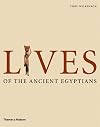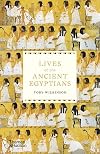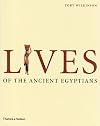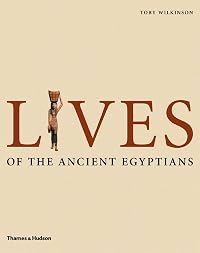
Lives of the Ancient Egyptians: Pharaohs, Queens, Courtiers and Commoners
by Toby Wilkinson
On This Page
Description
From the dawn of history to the death of Cleopatra, ancient Egypt was home to larger-than-life personalities. Across one hundred lives, Toby Wilkinson explores the true character and diversity of human experience in the ancient world's greatest civilization. Some of those profiled are famous: pharaohs and queens such as Akhenaten, Nefertiti, Ramesses II and Tiye. Others are lesser known but equally engaging: Imhotep, architect of the first pyramid; Perniankhu, the court dwarf; and the royal show more sculptor Bak. Equally illuminating are the lives of commoners, so rarely given their own voice: ordinary men and women who include a doctor, a dentist, a housewife, a musician - and a serial criminal.00Original Hbk. edition (ISBN 9780500051481, 2007) no longer available. show lessTags
Recommendations








Member Reviews
What a surprise that this history of Egypt, ending with the bio of Cleopatra, would prove so readable and interesting. At first, the idea of 100 short bios of figures throughout Egypt's ancient history sounds disjointed; why not just read Wikipedia entries? But the stories of pharaohs, administrators, scribes, priests, tomb-builders, and even a common criminal, unfold logically and form a fine portrait of life in the Old Kingdom onwards to Ptolemaic period and then the Romans,
I have read several books that seem to be written for the amateur Egyptologist (!)--like myself--but this is the first one that truly gives me a feeling for how the religious, economic and political aspects of Egyptian life changed over 3,000 years. A standard show more historical view focuses on the 3,000 years of continuity in art, etc. (except for the Amarna period) but reading of these lives the differences emerge.
One note: Some promotional statements note the book is "profusely illustrated! I don't think 17 color plates is how I would define "profusely" and as I read I longed for more illustrations of tombs, sculpture and visual aids. Perhaps even a map. But the convenient paperback is easy to hold and absorb, whereas an expanded format with illustrations could make it into a reference book no one could casually read through so easily as I did. show less
I have read several books that seem to be written for the amateur Egyptologist (!)--like myself--but this is the first one that truly gives me a feeling for how the religious, economic and political aspects of Egyptian life changed over 3,000 years. A standard show more historical view focuses on the 3,000 years of continuity in art, etc. (except for the Amarna period) but reading of these lives the differences emerge.
One note: Some promotional statements note the book is "profusely illustrated! I don't think 17 color plates is how I would define "profusely" and as I read I longed for more illustrations of tombs, sculpture and visual aids. Perhaps even a map. But the convenient paperback is easy to hold and absorb, whereas an expanded format with illustrations could make it into a reference book no one could casually read through so easily as I did. show less
As others have mentioned, the title of this book is a little misleading. I thought I'd be learning about the average life of an ancient Egyptian, whereas what I actually got was a hundred short biographies of ancient Egyptian individuals. It's not very deep and I didn't find it particularly engaging, but it did serve as a decent re-cap to reinforce my more in-depth learnings about ancient Egypt.
What I most appreciated was the inclusion of names of the subjects' family members and sometimes even pets. I feel like these are too often forgotten.
What I most appreciated was the inclusion of names of the subjects' family members and sometimes even pets. I feel like these are too often forgotten.
100 Ancient Egyptian Lives, from the (probably) first pharaoh, Narmer, to the last, Cleopatra. Toby Wilkinson spends an average of three pages on each figure. Not only kings, of course, but also court officials and gradually also a bit more 'ordinary' figures. Positive is the special attention given to women, although they remain scarce. Each period is introduced appropriately. But all in all this remains a rather stereotypical and superficial introduction to Ancient Egyptian history. More in my History account on Goodreads: https://www.goodreads.com/review/show/6818893951
Ratings
Members
- Recently Added By
Author Information

21+ Works 2,804 Members
Toby Wilkinson is the author of Tutankhamun's Trumpet (2022) and the-New York Times best-selling The Rise and Fall of Ancient Egypt, which won the Hessell-Tiltman Prize for History. He is a Bye-Fellow of Clare College, University of Cambridge, England.
Common Knowledge
- Important places
- Ancient Egypt
- First words
- What was it really like to live in ancient Egypt?
- Original language
- English
Classifications
Statistics
- Members
- 159
- Popularity
- 205,825
- Reviews
- 3
- Rating
- (3.56)
- Languages
- Czech, English, Spanish
- Media
- Paper, Ebook
- ISBNs
- 7
- ASINs
- 3