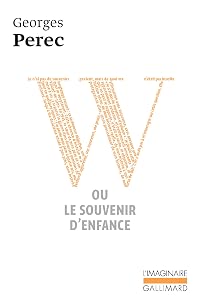
W, or The Memory of Childhood
by Georges Perec
On This Page
Description
"Guaranteed to send shock waves through the literary community, Perec's W tells two parallel stories. The first is autobiographical, describing the author's wartime boyhood. The second tale, denser, more disturbing, more horrifying, is the allegorical story of W, a mythical island off Tierra del Fuego, governed by the thrall of the Olympic "ideal," where losers are tortured and winners held in temporary idolatry." "As the reader soon discovers, W is a place where "it is more important to be show more lucky than to be deserving," and "you have to fight to live ... [with] no recourse, no mercy, no salvation, not even any hope that time will sort things out." Here, sport is glorified and victors honored, but athletes are vilified, losers executed, stealing encouraged, rape common, and violence a fact of life." "Perec's interpretive vision of the Holocaust forces us to ask the question central to our time: How did this happen before our eyes? How did we look at those "shells of skin and bone, ashen faced, with their backs permanently bent, their eyes full of panic and their suppurating sores?" How did all of this happen, not on W, but before millions of spectators, some horrified, some cheering, some in-different, but all present at the games watching the events of that grisly arena?"--BOOK JACKET. show lessTags
Recommendations








Member Recommendations
fleurdiabolique Perec and Rodoreda both build increasingly menacing and violent worlds with strange rituals that the reader struggles to fully understand. Both authors mean to provoke thought more than to tell a story, although the plot of both books will nevertheless draw the reader in. The plotting of W is more complex, with subplots and multiple stories that seem only tenuously related, and its main story lacks the kind of central character who guides us through Rodoreda's narrative. But readers looking for haunting, evocative prose that explores the darker side of human societies will probably enjoy both of these books.
Mouseear Where Lagerkvist investigates the possibilities of pure evil on an individual level, Perec examines the next step; when it becomes the foundation of an entire society. Both are dark allegories of the Nazi ideology and how it affects perpetrator and victim. Both are beautiful.
Member Reviews
Perec explores his memories of childhood and his reaction to the loss of his parents, both Jewish immigrants from Poland, during World War II. His father died in 1940 from wounds he received fighting in the French army; his mother was deported by the Nazis in early 1944 and is presumed to have been murdered at Auschwitz. Perec was evacuated from Paris to the Dauphiné by the Red Cross in 1942, where he attended a Catholic boarding school and later went to live with relatives.
The book has two alternating and apparently independent narratives. The even-numbered chapters form a fairly conventional memoir narrative, in which Perec examines memories, photographs, and texts he has written about himself earlier and tries to resolve them with show more what he can learn from family members and others who were around at the time. In many cases he finds that his memories don't square with the facts: he has appropriated to himself interesting or significant events that actually happened to other people, or he has shifted things around in time.
Meanwhile, the odd-numbered chapters, printed in italics, tell the (imaginary) story of a deserter from a French colonial war, now living in Germany under the false name Gaspard Winckler, who is asked to go to the island of W in Tierra del Fuego in search of the real Gaspard Winckler, missing after a shipwreck. As the narrator tells us more and more about W, we start to realise what a strange and disturbing place it is, in which the whole of life is centred around meaningless sporting competitions conducted under an arbitrary, changeable and undisclosed code of rules. Eventually we work outthat it is a coded, indirect way into exploring the distorted moral universe of the Nazi concentration camps. Perec doesn't trust himself, or doesn't feel entitled, to write directly about what his mother and other victims must have experienced, and he works his way in by this unexpected and very effective side-entrance. Perec obviously meant us to come to a clear realisation of how the two halves of the book fit together only in the last chapters, but my copy had helpfully been annotated all the way through by an earlier reader. It didn't really spoil it. show less
The book has two alternating and apparently independent narratives. The even-numbered chapters form a fairly conventional memoir narrative, in which Perec examines memories, photographs, and texts he has written about himself earlier and tries to resolve them with show more what he can learn from family members and others who were around at the time. In many cases he finds that his memories don't square with the facts: he has appropriated to himself interesting or significant events that actually happened to other people, or he has shifted things around in time.
Meanwhile, the odd-numbered chapters, printed in italics, tell the (imaginary) story of a deserter from a French colonial war, now living in Germany under the false name Gaspard Winckler, who is asked to go to the island of W in Tierra del Fuego in search of the real Gaspard Winckler, missing after a shipwreck. As the narrator tells us more and more about W, we start to realise what a strange and disturbing place it is, in which the whole of life is centred around meaningless sporting competitions conducted under an arbitrary, changeable and undisclosed code of rules. Eventually we work out
[W, or The Memory of Childhood] is a short but powerful and disturbing novel which consists of alternating chapters in two parts. In the first part, the autobiographical chapters describe his first few years of life. However, he cannot remember much of his childhood, and we are given fragments that are amended and corrected, based on what he is told by the aunt and uncle who adopted him and other relatives. His parents are almost ghostlike figures in this narrative, and the reader wonders if they truly did exist. The fictional chapters are the account of a French soldier who deserts his post and lives in a small German town after receiving a new name and identity by conscientious objectors. He receives a mysterious letter one day, and show more the man who sends him the letter provides him with information about his namesake, a boy who is missing after a boating accident near Tierra del Fuego. The mysterious man encourages him to conduct a search for his namesake.
In the second part of the book, the autobiographical chapters consist of Perec's life with his aunt and uncle in southeastern France during the war. Once again, the narrator's memory is hazy, but his recall of events sharpens as the years progress. The fictional chapters consist of a story of what first appears to be an Olympic utopia on the island of W, located in Tierra del Fuego, an archipelago near the tip of South America. The setting seems to be idyllic initially, with friendly competition between the athletes of the four towns on the island. However, with each subsequent chapter another layer is peeled away to reveal a more sinister society, as losing athletes are starved, tortured and even killed, and fertile women are chased by the athletes and allowed to be raped by the winners. The officials overseeing the games encourage the increasingly violent and lawless behavior, and the villagers passively and unquestioningly accept what their lives have become.
The reader eventually realizes what the island is meant to portray, and the interrelationship between the alternating autobiographical and fictional chapters becomes apparent. I highly recommend this novel, but it is not one to be read at bedtime! show less
In the second part of the book, the autobiographical chapters consist of Perec's life with his aunt and uncle in southeastern France during the war. Once again, the narrator's memory is hazy, but his recall of events sharpens as the years progress. The fictional chapters consist of a story of what first appears to be an Olympic utopia on the island of W, located in Tierra del Fuego, an archipelago near the tip of South America. The setting seems to be idyllic initially, with friendly competition between the athletes of the four towns on the island. However, with each subsequent chapter another layer is peeled away to reveal a more sinister society, as losing athletes are starved, tortured and even killed, and fertile women are chased by the athletes and allowed to be raped by the winners. The officials overseeing the games encourage the increasingly violent and lawless behavior, and the villagers passively and unquestioningly accept what their lives have become.
The reader eventually realizes what the island is meant to portray, and the interrelationship between the alternating autobiographical and fictional chapters becomes apparent. I highly recommend this novel, but it is not one to be read at bedtime! show less
Je ne retrouverai jamais dans mon ressassement même que l'ultime reflet d'une parole absente à l'écriture, le scandale de leur silence et de mon silence : l'écriture est le souvenir de leur mort et l'affirmation de ma vie.Georges Perec remonte le cours asséché de son enfance. Longue marche dans le lit désormais inutile d'une existence à jamais évaporée. Pourtant, aussi disloquées soient-elles, les bribes, une fois rassemblées, finissent par faire sens. Et c'est l'identité organique de Perec qu'elles signifient. Sans doute, fouillant sa mémoire et les vieilles photographies, le choc eût été trop violent, trop enivrant l'encens du passé. Alors l'écrivain mêle la fiction au réel. Petite histoire savamment entrelacée, show more récit d'aventures qui ne prend sens qu'en regard de l'autre, qui, elle-même, s'appuie sur la première pour exister. On connaît le Perec des Choses, celui de l'Oulipo (Un homme qui dort, La Disparition, Alphabets), mais peut-être moins celui qui avance 'démasqué', ose fouiller, comme tout autobiographe, les méandres de ce silence que chacun porte en soi et qui nous recèle. --Laure Anciel show less
e ne retrouverai jamais dans mon ressassement même que l'ultime reflet d'une parole absente à l'écriture, le scandale de leur silence et de mon silence : l'écriture est le souvenir de leur mort et l'affirmation de ma vie.
Georges Perec remonte le cours asséché de son enfance. Longue marche dans le lit désormais inutile d'une existence à jamais évaporée. Pourtant, aussi disloquées soient-elles, les bribes, une fois rassemblées, finissent par faire sens. Et c'est l'identité organique de Perec qu'elles signifient. Sans doute, fouillant sa mémoire et les vieilles photographies, le choc eût été trop violent, trop enivrant l'encens du passé. Alors l'écrivain mêle la fiction au réel. Petite histoire savamment entrelacée, show more récit d'aventures qui ne prend sens qu'en regard de l'autre, qui, elle-même, s'appuie sur la première pour exister. show less
Georges Perec remonte le cours asséché de son enfance. Longue marche dans le lit désormais inutile d'une existence à jamais évaporée. Pourtant, aussi disloquées soient-elles, les bribes, une fois rassemblées, finissent par faire sens. Et c'est l'identité organique de Perec qu'elles signifient. Sans doute, fouillant sa mémoire et les vieilles photographies, le choc eût été trop violent, trop enivrant l'encens du passé. Alors l'écrivain mêle la fiction au réel. Petite histoire savamment entrelacée, show more récit d'aventures qui ne prend sens qu'en regard de l'autre, qui, elle-même, s'appuie sur la première pour exister. show less
Georges Perec entrelaça duas histórias: uma é formada pelas suas memórias da infância durante a Segunda Guerra e suas pesquisas sobre o destino dos pais, a segunda, pela reescrita de uma história que ele escreveu aos 13 anos, sobre a ilha de W.
Por um lado, vemos como Perec busca pelas poucas memórias dos pais, que morreram durante a guerra, ele no front e ela em Auschwitz. Ele tenta achar fotos, anotaçãoes manuscritas, tudo que permita descobrir um pouco mais sobre eles. Por outro, vemos a aparente utopia da ilha de W se revelar um regime totalitário, em uma ligação que só fica clara pela citação final.
A cada livro que leio, mais gosto do autor.
Por um lado, vemos como Perec busca pelas poucas memórias dos pais, que morreram durante a guerra, ele no front e ela em Auschwitz. Ele tenta achar fotos, anotaçãoes manuscritas, tudo que permita descobrir um pouco mais sobre eles. Por outro, vemos a aparente utopia da ilha de W se revelar um regime totalitário, em uma ligação que só fica clara pela citação final.
A cada livro que leio, mais gosto do autor.
Not Perec's strongest in my opinion. I enjoy his style enough that I finished it, but the allegory was a little too heavy handed for me. Usually I find Perec light hearted and playful, which was not completely absent in W, but I felt like I was being asked to be a little too serious, too concerned. Ah well, I think I'll move on to his Exeter Text next.
Not Perec's strongest in my opinion. I enjoy his style enough that I finished it, but the allegory was a little too heavy handed for me. Usually I find Perec light hearted and playful, which was not completely absent in W, but I felt like I was being asked to be a little too serious, too concerned. Ah well, I think I'll move on to his Exeter Text next.
Members
- Recently Added By
Lists

1001 Books You Must Read Before You Die
1,448 works; 1,133 members

Childhood: Books for or about children in different cultures around the wor
345 works; 17 members

Experimental Literature
141 works; 18 members

1,001 BYMRBYD Concensus
723 works; 27 members

One Letter Titles
31 works; 4 members

Reading list
170 works; 1 member

Les 50 meilleurs livres de langue française de 1900 à aujourd’hui
69 works; 2 members
Author Information

150+ Works 13,570 Members
Georges Perec was born in Paris on March 7, 1936 and was educated in Claude-Bernard and Geoffroy-Saint-Hilaire. Perec was a parachutist in the French Military before he began publishing his writing in magazines like Partisans. Perec also wrote the book, Life: A Users Manual. Perec is noted for his constrained writing: his 300-page novel La show more disparition (1969) is a lipogram, written without ever using the letter "e". Perec won the Prix Renaudot in 1965, the Prix Jean Vigo in 1974, the Prix Médicis in 1978. Georges Perec died on March 3, 1982. (Bowker Author Biography) show less
Some Editions
Awards and Honors
Series
Belongs to Publisher Series
Work Relationships
Has as a study
Has as a student's study guide
Common Knowledge
- Canonical title
- W, or The Memory of Childhood
- Original title
- W ou le souvenir d'enfance
- Original publication date
- 1975
- Epigraph
- That mindless mist where shadows swirl, how could I pierce it?
- Raymond Queneau - Dedication
- Till E
for E - First words
- Jag har länge dragit mig för att berätta om min resa till W, men idag har jag bestämt mig.
The twenty-third letter of the alphabet is written in French, as in English, as a double V; and in French the letter "W" is also called "double-ve". - Last words
- (Click to show. Warning: May contain spoilers.)Jag har glömt av vilka skäl jag tolv år gammal valde att förlägga W till Eldslandet: Pinochets fascister har sett till att min fantasivärld har fått en förlängd efterklang: flera av Eldslandets mindre öar är idag deportationsläger.
(Click to show. Warning: May contain spoilers.)I have forgotten what reasons I had at the age of twelve for choosing Tierra del Fuego as the site of W. Pinochet's Fascists have provided my fantasy with a final echo: several of the islands in that area are today deportation camps.
Paris-Carros-Blevy
1970 - 1974 - Original language
- French
Classifications
Statistics
- Members
- 1,046
- Popularity
- 24,639
- Reviews
- 12
- Rating
- (3.97)
- Languages
- 16 — Catalan, Danish, Dutch, English, Finnish, French, German, Italian, Japanese, Norwegian (Nynorsk), Polish, Russian, Spanish, Swedish, Turkish, Portuguese (Portugal)
- Media
- Paper, Ebook
- ISBNs
- 40
- ASINs
- 4