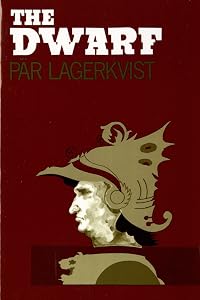
The Dwarf
by Pär Lagerkvist
On This Page
Description
Allegorical tale of renaissance Italy, told in the guise of a diary kept by the court dwarf who both hates and loves his prince, and despises the lascivious princess.Tags
Recommendations




















Member Recommendations
Mouseear Where Lagerkvist investigates the possibilities of pure evil on an individual level, Perec examines the next step; when it becomes the foundation of an entire society. Both are dark allegories of the Nazi ideology and how it affects perpetrator and victim. Both are beautiful.

Member Reviews
This might be one of my favorite books. It's difficult to find a narrator so despicable, and yet in the end the dwarf's warped view of the world ends up clarifying the world for the reader. Through the bloodthirsty war, the siege, and the plague that ravishes the land, the dwarf's misanthropic attitudes makes you wonder at the hatred in men's hearts.
I really liked this one!
Historical fiction, set in Renaissance-era Italy, with squabbling city-states and courtly intrigues as the backdrop. The narrator, a dwarf kept as a curiosity by a local lord, has rejected all connections to humanity, and views everything and everyone else with barely-concealed hatred and disgust. Absolutely no-one he’s ever met has treated him in any other way than as a despicable non-human, and so he keeps himself aloof, separate from the accursed human race.
The narrator is unapologetically and just so delightfully evil. Early on in the book, to establish his character, Lagerkvist has him kill a kitten, just to hurt the child whose pet it is. As the novel progresses, and his lord’s ambitions soar, he show more delights in wreaking underhanded havoc, revels vicariously in crude bloodshed, and spews his indiscriminate revulsion at any and all.
It’s one of those books where the main character would be an awesome villain in someone else’s story, and where the story is one ofthings going from bad to worse for a fascinatingly evil main character, such that you enjoy the destruction while at the same time kinda rooting for and admiring them . show less
Historical fiction, set in Renaissance-era Italy, with squabbling city-states and courtly intrigues as the backdrop. The narrator, a dwarf kept as a curiosity by a local lord, has rejected all connections to humanity, and views everything and everyone else with barely-concealed hatred and disgust. Absolutely no-one he’s ever met has treated him in any other way than as a despicable non-human, and so he keeps himself aloof, separate from the accursed human race.
The narrator is unapologetically and just so delightfully evil. Early on in the book, to establish his character, Lagerkvist has him kill a kitten, just to hurt the child whose pet it is. As the novel progresses, and his lord’s ambitions soar, he show more delights in wreaking underhanded havoc, revels vicariously in crude bloodshed, and spews his indiscriminate revulsion at any and all.
It’s one of those books where the main character would be an awesome villain in someone else’s story, and where the story is one of
I very much enjoyed this novel for, among other things, its relentlessly bleak and darkly comic (by way of the grotesque) tone. This is a story that just. doesn't. give. a. damn. about your feelings concerning the events described or the characters partaking in said events....it simply presents them (adroitly if also matched by concomitant bitterness) as they are and leaves you to judge them, in a sense, purely. No consideration is given to modulation or amelioration of darkness, it's a dark little treatise on the fallibility and numerous (beyond that into the realm of multifarious) sins and weaknesses of the human condition. This is a novel for those with a bit more iron than normal in their blood...but it does pay back, in dividends show more even.
If nothing else, it's assiduously honest. And in this age of uber sensitivity and pseudo-intellectual soundbites being palmed off as dogma, every conceivable side, readers can use this kind of bracing transparency. It's not a perfect novel, however. What keeps this novel from transcending (or 'full bloom' if you'll indulge me) is that it's too damn short. Don't crucify me too severely for playing the 'authorial intent' card but it's almost as if Par Lagerkvist either lost his enthusiasm for the story, maybe had some of his nerve diminished (or exhausted) or, very likely, he meant it this way. And if the final possibility is the case then I am at least grateful for the jarring (and jagged) black diamond of a novel(lla) we have. I just wanted more of that honesty. show less
If nothing else, it's assiduously honest. And in this age of uber sensitivity and pseudo-intellectual soundbites being palmed off as dogma, every conceivable side, readers can use this kind of bracing transparency. It's not a perfect novel, however. What keeps this novel from transcending (or 'full bloom' if you'll indulge me) is that it's too damn short. Don't crucify me too severely for playing the 'authorial intent' card but it's almost as if Par Lagerkvist either lost his enthusiasm for the story, maybe had some of his nerve diminished (or exhausted) or, very likely, he meant it this way. And if the final possibility is the case then I am at least grateful for the jarring (and jagged) black diamond of a novel(lla) we have. I just wanted more of that honesty. show less
There are only a small handful of books that I consider masterpieces. "The Dwarf" by Pars Lagerkvist is one of them. The book, written in the format of a diary, is short, easy to read, and complete. Even several weeks after finishing it, I keep thinking about the title character.
It is set in the Italian Renaissance, a period of great artistic progress, but also a period of war and court intrigue. The title character is a member of a large, influential palace in a city-state. Although he has some interactions with some of the main characters, he is largely an observer, telling stories through his own, fascinating point of view.
He is an angry man who believes that he is of a different "race" than the rest of humanity. That belief - his show more apartness - festers in him. He finds so much about humanity to be detestable: the way people eat, the way they create art, the way they make love, and the way they worship. Given how he was probably brought up and how he is treated in the court, it is understandable that he would believe as such. Plot developments in the book are vehicles to show his personality and his antipathy for people.
Readers can game out that some of the characters are actual historic figures in actual historic places. After reading it, I looked up some of the history of Milan during the city-state period, but what I learned added little value to my understanding of this brilliant book. That suggests a certain timeless quality.
Today, an interpretation of the book should point out that by rendering a minority (in this case, a person of short stature) in such an angry, violent, and antipathetic way is one-dimensional. As I continue to think about the title character though, I understand why Lagerkvist gives him these qualities.
Many early reviewers claim that "The Dwarf" is Lagerkvist's attempt to create a fully evil character. This might be true, but there were many instances where the character could commit evil acts, but choses not to through inaction. There are also suggestions by reviewers that the character might actually be the Machiavellian prince. I prefer to think that the character has simple antipathy for the world around him.
Alexandra Dick, the English translator, seems to have done a wonderful job. The language is even and unambiguous, which I assume was Lagerkvist's intention. It is a brilliant book. show less
It is set in the Italian Renaissance, a period of great artistic progress, but also a period of war and court intrigue. The title character is a member of a large, influential palace in a city-state. Although he has some interactions with some of the main characters, he is largely an observer, telling stories through his own, fascinating point of view.
He is an angry man who believes that he is of a different "race" than the rest of humanity. That belief - his show more apartness - festers in him. He finds so much about humanity to be detestable: the way people eat, the way they create art, the way they make love, and the way they worship. Given how he was probably brought up and how he is treated in the court, it is understandable that he would believe as such. Plot developments in the book are vehicles to show his personality and his antipathy for people.
Readers can game out that some of the characters are actual historic figures in actual historic places. After reading it, I looked up some of the history of Milan during the city-state period, but what I learned added little value to my understanding of this brilliant book. That suggests a certain timeless quality.
Today, an interpretation of the book should point out that by rendering a minority (in this case, a person of short stature) in such an angry, violent, and antipathetic way is one-dimensional. As I continue to think about the title character though, I understand why Lagerkvist gives him these qualities.
Many early reviewers claim that "The Dwarf" is Lagerkvist's attempt to create a fully evil character. This might be true, but there were many instances where the character could commit evil acts, but choses not to through inaction. There are also suggestions by reviewers that the character might actually be the Machiavellian prince. I prefer to think that the character has simple antipathy for the world around him.
Alexandra Dick, the English translator, seems to have done a wonderful job. The language is even and unambiguous, which I assume was Lagerkvist's intention. It is a brilliant book. show less
in a perfect world I'd have time to do this book justice--there is a lot to say. It is a story that seems simple until the end, when you see the twisted innards; I see it as an allegory on war guilt, a look at how we impose narratives of guilt and punishment on scapegoats to turn the infinitude of human suffering into the individual banishable ill, and a creepy gothic story about a melodramatized Italian Renaissance court and the atavistic dwarf who lets evil out of the bottle and looks on with his ancient eyes, who is expelled at the end but lies in wait still, who is nothing but what we made him. Second-best WWII face-of-evil story about a dwarf, after The Tin Drum, whose protagonist Oskar convinces as a human monster of ego and not show more just the mask on a malevolence. show less
Set in Renaissance Italy, "The Dwarf" introduces a most unique literary character -- that of a man no more than twenty-six inches in height, but with an ego far grander and far more devious than any regular-sized person. The dwarf recounts the tale of his master, The Prince, working on a scheme to seize the stronghold of Montanza from his enemy, Il Toro, and at the same time grumbles on about the Princess and other member of the court. As a dwarf, people of the court look at him patronizingly and sometimes forget that he's even present so he goes about his business without bother. Through his subjective vision, the world of Renaissance Italy springs to life, with the wealthy living the high life, the fantastic art and weaponry of the show more age created by Maestro Bernardo (who strongly resembles Leonardo Da Vinci), the weariness of war and the terror of plague.
The dwarf sets himself above humans, declaring many times that he is not like them and comes from a much older race of beings. At the same time, he calls his fellow dwarves buffoons and can't stand being around them because "they have to make jokes and play tricks to make their masters and the guests laugh." Only he can make real sense of what is going on around the palace, and only he knows what truly lies in the hearts of those at court -- especially that of the Prince. In that respect, I think the author makes him more human than he would like to believe. We all sometimes think we know more than we actually will let on, getting us into trouble. When he takes his "intuition" of the Prince's needs a step too far, though, he holds onto that sense of being above everyone like a liferaft, keeping him safe from the world around him.
With "The Dwarf", author Pär Lagerkvist has created a truly ugly character, filling him with all the evils within the human heart -- he lusts for war and battle, feels no remorse for killing another human (or dwarf), and has a superiority complex like no other. This makes for an interesting character study and is definitely worth a read. show less
The dwarf sets himself above humans, declaring many times that he is not like them and comes from a much older race of beings. At the same time, he calls his fellow dwarves buffoons and can't stand being around them because "they have to make jokes and play tricks to make their masters and the guests laugh." Only he can make real sense of what is going on around the palace, and only he knows what truly lies in the hearts of those at court -- especially that of the Prince. In that respect, I think the author makes him more human than he would like to believe. We all sometimes think we know more than we actually will let on, getting us into trouble. When he takes his "intuition" of the Prince's needs a step too far, though, he holds onto that sense of being above everyone like a liferaft, keeping him safe from the world around him.
With "The Dwarf", author Pär Lagerkvist has created a truly ugly character, filling him with all the evils within the human heart -- he lusts for war and battle, feels no remorse for killing another human (or dwarf), and has a superiority complex like no other. This makes for an interesting character study and is definitely worth a read. show less
It strikes me that both The Dwarf and Lagerkvist's The Sibyl are about the divine that resides deep inside all of us -- but much closer to the surface in some. This divine is amoral -- it doesn't follow the rules of good or evil -- it's much more like the divine power in the Book of Job. Unknowable.
The Dwarf is an allegory set in Renaissance Italy. I don't think the Dwarf is actually even a character in the novel despite that he is the narrator. He's the impulse to power, to avenge, to destroy, that lurks in humanity. When it's unleashed, all hell breaks loose. At the end of the novel, he's chained to an underground cell, but he knows that he'll be freed at some point, because he is needed.
In The Sibyl, the Wandering Jew, cursed with show more eternal life because he refused to let Jesus, on his way to be crucified, rest his head against his wall, has come to Delphi to seek wisdom from the Oracle. As an alien, he is driven away from the temple, but he discovers an ancient sybil high in the hills who recounts her tale of divine possession to him. She does not understand the divine possession that had taken hold of her, but she has borne the son of the god -- a mute idiot. Her life has been spent ostracized from the common life of humanity, except for a brief passionate love.
One interesting grace note that the novels share is that enigmatic smile -- the one that the painter Bernardo (Da Vinci) gives to his portrait of the Princess in The Dwarf and that an ancient statue of the god bears in The Sibyl:
"Suddenly he knew of what that perpetual smile reminded him. It was the image of a god which he had seen yesterday, down in the temple at Delphi: an ancient image standing somewhat apart as if to make room for newer, finer images. It had the same smile, enigmatic and remote, at once meaningless and inscrutable. A smile neither good nor evil, yet for that very reason frightening."
The characters in Lagerkvist's novels seem to be god-struck -- at once inspired and scapegoats for the common run of humanity (I couldn't help but to think of Ursula LeGuin's story, "The Ones Who Walk Away from Omelas").
Lagerkvist's other two famous novels, Barrabas about the thief who is freed by Pontius Pilate in exchange for Jesus, and The Death of Ahasuerus, who is the wandering Jew, undoubtedly deal with a similar theme. show less
The Dwarf is an allegory set in Renaissance Italy. I don't think the Dwarf is actually even a character in the novel despite that he is the narrator. He's the impulse to power, to avenge, to destroy, that lurks in humanity. When it's unleashed, all hell breaks loose. At the end of the novel, he's chained to an underground cell, but he knows that he'll be freed at some point, because he is needed.
In The Sibyl, the Wandering Jew, cursed with show more eternal life because he refused to let Jesus, on his way to be crucified, rest his head against his wall, has come to Delphi to seek wisdom from the Oracle. As an alien, he is driven away from the temple, but he discovers an ancient sybil high in the hills who recounts her tale of divine possession to him. She does not understand the divine possession that had taken hold of her, but she has borne the son of the god -- a mute idiot. Her life has been spent ostracized from the common life of humanity, except for a brief passionate love.
One interesting grace note that the novels share is that enigmatic smile -- the one that the painter Bernardo (Da Vinci) gives to his portrait of the Princess in The Dwarf and that an ancient statue of the god bears in The Sibyl:
"Suddenly he knew of what that perpetual smile reminded him. It was the image of a god which he had seen yesterday, down in the temple at Delphi: an ancient image standing somewhat apart as if to make room for newer, finer images. It had the same smile, enigmatic and remote, at once meaningless and inscrutable. A smile neither good nor evil, yet for that very reason frightening."
The characters in Lagerkvist's novels seem to be god-struck -- at once inspired and scapegoats for the common run of humanity (I couldn't help but to think of Ursula LeGuin's story, "The Ones Who Walk Away from Omelas").
Lagerkvist's other two famous novels, Barrabas about the thief who is freed by Pontius Pilate in exchange for Jesus, and The Death of Ahasuerus, who is the wandering Jew, undoubtedly deal with a similar theme. show less
Members
- Recently Added By
Lists

Best Historical Fiction
620 works; 261 members

Historical Fiction
889 works; 89 members

20th Century Literature
1,161 works; 54 members

Hidden Classics
73 works; 14 members

Short and Sweet
246 works; 24 members

Nobel Price Winners
222 works; 20 members

Troublesome bodies
110 works; 7 members

Mustich's 1000 Books to Read Before You Die: A Life Changing List
1,001 works; 19 members
School Made Us Read It
380 works; 196 members
Author Information

139+ Works 5,019 Members
Swedish novelist, poet and playwright Par Lagerkvist was born on May 23, 1891 in Vaxjo, Sweden. He attended the University of Uppsala briefly, but did not complete a degree. His first book was published in 1912, the same year he left the University. In 1913 Lagerkvist moved to Paris. He lived abroad, mainly in France and Italy, for many years, and show more even after returning to Sweden, he traveled frequently in Europe. In his earlier writing, Lagerkvist was often bleakly pessimistic. His strong opposition to totalitarianism was voiced in the plays Victor in the Darkness and The Man without a Soul. In the 1940s, however, his focus shifted, and his writing began to explore religious and moral themes, such as the struggle between good and evil or reconciliation with God. Works from this period include The Sibyl, The Death of Ahasuerus, Herod and Mariamne, and The Dwarf. Although he is now probably best known for The Dwarf, which was first published in the 1940s, Lagerkvist's first international success came in 1951, with the publication of Barrabas, a story about the life of the biblical character after he, rather than Jesus Christ, was pardoned. Barrabas was translated into several languages, and adapted as both a play and a movie. Par Lagerkvist was named as one of the 18 "immortals" of the Swedish Academy in 1940. Several years later, in 1951, he received the Nobel Prize for Literature. He died in Stockholm on July 11, 1974. (Bowker Author Biography) show less
Some Editions
Awards and Honors
Series
Belongs to Publisher Series
Work Relationships
Is contained in
Common Knowledge
- Canonical title*
- Dvärgen
- Original title
- Dvärgen
- Original publication date
- 1944
- People/Characters
- The Prince; Maestro Bernardo; Boccarossa; Don Riccardo; The Princess; Il Toro (show all 8); Angelica; Giovanni
- Important places
- Montanza; Santa Croce
- First words
- I am twenty-six inches tall, shapely and well proportioned, my head perhaps a trifle too large.
- Last words
- (Click to show. Warning: May contain spoilers.)I reflect on the day when they will come and loosen my chains, because he has sent for me again.
- Original language
- Swedish
*Some information comes from Common Knowledge in other languages. Click "Edit" for more information.
Classifications
- Genres
- General Fiction, Fiction and Literature, Historical Fiction
- DDC/MDS
- 839.7372 — Literature & rhetoric German & related literatures Other Germanic literatures Swedish literature Swedish fiction 1900-1999 1900-1945
- LCC
- PT9875 .L2 .D81 — Language and Literature German, Dutch and Scandinavian literatures Swedish literature Individual authors or works 1900-1960
- BISAC
Statistics
- Members
- 1,206
- Popularity
- 20,557
- Reviews
- 29
- Rating
- (4.00)
- Languages
- 18 — Czech, Danish, Dutch, English, Estonian, French, German, Greek, Hebrew, Italian, Norwegian (Bokmål), Norwegian, Farsi/Persian, Polish, Portuguese, Russian, Spanish, Swedish
- Media
- Paper, Audiobook, Ebook
- ISBNs
- 46
- ASINs
- 15