
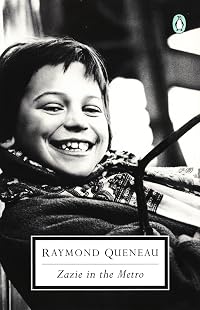
Zazie in the Metro
by Raymond Queneau
On This Page
Description
"Impish, foul-mouthed Zazie arrives in Paris from the country to stay with her female-impersonator Uncle Gabriel. All she really wants to do is ride the metro, but finding it shut because of a strike, Zazie looks for other means of amusement and is soon caught up in a comic adventure that becomes wilder and more manic by the minute. Queneau's cult classic was made into a hugely successful film by Louis Malle in 1960. Packed full of word play and phonetic games, Zazie in the Metro remains as show more stylish and witty as ever."--Jacket. show lessTags
Recommendations









Member Recommendations

Member Reviews
2 cosas simples para resumir mi experiencia lectora sobre este libro.
1) Ha sido un gustazo leer una obra de Queneau. La locura, el desorden y el caos en esta novelita son geniales, pero...
2) Tendría una estrella de más si no fuera porque el lenguaje fresco de la época, que seguro que lo tiene, está pobremente reflejado en una traducción más que nefasta, con expresiones coloquiales pasadas de época y otras que ya no se entienden, además de unas notas al pie pedantes tipo "mira cuánto francés sé, qué listo que soy, y lo traduzco a mi manera". Las cosas no se hacen así, señor Sánchez Dragó.
Al menos las ilustraciones son de Miguel Gallardo...
(Próximamente, en verano, veré la película.)
1) Ha sido un gustazo leer una obra de Queneau. La locura, el desorden y el caos en esta novelita son geniales, pero...
2) Tendría una estrella de más si no fuera porque el lenguaje fresco de la época, que seguro que lo tiene, está pobremente reflejado en una traducción más que nefasta, con expresiones coloquiales pasadas de época y otras que ya no se entienden, además de unas notas al pie pedantes tipo "mira cuánto francés sé, qué listo que soy, y lo traduzco a mi manera". Las cosas no se hacen así, señor Sánchez Dragó.
Al menos las ilustraciones son de Miguel Gallardo...
(Próximamente, en verano, veré la película.)
This is one of those rare cases where the book and the film are both worth the effort. Raymond Queneau spent fourteen years tinkering away at this superficially light and fluffy romp through Paris, and Louis Malle turned it into a wonderful, hilarious film.
Little Zazie comes to Paris to be parked with her uncle Gabriel for 36 hours whilst her mother spends some quality time with a new boyfriend. Zazie's one ambition is to ride on the Métro, but the ticket-punchers are on strike, so she's out of luck.
The storyline is full of eccentric characters, repetitions and bizarre twists of logic, but what Queneau is really trying to do here is to explore the complicated interface between the way people actually talk and the way language is show more written down on paper. If you're not a native speaker of Parisian French, you may have a hard time decoding the very funny mix of puns, malapropisms, run-together words, dialect, and good old-fashioned swearing. You're unlikely to find bloudjinnzes in your dictionary, but it's always more fun when the penny doesn't drop until a line or two later. Reading the line aloud often helps.
The current Gallimard edition comes with a couple of "out-takes" from early drafts of the novel, completing the confusion between the book and the DVD... show less
Little Zazie comes to Paris to be parked with her uncle Gabriel for 36 hours whilst her mother spends some quality time with a new boyfriend. Zazie's one ambition is to ride on the Métro, but the ticket-punchers are on strike, so she's out of luck.
The storyline is full of eccentric characters, repetitions and bizarre twists of logic, but what Queneau is really trying to do here is to explore the complicated interface between the way people actually talk and the way language is show more written down on paper. If you're not a native speaker of Parisian French, you may have a hard time decoding the very funny mix of puns, malapropisms, run-together words, dialect, and good old-fashioned swearing. You're unlikely to find bloudjinnzes in your dictionary, but it's always more fun when the penny doesn't drop until a line or two later. Reading the line aloud often helps.
The current Gallimard edition comes with a couple of "out-takes" from early drafts of the novel, completing the confusion between the book and the DVD... show less
This is a hoot of a book. Surreal like Flann O'Brien is surreal. The word play is fun and gives the prose its rhythm. Zazie is a feisty potty-mouth who stirs up the weekend of her uncle and his friends. On her account they encounter all kinds of rum characters, and largely take it in their stride. Good fun, all of it.
Zazie is a young girl who comes to stay with her aunt and uncle in Paris for a few days. In spite of the title, she'll never get a chance to ride the metro.
Queneau loves to play with language, be it through vocabulary, style and spelling: arcane words appear, quoted from the dictionary and neologisms, alliterations and wordplay abound, style registers vary from street slang to very formal and archaic (the subjonctif passé makes a few appearances, rendered either in orthodox spelling or phonetically like "upu" for "eût pu"). Especially the vocabulary makes this a hard book to judge for someone who's not a native speaker of French.
I found the Zazie character mildly disturbing (a bit like when one is viewing earlier Woody Allen movies show more featuring a sexually omniscient female lead who is decades younger than the male lead): she is a prepubescent girl (9? 12?) who nevertheless seems very sexually aware of her power over older gentlement, and at times even manages to be a mental dominatrix who loves to denigrate the male characters' virility. It would make sense then, that this evil nymphet "who can make mountains quarrel" (whose name reminds one, not coincidentally, of the word "zizanie") is as fascinated as she is by her uncle's alleged homosexuality, because if true, that would make her powerless.
Right after finishing his 190-page book, I felt I needed to read a 500-page companion guide if I wanted to understand all wordplay and intertextual references. But I'll give that a pass. show less
Queneau loves to play with language, be it through vocabulary, style and spelling: arcane words appear, quoted from the dictionary and neologisms, alliterations and wordplay abound, style registers vary from street slang to very formal and archaic (the subjonctif passé makes a few appearances, rendered either in orthodox spelling or phonetically like "upu" for "eût pu"). Especially the vocabulary makes this a hard book to judge for someone who's not a native speaker of French.
I found the Zazie character mildly disturbing (a bit like when one is viewing earlier Woody Allen movies show more featuring a sexually omniscient female lead who is decades younger than the male lead): she is a prepubescent girl (9? 12?) who nevertheless seems very sexually aware of her power over older gentlement, and at times even manages to be a mental dominatrix who loves to denigrate the male characters' virility. It would make sense then, that this evil nymphet "who can make mountains quarrel" (whose name reminds one, not coincidentally, of the word "zizanie") is as fascinated as she is by her uncle's alleged homosexuality, because if true, that would make her powerless.
Right after finishing his 190-page book, I felt I needed to read a 500-page companion guide if I wanted to understand all wordplay and intertextual references. But I'll give that a pass. show less
Back in the days when Flea and I were rose cheeked students, my dorm room had no TV. Instead we would spend our evenings naked in my narrow bed, reading aloud. This brusque, wobbly novel was a favorite back then, making us break out in giggles, and I was looking forward to a reread.
The heroine of this book is a foul-mouthed world weary country girl in her early teens. Her own father has drunkenly tried to molest her, which has caused her mother to put an axe in his head. Now she’s sent to her uncle (who is considered ”safe”, since he’s working as a ballerina in a gay club) in Paris to recover. Zazie is uttelry unfazed by her experiences, and equally unimpressed by Paris. The only thing she was looking forward to was going on the show more Metro, only to find out there’s a bloody strike! Annoyed, she sets out on her own, to at least get a pair of blue jeans. It isn’t long before a strange policeman starts to make passes at her.
What follows is a rather mad romp through the streets of Paris. Mostly told in crude dialogue, full of invectives, we follow a laconic Zazie as her uncle is getting kidnapped by a horde of enthusiastic tourists, though numerous bar fights and taxi rides in over crowded streets and ending in a full scale siege at the Halles. Packed with puns, quirky dialogue and absurd detail, this is a book that makes your head spin. Occasionally trying just a little too hard, occasionally a little sexist, but mostly high speed fun. I have no idea how the english translation is, but if it’s as good as the Swedish one, this is a book worth checking out. show less
The heroine of this book is a foul-mouthed world weary country girl in her early teens. Her own father has drunkenly tried to molest her, which has caused her mother to put an axe in his head. Now she’s sent to her uncle (who is considered ”safe”, since he’s working as a ballerina in a gay club) in Paris to recover. Zazie is uttelry unfazed by her experiences, and equally unimpressed by Paris. The only thing she was looking forward to was going on the show more Metro, only to find out there’s a bloody strike! Annoyed, she sets out on her own, to at least get a pair of blue jeans. It isn’t long before a strange policeman starts to make passes at her.
What follows is a rather mad romp through the streets of Paris. Mostly told in crude dialogue, full of invectives, we follow a laconic Zazie as her uncle is getting kidnapped by a horde of enthusiastic tourists, though numerous bar fights and taxi rides in over crowded streets and ending in a full scale siege at the Halles. Packed with puns, quirky dialogue and absurd detail, this is a book that makes your head spin. Occasionally trying just a little too hard, occasionally a little sexist, but mostly high speed fun. I have no idea how the english translation is, but if it’s as good as the Swedish one, this is a book worth checking out. show less
Os fatos pitorescos e absurdos da curta visita de Zazie a Paris.
Precursor do humor absurdo, este livro conta a estória da impertinente, desbocada e independente Zazie, uma pré-adolescente que vai visitar Paris com o único objetivo de andar de metrô. Nesta viagem, ela encontra as mais variadas e inverossímeis personagens, sempre em uma atmosfera desleixada e indefinível.
Queneau brinca muito com palavras e expressões e tem um estilo fluente e cômico. Na mistura de tipos e situações disparatadas ele consegue levar o leitor a divertir-se, cair na gargalhada mesmo. Entre os malucos que caminham pelo livro temos um tarado elegante, um travesti filósofo que não conhece os pontos turísticos de Paris e uma viúva iludida e show more inescrupulosamente disponível. Os diálogos engraçadíssimos e inteligentes e o humor diferente (para a época) tornam este um livro que vale a pena ser lido. show less
Precursor do humor absurdo, este livro conta a estória da impertinente, desbocada e independente Zazie, uma pré-adolescente que vai visitar Paris com o único objetivo de andar de metrô. Nesta viagem, ela encontra as mais variadas e inverossímeis personagens, sempre em uma atmosfera desleixada e indefinível.
Queneau brinca muito com palavras e expressões e tem um estilo fluente e cômico. Na mistura de tipos e situações disparatadas ele consegue levar o leitor a divertir-se, cair na gargalhada mesmo. Entre os malucos que caminham pelo livro temos um tarado elegante, um travesti filósofo que não conhece os pontos turísticos de Paris e uma viúva iludida e show more inescrupulosamente disponível. Os diálogos engraçadíssimos e inteligentes e o humor diferente (para a época) tornam este um livro que vale a pena ser lido. show less
A Raymond Queneau funny-bone tickler, a witty zazissle through Paris with Uncle Gabriel hosting visiting Zazie, the ever oh so very loveable little wisecracker who oh so very much wishes to ride the city’s Metro. And I was ever on the qt for how many of RQ’s 99 exercises in style turn up displaying their linguistic proboscis in this whimsical 150 page chocolate croissant. Oodles and oodles as per this snatch of dialogue in the opening pages:
Not displeased with his turn of phrase, the little chap wasn’t. Only the great hulk didn’t let up, it leant over him and uttered this monophasic pentasyllable:
‘Wottusaidjustnow.’
The little chap began to get apprehensive. Now was his time, now was the moment to forge some sort of verbal show more buckler. The first that came into his head was an alexandrine:
‘And anyway who said that you could call me tu?’
‘Yellow-belly,’ retorted Gabriel with simplicity.’
That's alexandrine (like many readers, I have to look up such words), as in a line of poetic meter comprising 12 syllables. Anyway, this little book, is sooo much fun. That’s so much fun as in novel as literary polyphony, one melodic line being the light, lyrical, oh-so-very-much-like a French film storyline of Zazie’s romp; the second melodic line as in the ever present fun and games with all phases of language: spelling, slang, colloquialisms, malapropisms, grammar, syntax, run-ons and run-overs and many of those 99 fanciful exercises in style. One more for instance to service up a la fin:
She dares not articulate the disyllabic and anglo-saxon word which would mean what she means. It’s the chap who pronounces it.
‘You wouldn’t by any chance have a pair of blewgenes for the little girl? He asks the middleman. ‘That is what you’d like?’
‘Oh yess,’ yespers Zazie.
Tally-ho with Raymond Queneau! show less
Members
- Recently Added By
Lists

The Guardian's 1000 Novels Everyone Must Read
1,005 works; 550 members

1001 Books You Must Read Before You Die
1,448 works; 1,132 members

Best of French Literature
138 works; 27 members

Le Monde - Les 100 livres du siècle
121 works; 25 members

French Books
102 works; 15 members

1950s
340 works; 22 members

child hero ~ adult novel
60 works; 12 members
1940s
221 works; 25 members

Canon de la narrativa universal del siglo XX
254 works; 6 members

A High School Trip to France
57 works; 5 members

Best public-transport fiction
72 works; 17 members

1001 Children's Books You Must Read Before You Grow Up
774 works; 100 members
Paris, City of Lights
103 works; 17 members

french letters
18 works; 1 member

Books Read in 2022
5,166 works; 114 members

Nifty Fifties
129 works; 13 members
Canon de la narrativa universal del s. XX (cicutadry)
499 works; 3 members
Reading LIst
648 works; 1 member
Author Information

173+ Works 9,843 Members
This French author of treatises on mathematics and other scholarly works has made his reputation writing comic novels. Raymond Queneau (through one of his characters) once defined humor as "an attempt to purge lofty feelings of all the baloney." Roger Shattuck interprets his philosophy: "Life is of course absurd and it is ludicrous to take it show more seriously; only the comic is serious." Life is so serious to Queneau that only laughter makes it bearable. He has written a play, screenplays, poetry, numerous articles, and many novels, the first of which, Le Chiendent (The Bark Tree), was published in 1933. In Exercises in Style (1947) he tells a simple anecdote 99 different ways. According to some critics, The Blue Flowers (1965) represents Queneau at his best. Its jokes, puns, double-entendres, deceptions, wild events, tricky correspondences, and bawdy language make it a feast of comic riches. The influence of Charlie Chaplin, as well as James Joyce is detectable in Queneau's fiction. (Bowker Author Biography) show less
Some Editions
Awards and Honors
Notable Lists
Series
Belongs to Publisher Series
Venècies (2)
Work Relationships
Common Knowledge
- Canonical title
- Zazie in the Metro
- Original title
- Zazie dans le métro; Zazie dans le métro [Edition illustrée grad format luxe, Gallimard]
- Original publication date
- 1959
- People/Characters
- Zazie Lalochère; Gabriel; Turandot; Gridoux; Marceline
- Important places
- Paris, France
- Related movies
- Zazie dans le metro (1960)
- Epigraph*
- ό πλάσας ήϕάνισεν
Aristote - Dedication*
- /
- First words
- Doukipudonktan, se demanda Gabriel excédé. (In English: "Howcanyastinksotho, wondered Gabriel, exasperated.")
- Quotations
- — Ah, la foire aux puces, dit Zazie de l'air de quelqu'un qui veut pas se laisser épater, c'est là où on trouve des ranbrans pour pas cher, ensuite on les vend à un Amerlo et on a pas perdu sa journée.
— Y a pas q... (show all)ue les ranbrans, dit le type.
— Tu causes, tu causes, c’est tout ce que tu sais faire.
— Alors ? pourquoi que tu veux l’être, institutrice ?
— Pour faire chier les mômes, répondit Zazie.
— Alors, déclara-t-elle, je serai astronaute.
— Voilà, dit Gabriel approbativement. Voilà, faut être de son temps.
— Oui, continua Zazie, je serai astronaute pour aller faire chier les Martiens. - Last words
- (Click to show. Warning: May contain spoilers.)— J’ai vieilli. (In English: "'I've aged.'")
- Original language
- French
*Some information comes from Common Knowledge in other languages. Click "Edit" for more information.
Classifications
Statistics
- Members
- 1,888
- Popularity
- 11,338
- Reviews
- 34
- Rating
- (3.71)
- Languages
- 19 — Catalan, Chinese, Czech, Dutch, English, Finnish, French, German, Hungarian, Italian, Japanese, Norwegian (Bokmål), Polish, Portuguese, Russian, Serbian, Slovak, Spanish, Turkish
- Media
- Paper, Audiobook, Ebook
- ISBNs
- 74
- UPCs
- 1
- ASINs
- 41