
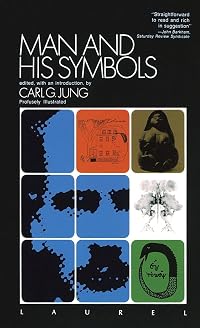
Man and His Symbols
by Carl Gustav Jung
On This Page
Description
Man and His Symbols owes its existence to one of Jung's own dreams. The great psychologist dreamed that his work was understood by a wide public, rather than just by psychiatrists, and therefore he agreed to write and edit this fascinating book. Here, Jung examines the full world of the unconscious, whose language he believed to be the symbols constantly revealed in dreams. Convinced that dreams offer practical advice, sent from the unconscious to the conscious self, Jung felt that show more self-understanding would lead to a full and productive life. Thus, the listener will gain new insights into himself from this thoughtful volume, which also illustrates symbols throughout history. Completed just before his death by Jung and his associates, it is clearly addressed to the general listener. show lessTags
Recommendations










Member Recommendations
Member Reviews
This is a popular account of Jung’s psychological theories, centred on symbolism. This includes chapters on the Unconscious and Collective Unconscious, its links to mythology, the process of Individuation, and psychological symbols in the arts, and in psychoanalysis. This was written and edited by him when he was near the end of his career, together with four of his disciples who have contributed full chapters.
Unlike his academic works, this is written more for a wide audience, with each chapter here condensing the work of one or more his separate full-length books. For this reason it cannot but help leaving out a lot of the painstaking research that he has done to back up his theories, and presents the findings more on trust. Though show more there are illustrations throughout from both case histories and research findings, I do not think that these on their own would be sufficient to convince the reader of the credibility of Jung’s theories, were they not already familiar with his longer more detailed works. For a summary however, this book covers a huge breadth of Jung’s work, and does a pretty good job of conveying its importance.
As Jung’s theories touch on so many aspects of life, from art, to dreams, to mythology, mental illness, personal development, and the events of everyday life, this can’t help but being an interesting book. One problem with Jung is that he can sometime come-across as a being a bit mystic, and this reading is not helped in this book where the work is condensed and there is less scope for qualifying terms with scientific precision. I would however still recommend it to those interested in psychology, art, or mythology. show less
Unlike his academic works, this is written more for a wide audience, with each chapter here condensing the work of one or more his separate full-length books. For this reason it cannot but help leaving out a lot of the painstaking research that he has done to back up his theories, and presents the findings more on trust. Though show more there are illustrations throughout from both case histories and research findings, I do not think that these on their own would be sufficient to convince the reader of the credibility of Jung’s theories, were they not already familiar with his longer more detailed works. For a summary however, this book covers a huge breadth of Jung’s work, and does a pretty good job of conveying its importance.
As Jung’s theories touch on so many aspects of life, from art, to dreams, to mythology, mental illness, personal development, and the events of everyday life, this can’t help but being an interesting book. One problem with Jung is that he can sometime come-across as a being a bit mystic, and this reading is not helped in this book where the work is condensed and there is less scope for qualifying terms with scientific precision. I would however still recommend it to those interested in psychology, art, or mythology. show less
This is not really a book by Jung, but one edited by him with his personal contribution being the first chapter. Released posthumously, this became him passing the baton to the analysts he trained as a first generation of post-Freudian psychiatrists. Written for a popular audience, this is also an excellent introduction to Jung's views of the unconscious. As for this "collective unconscious", it is like with ET-piloted, "I want to believe", but thinking it through it is hard for me to commit to more than a shared, collective, species experience. Still, as with all Jungian works I find this compelling, enlightening, and educational. Joseph L. Henderson explores "Ancient Myths and Modern Man" in a survey not unlike something like Joseph show more Campbell. There is a chapter and conclusion from Swiss Jungian Marie-Louise von Franz. I found most compelling the final two chapters. The penultimate one "Symbolism in the Visual Arts" by Aniela Jaffé bringing up modern artists and their views, like Jean Arp: “Art is about a secret, primal meaning slumbering beneath the world of appearances" and more. This is the chapter of the "profusely illustrated" book that I wish was in color. A very suitable final chapter from Jolande Jacobi applies this to dream interpretation (I prefer the approach as a personal lexicon to Freud's universal symbology) of a specific case from start of analysis to conclusion. show less
If anthropology is the study of what it means to be human, we may consider Jung as much an anthropologist as a formative psychologist, for he does well to remind us unabashedly of what man truly is – a thinking animal, but a chthonic animal nonetheless. Though we may like to think otherwise, civilized man is not so different from archaic man. “Thoughts … are a relatively late discovery of man,” he stresses, and yet, as Joseph Campbell points out, “consciousness thinks it’s running the shop. But [in fact] it's a secondary organ of a total human being, and it must not put itself in control. It must submit and serve the humanity of the body.” The “human body represents a whole museum of organs, each with a long evolutionary show more history behind it.” Truly, “Modern man is in fact a curious mixture of characteristics acquired over the long ages of his mental development. This mixed-up being is the man and his symbols that we have to deal with.”
Contemporary man “is blind to the fact that, with all his rationality and efficiency, he is [still] possessed by powers that are beyond his control. His gods and demons have not disappeared at all; they have merely got new names. They keep him on the run with restlessness, vague apprehensions, psychological complications, an insatiable need for pills, alcohol, tobacco, food -- and above all, a large array of neuroses.” In other words, “What we call civilized consciousness has steadily separated itself from the basic instincts. But these instincts have not disappeared. They have simply lost their contact with our consciousness and are thus forced to assert themselves in an indirect fashion.”
In short, our intimacy with the total psyche has been an unfortunate jetsam of evolved society. But Jung points out, “As a plant produces its flower, so [we know] the psyche creates its symbols. Every dream is evidence of this process.” Thus, through these symbols, through these echoes of the unconscious, we can again come to know and relate to the whole Self. Cultivating a relationship with these symbols means becoming more familiar with the unknown parts of one’s Self (and also with the selfsame struggles of ancient man). Jung reminds us that “the study of individual, as well as of collective, symbolism is an enormous task”, but with his help we find ourselves much closer to accomplishment. show less
Contemporary man “is blind to the fact that, with all his rationality and efficiency, he is [still] possessed by powers that are beyond his control. His gods and demons have not disappeared at all; they have merely got new names. They keep him on the run with restlessness, vague apprehensions, psychological complications, an insatiable need for pills, alcohol, tobacco, food -- and above all, a large array of neuroses.” In other words, “What we call civilized consciousness has steadily separated itself from the basic instincts. But these instincts have not disappeared. They have simply lost their contact with our consciousness and are thus forced to assert themselves in an indirect fashion.”
In short, our intimacy with the total psyche has been an unfortunate jetsam of evolved society. But Jung points out, “As a plant produces its flower, so [we know] the psyche creates its symbols. Every dream is evidence of this process.” Thus, through these symbols, through these echoes of the unconscious, we can again come to know and relate to the whole Self. Cultivating a relationship with these symbols means becoming more familiar with the unknown parts of one’s Self (and also with the selfsame struggles of ancient man). Jung reminds us that “the study of individual, as well as of collective, symbolism is an enormous task”, but with his help we find ourselves much closer to accomplishment. show less
This collection of essays was designed by Jung to introduce his work to lay people. Evidently all his other work is very technical.
I've long thought that Jungian psychology was at best an misguided effort to understand the role of culture on the individual and at worst a crock. Reading here about the analysis of the dreams of several women where the analyst steers them into roles determined for them by a masculine elite, I've decided it really is a crock.
If you still find meaning in 20th century psychological thinking and want to get your life to conform to a Western, middle class standard of "good," you will probably find a lot of interesting material in this book. Otherwise, give it a miss.
I've long thought that Jungian psychology was at best an misguided effort to understand the role of culture on the individual and at worst a crock. Reading here about the analysis of the dreams of several women where the analyst steers them into roles determined for them by a masculine elite, I've decided it really is a crock.
If you still find meaning in 20th century psychological thinking and want to get your life to conform to a Western, middle class standard of "good," you will probably find a lot of interesting material in this book. Otherwise, give it a miss.
I enjoyed this read. Since young, I have always written my dreams down. I've always had an obsession with lucid dreaming (never managed it)... And I still think there's a lot of significance in one's subconscious. This book provides an introduction to the core components of Jungian analysis, and one dedicated to the study may wish to further pursue his other works. I will try to analyse myself and my friends' dreams now.
This ranks as one of the most interesting nonfiction books I've read. Jung's theories and capabilities to generalize across cultures and through time are nothing short of astounding.
Much of this information is so dense that it gave me the feeling of learning something and being influenced without being able to list out general principles.
The illustrations throughout help to strengthen the variety of arguements which are developed and the through-line of counterpoint with Freudian thought creates a nice synergy.
Much of this information is so dense that it gave me the feeling of learning something and being influenced without being able to list out general principles.
The illustrations throughout help to strengthen the variety of arguements which are developed and the through-line of counterpoint with Freudian thought creates a nice synergy.
Interesting for writers and artists but how these ideas are supposed to help anyone in pain is beyond me.
Members
- Recently Added By
Published Reviews
Poslednje mesece svog života Jung je posvetio uređivanju ovog dela koje je završio deset dana pre smrti. Čitavom ovom knjigom Jung naglašava kako čovek može da postigne potpunost samo spoznajom i prihvatanjem nesvesnog - spoznajom do koje se dolazi putem snova i njihovih simbola. Svaki san je neposredna, lična i smislena poruka snivaču - poruka koja koristi simbole zajednicke celom show more čovečanstvu, ali se uvek njima služi na sasvim individualan način, koji se može objasniti samo pomoću isključivo individualnog ključa. show less
added by Sensei-CRS
Lists

Jenny, read this!
6 works; 1 member

Alan Kay's Reading List
103 works; 3 members

Psicología - Clásicos
165 works; 2 members

Blue Pyramid 1,276 Best Books of All Time
1,248 works; 32 members

Tonikat reading completed on Librarything journals
329 works; 2 members

1960s, Best books published therein
254 works; 22 members

My List
302 works; 1 member

Men's healing resources
746 works; 1 member
Author Information

Carl Gustav Jung was born in Switzerland on July 26, 1875. He originally set out to study archaeology, but switched to medicine and began practicing psychiatry in Basel after receiving his degree from the University of Basel in 1902. He became one of the most famous of modern psychologists and psychiatrists. Jung first met Sigmund Freud in 1907 show more when he became his foremost associate and disciple. The break came with the publication of Jung's Psychology of the Unconscious (1912), which did not follow Freud's theories of the libido and the unconscious. Jung eventually rejected Freud's system of psychoanalysis for his own "analytic psychology." This emphasizes present conflicts rather than those from childhood; it also takes into account the conflict arising from what Jung called the "collective unconscious"---evolutionary and cultural factors determining individual development. Jung invented the association word test and contributed the word complex to psychology, and first described the "introvert" and "extrovert" types. His interest in the human psyche, past and present, led him to study mythology, alchemy, oriental religions and philosophies, and traditional peoples. Later he became interested in parapsychology and the occult. He thought that unidentified flying objects (UFOs) might be a psychological projection of modern people's anxieties. He wrote several books including Studies in Word Association, Flying Saucers: A Modern Myth of Things Seen in the Skies, and Psychology and Alchemy. He died on June 6, 1961 after a short illness. (Bowker Author Biography) show less
Some Editions
Awards and Honors
Notable Lists
Work Relationships
Inspired
Common Knowledge
- Canonical title*
- Čovek i njegovi simboli
- Original title
- Man and his symbols
- Original publication date
- 1964
- People/Characters
- Carl Jung (1875-1961, Swiss psychotherapist & psychiatrist, founder of analytical psychology)
- First words
- The origins of this book are sufficiently unusual to be of interest, and they bear a direct relation to its contents and what it sets out to do. -- Introduction . . . John Freeman
Man uses the spoken or writ... (show all)ten word to express the meaning of what he wants to convey. -- Approaching the unconscious . . . Carl G. Jung
The ancient history of man is being meaningfully rediscovered today in the symbolic images and myths that have survived ancient man. -- Ancient myths and modern man . . . Joseph L. Henderson
At the beginning of this book Dr. C. G. Jung introduced the reader to the concept of the unconscious, its personal and collective structures, and its symbolic mode of expression. -- The process of individuation . . . M.-L. von Franz
The history of symbolism shows that everything can assume symbolic significance: . . . -- Symbolism in the visual arts . . . Aniela Jaffé
In the preceding chapters C. G. Jung and some of his associates have tried to make clear the role played by the symbol-creating function in man's unconscious psyche and to point out some fields of applications in the newly discovered area of life. -- Conclusion: Science and the unconsious . . . M.-L. von Franz - Quotations
- But it seems to me it seems certain that Jung's discovery of the process of individuation is a fact that future generations will have to take into account if they want to avoid drifting into a stagnant or even regressive outl... (show all)ook.
- Last words
- (Click to show. Warning: May contain spoilers.)This book is his legacy to the broad reading public. -- Introduction . . . John Freeman
(Click to show. Warning: May contain spoilers.)The early results are encouraging, and they seem to indicate an answer to many so far unanswered questions of present-day mankind. -- Introduction . . . John Freeman
(Click to show. Warning: May contain spoilers.)In this way every individual can reconcile the conflicting elements of his personality: He can strike a balance that makes him truly human, and truly the master of himself. -- Ancient myths and modern man . . . Joseph L. Henderson
(Click to show. Warning: May contain spoilers.)But it seems to me it seems certain that Jung's discovery of the process of individuation is a fact that future generations will have to take into account if they want to avoid drifting into a stagnant or even regressive outlook. -- The process of individuation . . . M.-L. von Franz
(Click to show. Warning: May contain spoilers.)It proves that the self-regulating action of the psyche (When not disturbed by too much rationale explanation or dissection) can support the developmental process of the soul. -- Symbolism in the visual arts . . . Aniela Jaffé
(Click to show. Warning: May contain spoilers.)If the reader should feel stimulated to work further on the investigation and assimilation of the unconscious --which always begins by working on oneself -- the purpose of this introductory book would be fulfilled. -- Conclusion: Science and the unconsious . . . M.-L. von Franz - Blurbers
- Barkham, John
- Original language
- German
*Some information comes from Common Knowledge in other languages. Click "Edit" for more information.
Classifications
- Genres
- General Nonfiction, Nonfiction, Anthropology, Philosophy, Art & Design, Religion & Spirituality
- DDC/MDS
- 153.8 — Philosophy & psychology Psychology Conscious mental processes and intelligence Decision Making And Persuasion
- LCC
- BF173 .J735 — Philosophy, Psychology and Religion Psychology Psychology Psychoanalysis
- BISAC
Statistics
- Members
- 5,993
- Popularity
- 2,130
- Reviews
- 28
- Rating
- (4.04)
- Languages
- 20 — Chinese, Czech, Danish, Dutch, English, Estonian, Finnish, French, German, Hungarian, Italian, Japanese, Farsi/Persian, Russian, Serbian, Slovenian, Spanish, Swedish, Turkish, Portuguese (Brazil)
- Media
- Paper, Audiobook, Ebook
- ISBNs
- 73
- UPCs
- 1
- ASINs
- 57