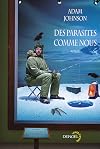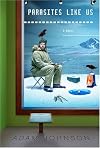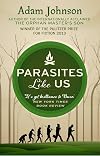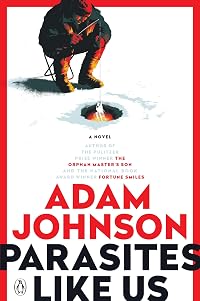
Parasites Like Us
by Adam Johnson
On This Page
Description
Hoping to learn more about those he loves by studying the lost civilizations of human history, anthropologist Hank Hannah works at the site of a twelve-thousand-year-old grave and unearths a deadly legacy linked to the Ice Age.Tags
Recommendations







Member Reviews
In the last several years, I have found myself unable to read fiction with my old wide-ranging zeal. Science fiction, in particular, wears on me, and I stop after a few sentences.
Parasites Like Us, by Adam Johnson, is an exception. This book grabbed me from the beginning, and, had I not lost track of it in the mess of my office, and then in the mess of my bedroom, I would have read it immediately upon purchase, in as close to one sitting as possible. As it is, it's taken me many months to read. (I've since cleaned up my bedroom, and I'm cleaning my office as I move to the room next door.)
It is a first-person narrative, but one of those with plenty of description and opinion, and one that builds up its story. In structure, it most show more resembles (or so I say in dim memory) Gore Vidal's Kalki. But this book is far superior to that.
And, though billed as literary fiction, and obviously written at a high level, this book cannot help but be called science fiction. It is more science fictional than most books so labelled, for here a science is focused on, as a living, breathing human enterprise, and the focus of that science provides the major plot points.
The science? Anthropology. The focus? The Clovis hunters, who (may have)eradicated the bulk of the large mammals of the North American continent. A Clovis discovery by the narrator's star pupil turns into something almost farcical, and then horrific.
This is one of the better end-of-the-world stories I've read. It is one of the best novels I've read in some time.
The title is meant, I think, to be evocative, not literal. Towards the end there is something said about parasites:
The successful forms of life are the parasites, the ones who bleed their environment to otpimal exploitation, who stunt everything by taking a lion's share, who leave their hosts alive but shriveled.
Interesting, but not glorious. One might say that's the author's view of humanity: interesting, but not glorious. show less
Parasites Like Us, by Adam Johnson, is an exception. This book grabbed me from the beginning, and, had I not lost track of it in the mess of my office, and then in the mess of my bedroom, I would have read it immediately upon purchase, in as close to one sitting as possible. As it is, it's taken me many months to read. (I've since cleaned up my bedroom, and I'm cleaning my office as I move to the room next door.)
It is a first-person narrative, but one of those with plenty of description and opinion, and one that builds up its story. In structure, it most show more resembles (or so I say in dim memory) Gore Vidal's Kalki. But this book is far superior to that.
And, though billed as literary fiction, and obviously written at a high level, this book cannot help but be called science fiction. It is more science fictional than most books so labelled, for here a science is focused on, as a living, breathing human enterprise, and the focus of that science provides the major plot points.
The science? Anthropology. The focus? The Clovis hunters, who (may have)eradicated the bulk of the large mammals of the North American continent. A Clovis discovery by the narrator's star pupil turns into something almost farcical, and then horrific.
This is one of the better end-of-the-world stories I've read. It is one of the best novels I've read in some time.
The title is meant, I think, to be evocative, not literal. Towards the end there is something said about parasites:
The successful forms of life are the parasites, the ones who bleed their environment to otpimal exploitation, who stunt everything by taking a lion's share, who leave their hosts alive but shriveled.
Interesting, but not glorious. One might say that's the author's view of humanity: interesting, but not glorious. show less
I was very looking forward to reading this one since I loved the brilliant 'The Orphan Master's Son' that should win all the awards and that still wouldn't say how amazing the book is. This one is interesting! It's a bit like a humorous Darwinian apocalypse tale, with shades of Kurt Vonnegut (especially 'Cat's Cradle' with the scientists as main characters and the icy doom... this one even has little drawings reminiscent of Vonnegut's.) It also reminded me of T.C. Boyle's smart and detailed writing ('A Friend of the Earth' mostly), Margaret Atwood (The MaddAddam trilogy) and Marcel Theroux's 'Far North' -- basically all of these books are eco-centric apocalypses.
Dr. Hannah is a professor of anthropology at a college in South Dakota. show more He calls the boxes of his research crowding his office "Junior" but knows his life's work will be thrown in the shredder once he is gone. He pals around with two students, one who is trying to imitate one of the Clovis people (one of the first human inhabitants of North America), for his thesis. It does take a while for the apocalypse to happen (only around the last hundred pages). When it happens, it happens quick, and so many are decimated. I think this is the best part of the book, since in both this one and 'Orphan', Johnson has an amazing skill at creating these haunting, bleak images, that really fit well in both North Korea and an apocalypse. Somehow two of the most vivid examples feature aquatic life: a de-finned shark floating to the bottom of the ocean in 'Orphan' and a frozen fish tank in 'Parasites'. I do wish that I had seen more of this apocalypse, since there was so much set-up, but what is here is very worthwhile. There is some good stuff here. It is interesting how the Clovis were involved with downfall of humans here, just as they were responsible for so many extinctions of the large North American animals, but I won't say anything more to spoil the book.
It's funny I compared Johnson's book 'The Orphan Master's Son' to the last book I read, Louise Erdrich's 'The Round House' since this book is much more similar to 'The Round House', as both books feature Native Americans in the Dakotas. I can't wait to see what Johnson writes next. He isn't writing them fast enough, and I hate to read all of a favorite writers books before the next one comes out. Looking back through my favorite parts after finishing the book, I realized how little things connected in a huge way. I appreciate the extra effort that a writer puts into their books. I need to appreciate it, since Adam Johnson is highly underappreciated! I feel bad for the other books on my shelves... I'd rather read 'The Orphan Master's Son' again! I suppose Johnson's story collection is there too... show less
Dr. Hannah is a professor of anthropology at a college in South Dakota. show more He calls the boxes of his research crowding his office "Junior" but knows his life's work will be thrown in the shredder once he is gone. He pals around with two students, one who is trying to imitate one of the Clovis people (one of the first human inhabitants of North America), for his thesis. It does take a while for the apocalypse to happen (only around the last hundred pages). When it happens, it happens quick, and so many are decimated. I think this is the best part of the book, since in both this one and 'Orphan', Johnson has an amazing skill at creating these haunting, bleak images, that really fit well in both North Korea and an apocalypse. Somehow two of the most vivid examples feature aquatic life: a de-finned shark floating to the bottom of the ocean in 'Orphan' and a frozen fish tank in 'Parasites'. I do wish that I had seen more of this apocalypse, since there was so much set-up, but what is here is very worthwhile. There is some good stuff here. It is interesting how the Clovis were involved with downfall of humans here, just as they were responsible for so many extinctions of the large North American animals, but I won't say anything more to spoil the book.
It's funny I compared Johnson's book 'The Orphan Master's Son' to the last book I read, Louise Erdrich's 'The Round House' since this book is much more similar to 'The Round House', as both books feature Native Americans in the Dakotas. I can't wait to see what Johnson writes next. He isn't writing them fast enough, and I hate to read all of a favorite writers books before the next one comes out. Looking back through my favorite parts after finishing the book, I realized how little things connected in a huge way. I appreciate the extra effort that a writer puts into their books. I need to appreciate it, since Adam Johnson is highly underappreciated! I feel bad for the other books on my shelves... I'd rather read 'The Orphan Master's Son' again! I suppose Johnson's story collection is there too... show less
Hank Hannah is an anthropologist working at The University of South Eastern South Dakota. He once wrote a book about the Clovis people, the first people to cross the Bering Strait to North America, and who were thought to have caused the extinction of 35 species of mammals. He is no longer held in such high esteem by his peers, having produced nothing of note since writing his book “The Depletionists”. He is supervising two anthropology students – Eggers is living in the style of the Clovis people for one year as part of his thesis. He eats the local wildlife (squirrels), wears animal hides and uses primitive tools. Trudy, the other student, is a strong woman who is a target for Hank’s latent lust.
Eggers discovers a grave of show more what appears to be a Clovis woman and in that grave are two clay balls, inside of which will be the future of the human race.
The reader knows from the start that humanity is about to suffer its own extinction, but it is a long wait before we get there. It takes about 150 pages before the disaster occurs, but those 150 pages are full of fun and games. Hank’s relationship with his father is interesting, his thoughts on his mother and his step-mother – both now gone – are quite moving; his friend Farley is a complex character and the policeman with his tribe of children provide some light relief. And then there is Julia, a paleobotanist from Russia with a past.
This book is a real romp. It is light and breezy and easy to read. Yes, there is a strong message within its pages, but rather than being a preachy book, it is fun and amusing. show less
Eggers discovers a grave of show more what appears to be a Clovis woman and in that grave are two clay balls, inside of which will be the future of the human race.
The reader knows from the start that humanity is about to suffer its own extinction, but it is a long wait before we get there. It takes about 150 pages before the disaster occurs, but those 150 pages are full of fun and games. Hank’s relationship with his father is interesting, his thoughts on his mother and his step-mother – both now gone – are quite moving; his friend Farley is a complex character and the policeman with his tribe of children provide some light relief. And then there is Julia, a paleobotanist from Russia with a past.
This book is a real romp. It is light and breezy and easy to read. Yes, there is a strong message within its pages, but rather than being a preachy book, it is fun and amusing. show less
Absolutely the best part of this story are the ideas in it - theories about early man (The Clovis) in North America. The main character here is an anthropology professor at a South Dakota University and one of his grad students makes an astounding discovery. Another student becomes involved with the action and discoveries. There are a lot of internal discussions and serious "mother" and "father" issues in here as well. The setting seems pretty unique as you read and there is a good cast of interesting well-realized characters.
The story takes a serious turn when the apocalypse hits. Not that we weren't warned because right at the beginning we are told that this is a look back at a gone world and how it happened. I'd say the book is show more uneven and doesn't rise to the great level but I really enjoyed it and kept turning the pages. It rambles and stumbles here and there and the internal dialogue is a bit much at times. I would have like a stronger finish. We are told bits of an adventurous journey to follow, almost like a sequel set-up. I would have liked a bit more here in this book.
The novel got me thinking about a lot of stuff. I was unaware that many scholars consider the Clovis people responsible for the extinction of 35 large mammal species in North America from Mammoths on down. Apparently only the bison and boars because of their large population numbers escaped their murderous ways in a relatively short period of time before the Clovis put themselves out of business by killing all the prey.
Johnson is an English professor at Stanford University and also won the Pulitzer prize earlier this year for The Orphan Master's Son. show less
The story takes a serious turn when the apocalypse hits. Not that we weren't warned because right at the beginning we are told that this is a look back at a gone world and how it happened. I'd say the book is show more uneven and doesn't rise to the great level but I really enjoyed it and kept turning the pages. It rambles and stumbles here and there and the internal dialogue is a bit much at times. I would have like a stronger finish. We are told bits of an adventurous journey to follow, almost like a sequel set-up. I would have liked a bit more here in this book.
The novel got me thinking about a lot of stuff. I was unaware that many scholars consider the Clovis people responsible for the extinction of 35 large mammal species in North America from Mammoths on down. Apparently only the bison and boars because of their large population numbers escaped their murderous ways in a relatively short period of time before the Clovis put themselves out of business by killing all the prey.
Johnson is an English professor at Stanford University and also won the Pulitzer prize earlier this year for The Orphan Master's Son. show less
Adam Johnson has won the The National Book Award and the Pulitzer Prize for his last 2 books. I enjoyed both of them and decided I wanted to read his earlier works. This book was his first novel. It deals with an anthropologist communicating with the future as he explains what happened to the world. The book is very creative and a bit absurdist. This combines with some great insights into our culture versus the ancient Clovis(native American) culture that died out. Johnson is an excellent writer and you can see the groundwork being laid for his future books. For people who have read his previous books, this is a worthwhile and entertaining read. It could have used some editing and does drag in certain parts. If you have not read any show more Johnson then proceed directly to "The Orphan Masters Son" and "Fortune Smiles. show less
It seems like there ought to be more to this book, and perhaps a sequel is planned. Although little hints are dropped here and there, what I take to be the main plot of the novel—the virus—does not develop until near the end of the book. And up until then, it’s rather slow to develop. It’s nice to get to know your characters, but much too much time was spent on their foibles and weaknesses—and then hardly any on what must be their personal grief. There is, peculiarly, no talk of repopulating the species, although Trudy is still taking birth control pills. No character in the novel has a mother, which seems peculiar. There are intriguing ideas in this book, but so much space seems wasted on, for instance, ice fishing, that the show more reader never feels invited to ponder them. Why would anybody want to read about ice fishing? Meanwhile, it is never explained why there is still life on earth—life in North America did not even die out—if the virus existed twelve thousand years ago. Not a bad book, but perhaps not altogether worth the reading. show less
eh, a plague with a 99.99999999% kill rate and 100% transmission and a
Members
- Recently Added By
Lists

Biggest Disappointments
606 works; 163 members
Author Information

10+ Works 6,095 Members
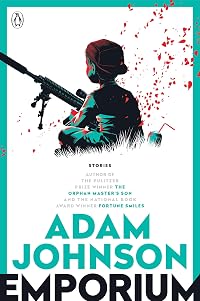
Adam Johnson is currently a Jones Lecturer at Stanford University. He lives in San Francisco. Adam Johnson was born on July 12, 1967 in South Dakota. He received a BA in journalism from Arizona State University in 1992, a MFA from the writing program at McNeese State University in 1996, and a PhD in English from Florida State University in 2000. show more He is a writer and associate professor in creative writing at Stanford University. He founded the Stanford Graphic Novel Project. He is the author of several books including Emporium and Parasites Like Us. He won the Pulitzer Prize for fiction in 2013 for The Orphan Master's Son and National Book Award for Fiction in 2015 for Fortune Smiles: Stories. (Bowker Author Biography) show less
Awards and Honors
Common Knowledge
- People/Characters
- Dr. Hank Hannah
- Dedication
- For my mother, Patricia, and her mother Lavina
- First words
- This story begins some years after the turn of the millennium, back when gangs were persecuted, back before we all joined one.
- Last words
- (Click to show. Warning: May contain spoilers.)It was a story we knew by heart.
Classifications
Statistics
- Members
- 378
- Popularity
- 82,810
- Reviews
- 12
- Rating
- (3.43)
- Languages
- English, French, Serbian
- Media
- Paper, Ebook
- ISBNs
- 8
- UPCs
- 1
- ASINs
- 7